Northern Territory · Holiday-Home Marketing

Airbnb Marketing
in Darwin

Marketing for holiday homes in Darwin City, Larrakeyah, Cullen Bay, Fannie Bay, Nightcliff and Stuart Park, from harbour-side apartments to family houses a short walk from a Sunday market.

Start here Work with Cavmir in Darwin
Get a Quote
A$309
Avg. nightly rate
48%
Avg. occupancy
A$3,612
Avg. monthly revenue
6-9%
Est. gross yield
HIGH
Seasonality
LOW
Rules to follow

* Market averages in Australian dollars from AirROI data for Darwin, Northern Territory, October 2025 to September 2026, in Australian dollars as AirROI shows them (converted from US dollars at A$1.44); Darwin City and Darwin Waterfront Precinct figures from their own AirROI markets are labelled as such in the copy. The yield is Cavmir's estimate. A single home's numbers depend on its size, its location and how it is marketed.

The market

Holiday Rentals in Darwin

Cavmir is an Airbnb marketing agency for Australian holiday homes. This page is for owners and managers of short-stay homes in Darwin.

Darwin sits on Larrakia Country, on a harbour that Wickham and Lieutenant John Lort Stokes named in 1839 after their former shipmate Charles Darwin, and it is the capital of a territory where the year runs on two seasons rather than four. Tourism NT's guide to Litchfield National Park describes the dry season, May to October, as warm and pleasant with sunny days and cooler nights, and November to April as warmer, with thunderstorms and smaller crowds. We call that second stretch the wet season. This page covers the part of the city holiday guests actually stay in: Darwin City, Larrakeyah, Cullen Bay, Fannie Bay, Nightcliff and Stuart Park. A guest booking any of those suburbs is choosing the same harbour city, the same evening markets and the same dry-season weather, so one marketing plan can serve all of them. The market numbers on this page come from AirROI's Darwin market for the twelve months from October 2025 to September 2026, in Australian dollars as AirROI prints them. AirROI reports Darwin City and the Darwin Waterfront Precinct as separate markets from its wider Darwin one, and we say so wherever we use their figures.

Darwin's holiday homes are mostly apartments. Of the 574 active listings in AirROI's Darwin market, 90.1% are entire homes and 9.2% are private rooms. By property type, 70.6% are apartments or condos (405 listings), 19.3% are houses (111) and 7.5% are hotel or boutique stays (43). Size sets the price. Among the 497 entire homes with a bedroom count, one-bedroom homes are 31.6% of the market and two-bedroom homes 32.4%, and the median annual revenue climbs from A$18,500 for a studio to A$27,900 for one bedroom, A$40,400 for two, A$63,600 for three, A$85,000 for four and A$136,000 for five or more. Guest capacity follows the same pattern: 32.8% of listings sleep two, 29.2% sleep four, 16.3% sleep six and 10.1% sleep eight or more. That mix tells an owner something useful. A two-bedroom apartment is the typical Darwin product, so a house with a pool and room for eight is a different business from the crowd, and a one-bedroom unit has to win on location and detail.

The guests are mostly Australians, and mostly from the south. AirROI's review data puts domestic guests at 83% and international guests at 17%. The leading origin cities are Melbourne (4.8%), Adelaide (3.0%), Perth (2.8%), Darwin itself (2.5%) and Sydney (2.3%), and the leading countries are Australia (82.7%), the United Kingdom (3.5%), New Zealand (2.7%), the United States (2.4%) and France (1.4%). The language split is wider than you might expect for a capital city. English is 69.3% of guest languages in AirROI's data, then French (7.8%), Spanish (5.0%), German (3.9%) and Chinese (1.9%). A listing written only in English is not speaking to a fair share of its readers, and a few lines in French or German on a direct-booking page cost very little.

What stands out in Darwin is how much the results vary. AirROI's average Darwin listing earned A$43,344 over the year, up 19.9% on the year before, against an Australian average of A$44,129. Occupancy was 48.4% against 43% for Australia, and the average daily rate was A$309 against A$385. AirROI's performance tiers show the spread in monthly terms: the median listing earns about A$4,200 a month at about 52% occupancy and about A$250 a night, the top quarter earns A$6,780 or more at 74% occupancy or better, and the top tenth earns A$10,600 or more at 87% or better and A$540 or more a night. The bottom quarter earns A$2,130 or less at 28% or less. The same home can sit in any of those bands depending on its season, its photos, its price calendar and its channels, which is the work a marketing plan does. The market is also getting tighter: active listings fell 18% on the year while average revenue rose.

Where a home sits in Darwin matters as much as how big it is. AirROI's separate Darwin Waterfront Precinct market, with 74 listings, averaged A$73,814 a year at A$437 a night and 52% occupancy. Its Darwin City market, with 69 listings, averaged A$42,927 at A$297 a night and 55.3% occupancy, and 95.7% of those listings are apartments. AirROI's own guide to Darwin names the Waterfront, Cullen Bay, Parap, Larrakeyah, Gardens, Nightcliff and Fannie Bay as the areas with the most guest appeal, and notes that these picks are about appeal, not earnings. We read that as a map of the pitches an owner can make: the walk to the Wave Lagoon and the restaurants, the marina at Cullen Bay, the beach and the racecourse at Fannie Bay, the Sunday market at Nightcliff.

What brings guests to Darwin

  • Mindil Beach Sunset Market, Thursday and Sunday evenings from the last Thursday in April to the last Thursday in October
  • Parap Village Markets on Saturday mornings, and Nightcliff Markets on Sunday mornings
  • Darwin Waterfront and its Wave Lagoon, which Tourism NT calls Darwin's most popular attraction
  • Crocosaurus Cove on Mitchell Street, with saltwater crocodiles and the Cage of Death
  • East Point Reserve, with wallabies, a monsoon forest walk and stinger-free Lake Alexander
  • Litchfield National Park, about an hour's drive south, for Wangi Falls, Florence Falls and Buley Rockhole
  • The Mandorah ferry from Cullen Bay, a 15-minute crossing
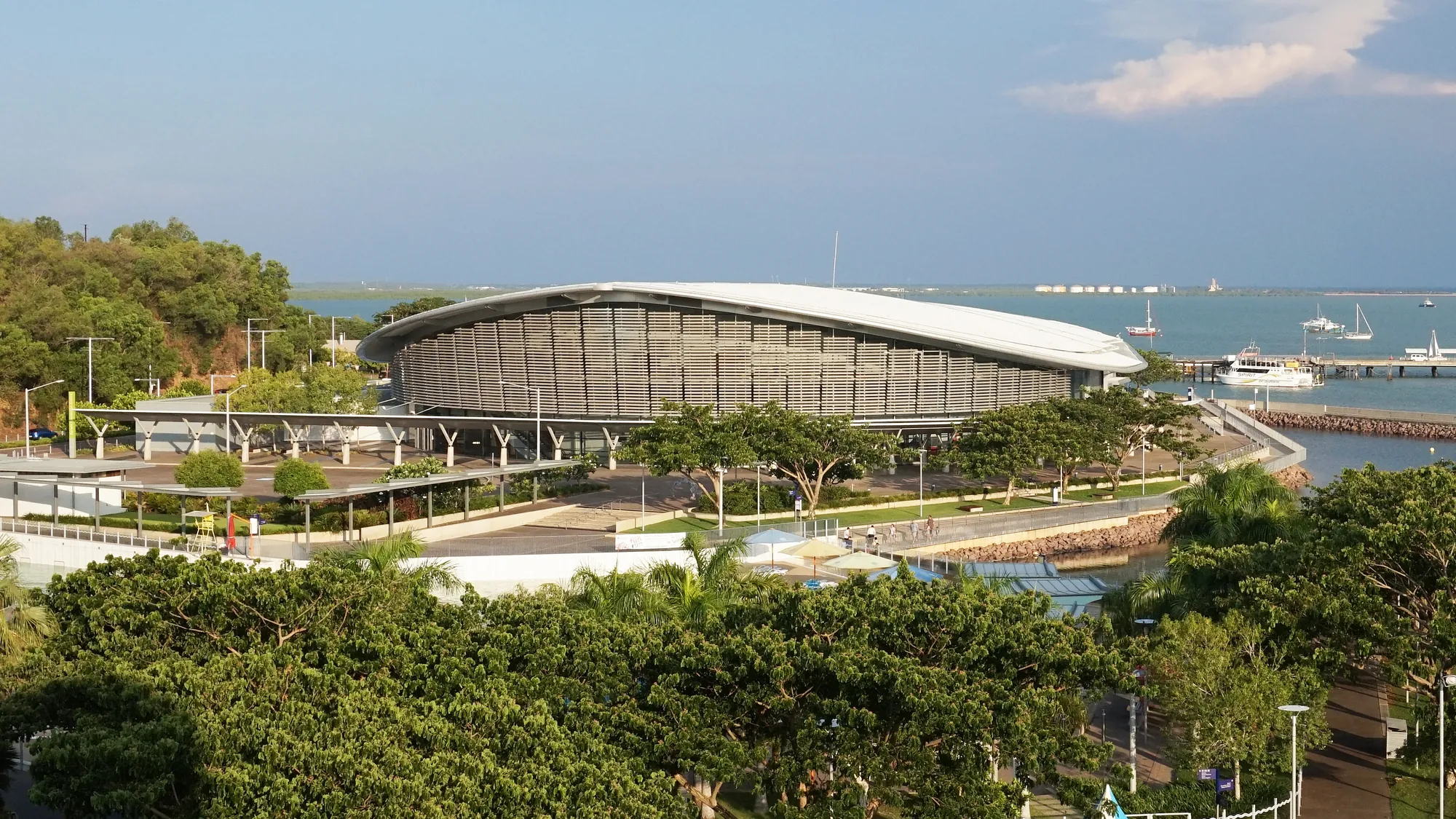
  • Darwin Festival every August and the Darwin Aboriginal Art Fair on the Convention Centre's Larrakia Country site
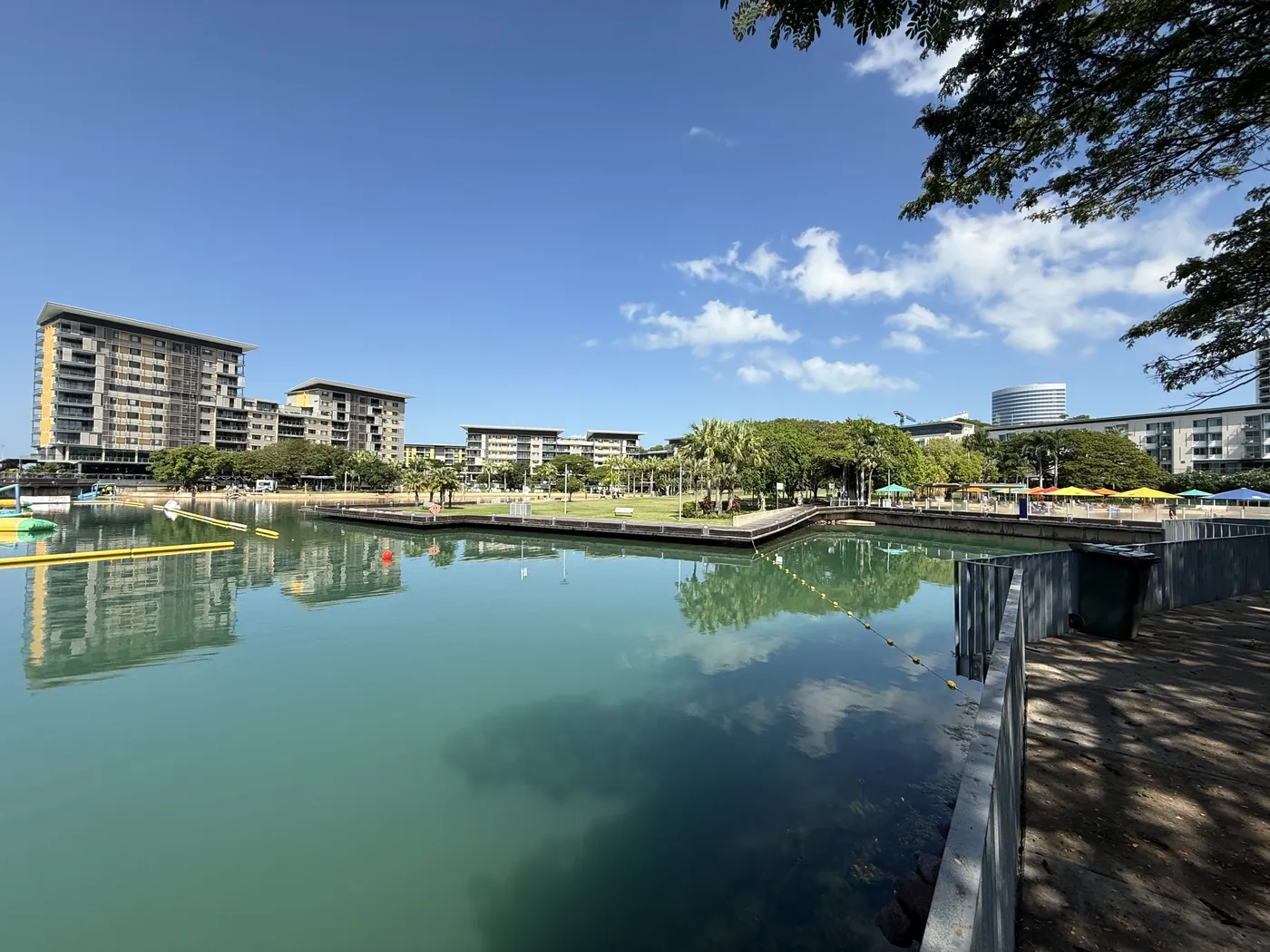
The lagoon and apartments at the Darwin Waterfront

Photo: “Darwin Waterfront, September 2025 11” by DaHuzyBru, CC BY-SA 4.0, via Wikimedia Commons

Cavmir in Darwin

What Cavmir Does for Darwin Hosts

Cavmir markets a Darwin holiday home as the small hospitality business it is. For a harbour-side apartment that means a direct-booking website that leads with the walk to the Waterfront and the marina, a complete Google Business Profile, listing copy and photo briefs written for Airbnb, Booking.com, Stayz and Vrbo, and pages that answer the questions Australians and overseas visitors ask an AI assistant before they pick a dry-season week. For a family house in Fannie Bay or Nightcliff it means the pool, the garden and the Sunday market up front, and an email list that reaches last year's guests the autumn before they plan the next trip north. Cavmir works with owners here remotely, and the plan covers the website, Google and AI search, photos, social posts and email.

Then and now

The Darwin Short-Stay Market, Then and Now

Darwin's story starts with the Larrakia people, whom the City of Darwin names as the traditional owners of the city and whose peak body, Larrakia Nation, describes its members as descendants of the original inhabitants of the Darwin region. The harbour got its European name in 1839, when HMS Beagle, with Lieutenant John Lort Stokes aboard, sailed in. The settlement followed in 1869 under the name Palmerston, established by Surveyor-General George Goyder. The Northern Territory's place names register records that because all communications with the settlement were by sea, goods and passengers kept being consigned to Port Darwin, that the name had reverted to Port Darwin by 1900, and that when the Commonwealth took over the Territory from South Australia in 1911 the capital's official name became Darwin. The change was gazetted on 18 March 1911.

The rest of the timeline explains why the city looks the way it does. The City of Darwin dates gold at Pine Creek to 1871, which sped up the town's growth, and records the Japanese bombing of Darwin on 19 February 1942. Darwin elected its first mayor and 12 councillors in 1957 and was granted city status in 1959. Cyclone Tracy struck on Christmas Day 1974, and the Darwin Reconstruction Commission oversaw the rebuilding that, in the city's words, gradually made Darwin the most modern capital city in the nation. The Northern Territory gained self-government on 1 July 1978, and Darwin City Council became the City of Darwin in 2012. A city rebuilt in the second half of the twentieth century is the base the short-stay market grew on.

Short-stay hosting grew on top of that. AirROI counts 574 active listings in its Darwin market today and reports that the number fell 18% in the year to September 2026 while average revenue per listing rose 19.9%, so fewer listings are sharing more income. AirROI does not say why, and one year does not make a trend. The market is concentrated. AirROI says the top ten hosts operate 44% of listings, the largest running 95, and that the three largest management companies, Hometime (103 listings), Zen Luxury Retreats (38) and Ramada Suites (10), together run 151 listings, about 26%. Only 7.5% of Darwin listings are professionally managed in AirROI's count, while 53.1% are co-hosted and 51% have a Superhost badge, so a large share of the market is owner-run with help.

We looked for an official count of Darwin's holiday homes in earlier years and for a dated history of when short-stay letting took off here, and did not find one we could open and verify, so this page does not claim a start date or a growth rate beyond AirROI's year-on-year figures. What the data does show is a market that rewards the details. AirROI finds that fewer than 1% of Darwin listings show a registration, permit or licence number, which fits what we found about the rules: there is no Northern Territory register to put a number on. The average Darwin listing carries 12 photos and only 39% show their exact location, which are two gaps an owner can close in a week.

Rates and seasons

Rates, Occupancy and Seasons in Darwin

Rates and revenue

These figures describe AirROI's Darwin market for the twelve months from October 2025 to September 2026, in Australian dollars as AirROI prints them. The average daily rate is A$309 and average occupancy 48.4%, which works out to about 177 booked nights a year. Revenue per available night, AirROI's RevPAR, is A$162. The average listing earned A$43,344, which is about A$3,612 a month when spread across the year, but no month looks average: July is the peak and February the low, and the stats box above shows the annual average. Bedrooms drive the rate. Studios average A$176 a night at 45% occupancy, one-bedroom homes A$206 at 49%, two-bedroom homes A$305 at 50%, three-bedroom homes A$427 at 51%, four-bedroom homes A$636 at 49% and homes with five or more bedrooms A$841 at 51%. Notice that occupancy barely moves with size, so the revenue gap between a one-bedroom unit and a five-bedroom house is almost all rate.

AirROI's amenity comparisons show what Darwin guests pay for, with a caution the page itself makes: the gaps partly reflect the type of home that has the feature, not only the feature. Listings with a pool view earn 140% more per year than those without (9% of listings have one), outdoor furniture shows +106% (61% have it), a patio or balcony +98% (74%), free parking on the premises +61% (75%), an ocean view +55% (14%) and a waterfront position +53% (19%). Guests also book with a long run-up. The average lead time is 71 days, and in the monthly table July bookings arrive about 106 days ahead against 34 days for February. Stays average 6.6 nights and range from 5.1 nights in August to 9.1 nights in January, so the longest stays come in the wet season and the shortest at the peak. About 20 bookings a year per listing is the typical rhythm.

The fee and policy mix is where many owners leave money on the table. According to AirROI, 84% of Darwin listings charge a cleaning fee, with a median of A$206 and an average of A$282, which is about A$30 a night and 10.4% of gross revenue. Minimum stays cluster at three nights (39%) and two nights (30%), 16% accept one-night stays, and the most common cancellation policy is Moderate (54%), then Firm (21%) and Flexible (14%). AirROI's profit estimate for an owner-operator takes the average A$43,344 of bookings, subtracts about A$15,250 of running costs and leaves about A$28,094, or about A$2,340 a month, before mortgage or rent, insurance and income tax. A co-host at about 10% of bookings leaves about A$2,020 a month. For a sense of yield, Cotality figures to September 2026, as shown by OpenAgent, put Darwin's median house value at A$747,252 and median unit value at A$480,748, so the average listing's A$43,344 equals about 5.8% of a median house and 9.0% of a median unit before costs. After AirROI's running costs the same figures are about 3.8% and 5.8%. These are market averages, not a forecast for any one home.

The year in Darwin

Darwin's high season is the dry season, which is the southern winter, and its low season is the wet. AirROI's calendar-month averages, taken over the two years from September 2024 to August 2026, put July at A$8,950 of revenue per listing and February at A$2,610, so July earns about 3.4 times February. Across the year, AirROI defines high season as May to September, at about A$6,860 a month, 60% occupancy and A$343 a night, and low season as October to April, at about A$3,370, 45% and A$246. AirROI's monthly table for September 2025 to August 2026 runs: September 2025, 61.0% occupancy at A$308; October, 46.7% at A$262; November, 44.8% at A$246 with a 39-day lead time; December, 42.9% at A$254; January 2026, 44.2% at A$251; February, 40.4% at A$252; March, 45.5% at A$259; April, 51.6% at A$277; May, 52.8% at A$341; June, 59.3% at A$393; July, 62.3% at A$425; and August, 64.5% at A$396. The daily rate climbs by about 73% from the wet-season floor of A$246 to the July peak of A$425, and the occupancy climbs with it.

The events that matter sit in the dry season. Mindil Beach Sunset Market runs Thursday and Sunday evenings, 4 pm to 9 pm, from the last Thursday in April to the last Thursday in October, so the 2026 season ends on Thursday 29 October and the 2027 season starts on Thursday 29 April. Parap Village Markets (Saturdays, 8 am to 2 pm) and Nightcliff Markets (Sundays, 8 am to 2 pm) appear in Tourism NT's market guide without a season. The Great Northern Darwin Cup Carnival ran from Saturday 4 July to Monday 3 August 2026 across eight race days, and the Darwin Turf Club says it moved Ladies' Day to 8 July 2026 so it fell within the school holiday period. The Darwin Festival runs 4 to 22 August 2027, and the Darwin Aboriginal Art Fair, which marked its 20th year in 2026, is on 5 to 8 August 2027 at the Darwin Convention Centre. The wet season is for owners who plan for it: longer stays (January averages 9.1 nights), a lower price tier, a lead-time strategy that accepts later bookings, and offers for Darwin residents, who are 2.5% of guests, to take a night at the harbour.

The rules

Short-Stay Rules in Darwin

In the Northern Territory we did not find a statewide short-stay register, a levy or a cap on nights when we checked on 29 October 2026. The planning pages we could open describe development permits and the NT Planning Scheme 2020 but say nothing specific about holiday letting. AirROI's Darwin data shows the same thing from the other side: fewer than 1% of the 574 listings display a registration or permit number. That is a lighter regime than New South Wales or Western Australia, and it is not the same as no rules. Planning, strata and tax rules all still apply, and they are set out in the paragraphs below. Our short-stay rules page compares every state and territory.

Planning is the layer to understand. The City of Darwin's planning guidance says the Northern Territory Planning Scheme governs how applications are assessed, and the NT Government's page on development applications says you may need a development permit to change the use of land, with the Development Consent Authority deciding in its division areas and the Minister for Lands, Planning and Environment deciding elsewhere. When we opened clause 5.4.10.1 of the NT Planning Scheme 2020, the clause for a home based business, it covered temporary visitor accommodation run by a resident from their dwelling. Among its conditions, the consent authority must not consent where residents and guests together exceed twelve people, the guests on the premises at any time are limited to six, one extra car space is needed for each guest room, the accommodation cannot be in a multiple dwelling or group dwelling, the lot must be at least 600 square metres, and an editor's note says any part of a dwelling used for temporary visitor accommodation needs to meet the National Construction Code as Class 1b. That clause is written for a resident who hosts, and it rules out multiple dwellings, which is the form most Darwin apartments take. We could not find text in the pages we opened saying how a whole home or apartment let with no host present is classed, so the safe step is to ask the Development Assessment Services team, which the NT Government's development applications page names as the contact for questions like this, before you list.

If the home is an apartment, the strata layer matters, because 70.6% of Darwin's listings are apartments or condos. The Northern Territory's Unit Title Schemes Act 2009 (the version in force at 1 August 2023 that we opened) says unit owners and unit occupiers are taken to have agreed to comply with the scheme statement, the management module and the by-laws (later amendments may have changed other parts of the Act). A scheme statement can be amended to include or omit a by-law by special resolution, which needs at least two-thirds of the votes cast in favour and votes against that do not exceed 25% of total contribution entitlements. The pages we could read did not show what the by-laws may regulate, so we cannot tell you whether a scheme can ban holiday letting. Read your scheme's by-laws and ask the body corporate manager before you buy or list, and expect the answer to differ building by building.

Tax and money rules sit above all of it. The ATO says you can claim ownership and use expenses for a holiday home, such as interest, council and water rates, body corporate fees and repairs, only if the home is used or held for use chiefly to produce rental income, and it looks at how often the home is available in school holidays, public holidays and peak seasons. If it is mainly rented you still apportion for private use, and rental-only costs such as booking fees, commissions and advertising stay deductible. The ATO's page on residential premises says rent for residential accommodation is input taxed, with no GST in the rent, but that page does not discuss holiday rentals, so ask your accountant how GST applies to your set-up. The Northern Territory Government says there is no land tax in the NT, though stamp duty applies when you buy. For foreign owners, the Foreign Investment Review Board's guidance of 1 July 2026 states that from 1 April 2025 to 30 June 2029 foreign persons are generally banned from buying established dwellings, and an annual vacancy fee applies if a foreign-owned home is not occupied or genuinely available for rent for at least 183 days, with short holiday lets not counting. Since 1 October 2026 businesses cannot surcharge Visa, Mastercard, American Express or eftpos payments, and the ACCC's price-display guidance says a total price must include taxes and unavoidable fees, with the new drip-pricing law starting on 1 July 2027. For insurance, Moneysmart warns that cover you would usually expect may not apply if you rent a space out, so tell your insurer you take paying guests and read the exclusions and the product disclosure statement.

This is orientation, not legal advice. Confirm anything that affects your property with the Development Assessment Services team, the City of Darwin, your body corporate, a lawyer and an accountant. Cavmir handles the marketing side: the website, search, photos, social and email.

Marketing

Marketing a Holiday Home in Darwin

What works here

First, sell the dry season early and the wet season differently. July books about 106 days ahead and June about 88, so the dry-season calendar should open as soon as your channel allows and carry a rate that reflects A$393 to A$425 market averages for the best weeks, not a flat year-round figure. In the wet season, AirROI's monthly lead times shrink to between 34 and 43 days for February, November and March, and stays lengthen to between seven and nine nights. AirROI does not break the guest type out by month, so test who is booking before you assume. Price for those stays with weekly rates, a lower cleaning fee on long stays and a plain line about air conditioning, wet-season storms and what is open. Cleaning fees matter because the median in this market is A$206 and the fee runs about 10.4% of gross revenue.

Second, put the detail guests compare in the first screen and the first photos. The pool view, outdoor furniture, a patio or balcony and free parking are the amenities AirROI finds linked with higher revenue in Darwin, and they are also what a guest scanning twenty listings looks for. The average listing carries 12 photos and only 39% show their exact location, so a listing with 30 well-ordered photos, a map of the walk to the Waterfront, Mindil Beach or Cullen Bay marina, and a plain line on how far the nearest market is will stand out. Tell guests how the building works as well: where to park, how the lift and the pool gate operate, and whether the unit has a washing machine. For houses in Fannie Bay or Nightcliff, show the yard, the pool fence and the shade.

Third, run channels with a plan rather than a habit. AirROI's data covers Airbnb, where 34% of Darwin listings use Instant Book, 82% use Simplified Pricing and 37% carry the Guest Favourite badge, with an average guest rating of 4.78. Booking.com, Stayz and Vrbo are the other channels Australian hosts compare, and AirROI's data covers Airbnb only, so check each channel's own reports before you decide where to spend effort. A direct-booking website reaches the guests who come back every dry season. Melbourne and Adelaide are the two largest origin cities in AirROI's data, and an email list lets you reach past guests from those cities in autumn, before they plan their winter escape north. Add a French and German paragraph to the direct-booking page, since those languages are 7.8% and 3.9% of Darwin guest reviews. Our pricing page sets out how Cavmir packages the work.

Fourth, treat the operations as marketing. The bar in this market is high: AirROI's Darwin listings average 4.78 stars, with value the weakest category at 4.70, so a guest who pays A$309 on average expects the room, the pool and the air conditioning to be exactly as shown. Co-hosting is the norm, with 53.1% of listings co-hosted, so a clear check-in routine, a local contact who answers quickly and a welcome book listing the markets, the Mandorah ferry and the Litchfield swimming spots are part of the product. Honour the neighbours as well: in an apartment tower the other residents, the building manager and the body corporate decide whether your listing survives, and a host who keeps noise and parking tidy protects the calendar.

What makes it hard

Seasonality is the first challenge. A home that earns A$8,950 in July and A$2,610 in February on AirROI's two-year averages has a cash-flow shape owners must plan around, with a mortgage, strata levy and rates arriving every month. The answer is a wet-season plan, not hope: longer stays at a weekly rate, offers to Darwin residents and nearby southern visitors, a sharper cleaning fee, and a direct-booking page that makes the off-season discount visible to repeat guests. A host who prices the whole year at the dry-season rate will see gaps from November to March.

Competition is the second. The market is concentrated, with the top ten hosts running 44% of listings and Hometime alone running 103. AirROI's top earner made A$311,569 on a four-bedroom home at 68.5% occupancy and A$1,151 a night, about 7.2 times the city average, which shows how far a single home can sit above the average when the product is strong. The way to compete is clarity: a listing that says which suburb, which side of the harbour and how many minutes on foot to the Waterfront, a calendar priced against the festivals, and reviews that mention the things guests came for. Another pressure is the apartment mix: 70.6% of listings are units, so a unit in a crowded tower has dozens of neighbours selling the same view.

Rules and access are the third. Darwin has no register today, but planning and strata rules still decide whether a particular home can be let, and the planning clause we read is written for resident hosts, not whole homes. Owners who live in Sydney, Melbourne or overseas also face distance: Darwin is a very long way from every other market in our set, so remote owners need a local cleaner, a local contact and a marketing plan that does not depend on being in the city. The wet season adds its own checks, with air conditioning, drainage and storm preparation worth confirming with your cleaner, your handyperson and your building manager before the build-up.

Worth knowing. Darwin began life as Palmerston. Surveyor-General George Goyder established the town under that name in 1869, but because all communications with the settlement were by sea, the Northern Territory's place names register records that goods and passengers kept being consigned to Port Darwin, and the name had reverted to Port Darwin by 1900. The Commonwealth took over the Territory from South Australia in 1911, and the name Darwin became official, with the change gazetted on 18 March 1911.
Money matters for Darwin owners
Insurance

A normal home and contents policy may not cover paying guests, and Moneysmart warns that cover you would usually expect, such as for a granny flat, may not apply if you rent it out. Tell your broker or insurer the home takes short-stay guests and ask in writing whether public liability, loss of rent, guest damage and cyclone or storm cover apply, then read the exclusions, the Key Fact Sheet and the product disclosure statement. In an apartment, ask what the body corporate's building policy covers and what your contents policy must cover. Cavmir does not recommend an insurer.

Tax

The ATO treats short-stay income as rental income. You can claim ownership and use expenses for a holiday home, such as interest, council and water rates, body corporate fees and repairs, only if it is used or held for use chiefly to produce rental income, and you must apportion for private use, including stays by family or friends at below-market rent. The ATO looks at how often the home is available for rent at the times people want to holiday. Costs that relate only to renting it out, such as booking fees, commissions and advertising, stay deductible. The ATO's residential premises page says rent for residential accommodation is input taxed, but it does not address holiday rentals, so ask an accountant how GST applies to your set-up. The Northern Territory Government states there is no land tax in the NT. Sofie is not an accountant: ask one before you act on any of this.

Lending and land tax

Lenders treat a home used for short stays differently from a home let on a long lease, and policies vary, so ask a mortgage broker about the lender's view before you buy or refinance. Cotality figures to September 2026, as shown by OpenAgent, put Darwin's median house value at A$747,252 and median unit value at A$480,748, with a gross rental yield of 6.5%. Stamp duty applies when you buy in the Northern Territory, and the Territory has no land tax. Foreign purchasers face a ban on established dwellings from 1 April 2025 to 30 June 2029, with limited exceptions that still need approval, and an annual vacancy fee on foreign-owned homes that are not occupied or available for rent for at least 183 days. Ask a broker and a lawyer, not Cavmir.

Your own website

A Direct-Booking Website for a Darwin Home

A direct-booking website for a Darwin home has a short list of jobs. It has to show the guest the harbour, the pool and the walk to the Waterfront or the Sunday market within a few seconds, state the total price, and make the dry-season week they want easy to book. The questions guests ask before they book are practical: how far is the airport, can I walk to Mindil Beach or the Waterfront, is there parking, is the pool fenced, does it have air conditioning, what happens in a storm. Pages that answer each one, in plain language and with real photos, serve both the guest and the search engine. A page on the Mandorah ferry, one on Litchfield swimming spots and one on the dry-season markets turn a listing into a trip, and they give Google and AI assistants a reason to cite your site. Our website design page explains how we build these.

Australian consumer law shapes the booking page. The ACCC's guidance says the price you show should be a single total that includes taxes and unavoidable or pre-selected extra fees, with the types of fees disclosed at the start of the purchase, and the drip-pricing law that makes this a specific ban starts on 1 July 2027. Since 1 October 2026 businesses cannot surcharge Visa, Mastercard, American Express or eftpos payments, though other fees that are not based on how the guest pays are still allowed, and discounts for a payment method are permitted as long as the full price is shown first. Put the cleaning fee inside the price the guest sees or show it plainly at the start, and do not label a card cost as a service fee. Add a privacy policy, a cookie notice and clear cancellation terms.

We found no Northern Territory registration number to display on a listing, so the page can stay simple on that point, but check again if the rules change. Add what the guest needs for a safe stay: the pool fence and gate arrangements, the building rules in an apartment, emergency numbers, and a short note on crocodile signage if you point guests to swimming spots, since Tourism NT notes that rangers monitor Litchfield's waterways for crocodiles and guests should follow signage. A direct booking should also be easy for repeat guests, with a returning-guest rate and a clear route back to your email list.

AI search

Getting Named in AI Answers About Darwin

Guests now ask AI assistants questions like 'where should I stay in Darwin for the dry season' or 'is Cullen Bay or the CBD better for a week in July', and the assistant answers from pages it can read and trust. A host's site becomes the one quoted when it states plain facts in the places an assistant looks: the suburb, the bedrooms, the walking time to the Waterfront, the season that suits, and what the area offers on each day of the week. Short, specific pages beat long, vague ones. A page that says Mindil Beach Sunset Market runs Thursday and Sunday evenings from the last Thursday in April to the last Thursday in October, and which of your rooms is closest, is the sort of page an assistant will cite.

That is the work behind generative engine optimisation, which we explain in our guide to generative engine optimisation for holiday rentals. For Darwin it means a Google Business Profile that is complete, consistent listing details across Airbnb, Booking.com, Stayz and Vrbo, pages on the seasons, the markets and the day trips, and reviews that name what guests liked. AirROI's review data shows Darwin guests who write in French, Spanish and German, so including short summaries in those languages gives assistants more to quote for those searches.

What's next

Where Darwin Is Heading

The market is shifting in a way owners can use. AirROI reports that active Darwin listings fell 18% in the year to September 2026 while average revenue per listing rose 19.9%. If fewer homes compete for the same dry-season weeks, the homes that stay listed will have more room to hold their rate, but we cannot forecast this, and the pressure on rents and housing that sits behind regulation elsewhere is a reason to keep a close eye on the Territory. We found no proposal for a Northern Territory register or levy when we checked on 29 October 2026, and other states and territories are moving on registers and levies, which our rules page tracks.

The calendar ahead is already set for several things. Mindil Beach Sunset Market returns on Thursday 29 April 2027, the Darwin Festival runs 4 to 22 August 2027 and the Darwin Aboriginal Art Fair 5 to 8 August 2027. The Darwin Turf Club had not published 2027 Carnival dates on the page we read, so ask the club for them once they are out. The Mandorah ferry operator's timetable page says the vessel MV Tommy Lyones is out of service for maintenance and expected back in early December 2026, with two other vessels covering services in the meantime. Tourism NT has published its overnight, domestic and international visitor factsheets for the year ending June 2026 and notes that domestic figures changed method in January 2025, so older comparisons are not direct.

For an owner, the plan for the next twelve months is practical. Write the 2027 festival and market pages now, open the July and August calendar early, set a wet-season offer that targets stays of a week or more, and check your booking page against the ACCC's total-price guidance before the 2027 dry season. Card surcharges are already banned, and the drip-pricing law starting on 1 July 2027 is the one that will apply on every booking page. If a planning or strata change comes, the owners who have kept their paperwork and their guest register in order will be the ones who can keep trading.

Why we like the work

Why We Love Marketing in Darwin

What I love about marketing homes here is how clearly Darwin knows what it is. A guest from Melbourne or Adelaide arrives in the dry season for the light, the markets and the harbour, and every part of the trip follows from that. The Mindil Beach Sunset Market on a Thursday evening, a swim at Litchfield, a Saturday morning at Parap and a ferry across to Mandorah are things a host can describe in a sentence and a guest can picture. Few places make the guest's reason for coming so easy to put on a page.

I also like that the numbers in Darwin reward the details. AirROI shows the average Darwin listing carries 12 photos and only 39% show the exact location, while the homes with a pool view or a patio earn far more than those without. That means the work is concrete: a clearer title, a better first photo, a price calendar built around July and August, and a direct-booking page that shares the walk to the Waterfront. When a home gets the basics right, the result usually shows in the reviews first.

And I like that the city's story is on the surface. The Larrakia people, the harbour named in 1839, a town first called Palmerston, and a rebuilt city that has been modern for decades are all things a guest can see in a morning at the museum or Fannie Bay Gaol. A host who tells guests where to go next, with real opening times, is doing the part of marketing I find most useful: giving a stranger a reason to trust the place before they arrive.

Welcome book

Picks for Your Darwin Welcome Book

Eleven places a Darwin host can put in a welcome book, each checked on 29 October 2026 against an operator, official or Tourism NT page, with the hours and dates published when we looked.

Evening

Mindil Beach Sunset Market

Thursday and Sunday evenings, 4 pm to 9 pm, from the last Thursday in April to the last Thursday in October. The 2026 season ends on Thursday 29 October and the 2027 season starts on Thursday 29 April, so tell guests booking outside those months to look at the markets below instead.

Saturday morning

Parap Village Markets

Tourism NT lists the markets on Saturdays from 8 am to 2 pm with no season given. Good for a late breakfast, so tell guests which suburb it is in relative to your home.

Sunday morning

Nightcliff Markets

Tourism NT lists Nightcliff Markets on Sundays from 8 am to 2 pm, with no season given. A natural pick for guests staying in Nightcliff or Fannie Bay.

Waterside

Darwin Waterfront and Wave Lagoon

Tourism NT calls the Wave Lagoon Darwin's most popular attraction and describes a man-made beach on a saltwater recreation lagoon, restaurants and Stokes Hill Wharf. It lists entry to the precinct as free, so check what a lagoon session costs before you quote it.

Wildlife

Crocosaurus Cove

At 58 Mitchell Street. Its website footer lists daily opening from 9 am to 6 pm with last entry at 5 pm, but an Instagram post gives other hours, so confirm before you quote them. It has saltwater crocodiles, a 200,000-litre freshwater aquarium and the Cage of Death, where the site says bookings are heavy and early, with a waiting list by email.

Rainy day

Museum and Art Gallery of the Northern Territory

Open every day, 10 am to 4 pm. The museum lists a Cyclone Tracy exhibition, Sweetheart and the Colin Jack-Hinton Maritime Gallery. Check entry conditions on its site.

History

Fannie Bay Gaol

A former prison that ran from 1883 to 1979 and was Darwin's main gaol for almost 100 years, with free admission. Tourism NT lists it as closed on Mondays and open Wednesday to Sunday from 10 am to 2 pm, and closed on 25 and 26 December 2026, 1 January 2027 and 26 March 2027.

Outdoors

East Point Reserve

Darwin's largest park area, with wallabies, a 30-minute loop walk through monsoon vine forest to the mangroves and Lake Alexander, which draws seawater from the bay and which Tourism NT calls safe, stinger-free swimming throughout the year. The Darwin Military Museum, with its WWII footage and gun turret precinct, is also there.

Day trip

Litchfield National Park

About a 60-minute drive south of Darwin, with swimming at Wangi Falls, Florence Falls and Buley Rockhole. Visitors need an NT Parks Visitor Pass (NT residents do not), with a one-day adult pass at A$10, rangers monitor the waterways for crocodiles, and the dry season runs May to October.

Harbour

Mandorah ferry from Cullen Bay

A 15-minute crossing. The timetable lists 12 daily sailings from Cullen Bay, plus an early weekday sailing and a midnight sailing on Fridays, Saturdays and public holiday eves. The operator says MV Tommy Lyones should return to service in early December 2026, with the Flatback and Olive Ridley covering until then, so check the timetable before sending guests.

Festival

Darwin Festival and Darwin Aboriginal Art Fair

Darwin Festival runs 4 to 22 August 2027. The Darwin Aboriginal Art Fair is on 5 to 8 August 2027 at the Convention Centre. The DAAF Foundation, a not-for-profit Indigenous organisation, runs it and takes no commission on art sales.

The playbook

How Cavmir Would Market Three Darwin Homes

Cavmir has no clients in Darwin yet. These are the plans it would start with for three common kinds of home here: the situation, the plan, and what each one aims at.

Two-bedroom apartment near Cullen Bay or Larrakeyah
The situation

A unit with a harbour or pool view, listed on Airbnb with a handful of photos, a flat year-round rate and no direct-booking page. Most guests are southern Australians planning a dry-season week, and the owner lives interstate.

The plan

Cavmir rewrites the listing around the walk to the marina and the Waterfront, briefs a photographer on the view, the pool and the balcony, and builds a direct-booking website with a page for each dry-season event. A Google Business Profile and a season-by-season price calendar follow, with a wet-season weekly rate and a returning-guest offer collected by email.

What it targets

The plan targets more dry-season enquiries direct to the owner's site, a stronger first photo and title, and better-priced July and August weeks. Track direct enquiries, the share of bookings made direct, and the average nightly rate in the peak weeks.

Three-bedroom house with a pool in Fannie Bay or Nightcliff
The situation

A family house with a yard and a pool, listed mainly as a place for six, with little said about the suburb. It competes with apartments that offer a view, and the owner has not thought about stays longer than a week.

The plan

Cavmir leads with the pool, the shade and the garden, and writes pages on the Sunday market, East Point Reserve and Litchfield as a day trip. It adds a weekly rate for the wet season, a French and German summary on the direct-booking page, and an email campaign to past guests before the dry season opens.

What it targets

The plan targets family and group bookings in the dry-season weeks and longer stays in the wet season. Track the nights booked from November to March, the share of repeat guests, and the enquiries that name the pool or the market.

One-bedroom or studio apartment in Darwin City or Stuart Park
The situation

A small CBD unit that attracts short trips and some work travel, with a Moderate cancellation policy, a high cleaning fee for a one-night stay and little to set it apart from the other units in the tower.

The plan

Cavmir sets minimum stays and a cleaning fee that suit two- and three-night trips, writes the listing around walking distance to restaurants, the Waterfront and the Wave Lagoon, and adds a long-stay rate for work and relocation guests. It builds a direct page that lists total prices clearly and answers building questions on parking and check-in.

What it targets

The plan targets more mid-week and wet-season bookings and fewer gaps between short stays. Track the average length of stay, the cleaning fee as a share of the booking, and the number of enquiries for stays of a week or more.

FAQ

Darwin Airbnb Marketing: Questions, Answered

Does Cavmir offer Airbnb and holiday-home marketing in Darwin?

Yes. Cavmir works with owners and managers of Darwin holiday homes remotely, building a direct-booking website, setting up and tuning the Google Business Profile, writing listing copy and photo briefs for Airbnb, Booking.com, Stayz and Vrbo, and running social posts and email to past guests. Cavmir is a marketing agency, not a property manager, so cleaning, check-in and compliance stay with you or your manager.

Do I need to register a holiday rental in the Northern Territory?

We did not find a Northern Territory register for short-stay homes, a levy or a cap on nights when we checked on 29 October 2026. That does not mean there are no rules. Planning, strata and tax rules still apply, so ask the Development Assessment Services team and your body corporate before you list. This is orientation, not legal advice.

Do I need council or planning approval to list my home in Darwin?

It depends on the home. The NT Planning Scheme 2020 clause for home based business covers resident-run temporary visitor accommodation with limits such as twelve residents and guests together and six guests at a time. We could not find text on a whole home let with no host present, so ask the Development Assessment Services team before you list.

Can my body corporate stop me from listing my apartment in Darwin?

We could not confirm that from the pages we could read. The Unit Title Schemes Act 2009 says owners and occupiers must follow the scheme's by-laws, and by-laws can be added or removed by special resolution, but the text we opened did not show what by-laws may cover. Read your scheme's by-laws and ask the manager before you buy or list.

When is the best time of year for holiday rentals in Darwin?

The dry season. In AirROI's monthly table, July 2026 earned the most per listing, at 62.3% occupancy and A$425 a night, and August had the highest occupancy, 64.5% at A$396. February was the lowest month for revenue. May to September is AirROI's high season and October to April its low season.

How much can a Darwin holiday home earn?

AirROI's Darwin market shows an average listing earning A$43,344 over the twelve months to September 2026, at A$309 a night and 48.4% occupancy. AirROI's performance tiers put the median listing at about A$4,200 a month and the top quarter at A$6,780 or more. These are market averages for Airbnb listings, not a promise for any one home.

Do I pay land tax on a holiday home in the Northern Territory?

The Northern Territory Government states there is no land tax in the NT, though stamp duty applies when you buy. Income tax still applies to your rental income, and the ATO's rules on holiday homes decide which expenses you can claim. Ask an accountant.

Can a foreign buyer purchase a holiday home in Darwin to rent out?

Generally not an established dwelling. The Foreign Investment Review Board's guidance of 1 July 2026 says foreign persons are generally banned from buying established dwellings from 1 April 2025 to 30 June 2029, with limited exceptions that need approval. Foreign owners also pay an annual vacancy fee if a home is not occupied or genuinely available for rent for at least 183 days. Ask a lawyer.

Get a quote

Tell Us About Your Darwin Holiday Home

Which home, which town, and where it lists today. A written proposal in A$ follows within 48 hours.

What do you need?

Your details go to Cavmir only and are used to answer you. Privacy policy.

Nearby

Markets Near Darwin

All Australian markets

Photo Credits