Queensland · Holiday-Home Marketing

Airbnb Marketing
in Gold Coast

Marketing for people who own or manage holiday homes and apartments from Main Beach and Broadbeach to Burleigh Heads, Coolangatta and the hinterland, written around what Gold Coast guests search for and what the council expects of you.

Start here Work with Cavmir in Gold Coast
Get a Quote
A$416
Avg. nightly rate
47%
Avg. occupancy
A$4,820
Avg. monthly revenue
4-6%
Est. gross yield
MODERATE
Seasonality
HIGH
Rules to follow

* Market averages in Australian dollars from AirROI data for the Gold Coast City market (Queensland), October 2025 to September 2026 (updated 1 October 2026), in Australian dollars as AirROI shows them; nearby-town figures (Broadbeach, Surfers Paradise, Burleigh Heads and others) are from AirROI's own nearby-markets table on the same page. The yield is Cavmir's estimate. A single home's numbers depend on its size, its location and how it is marketed.

The market

Holiday Rentals on the Gold Coast

Cavmir is an Airbnb marketing agency for Australian holiday homes. This page is for owners and managers of short-stay homes in Gold Coast.

The Gold Coast is one of Queensland's biggest short-stay markets. AirROI lists it as the second-largest by listings of the 134 Queensland markets it tracks, and its revenue per listing sits above the state average. This page uses AirROI's data for the Gold Coast City market for the twelve months from October 2025 to September 2026, updated on 1 October 2026. That market is the whole city, so it takes in the beachfront towers at Surfers Paradise, the houses and canal homes behind Main Beach and The Spit, the surf towns south to Coolangatta and Kirra, and the hinterland. Where we quote a single town, such as Broadbeach or Burleigh Heads, the figure comes from AirROI's nearby-markets table on the same page and covers only that town. The Gold Coast sits roughly 70 km south of Brisbane, which matters for how guests arrive and how long they stay.

The listings are mostly apartments. AirROI counts 4,348 active listings in the city, and 73.8 percent of them are apartments or units, against 18.5 percent houses and 3.8 percent hotel or boutique stays. Nine in ten, 91.6 percent, are entire homes. The most common size is the two-bedroom, which makes up 1,787 of the entire homes AirROI can size, followed by one-bedroom homes (827) and three-bedroom homes (777). That mix explains the guest profile. Four guests is the most common capacity, at 33 percent of listings, and one listing in seven, 14.3 percent, sleeps eight or more. The largest homes behave like a separate business: AirROI's five-bedroom-or-larger homes average about A$165,000 a year at A$1,158 a night, while the median studio earns about A$37,200.

Guests are mostly Australians. AirROI's reviewer data puts domestic guests at 75 percent, with Brisbane the largest single source at 5.9 percent, then Melbourne (4.5 percent) and Sydney (4.2 percent). Auckland is next at 2.5 percent, and New Zealand overall supplies 7.5 percent of guests, followed by the United Kingdom (4.1 percent), the United States (2.7 percent) and Canada (1.3 percent). Spanish, Chinese, French and German each account for a few percent of reviewers by language. For an owner this means two audiences: southern and Brisbane families and groups who drive or fly in for school holidays and long weekends, and a smaller international group who book further ahead and stay for the week.

What the market rewards is easy to see in the ratings. AirROI's average rating in the city is 4.72 out of 5, with location the highest-scoring category at 4.88 and value the lowest at 4.65, and 29 percent of listings hold Airbnb's Guest Favourite badge. A guest picking a Gold Coast home is choosing a stretch of coast, a beach and a building or street, so the pages and listings that do well say exactly where the home is and how far it is from the sand, the light rail and the restaurants. AirROI notes that only 42 percent of listings show their exact location and the average listing carries 14 photos. A home that publishes its walking times, its floor and its view in the first lines, with a full photo set behind it, starts ahead of most of its competitors.

What brings guests to Gold Coast

  • Surfers Paradise Beach, the SkyPoint observation deck and the Gold Coast Highway strip
  • Burleigh Head National Park and Burleigh Heads' beach and cafe strip
  • Broadbeach's beach, restaurants and light rail stop
  • Currumbin Wildlife Sanctuary, with free wild lorikeet feeding
  • HOTA, Home of the Arts, and its parklands in Surfers Paradise
  • Tamborine Mountain's Rainforest Skywalk
  • Springbrook National Park's rainforest, a World Heritage area
  • O'Reilly's and the Tree Top Walk in Lamington National Park
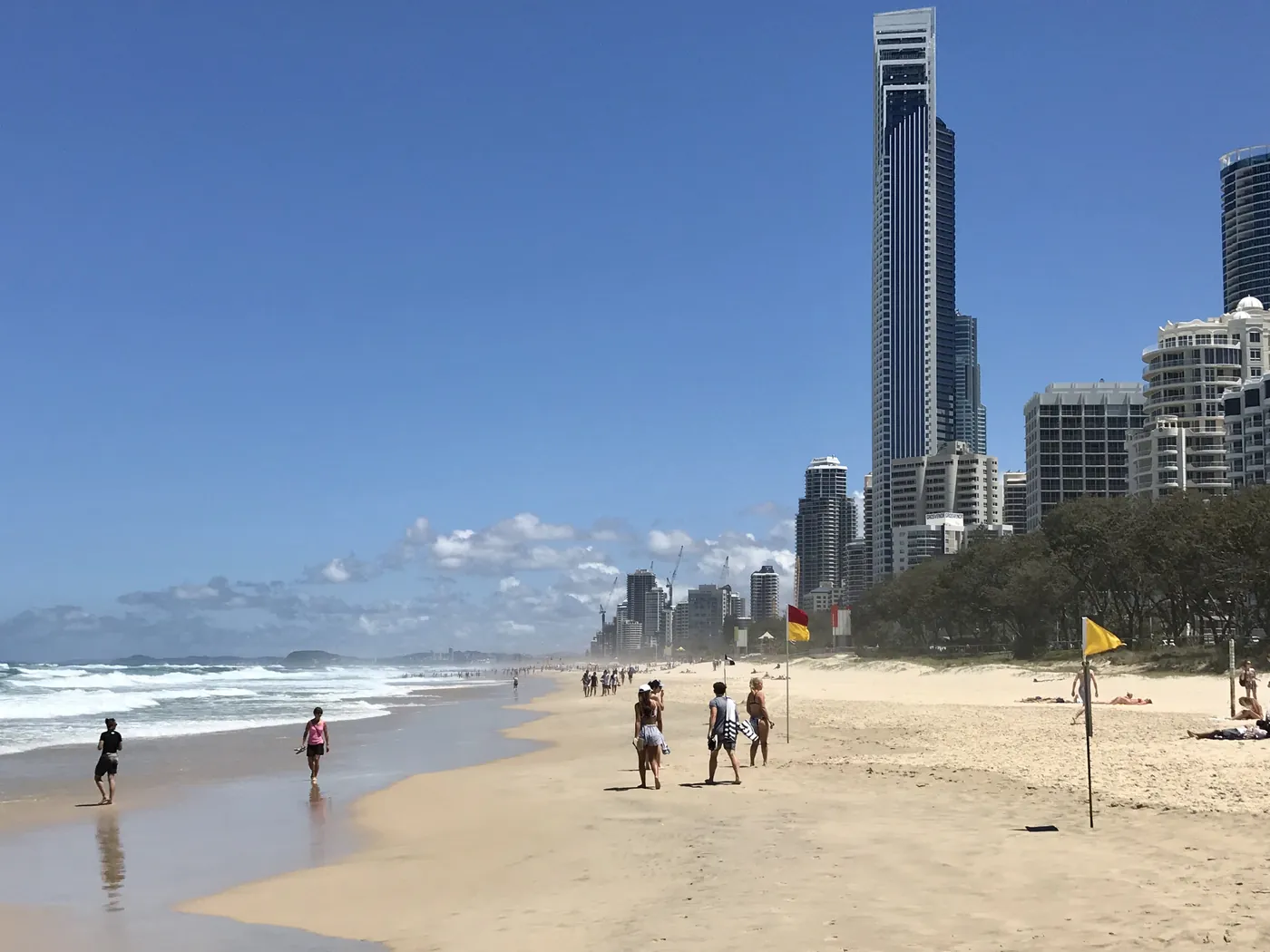
The beach north of Surfers Paradise, with the towers behind

Photo: “Surfers Paradise north beach, Queensland 01” by Kgbo, CC BY-SA 4.0, via Wikimedia Commons

Cavmir in Gold Coast

What Cavmir Does for Gold Coast Hosts

Cavmir markets Gold Coast stays as the individual homes they are: the two-bedroom Broadbeach apartment near the light rail, the Burleigh Heads house a short walk from the headland, the Main Beach or Spit residence on the water, the Tamborine Mountain cottage. Cavmir works remotely for Australian owners, and the job is marketing: we don't manage, clean or check guests in. For each home we make a direct-booking website, pages for Google and AI search that answer what travellers ask about the Gold Coast, photography direction, social posts, and the email list that brings last season's guests back, so that you depend less on one platform's search ranking and more on guests who already know your home.

Then and now

How the Gold Coast Short-Stay Market Has Changed

The Gold Coast's best-known stretch of sand began as a river crossing and a pub. According to Gold Coast Stories, a local history site, James Beattie took up land on the northern bank of the Nerang River in 1869, and in 1877 a German immigrant, Johann Meyer, bought it, tried sugar, ran a private ferry and built the Main Beach Hotel near the bank. A horse and coach service ran from Southport three times a week by 1888, and in 1889 the receiving office at the hotel gave the place an official name, Elston, although many people still called it Meyer's Ferry. Access was the problem: an auction of the Surfers Paradise Estate in 1917 was unsuccessful, partly because getting there was so difficult.

Holiday accommodation came with the next owner. Jim Cavill acquired around 10 hectares of land at Elston from about 1920, and in 1925 he built the 16-bedroom Surfers Paradise Hotel, the same year the Jubilee Bridge opened as the first permanent crossing of the Nerang River between Southport and Elston. The Lands Department favoured the name Sea Glint in the early 1930s, but Cavill and local supporters kept lobbying, and in 1933 Elston was formally renamed Surfers Paradise. The sources I opened stop there. They don't give the date when owners first let private homes to holidaymakers on the coast, so we leave that story out rather than guess at it.

The modern market is an apartment market, and the state has been watching it. A Queensland Government statement of 2 August 2023 reported 19,773 active short-term rentals across the state in the first quarter of 2023, roughly two out of three in the south-east, with the most listings in high-tourism coastal council areas including the Gold Coast, Sunshine Coast, Brisbane and Cairns. The review behind the statement found that short-term rentals had a limited effect on rental affordability, that dwelling supply is a major factor in rent increases and that statewide restrictions would not suit varied local conditions. The Deputy Premier, Steven Miles, said the government would consult an industry reference group and the Local Government Association of Queensland on a possible registration system. The sources I could open don't show a register since then, so as of 29 October 2026 the rules here remain council rules.

Today's supply is shrinking while revenue per listing is rising. AirROI shows 4,348 active listings, down 18 percent on the previous year, with average annual revenue per listing up 4.0 percent to A$57,874. The market is professionalised at the top: AirROI lists Q Stay as the largest operator, with 292 listings or about 7 percent of the market, followed by Serain Residences with 100, Hometime with 46, Manage My BNB QLD with 29 and Nuve Escapes with 26, and the ten top-grossing hosts run 21 percent of listings. Superhosts hold 33.9 percent of listings, 38.9 percent are co-hosted, and under 1 percent display a permit number. A single owner here competes with those operators on photos, pricing discipline and a clear idea of who the home is for.

Rates and seasons

Rates, Occupancy and Seasons in Gold Coast

Rates and revenue

AirROI's figures for the city for the twelve months to September 2026 show an average daily rate of A$416, occupancy of 47.3 percent and average annual revenue of A$57,874 per listing, which is about A$4,820 a month averaged across the year. AirROI compares that with a Queensland average of A$48,565 a year and notes that the city's revenue per listing is about 19 percent higher. Revenue per available night, AirROI's RevPAR, is A$197. The spread between listings is wide. At the median a listing earns A$5,090 a month at 51 percent occupancy and A$345 a night. The top quarter earns A$8,470 or more a month at 74 percent or more occupancy and A$500 a night or more, and the top tenth A$12,800 a month or more at 87 percent occupancy and A$740 a night. The bottom quarter earns A$2,560 or less a month at 26 percent occupancy or lower. Treat these as market-wide figures, not a promise for your own home.

Size and place do most of the pricing work. By bedrooms, AirROI shows entire homes averaging A$39,800 a year for one bedroom at A$261 a night, A$54,500 for two bedrooms at A$388, A$75,600 for three at A$553, A$105,000 for four at A$820, and A$165,000 for five or more at A$1,158. Occupancy drifts down as homes get bigger, from 51 percent for one bedroom to 45 percent for four. By town, AirROI's nearby-markets table shows Broadbeach leading on revenue per listing at A$62,002 and 53 percent occupancy, Burleigh Heads at A$56,562 with the highest daily rate of the group at A$503, Palm Beach at A$52,835 and A$452, Coolangatta at A$51,625 and A$447, Mermaid Beach at A$47,381 and A$364, and Surfers Paradise at A$46,664 and A$373 across 735 listings, the biggest pool of competition. Waterfront homes average A$79,200 a year against A$51,800 without, and ocean-view homes A$76,400 against A$53,900, though AirROI notes the larger, professionally run homes also tend to have more amenities, so part of each gap is home size.

Guests book about 72 days ahead on average, with lead time longest for December stays (more than 80 days in both of AirROI's December figures) and shortest for February (under 60 days). Stays average between four and five nights, and a typical listing takes around 28 bookings a year. Minimum stays are short: 14 percent of listings accept one night, 35 percent set two nights and 30 percent set three. The cleaning fee is a visible part of the price. 82.7 percent of listings charge one, the median is A$175 and the average A$289, which AirROI puts at roughly A$35 a night for the median fee on a typical stay, and the fees come to 9.3 percent of gross revenue. The most common cancellation policy is Firm, at 48 percent. Most listings that state a check-in time use 2 pm, and check-out is usually 10 am. Pricing each season and each length of stay as its own product, rather than one rate all year, is where a marketing plan earns its keep.

The year in Gold Coast

The Gold Coast year follows the southern calendar, with summer from December to February, and AirROI's two-year seasonality shows two quite different kinds of peak. January is the strongest month at about A$9,200 of revenue per listing, December follows at A$8,990, and both are high season. July (A$6,870) and October (A$6,880) are also high season, which tells you the city is a winter-sun destination as well as a summer one. April, September and November are shoulder months at A$6,340, A$6,140 and A$6,130. The low months are February (A$4,850), March (A$5,210), May (A$4,690), June (A$5,060) and August (A$5,480). AirROI's season averages are A$7,980 a month at 56 percent occupancy and A$448 a night in high season, A$6,210 at 54 percent and A$400 in shoulder months, and A$5,060 at 47 percent and A$387 in the low months. The peak month earns roughly twice the weakest one.

The reasons are school holidays and events. Queensland state school holidays are the demand calendar: the Christmas break runs from 12 December 2026 to 26 January 2027, and in 2027 the breaks run from 26 March to 11 April, 26 June to 11 July and 18 September to 4 October, before the next summer break starts on 11 December 2027 (Education Queensland). Between them sit surf and sport weekends, the Christmas events at HOTA, Schoolies Week from 21 to 27 November 2026 with its Hub on Surfers Paradise Beach, and the quiet months of May and June, when AirROI's occupancy drops to 42 to 44 percent. A host who plans a mid-week offer, a weekly rate and a monthly rate for May and June is working on the weakest months, which is where there is the most room to improve.

The rules

Short-Stay Rules in Gold Coast

Queensland has no statewide short-term rental register. A Queensland Government statement of 2 August 2023 on the short-term accommodation review said the government would consult on a possible registration system, and AirROI's Queensland summary, checked on 17 October 2026, says none has been enacted. The state's Planning Regulation 2017 defines short-term accommodation as providing accommodation of less than three consecutive months to tourists or travellers, and the City of Gold Coast uses that definition. AirROI's summary adds that every Queensland home, townhouse and unit must have photoelectric alarms wired together by 1 January 2027, and that rented homes already must. I couldn't open the Queensland Fire Department page behind that statement, so check it before you rely on the date. For the full picture of what we found for every state, see our guide to Australian short-stay rules.

The City of Gold Coast sets the planning rules. Its short-term accommodation fact sheet (a three-page document, last updated 23 February 2024) says that renting a whole dwelling, or part of one that isn't subordinate to your own residence, is short-term accommodation, which City Plan treats as a tourist and entertainment activity rather than a residential one. Renting a room while you live there may instead be a home-based business such as a bed and breakfast. A development approval is needed. The use is code assessable in the centre, high-density residential, innovation, major tourism (The Spit's northern, southern and eastern tourism precincts) and mixed-use zones (other than the Fringe business precinct), in medium-density residential zones with direct access to the Gold Coast Highway, and in neighbourhood centre zones with direct access to Musgrave Street or Marine Parade at Coolangatta. Everywhere else it is impact assessable, which means public notification, neighbour submissions and appeal rights, and overlays can lift the level of assessment. Check your zone in the City Plan map before you buy or list.

Existing use rights and party houses. A home that lawfully operated as short-term accommodation before City Plan commenced on 2 February 2016 may continue without a new development approval, but the rights can be lost if the use stops or its scale and intensity change, and you will be asked to show evidence if a compliance matter arises. The council's fact sheet also defines a party house: a dwelling rented to guests for less than 10 days, with the owner not on site, where guests hold parties on more than two occasions in a consecutive 12-month period. Party house is a prohibited use across the city, except in a mapped party house area of Surfers Paradise where it is impact assessable, and a prohibited use cannot be made lawful by any approval. In practice, groups of friends, bucks and hens weekends and Schoolies bookings are where an owner should be strictest about occupancy and house rules.

Licence, rates, strata and tax. The council also requires a rental accommodation licence for tourist rental accommodation under Local Law No. 16 (Licensing) 2008 and its subordinate local law, and its licensing page says that for most properties the payment of rates is deemed a licence renewal, provided the rating category is correct. The licence doesn't replace a development approval, and the council can inspect for matters such as mould, water leaks, sanitation and the display of evacuation plans. Rates matter in their own right: the 2026-27 rating category statement defines itinerant use as stays by visitors or tourists of fewer than 42 consecutive days, counts listings and advertising as evidence, and has itinerant rental categories in the 3-series (houses, residential lots and units) and 7H-series (multi-dwelling buildings), and the council asks you to tell it through its confirm-your-rating-category form when you start renting. The council's fact sheet doesn't cover body corporate rules, so read the by-laws and community management statement for your building and ask the committee or a solicitor. Federally, the ATO lets you deduct the costs of owning and using a holiday home only where renting it out is its main purpose (its guidance cites Taxation Ruling TR 2026/1), and for a business registered (or required to be registered) for GST, accommodation for stays of fewer than 28 continuous days carries GST. Under FIRB policy, a foreign buyer generally can't purchase an established dwelling between 1 April 2025 and 30 June 2029, and Queensland adds an extra 8 percent duty for foreign purchasers.

None of this is legal or tax advice; it is orientation from public pages checked in October 2026, and the rules can change. The City of Gold Coast's Planning and Enquiries Centre, your solicitor and your accountant are the people who can say what applies to your address. Some hinterland addresses, including parts of the Tamborine Mountain and Lamington areas, may sit under a different council from the City of Gold Coast, and I haven't researched other councils' rules, so confirm which one covers your lot. Cavmir handles the marketing side; approvals, licences, insurance and tax remain with you and your advisers.

Marketing

Marketing a Holiday Home in Gold Coast

What works here

Start with the place, then the building. Gold Coast guests search by area, so the first lines of a listing should say which stretch of coast the home is on and what is in walking distance: the beach, the light rail, the restaurants, the headland. The G:link light rail's Stage 3 extension opened to passengers on 9 August 2026, linking Burleigh Heads and Broadbeach through Miami, Nobby Beach and Mermaid Beach, and a home near one of its eight new stations can say so. For apartments, name the floor and the view in the title, since AirROI's data shows ocean view and waterfront as two of the strongest revenue gaps, and show the balcony, because 76 percent of listings have a patio or balcony and those that do average A$62,300 a year against A$43,600 without.

Second, photos and amenities that guests rank. The average listing has 14 photos and only 42 percent show their exact location, so a set of 30 or more, in a deliberate order from the view to the bedrooms, helps a home stand out. AirROI's amenity table shows self check-in on 65 percent of listings, with those that offer it averaging A$65,100 a year against A$44,700 for those that don't, outdoor furniture on 55 percent, and a much smaller group with extras such as a pool table (4 percent of listings, A$94,800) or a children's playroom (2 percent). Those gaps partly reflect the size of the home and not only the feature, so choose upgrades that suit your guests: a family apartment wants a cot, a high chair and a sand-free entry; a group house wants beds that match the guest count and a table that fits everyone.

Third, price for the calendar and the length of stay. Open the Christmas and January dates early, since December lead times run past 80 days, and use a minimum stay on peak weekends and school holidays. For May, June and the low months, offer a weekly rate and a mid-week rate, because AirROI's occupancy falls to between 42 and 44 percent. Watch the cleaning fee: a median fee of A$175 adds about A$35 a night to a typical stay (the average fee is A$289), and value is already the lowest-scoring rating category at 4.65. Put the fee in the nightly rate where the platform allows it, or at least show the total. On Stayz and Vrbo, listing is free according to Vrbo's Australian host page, which shows a 5 percent commission plus a 3 percent payment processing fee on each reservation, so compare it with Airbnb, where AirROI's profit estimate uses a host fee of about 14 percent and shows 84.8 percent of listings on Simplified Pricing, with the host paying the full service fee. The stayz.com.au site would not open for our checker, so confirm in your own account whether a Stayz listing runs through Vrbo.

Fourth, build a direct channel. Three in four reviewers are Australian, so many of your guests live close enough to come back, and a family that enjoyed a school-holiday week can be offered the same week next year. Capture them: a short email list, a direct-booking page, a Google Business Profile with photos and a welcome guide, and a post-stay message that asks for a review and offers the next school holidays. Comply with the rules in your listing: where the council licence or approval applies, make sure the occupancy you advertise matches the approval, and keep the house rules clear on parties and noise, since the party house definition turns on repeated parties. Cavmir can write and run this channel with you remotely; the operations, cleaning and check-in stay with your manager or you.

What makes it hard

The first challenge is the planning system. Short-term accommodation needs a development approval across most of the city, public notification in many zones, and no approval can make a party house lawful outside its mapped area. A home bought as an investment without checking its zone, existing use rights or body corporate by-laws can turn out to be one you can't rent short term. Treat the zone check as the first step in a purchase, and ask for evidence of existing use rights if the seller says the home has always been let. A host's answer is to prove the approval before spending on marketing, and to build a plan that suits the rules for the address rather than the other way round.

The second challenge is competition at the top. AirROI shows the supply shrinking by 18 percent over the year while the average listing's revenue grew 4.0 percent, so the survivors are doing better, and the best are far ahead: the top quarter earns A$8,470 or more a month against a median of A$5,090. Professional operators run a large share of the supply, with the ten biggest hosts at 21 percent of listings and Q Stay alone at about 7 percent. The tools an independent owner has are specifics: a tightly described location, a design that photographs well, fast replies, a clean review record and a direct-booking page that does not depend on Airbnb's search.

The third is the calendar. January earns roughly twice what May does, and a home that sits at 42 percent occupancy in May and June has the same costs as in summer. The answer is not to chase every guest but to pick one or two extra audiences for the quiet months: couples and remote workers on weekly stays in the cooler months, winter-sun families in July, and event travellers around the surf and triathlon weekends. Hinterland homes face a different calendar, because their guests come for cool mornings, rainforest walks and a weekend away from the coast, and their pages need to say how long the drive takes and what the road is like.

Worth knowing. Surfers Paradise used to be called Elston. The place took that name when the Main Beach Hotel became a receiving office in 1889, and many people still called it Meyer's Ferry. The Lands Department favoured Sea Glint in the early 1930s, but Jim Cavill, who had built the 16-bedroom Surfers Paradise Hotel in 1925, and local supporters kept up the pressure, and in 1933 Elston was formally renamed. The name that now appears on holiday-rental listings up and down the coast was won by local lobbying.
Money matters for Gold Coast owners
Insurance

Home and contents cover usually doesn't extend to paying guests. Ask a broker about holiday-home or short-stay cover, public liability limits, loss of rent, and what the insurer expects if you use a booking platform's host protection. Coastal and hinterland properties can have different premiums, so ask about storm, flood and bushfire cover for your address. The council's licence and fire-safety expectations (and the smoke alarm rule coming in on 1 January 2027, per AirROI's Queensland summary) are also worth raising with the insurer.

Tax

Rental income goes in your tax return. Under the ATO's holiday-home rules, the cost of owning and running the place (loan interest, council and water rates, land tax, strata levies, repairs) is claimable only when it is mostly there to earn rent, and days it sat unavailable or housed family and friends have to be carved out. Platform commissions, booking fees and advertising aimed at guests are claimable regardless. For a business registered (or required to be registered) for GST, the ATO says accommodation for fewer than 28 continuous days carries GST, so ask an accountant whether you need to register. Sofie is not an accountant. Capital gains tax applies when you sell, so keep records from purchase onward.

Lending and land tax

Lenders treat a holiday-let home differently from an owner-occupied one, so ask a broker how rental income and short-stay use are assessed. A Gold Coast agency report (PRD Coolangatta, 3 September 2026) put the city's median house price at more than A$1.4 million for the June quarter of 2026, and Broker News, quoting Ray White chief economist Nerida Conisbee, reported a median unit price of A$956,000 on 28 October 2025, a figure now a year old. A foreign buyer is up against FIRB's policy ban on established dwellings between 1 April 2025 and 30 June 2029, on top of Queensland's additional 8 percent foreign acquirer duty; permanent residents and New Zealand Special Category Visa holders are treated differently, so ask FIRB or a lawyer before you commit.

Your own website

A Direct-Booking Website for a Gold Coast Home

A direct-booking website is where a Gold Coast home answers the questions the platforms limit. Guests check the exact location and the walk to the beach, the light rail and the shops, the floor and the view, the bed set-up, the car space and whether the building allows it, the cancellation terms and the total price. A page for each home, and a page for each town or stretch of coast you serve, gives search engines and AI assistants something specific. Our website design service builds that site for owners and managers, with the booking flow connected to the calendar and payments you already use.

Australian law puts requirements on a booking page. The Australian Consumer Law already bars misleading price claims, and the unfair trading practices law Parliament passed on 2 July 2026 adds drip-pricing rules from 1 July 2027, so show the total, including cleaning fees and any surcharges, up front and not at the last step. Your privacy policy has to say what you collect, and a cookie banner is sensible if you use analytics. Cancellation terms have to be clear, and you must have the planning approval and licence the City of Gold Coast expects before you take bookings. Queensland has no state registration number to display, so there is no state number to publish on the page, although if the council gives you an approval or licence reference, mention it in your own records. This is orientation, not legal advice, and a solicitor can confirm what applies to your situation.

Content wins on a site like this. The pages that bring bookings are the specific ones: a Broadbeach apartment page that lists the walk to the beach, the shops and the light rail, a Burleigh Heads page that talks about the headland walk and the new light rail station, a hinterland page that explains the drive up to Tamborine Mountain or Springbrook and what to bring. Each page needs real photos, the real distances, and the events guests plan around: the Christmas events at HOTA, the Gold Coast Open at Burleigh in February 2027 and the T100 triathlon in March. A short blog post a month on the school holidays, with dates, and a guest guide that links back to the booking page, builds the base of pages that a search engine or an assistant can use.

AI search

Getting Named in AI Answers About Gold Coast

Guests ask AI assistants things like "where should I stay on the Gold Coast for a family week in January" or "two-bedroom apartment in Broadbeach near the light rail". The assistants answer from pages they can read and trust, and the homes they name have a clear description, a stated location, consistent facts across platforms and a website that confirms them. Keep the name, address area, bedrooms, capacity, check-in time and house rules the same on your listings, your website and your Google Business Profile, so an assistant never has to choose between two versions.

Our guide to generative engine optimisation for holiday rentals explains the method. In practice, for the Gold Coast it means a page per home with the walking times, a page per stretch of coast with the real events and school-holiday dates, a short question-and-answer section on parking, pets, cots and the light rail, and an up-to-date calendar of what is on. We write those pages in plain English with sourced facts, so the assistants have something accurate to quote.

What's next

Where Gold Coast Is Heading

Transport is the clearest change. The G:link light rail's Stage 3 extension, which a Queensland Government statement of 7 August 2026 said would open that Sunday, connects Burleigh Heads to Broadbeach and runs through Miami, Nobby Beach and Mermaid Beach, with eight new stations along 6.7 km. The statement also mentions permanent 50 cent fares. A home near a new station can write about a car-free stay, and guests who fly into Coolangatta or Brisbane can plan a trip around the line. Over time we would expect the station areas to attract more bookings from guests who don't want to hire a car, though the effect on rates in any one suburb is something to watch rather than assume.

The rules are moving more slowly. Queensland's short-term accommodation review in 2023 recommended a registration system, and the government said it would consider one, but the sources I could open don't show a register in force. The smoke alarm rule due on 1 January 2027, according to AirROI's Queensland summary, will apply to homes that are rented or occupied, and the restriction on foreign buyers of established dwellings is government policy until 30 June 2029. Supply is the other moving part. With listings down 18 percent in a year and revenue per listing up 4.0 percent, owners who keep their approvals and standards in order are likely to see the market reward them, though that is a trend to track, not a promise.

The way guests search is also changing. They ask AI assistants for ideas, read summaries of reviews, and book from whichever source answers best. Owners who keep their facts accurate, their photos current and their direct channel working will be in the best position, whatever happens to platform fees. Plan the next 12 months around the calendar you can see: the Christmas break, the Gold Coast Open in February 2027, the T100 weekend in March 2027, the autumn and winter school holidays, and then spring.

Why we like the work

Why We Love Marketing in Gold Coast

What I love about marketing Gold Coast homes is how different the coast is from one end to the other. Broadbeach is a short walk from the restaurants, the beach and the light rail, Burleigh Heads has a national park walk by the beach, and Coolangatta sits at the Queensland-New South Wales border. Each has its own kind of guest, and each home has a reason to be chosen. The work is to find that reason and say it clearly.

I also like the hinterland. Inland from the beachfront towers there is a rainforest with a skywalk at Tamborine Mountain, the World Heritage forest at Springbrook, and the mountain cool at O'Reilly's, 930 metres above sea level and, according to its own page, up to seven degrees cooler than the coast. A holiday home up there is a different product from a beachfront apartment, and it deserves a different page and a different set of guests.

The part I enjoy most is the specifics: the floor of the building, the view at breakfast, the walk to the headland, the school-holiday week that books out a year ahead. A good listing and a good website are made of those details, and my job is to find the true ones and put them where the right guest will see them.

Welcome book

Picks for Your Gold Coast Welcome Book

The picks Cavmir would put in a Gold Coast welcome book: places we checked are open now, with the details a guest needs and a reason to book the next school holidays.

Morning

Burleigh Head National Park

Queensland Parks lists walks along the rocky foreshore and through rainforest at Burleigh Head National Park, with a lookout, no camping and no campfires. At the time of its last update on 16 October 2025 the park had no alerts, so check the page before you go. It's a short walk from Burleigh Heads' beach and cafe strip.

Wildlife

Currumbin Wildlife Sanctuary

At 28 Tomewin Street, Currumbin, the sanctuary is open from 9 am to 4 pm daily, with last admission at 3.30 pm, and closes on 25 April and 25 December. It runs a free wild lorikeet feeding at 8 am and 4 pm, which needs no ticket and no booking, as well as koala experiences and the Astra Lumina night walk.

View

SkyPoint at Surfers Paradise

SkyPoint is 230 metres above Surfers Paradise, reached by a lift to Level 77 in about 38 seconds, and its website says it is open until 9 pm. It's a good first-night stop for guests who want the whole coastline in one view.

Rainy day

HOTA, Home of the Arts

HOTA is at 135 Bundall Road, Surfers Paradise, with a gallery, a cinema, dining and an outdoor stage, and its parklands are a free, non-ticketed area. It lists a Brickman exhibition of more than 45 LEGO brick works from 5 December, and its Christmas events include the Mayor's Christmas Carols.

Getting around

The G:link light rail to Burleigh Heads

Stage 3 of the G:link opened on 9 August 2026 and connects Burleigh Heads to Broadbeach through Miami, Nobby Beach and Mermaid Beach, 6.7 km in all. The Queensland Government statement mentions permanent 50 cent fares, so a car-free day along the coast is realistic.

Hinterland

Tamborine Rainforest Skywalk

At 333 Geissmann Drive, Mount Tamborine, the walk is 1.5 km in total, including about 300 m of steel bridges through the canopy and a 40 m cantilever bridge 30 m above the creek. The site says it is open seven days from 9.30 am, and closes at 5 pm.

Mountain

O'Reilly's Tree Top Walk

O'Reilly's Rainforest Retreat is at 3582 Lamington National Park Road, Canungra, in the World Heritage-listed Lamington National Park. Its free Tree Top Walk is a 180 m suspension bridge about 15 m above the forest floor, and the retreat sits 930 m above sea level.

Rainforest

Springbrook National Park

Queensland Parks describes Springbrook as a World Heritage-listed park with ancient rainforest, a cave, waterfalls and volcanic cliffs, with toilets, picnic tables, barbecues and camping through the Queensland camping booking site. Check the park's alerts page on the day, since tracks can close.

Surf

Gold Coast Open at Burleigh Heads

The surfing competition, run by Surfing Queensland, returns to Goodwin Terrace, Burleigh Heads, from 17 to 21 February 2027, with live bands, skateboarding and sunrise yoga alongside the heats. It falls in a low month for bookings, so it's a good reason to visit.

Sport

T100 triathlon at Surfers Paradise

The Gold Coast T100 Triathlon and 10 km run is listed in Surfers Paradise on 20 and 21 March 2027, with a flat course that suits personal-best attempts and first-timers. Registration is through the T100 site.

Christmas

Christmas at HOTA

HOTA's site lists Christmas events, including the Mayor's Christmas Carols, where gates open at 4 pm. We couldn't confirm the 2026 dates, so check the HOTA What's On page before you promise guests a night. Good for guests who arrive for the summer break.

The playbook

How Cavmir Would Market Three Gold Coast Homes

Cavmir has no clients in Gold Coast yet. These are the plans it would start with for three common kinds of home here: the situation, the plan, and what each one aims at.

Two-bedroom apartment in Broadbeach, near the light rail
The situation

An apartment in a mid-rise building that lists on Airbnb with a standard set of photos, a single rate all year and a long cleaning fee, and doesn't say how far it is from the beach, the shops or the G:link.

The plan

Check the approval and building by-laws first. Then rewrite the listing around the location, with walking times and the floor and view in the title, a full photo set in order from the balcony to the bedrooms, a cot and high chair offer for families, a rate calendar built around Queensland school holidays and a direct-booking page with a past-guest list.

What it targets

Aimed at moving the guest away from a pure price comparison and towards the home's location. Track nightly rate against school-holiday dates, occupancy in the low months, the cleaning fee's effect on conversion, review scores for value and location and the share of direct and returning guests.

Four-bedroom house in Burleigh Heads, for groups
The situation

A house a short distance from the headland that sleeps eight, books groups of friends and families, and has never written house rules or confirmed its approval and occupancy.

The plan

Confirm the planning position, the licence and the occupancy with the council. Write house rules on parties, noise, parking and numbers, and put them in the listing. Reposition the house as a family and friends base for the headland, the beach and the light rail, with an outdoor table and barbecue in the first photos, a mid-week and weekly rate for the quiet months, and a direct page for past groups.

What it targets

Designed to keep the house compliant and protect its reviews while building a repeat group audience. Track complaints and incident reports, occupancy against the house's approved numbers, weekly stays in the low months, review comments on noise and the number of repeat bookings.

Hinterland cottage on Tamborine Mountain
The situation

A two-bedroom cottage that gets weekend bookings, is described as a countryside escape, and gives no detail on the drive, the weather or what's open nearby.

The plan

Check which council covers the address and what approvals it needs. Rewrite the pages for the weekend guest from Brisbane and the Gold Coast, with drive times, the rainforest skywalk and the cooler mountain weather described plainly, a mid-week couples offer, a gift voucher for birthdays and a winter fireplace weekend, and set up a direct-booking page and email list.

What it targets

Aimed at lifting mid-week bookings and winter weekends and building direct bookings among repeat visitors. Track mid-week occupancy, the gap between coast and mountain rates, review scores for accuracy and location, enquiries by source and returning guests.

FAQ

Gold Coast Airbnb Marketing: Questions, Answered

Does Cavmir offer Airbnb and holiday-home marketing in the Gold Coast?

Yes. Cavmir works remotely with Australian owners and managers of Gold Coast holiday homes and apartments, on listings, photo direction, direct-booking sites, visibility in search and AI assistants, social posts and email newsletters. We market; day-to-day operations, cleaning, approvals and tax remain with you or your manager. See pricing and monthly plans for how work is packaged, or contact us.

What do holiday rentals earn on the Gold Coast?

For the twelve months to September 2026, AirROI puts the city's average listing at A$416 a night, 47.3 percent occupancy and A$57,874 a year, about A$4,820 a month averaged over the year. The median listing earns A$5,090 a month, the top quarter A$8,470 or more, and Broadbeach leads the AirROI towns for revenue per listing. Treat these as market-wide figures, not a promise for your own home.

When is the busiest time of year for Gold Coast holiday homes?

January is the strongest month in AirROI's two-year data at about A$9,200 of revenue per listing, followed by December at A$8,990, with July and October also classed as high season. The Christmas break runs from 12 December 2026 to 26 January 2027. May and June are the quietest, with occupancy of about 42 to 44 percent.

Does a Gold Coast short-term rental need council approval?

Usually yes. The City of Gold Coast treats short-term accommodation as a development that needs approval: code assessable in listed zones and impact assessable (publicly notified) elsewhere, unless the home has existing use rights from before 2 February 2016. A rental accommodation licence is also required. This is orientation, not legal advice; ask the council's Planning and Enquiries Centre about your address.

Is there a party house rule on the Gold Coast?

Yes. The council defines a party house as a dwelling rented for less than 10 days, with no owner on site, where guests hold parties on more than two occasions in a consecutive 12-month period. It is prohibited across the city, except in a mapped party house area of Surfers Paradise where it is impact assessable. Clear house rules and occupancy limits protect you.

Does Queensland have a short-term rental register?

Not in the sources I could open. A Queensland Government statement on 2 August 2023 said the government would consult on a possible registration system, and AirROI's Queensland summary, checked on 17 October 2026, says no register has been enacted. Rules come from the council, so check the City of Gold Coast.

Can a foreign buyer purchase a Gold Coast holiday home?

Under FIRB's guidance, foreign persons generally can't buy an established dwelling between 1 April 2025 and 30 June 2029 (limited exceptions need approval), and Queensland charges an extra 8 percent duty for foreign purchasers. Permanent residents and eligible New Zealand citizens don't need approval. Ask FIRB or a lawyer about your case.

How much does Gold Coast Airbnb marketing cost with Cavmir?

It depends on what you need: a listing refresh, a direct-booking website or ongoing marketing. The prices are shown in Australian dollars on the pricing page, and the ongoing options are on the monthly plans page.

Get a quote

Tell Us About Your Gold Coast Holiday Home

Which home, which town, and where it lists today. A written proposal in A$ follows within 48 hours.

What do you need?

Your details go to Cavmir only and are used to answer you. Privacy policy.

Nearby

Markets Near Gold Coast

All Australian markets

Photo Credits