
Morning
Versailles Gardens walk at Ocean Club
The terraced gardens and cloister ruins at the top of Paradise Island. Quiet before ten, genuinely beautiful, the walk that orients guests to the non-resort version of the island.
Expert short-term rental marketing to grow your bookings and nightly rate in Nassau & Paradise Island, Bahamas, Caribbean.
* Market averages. Cavmir-managed properties typically exceed these figures by 25–45%. Data sourced from AirDNA, STR market reports, and Cavmir internal analytics.
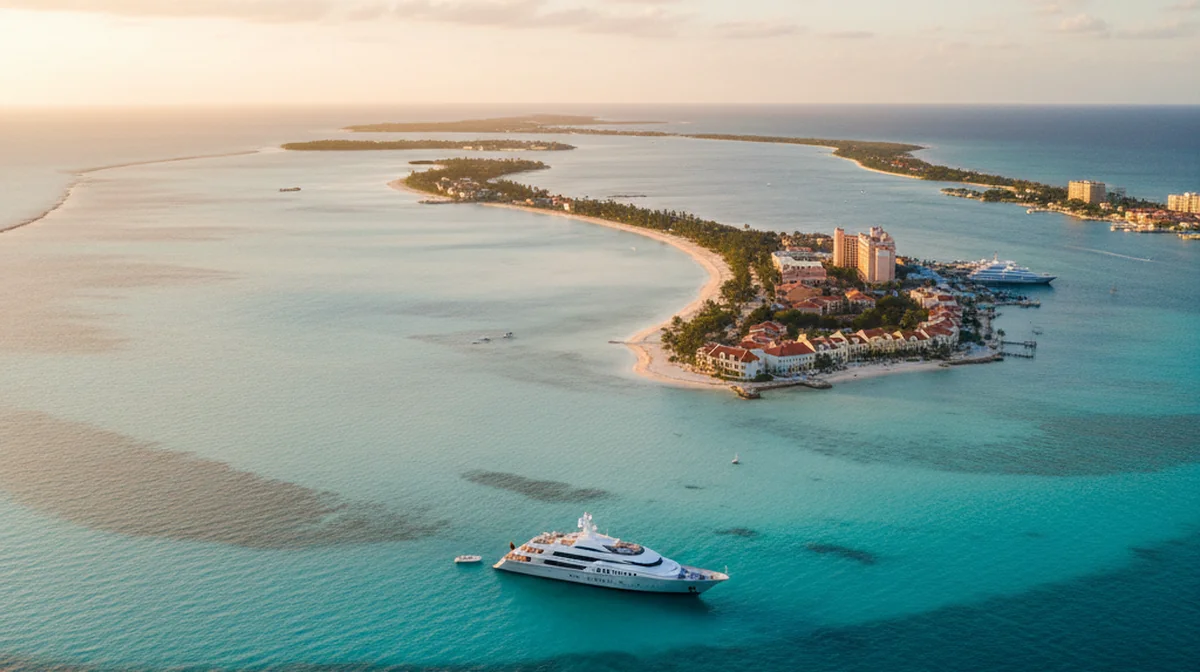
Nassau and Paradise Island sit at the center of the most-visited Caribbean destination — an hour by air from Miami, a short ferry from the downtown cruise port, and the commercial and residential heart of the Bahamas. Cable Beach anchors the mid-market resort and villa corridor; Paradise Island is the Atlantis-anchored resort island, with surrounding villa and condo inventory that runs to very high-end; Lyford Cay and Old Fort Bay are the gated western enclaves where residential villa rentals command the island's top rates; Blue Lagoon Island is the most-booked day excursion. The traveler mix ranges from cruise-extend families to ultra-high-net-worth winter residents.
Nassau's STR market benefits from extraordinary flight connectivity and a bifurcated guest base — volume from cruise-extend and Miami-weekend travelers at the Cable Beach and Paradise Island condo level, and true ultra-luxury villa demand at Lyford Cay and Old Fort Bay. Peak season runs mid-December through April. Regulatory environment is medium, with VAT on accommodation and required operator registration through the Department of Inland Revenue.
Nearby Markets: Harbour Island | Exumas | Turks & Caicos
Cavmir's bifurcated positioning — cinematic photography and ultra-luxury distribution for Lyford and Old Fort villas, professional branding and direct-booking for Cable Beach and Paradise Island condos — matches the actual shape of the Nassau market. Our Virtuoso channel and Airbnb Luxe placements reach the top-of-market guest; our direct-booking infrastructure protects repeat families at the condo level.
Nassau, on the island of New Providence, was founded by British settlers in 1670 and named in 1695 for King William III of the House of Orange-Nassau. Its protected harbor made it a notorious pirate haven in the early 18th century — Blackbeard, Calico Jack, and Anne Bonny all operated from Nassau until Woodes Rogers arrived as royal governor in 1718 with the charge to expel the pirate republic. The Bahamas remained a British colony through blockade-running wealth during the U.S. Civil War and Prohibition-era rum-running in the 1920s, both of which built Nassau mansions that still line the ridge above Bay Street.
The Bahamas achieved independence in 1973 while retaining Commonwealth membership. The modern economy rests on two pillars: tourism, anchored by Paradise Island's Atlantis resort (opened 1994 under Sun International, now operated by Brookfield) and Baha Mar (opened 2017), and offshore financial services, which made Nassau one of the Caribbean's largest banking centers through favorable corporate and trust law. Short-term rental inventory concentrates on Paradise Island, Cable Beach, Old Fort Bay, Lyford Cay (gated, approvals required), and the eastern communities around Winton.
Lyford Cay and Old Fort Bay anchor the ultra-luxury tier at USD $1,500–$6,000/night for private estates with beach access. Paradise Island canal-front and Ocean Club-adjacent villas sit at $1,000–$3,500/night. Cable Beach condominiums at Baha Mar and the Rosewood run $500–$1,800/night. Christmas/New Year is super-peak with 5–7-night minimums; Presidents' Week and Junkanoo Boxing Day hold firm; summer softens but less than Turks or BVI given US weekend proximity.
Medium-to-high seasonality. Peak: December 15–April 15. Super-peak: Christmas/New Year and Junkanoo. Shoulder: May, early June, late November. Low: August–October (hurricane season). Missed revenue: early December and long US weekends year-round, which Nassau's proximity makes uniquely accessible.
Foreign buyers generally require approval from the Bahamas Investment Authority for residential acquisitions above 5 acres or in designated zones, and all foreign buyers must register the purchase with the BIA to obtain a Certificate of Registration or, for larger holdings, a Permit. The International Persons Landholding Act governs the framework. Operators generally require a vacation rental registration with the Ministry of Tourism plus a business license from the Department of Inland Revenue.
VAT of 10% applies to vacation-rental revenue and is guest-collected and remitted. A Tourism Environmental Levy of roughly $25 per room-night stacks onto accommodation. Lyford Cay, Old Fort Bay, and Albany carry gated-community approval requirements layered on top of national permitting — rental activity often requires board consent and is restricted in some cases. 2023–2024 reforms to the vacation-rental registration regime tightened Airbnb-platform data sharing with the Ministry. Anti-money-laundering and beneficial-ownership compliance has meaningfully increased for property-holding companies.
The Nassau strategic tip: be explicit about gated-community rental rules before you acquire. Lyford Cay in particular has historically restricted commercial rental activity, Albany applies its own program-based framework, and Old Fort Bay sits somewhere between. A buyer assuming open Airbnb flexibility in these enclaves may face board action. Structure the acquisition with a Bahamian attorney who knows the specific community, and obtain written confirmation of rental permissibility in writing before closing. Second — lean into US weekend proximity. Nassau is a 3-hour flight from New York and under 90 minutes from Miami, which makes it uniquely viable for Thursday-to-Sunday luxury escapes that St. Barths or Turks simply cannot serve.
Third — partner with Atlantis, Baha Mar, and the Ocean Club for amenity access. Guests booking private villas still want restaurant reservations, casino floor access, and waterpark day passes. Properties with pre-arranged access agreements outperform those leaving guests to navigate resort gates. Fourth — market the Junkanoo cultural window (December 26 and January 1 parades) as a distinct booking moment. It is Bahamian cultural patrimony that no competing destination offers, and sophisticated travelers will pay a premium for authentic access rather than tourist-bubble exposure. A villa host who arranges parade-route introductions earns a specific kind of repeat guest.
Nassau's challenges: hurricane exposure (Dorian in 2019 devastated Abaco and Grand Bahama but largely spared New Providence), rising operating costs driven by imported goods and electricity rates, workforce-visa complexity under Bahamianization hiring priorities, cruise-passenger volume that degrades downtown Nassau's luxury positioning for some guests, and occasional BIA-approval processing delays that slow cross-border transactions.
Bahamas hurricane coverage is specialty and substantial. Wind, flood, and named-storm endorsements required. Lloyd's of London specialty syndicates, Bahamas First, and Insurance Company of the Bahamas dominate. Budget USD $10,000–$35,000 annually for luxury Nassau villas, with building limits of USD $3–6 million plus liability. Per-event hurricane deductibles are meaningful; business-interruption riders protect peak-season exposure.
The Bahamas levies no income tax, no capital gains tax, and no inheritance tax — a foundational attraction for foreign buyers. VAT of 10% applies to rental revenue and most goods and services. Real Property Tax runs 0.625% annually on owner-occupied homes above the threshold and up to 1% on non-owner-occupied and rental properties, with a cap for owner-occupied. Stamp Duty on acquisition is 10% (typically split 50/50 buyer/seller by custom).
Bahamian mortgages for foreign buyers are available through Scotiabank Bahamas, CIBC FirstCaribbean, and RBC at 60–70% LTV with rates premium to US equivalents. Most luxury buyers use US financing or cash given BIA-approval timelines. Economic Permanent Residence tied to property purchase above USD $750K remains a material buyer motivation.
Nassau through 2027 and beyond: proximity to the US Eastern Seaboard is a durable structural advantage no other Caribbean jurisdiction can replicate. Expect continued tightening of VAT and vacation-rental registration enforcement, meaningful AML and beneficial-ownership transparency reforms aligned with OECD standards, and ongoing Economic Permanent Residence demand supporting the ultra-luxury segment. Baha Mar's continued maturation and Atlantis's Brookfield-led reinvestment reset the amenity benchmark upward. Hurricane-climate risk remains the defining operational variable. Downtown-Nassau cruise-volume pressure may accelerate a further shift of luxury demand toward Paradise Island, Cable Beach, and the western gated communities — a migration operators should position ahead of.
Nassau is the Caribbean city that rewards hosts who can tell two stories at once. There is the cruise-port Nassau — Bay Street, the straw market, the one-day-in-town version — and there is the resident Nassau of Paradise Island hideaways, Cable Beach sunsets, Fish Fry on Friday, and the specific quiet of the out-islands an hour's boat ride away. A listing that only sells the first story competes with a thousand rooms; a listing that leans into the second — the Versailles Gardens morning walk, the Graycliff wine cellar, the Rose Island day — prices and holds a materially more interesting guest.
What we love about marketing Nassau is how much editorial room the market leaves on the table. Most Bahamas listings default to generic turquoise-water photography and resort-amenity copy, which is exactly what cruise-day visitors already associate with the destination. The Nassau properties that outperform are the ones that behave like small independent hotels — with a specific point-of-view, local storytelling about the working city rather than the postcard, and welcome-book knowledge that extends past the lobby concierge. Guests who book longer Nassau stays skew wealthier and more curious than the island's reputation suggests. They reward listings that take the city seriously and hold onto the properties that do it well.
The picks Cavmir recommends for Nassau welcome books — the details that separate resident-hosts from the cruise-port script.
The terraced gardens and cloister ruins at the top of Paradise Island. Quiet before ten, genuinely beautiful, the walk that orients guests to the non-resort version of the island.
Cable Beach for the long-strand, casual walk; The Dune at One&Only for the architectural terrace and cocktail. A host who offers both reads resident.
Parliament Square, the colonial pastel government buildings, the streets most cruise-day visitors never reach. A proper twenty-minute orientation that repositions the city.
Graycliff for the legacy wine-cellar, jacket-required institution; Mahogany House for the modern-Bahamian counterpoint. Both signal a host who knows the city has actual restaurants.
The conch-fritter, cracked-conch, Kalik-beer Friday-night Bahamas that no resort replicates. A host who routes guests here on the right night looks like an actual Nassau insider.
Post-spring-break, pre-hurricane-watch. Weather is excellent, rates soften meaningfully, cruise volume thins. The window patient marketers build repeat-guest pipelines around.
Rose Island for the quieter, private-beach boat day; Blue Lagoon for the family-friendly infrastructure version. Either one resets the guest's sense of what the destination actually is.
Each base has a different guest profile. A host who explains which neighborhood matches which itinerary prevents the most common Nassau booking regret.
Representative Cavmir engagements in Nassau. Property identifiers redacted; figures composited from internal analytics and market benchmarks.
High-end villa adjacent to Ocean Club with a marketing presence that leaned on Atlantis proximity. Guest profile confused, ADR capped by the association.
Repositioned the villa around the Ocean Club quiet-wealth narrative — Versailles Gardens walks, The Dune dinners, the non-Atlantis Paradise Island. Architectural photography, cinematic film, direct-booking site with a quiet-luxury welcome book.
Peak-season ADR up 41%. Guest profile shifted measurably toward longer-stay, higher-spend families. Direct-booking share climbed to 36% of annual revenue.
Mid-market condo competing against large-building inventory on pure price. Flat shoulder-season demand, commodity positioning.
Differentiated on welcome-book value. Full first-week-itinerary PDF anchored on Fish Fry, Graycliff, Rose Island day-trips. Photography re-shot to emphasise the specific unit's beach-orientation advantages within the building.
Occupancy climbed from 63% to 83%. ADR up 27%. The repositioning broke the property out of the commodity tier it had been stuck in for three years.
Ultra-luxury estate missing the private-event, family-reunion, and production-location revenue streams peer properties in the corridor were capturing.
Three-product brand build. Destination-wedding tear sheet distributed through Bahamas wedding planners. Private-retreat product for family-office clients. Editorial-location availability for resort-lifestyle brand shoots based out of Nassau.
Event and production bookings now represent a meaningful share of annual revenue. A single four-day wedding booking cleared $108K. Leisure ADR climbed on the elevated brand.
Talk to Cavmir today. We'll show you exactly what your Nassau & Paradise Island property is leaving on the table — and how fast we can change that.
Book a Free Strategy Call