

Morning
Shell Beach coffee and a Jojo Burger run later
Shell Beach for the walk-in morning swim before Gustavia wakes up; Jojo Burger in Lorient held in reserve as the informed lunch answer when guests tire of white-tablecloth.
Expert short-term rental marketing to grow your bookings and nightly rate in St. Barts, Saint-Barthélemy, Caribbean.
* Market averages. Cavmir-managed properties typically exceed these figures by 25–45%. Data sourced from AirDNA, STR market reports, and Cavmir internal analytics.
Saint-Barthélemy occupies a singular position in Caribbean travel — an eight-square-mile French island whose harbor at Gustavia hosts the superyacht set each winter and whose hillside villas are rented by families whose alternative would be Mustique or Porto Cervo. Shell Beach sits steps from the cobbled port; Saline and Gouverneur remain undeveloped and swimsuit-optional; Colombier is reachable only by boat or trail; Anse des Cayes and Flamands anchor the west-coast villa market; Lorient is where the island's year-round residents actually eat. St. Barts does not chase volume. It protects character.
St. Barts commands the highest nightly rates in the Caribbean, with peak-week villa rentals between mid-December and early January routinely clearing five figures per night. Gustavia and Flamands lead the high-end villa market; Saline and Gouverneur command premiums for beachfront privacy. The season is sharply defined — November through April — with August's Russian-and-European wave adding a secondary peak. The regulatory environment is light; the island self-polices through scarcity of inventory.
Nearby Markets: Anguilla | St. John | Turks & Caicos
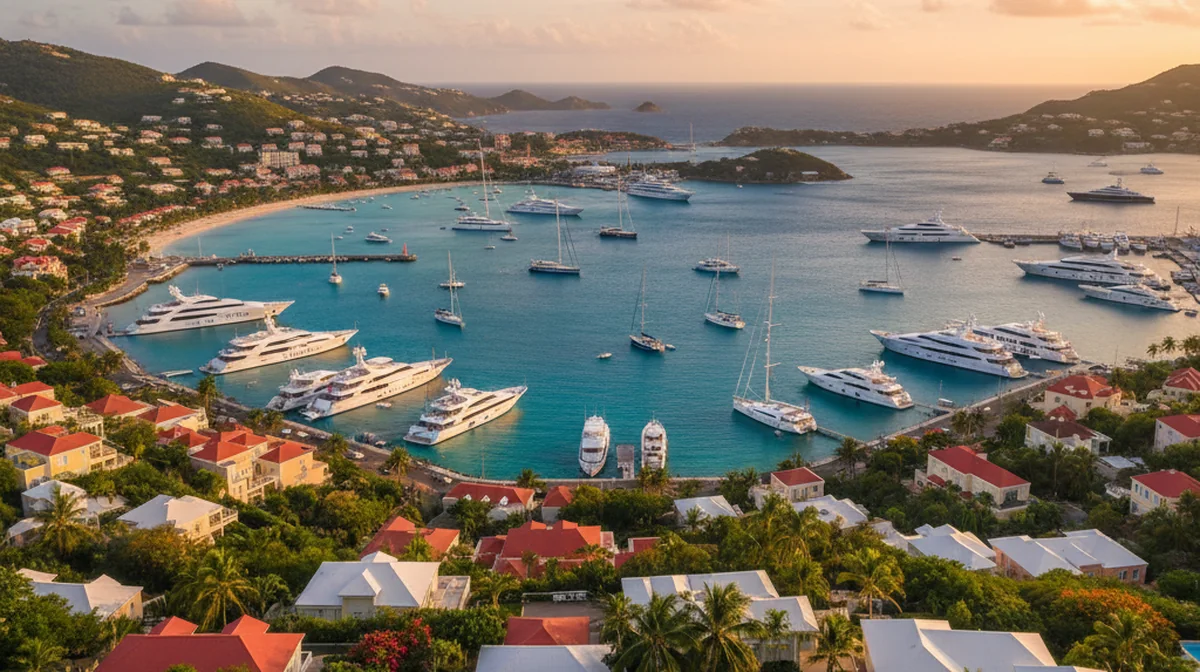
Cavmir's ultra-luxury positioning, Virtuoso travel-agent channel, and Airbnb Luxe placements put St. Barts villas in front of the traveler who is already planning Christmas in Gustavia and New Year's in the Alps. Our cinematic photography captures the quality of light that makes this island different from every other in the Caribbean — and our influencer network reaches the fashion, finance, and design communities that define the guest profile.
Saint-Barthelemy — 9.7 square miles of volcanic rock in the Leeward Islands — was claimed by Columbus in 1493, settled by French buccaneers in the 1600s, and famously traded to Sweden by Louis XVI in 1784 in exchange for warehouse rights in Gothenburg. The capital's name, Gustavia, is a Swedish legacy. France bought the island back in 1878 after a referendum. Unlike most Caribbean islands, St. Barts never developed a sugar-plantation economy — the terrain was too arid and rocky — so the island skipped the large enslaved-labor demographics that shaped neighboring economies. It remained a quiet fishing and salt-harvesting outpost into the mid-20th century.
David Rockefeller's 1957 purchase of a Colombier estate, followed by the Rothschilds at Pointe Milou, seeded the discreet-wealth positioning that still defines the island. The Eden Rock hotel opened in 1953, Hotel Le Toiny in 1992, and Cheval Blanc (LVMH) took over the old Isle de France in 2013. In 2007 St. Barts formally separated from Guadeloupe and became its own French Collectivite d'Outre-Mer — fiscal autonomy that let the island set its own tax and customs rules. STR inventory is almost entirely villa-based: roughly 450 rentable villas across the island, with no mass-market hotel supply.
Pointe Milou, Gouverneur, Colombier, and Lurin anchor the luxury tier — hilltop villas with infinity pools and sunset exposure clear USD $3,000–$15,000/night peak. Gustavia harbor-view and Shell Beach properties command a walk-to-town premium. St. Jean and Lorient are mid-tier, beach-adjacent, $1,200–$3,500/night. Flamands holds its own super-peak tier on proximity to Cheval Blanc. Christmas/New Year is the defining week — single-week revenue can match a full shoulder quarter — followed by February and Easter school breaks.
High seasonality. Peak: December 20–April 15. Super-peak: Christmas/New Year (7–14 night minimums standard). Shoulder: late April, May, November. Low: September–October (many villas and restaurants close entirely). Missed revenue: early-to-mid December, where weather is peak and the European early-season demand is live but many owners haven't opened calendars.
St. Barts is a French Collectivite, which means French civil law applies but fiscal and customs rules are locally set. Short-term rentals generally require a declaration en mairie (declaration at the town hall in Gustavia) and registration for the Contribution sur les Meubles de Tourisme (CTM), the local tourism tax currently 5% of nightly rate, guest-collected and remitted quarterly. Unlike metropolitan France, St. Barts sits outside the EU VAT zone — no TVA on rental income. Foreign ownership is unrestricted; most luxury villas are held through SCI (French civil real-estate companies) for succession planning.
The Collectivite has generally tightened enforcement since 2022 around unregistered rentals and construction permitting on hillside parcels. Building permits (permis de construire) are slow and conservative — the island protects its low-density silhouette aggressively. Platform listings without a declaration number are increasingly flagged. There is no blanket rental cap as in Paris, but commune-level rules around pool noise, staff housing, and septic capacity apply. Verify the specific parcel's zoning before acquisition — the difference between a rentable villa and a permission-blocked one is meaningful.
The St. Barts strategic tip: build the villa around the concierge, not the other way around. Guests paying $8,000 a night are buying the ecosystem — Le Select reservation at 8pm, a Laurent Perrier delivery at noon, a yacht tender to Colombier, a Nikki Beach daybed — and the villa is the base camp. Properties with a named concierge relationship (not a faceless app) book at meaningful premium and generate repeat direct bookings that skip platform commission entirely.
Tactically: first, cultivate the French travel-advisor channel specifically — Ile de France and Geneva-based advisors drive non-US peak demand that US operators routinely miss. Second, budget for off-season maintenance aggressively — salt air degrades exterior finishes roughly twice as fast as inland Caribbean, and a villa that looks tired in January photos loses the week that pays for the year. Third, negotiate staff housing at acquisition if possible — on-island housing for housekeeping and gardening teams has tightened sharply since 2023 and properties without staff accommodation now pay a material wage premium. Fourth, list in EUR as well as USD — European guests convert meaningfully better on native-currency pricing, and the FX spread is a line-item cost worth controlling.
Hurricane exposure is real — Irma in 2017 caused catastrophic damage and reshaped insurance pricing permanently. Air access is limited: the St. Jean airstrip takes only small STOL aircraft (Winair, Tradewind from St. Maarten), so connectivity depends on the SXM hub. Operating costs are among the highest in the Caribbean — everything is imported and cleared through Gustavia port. Workforce housing scarcity compounds wage pressure every season.
Post-Irma insurance is specialty and expensive. Named-storm, wind, and flood coverage required; French market carriers (Generali, AXA Caribbean) and Lloyd's syndicates dominate. Budget EUR 12,000–40,000 annually for luxury villas with adequate limits (EUR 3–6 million building plus liability). Per-event hurricane deductibles commonly 2–5% of insured value — material exposure to plan around.
St. Barts applies the French tax regime with local modifications: no VAT on rentals, 5% CTM tourism tax guest-collected, and rental income taxed at French rates if the owner is French tax resident. Non-resident owners generally pay French withholding on net rental income plus CSG/CRDS social charges. Real-estate transfer duties roughly 5% at acquisition. US owners remain subject to US tax with foreign-tax-credit offsets.
Local financing through BNP Paribas St. Barth, Credit Agricole, and BFC Antilles. Non-resident LTVs generally 50–60%, French-resident buyers up to 70–80%. Rates tracking French base rates plus spread. Cash purchase dominates the luxury tier — most transactions above EUR 5 million close without local debt.
St. Barts through 2027 and beyond: the Collectivite's fiscal autonomy and low-density building posture are politically durable, which protects supply scarcity indefinitely. Villa inventory is effectively capped — no large new subdivisions can be permitted — and that scarcity continues to compound pricing power in peak weeks. Climate risk is the defining variable; insurance market stability matters more than platform policy. The private-jet inbound trend (SXM-to-SBH shuttle volume up sharply since 2022) keeps the ultra-high-net-worth feeder pipeline healthy. Expect incremental regulatory tightening around unregistered rentals, not restrictive caps. The market's discreet-wealth positioning is the durable moat.
St. Barts is the Caribbean's most self-aware luxury market, and that self-awareness is precisely what most listings refuse to acknowledge. The guest flying into Gustavia is not shopping for beach — they have beach at home, on the yacht, in Mustique. What they are buying is a specific social choreography: the morning at Shell Beach, the long lunch at Shellona, the nap, the dress change, the Nikki Beach versus Bonito decision, the after-dinner drink at Le Ti. Listings that merchandise the villa as a beach house miss the point entirely. The villa is a base for a social calendar, and the marketing has to understand the calendar before it can sell the villa.
What we love about marketing St. Barts is how unforgiving the market is to generic storytelling. The repeat guest knows the island better than most hosts, which means welcome-book knowledge has to be genuinely editorial — the correct table at L'Isola, the right morning for the Saline hike, the specific week Orega takes reservations for New Year. The properties that win are the ones that treat themselves as private clubs with a known point of view. Peak weeks between Christmas and Presidents' Day reward that editorial confidence at ADRs no other Caribbean market sustains, and the advisor network rewards hosts who speak the island's language fluently.
The picks Cavmir recommends for St. Barts welcome books — the details that make a stay feel like resident-knowledge rather than concierge-script.
Shell Beach for the walk-in morning swim before Gustavia wakes up; Jojo Burger in Lorient held in reserve as the informed lunch answer when guests tire of white-tablecloth.
Shellona for the see-and-be-seen golden hour; Gouverneur Beach for the guests who want the sunset without the soundtrack. A host who offers both reads the room correctly.
The walk from the Wall House around the quay past the yachts before dinner reservations begin. Specific, walkable, photographable — and a rhythm most first-time guests miss without prompting.
L'Isola for the truffle-pasta-and-candlelight dinner the Instagram audience expects; Orega for the quieter Japanese-Mediterranean answer once guests have done the obvious rounds.
The Jimmy Buffett bar in Gustavia, pre-dinner, plastic chairs, cold beer. The single most un-precious recommendation a luxury host can make, and the one repeat guests quote back.
Post-hurricane-peak, pre-holiday-lockup. The island is fully open, the restaurants have their staff back, and rates are a fraction of Christmas. The window serious travel advisors protect for their best clients.
The beach you can only reach by boat or by the hike from Flamands. Pack the lunch, charter the tender, swim the turtles. The full-day experience that justifies the villa rate.
The Moke is the photograph; the SUV is what you actually want for the Saline road in the rain. A host who pre-books both, and explains why, prevents the first-morning frustration every rookie guest has.
Representative Cavmir engagements in St. Barts. Property identifiers redacted; figures composited from internal analytics and market benchmarks.
Trophy villa with a Gustavia-harbour view dependent on a single European broker for distribution. Peak-week ADR flat for four consecutive seasons despite a rising market.
Rebuilt the villa as a named brand with an editorial site, cinematic film shot during Christmas week, and a direct advisor-partnership program targeting the Virtuoso and Serandipians networks. Welcome-book positioned the villa as a social base rather than a beach house.
Peak-week ADR up to $14,200 from a prior ceiling near $9,800. Advisor-channel share of annual revenue grew to 41%. Christmas and New Year weeks now book eleven months ahead to repeat families.
Beautifully renovated villa losing the price comparison to larger competitors on the big OTA listings, despite a superior view and finish level.
Repositioned around the specific Lurin advantage — walking distance to Gustavia dinner, elevated sunset orientation, quieter than the Flamands corridor. Architectural photography rebuilt with interior stylist. Separate honeymoon and small-family narratives for two distinct advisor audiences.
Shoulder-season occupancy climbed from 52% to 78%. Blended ADR up 31%. Two-thirds of summer weeks now book direct rather than through commission channels.
Remote ultra-luxury estate that the general rental market could not price correctly. Peer estates capturing corporate-retreat and family-office revenue the property was missing entirely.
Split the product into three narratives: multi-generational family holiday, family-office retreat, and private-event venue. Built a dedicated retreats tear sheet for a short list of family-office concierge firms. Production-location rental added as a quiet tertiary line.
Annual revenue up 58% year over year. A single ten-day family-office retreat cleared $210K. Leisure ADR lifted on the halo effect of the elevated brand.
Talk to Cavmir today. We'll show you exactly what your St. Barts property is leaving on the table — and how fast we can change that.
Book a Free Strategy Call