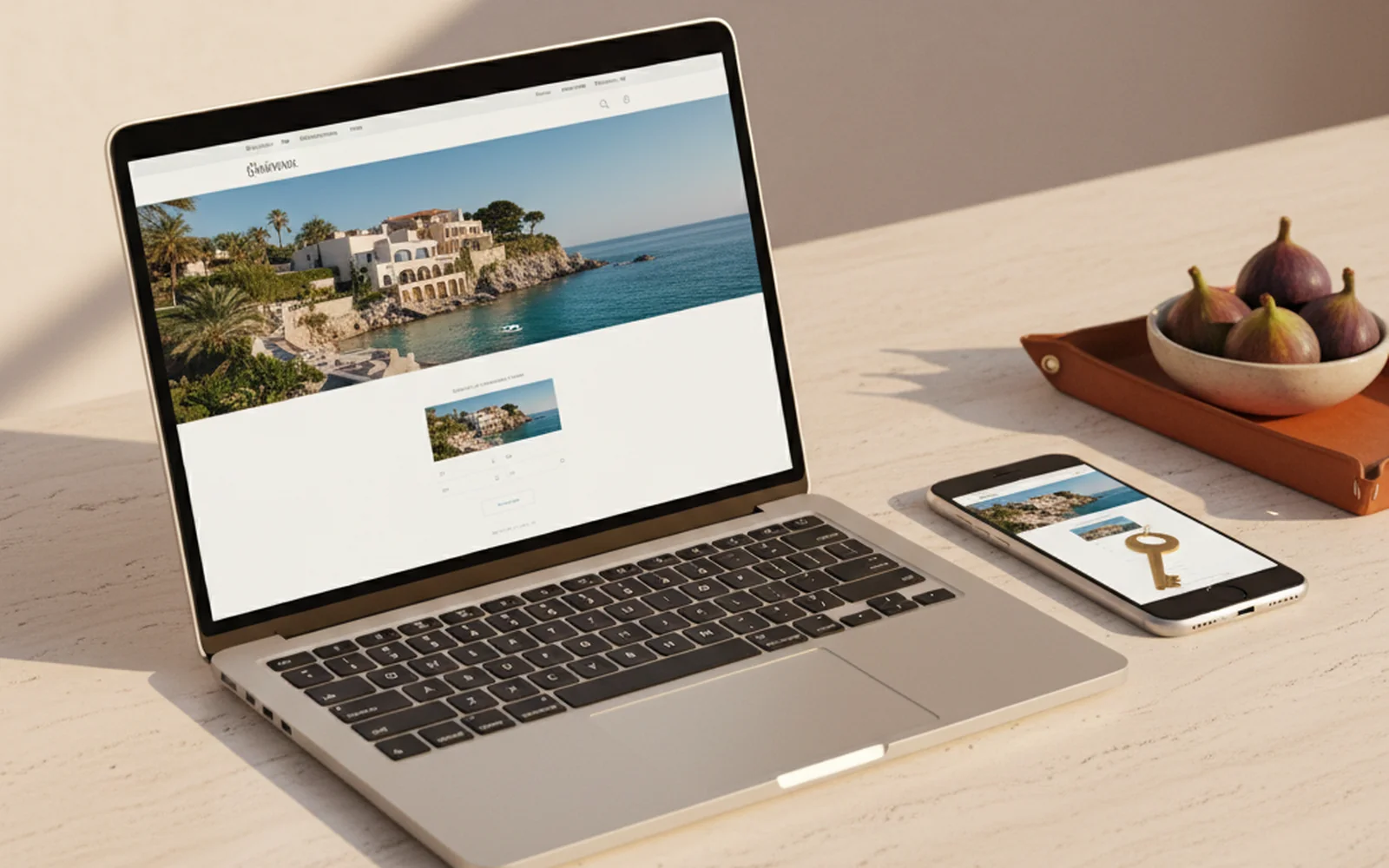
How Cavmir Approaches Direct Booking Website Design and Development
Cavmir builds direct booking websites that win bookings, not digital brochures. The distinction matters because most vacation rental websites on the market today are brochures — pretty enough, technically functional, but unable to convert a casual browser into a booked guest at the rates a premium property deserves. Our websites are engineered first for conversion, second for brand expression, and only third for aesthetic admiration. That ordering is uncommon in the industry, and the commercial results reflect it.
Every Cavmir direct booking website begins with a conversion strategy document that specifies the target traveler segment, the competitive set the site is positioning against, the primary and secondary conversion actions, the pricing signals, the social proof strategy, and the mobile-first architecture. This document is developed before any design work begins, because design decisions that precede conversion strategy are expensive and usually wrong. Once the strategy is locked, the visual design is developed against the property's brand system so the direct site sits in the same universe as the Airbnb listing, the Instagram feed, the paid ads, and the email flows. Every pixel is consistent with every other touchpoint the guest encounters.
The technical stack is chosen for speed, search performance and durability. Cavmir sites are static pages served from Cloudflare's network, built to load fast on phones, with schema markup so search engines and AI models can read the property correctly. On PMS-connected sites the booking box reads live availability and prices from Hostaway, Guesty or Hospitable and hands the guest to the PMS's own checkout; for other systems we connect the booking engine your PMS provides. Owners who inherit a site built on an old theme often find that every plugin update breaks something, and a static site has no plugins to break.
Search engine optimization is baked into the build, not added afterward. Every Cavmir site ships with a content architecture designed for high-intent travel search — destination guides, property feature pages, nearby experience pages, seasonal content, and AI-answer-optimized schema. The pages are structured so that when a traveler searches Google for "luxury villa Tulum" or "ski-in chalet Park City" or "private island rental Caribbean," our client's site has a credible chance of surfacing either organically or inside AI-generated travel answers. Competing sites that treat SEO as an afterthought never get this visibility, which is why they remain dependent on platforms for traffic.
Finally, every Cavmir direct booking website launches with measurement in place: Google Analytics 4 and Google Search Console, with booking clicks and inquiries counted as key events and a monthly report in your Cavmir dashboard. Analytics loads only after a visitor accepts cookies. After launch, a daily check covers uptime, the security certificate, the contact form, the legal pages and, on PMS-connected sites, the booking sync, and anything that fails goes into a fix queue. Owners on a monthly plan also get new pages, SEO and AI-search work every month.
💵
Conversion Before Aesthetics
Every decision runs through a conversion-strategy filter before any visual design begins. Pretty is welcome; pretty is not the goal.
⚡
Fast on Phones
Static pages served from Cloudflare's network, with images sized for phones. Speed is the baseline conversion lever.
🔎
SEO and AI-Search Built In
Content architecture, schema, and citation-ready structure — so the site gets found organically and in AI travel answers.
🔁
Checked Every Day
After launch, every live site is checked daily: uptime, certificate, forms, legal pages and the booking sync.
What Sets Cavmir Apart From Other Vacation Rental Website Builders
The vacation rental website market is crowded with template shops, Squarespace freelancers, and SaaS platforms offering drag-and-drop site builders aimed at hosts. They are cheap, easy to launch, and almost always under-deliver on revenue. Cavmir operates at a fundamentally different tier, and the difference matters in four specific ways.
First, we build custom, not templated. Template sites force the property's unique architecture, location, and positioning into a generic container, which dilutes the premium signal and reduces conversion. A custom Cavmir site is designed around the property: the hero film that opens the homepage is made from the property's own photography, the destination content is written about its actual neighborhood, and the photo sequence follows the way the home unfolds. Travelers arriving on a custom site see one specific place, and that is what they book.
Second, we own the booking engine integration end to end. Template sites either put the owner on a pre-integrated booking platform that takes a cut or leave the integration to the owner. Cavmir matches the booking engine to the property (one listing, several, a multi-property portfolio or hotel-style inventory) and builds the booking flow so it carries your brand from the first click to the checkout, with the full price shown before the guest pays. A clumsy last step loses guests at the moment they were ready to book, so we test the flow end to end before launch.
Third, every Cavmir site is part of a coordinated marketing ecosystem. The content on the site feeds the SEO strategy, the photography library feeds the Instagram feed, the email capture feeds the CRM, the blog feeds the paid ads, and the destination guides feed Google's algorithm. Most freelance-built websites exist in isolation — launched, then orphaned. A Cavmir site connects to every other channel the property operates, and the compounding effect is measurable in repeat bookings and direct-channel ADR.
Fourth, our sites are built for AI search as well as traditional SEO. Travelers now ask ChatGPT, Gemini and Google's AI Overviews where to stay, and those answers quote pages that state clear facts: entity-level schema, consistent name and address details, and plain sentences about the property. In Cavmir's July 2026 study of 550 Google AI answers across 15 U.S. markets, independent and regional operators took 82% of the citations and Airbnb or Vrbo appeared in 17% of answers, so a rental's own site can be the page an answer quotes. Cavmir sites launch with an llms.txt file and an /ai/ summary page that AI assistants can read.
🎨
Custom Architecture, Not Templates
Every Cavmir site is engineered to the specific property. Template sites dilute premium signal and reduce conversion.
🔌
Booking Engine Done Right
We audit, select and integrate the booking engine end to end, and test the booking flow before launch.
🌐
Connected to Every Channel
Site content feeds SEO, photography feeds social, email feeds CRM, blog feeds paid. The site never operates in isolation.
🤖
Engineered for AI Search
Schema, entity markup and plain statements of fact that AI answers can quote, plus an llms.txt file and an /ai/ page.
What to Consider Before Commissioning a Direct Booking Website
A direct booking website is the most expensive piece of marketing infrastructure most vacation rental owners will commission. It is also the one with the longest-running impact on the property's economics. Here is what we would ask a web developer or agency before signing any contract.
Start with the conversion strategy question. Ask the agency to explain, in specific numerical terms, what conversion rate their average client site produces, what ADR lift direct bookings deliver over platform bookings, and what direct-booking share their clients typically achieve at twelve months post-launch. If the agency cannot answer these questions with real numbers, they do not have visibility into whether their sites produce revenue — which means you will not have that visibility either.
Ask specifically about the booking engine. Which engines has the agency integrated, what were the trade-offs, and which engine do they recommend for your specific property profile and why. The booking engine choice has significant downstream consequences for payment processing fees, guest experience friction, refund policies, and channel-manager compatibility. A developer who defaults to a single booking engine for every client is likely optimizing for their own workflow, not your property's fit.
Clarify the technical stack. Modern vacation rental sites should be built on static or hybrid architectures with edge delivery, sub-two-second load times, and proper schema markup. Older WordPress-plus-plugins sites are a maintenance liability, frequently slow, and vulnerable to compatibility breaks when any of the dozens of plugins updates. You are signing up for years of operation; the technical choices on launch day govern how much pain you inherit for those years.
Demand an SEO and content plan, not just a launch. A beautiful site with no content strategy is a beautiful tombstone. Vacation rental direct sites compound bookings when they publish destination content, seasonal guides, local experience pages, and property features that attract high-intent search traffic. Ask the agency whether they produce this content, whether they have an ongoing content retainer option, and whether the site structure is built to accommodate editorial expansion without rebuild.
Clarify post-launch support. Vacation rental websites require ongoing maintenance — security patches, platform updates, booking engine changes, seasonal content refreshes, and performance tuning. Agencies that ship a site and disappear leave the owner holding technical debt that compounds quickly. Insist on either a retainer relationship with clear deliverables or a documented hand-off to a technical team the owner can engage directly. The site that nobody owns operationally is the site that quietly breaks during peak season.
Finally, budget for scope. Cavmir's website packages are priced by page count and booking setup: Starter (40 pages), Mid Tier (75 pages) and Full with Direct Booking (125 pages, with booking synced to your PMS), with current prices on the pricing page and a written proposal within 48 hours of a call. Larger portfolios and hotels are quoted to the inventory. Whatever you compare, line up what each quote includes: pages written, booking integration, photography, SEO and who looks after the site after launch. Our direct booking website cost guide walks through the line items.
🔢
Ask for Conversion Data
Real numbers on client conversion rates, ADR lift, and direct-share growth. No data = no visibility = no confidence.
🔗
Interrogate the Booking Engine Choice
Which engine, what trade-offs, why for your specific property. Default-engine-for-every-client is a workflow tell.
⚙️
Require a Modern Stack
Static or hybrid, edge-delivered, sub-two-second loads, schema-rich. Old WordPress stacks are long-term liabilities.
🛠️
Define Post-Launch Ownership
Site security, updates, content, and tuning need an owner. Unowned sites break silently during peak season.
What a Vacation Rental Website Costs
Website pricing in this industry runs from a few hundred dollars for a template hosted by a booking platform to well into five figures for a custom build with full content architecture. The spread is that wide because the word "website" covers two different products. At the low end you get a skin: a themed page attached to someone else's system, with your photos dropped into their layout and your brand reduced to a logo in the corner. At the high end you get infrastructure: a site you own outright, designed around your specific property and guest, engineered to rank in search and convert visitors into booked nights. The first is an expense. The second can earn its cost back in platform fees you stop paying on direct bookings; the direct booking calculator shows how many direct nights that takes at your rates. Current build pricing for Cavmir sites is published on the pricing page.
What drives the cost of a serious build is scope, not decoration. A single property with strong existing photography needs fewer pages than a twelve-property portfolio that needs a search interface, per-property pages, and a destination content library. A site that plugs into an existing channel manager costs less to integrate than one that needs a booking stack chosen and configured from scratch. Multilingual markets add translated page sets. Before comparing quotes from different builders, compare what each quote includes: page count, booking integration, content writing, SEO architecture, photography direction, and post-launch support. Two quotes that differ by thousands of dollars often describe entirely different amounts of work. Run your own numbers with the direct booking calculator to see what the platform fees you currently pay would cover.
Custom Design Compared With Templates and PMS-Hosted Sites
Most vacation rental owners start with the website their property management software generates. Hostaway, Guesty, Hospitable, Lodgify, Hostfully and OwnerRez all offer one, and for a new listing it's a reasonable first step: the calendar syncs and the booking flow works on day one. The limits show when you want to grow search traffic. A hosted site is built from the vendor's shared templates, so you have less control over page structure, metadata and how much you can publish, and those are what search rankings are won with.
A custom site keeps the PMS doing what it does well — calendar, payments, guest messaging — while the website itself becomes yours: your domain, your design, your page architecture, your content. The booking engine embeds into the custom site, so availability and pricing stay perfectly synced while everything a guest sees carries your brand. This split is how boutique hotels have operated for years, and it is why their direct-booking share is so much higher than the typical Airbnb host's. Owners who compare a custom build against a Wix or Squarespace do-it-yourself project should weigh the same factors: those tools produce presentable pages, but travel-specific conversion patterns, booking integration, and search architecture are exactly the parts they leave out.
The Design Details That Decide Whether a Visitor Books
Booking decisions are made in the first few seconds and confirmed over the following minutes, and the design details that govern those moments are specific. The opening frame has to establish place and quality instantly, which is why Cavmir sites lead with full-screen photography or film rather than a headline over a stock image. Photo sequencing matters as much as photo quality: the order a guest encounters spaces should mirror the way the property unfolds, from arrival to the view that sells the booking. Rates and availability need to be reachable within one interaction from any page, because a guest who has to hunt for the price assumes it is hiding for a reason.
On mobile, where most first visits happen, the layout has to keep a persistent path to the booking flow without burying the photography that does the persuading. Load speed is a design decision too: slow pages lose guests on phones, so images ship in modern formats at the right sizes and pages are built to render fast on a phone connection. Trust signals — verified guest reviews, clear cancellation terms, secure payment marks, a real address and phone number — sit near the booking action, where guests hesitate. None of these details is glamorous, and together they are the difference between a site that gets complimented and a site that gets booked.
How a Website Build Runs, Week by Week
A Cavmir build opens with a plan: the guests you want, the properties you compete with, the page list, the booking setup and the content plan. Design follows your brand system — if the property has no brand identity yet, that work comes first, because a website designed without one has nothing to express. Then the pages, the writing, the photography and the booking integration are built side by side on a preview link you can watch and mark up.
Before launch, the booking flow is tested end to end, every page is checked on phones and desktops, search metadata and schema are verified, old URLs are redirected if a site already exists, and analytics is in place for the first visitor. Starter sites take two to three weeks, Mid Tier four to five, and Full with Direct Booking six to eight depending on the PMS connection; the delivery date is agreed in writing before kickoff. You approve three times: the plan, the design and the finished site before it goes live. After launch, the daily site check takes over.
Rental Websites Cavmir Has Built
The quickest way to judge a web designer is to open sites they've built and try to book a stay. These are live on their owners' own domains, and each case study sets out what the build included.
SP Vacations, St. Croix. More than a dozen villas and condos under one new brand. Each villa page reads its calendar and rates live from the owner's booking system and shows the whole stay before checkout: nightly rate, cleaning, card fee, hotel tax, the total and what's due today. Around the homes sit 150 St. Croix guides and "fly from" pages for 15 departure cities. Read the SP Vacations case study.
Art de Vivre, Rio de Janeiro. A licensed brokerage's sales listings, long leases and short stays on one 200-page site in English, French, Portuguese and Spanish, with every price switching live between reais, dollars and euros and the rentals connected to Guesty. See how the Art de Vivre site was built.
The Cerulean, St. Croix. A five-bedroom oceanfront villa on its own domain, inside a library of 44 St. Croix guides and "fly from your city" pages that follow the real nonstop routes to the island. The Cerulean case study.
OASENA, Singer Island, Florida. A twelfth-floor residence that came to Cavmir as an Airbnb listing. It now has a name, its own domain, a hero film, an interactive island map and 35 Singer Island guides. Read about OASENA.
Maui Beachside Bungalows, Kihei. Four bungalows hosted since 2012, given a ninety-page site that works as a Maui travel guide: beaches, restaurants, trails and day-by-day itineraries, each leading to the booking button. The Maui case study.
Lux Vidigal, Rio de Janeiro. One hillside apartment with its own website and neighborhood guides in seven languages, answering the questions travelers ask before they book Vidigal. The Lux Vidigal case study.
Most of each of these sites is writing about the place, because the searches guests make before they choose a home are where bookings start.
What Each Website Package Includes
Cavmir sells three ready-made website packages, quoted to your portfolio, with current prices on the pricing page. They differ in page count, booking setup and the brand work around the site.
Starter Website. 40 pages for up to two properties, two market-targeted blog posts, basic SEO, and your custom domain for 12 months. Built in two to three weeks.
Mid Tier. 75 pages for up to three properties, a direct-booking option, a 15-second hero video loop, a branding audit with guidelines, image editing for up to five photos, 10 blog posts and the SEO Hero package. Four to five weeks.
Full with Direct Booking. 125 pages for up to five properties, booking synced with your PMS, a 30-second hero video loop, an advanced branding audit with guidelines, image editing for up to 20 photos, 20 blog posts, the SEO Hero package and a custom email address for 12 months. Six to eight weeks, depending on the PMS connection.
Every package is billed half at the start and half at launch, and the domain, code, content and photos are yours at launch. Larger portfolios and hotels are quoted to the inventory.
What every Cavmir site gets. Pages written for the searches your guests make; the TrollBuster™ compliance scan before launch (photo licences and credits, an automated WCAG 2.1 AA accessibility scan, the privacy policy and cookie consent); Google Analytics 4 and Search Console with a monthly report in your Cavmir dashboard; an llms.txt file and /ai/ page for AI assistants; hosting on Cloudflare's network; and the daily check after launch.
How the Site Connects to Your PMS
If your homes run on a property management system, the PMS stays the one place you edit. On Cavmir's PMS-connected sites the homes, photos, descriptions, amenities, reviews, availability, prices, fees and taxes are read from the PMS, and a change you make there shows on the site within about ten minutes. You never update two systems.
The booking box on each home quotes the exact dates and party size live, then hands the guest to the PMS's own checkout with everything filled in, so the payment, the guest record and the confirmation stay in the system you already use. Live client sites read from Hostaway, Guesty and Hospitable today; SP Vacations, on Hostaway, is the one to try. For Lodgify, Hostfully, OwnerRez and other systems, we connect the booking engine your PMS provides, and the quote states how your site will book.
One fee detail matters here. Airbnb puts hosts who connect property management software on its host-only fee, 15.5% for most of them, and that is the fee a booking on your own site avoids. If you don't use a PMS yet, a site can take inquiries or send guests to your Airbnb or Vrbo listing to book until direct demand justifies a booking engine.
Rules a U.S. Rental Website Has to Follow
A rental website is an advertisement, a shop and a data collector at once, and in the U.S. each of those has rules. These are the ones every Cavmir site is built to meet. Laws differ by state and city, so confirm your own obligations with a local attorney.
The total price, up front. Since May 12, 2025, the FTC's Rule on Unfair or Deceptive Fees has required any business advertising short-term lodging, vacation rentals included, to show the total price with mandatory fees such as a cleaning fee built in. Government taxes may be shown separately, as long as they appear before the guest is asked to pay. A nightly rate that grows a cleaning fee at checkout is the pattern the rule targets.
Accessibility. Seyfarth Shaw counted 3,117 website accessibility lawsuits in U.S. federal courts in 2025, up 27% from 2024 and 36% of all ADA Title III filings. Cavmir runs an automated WCAG 2.1 AA scan on every page before launch (contrast, image descriptions, form labels and page structure) and again after launch. Our guide to vacation rental website accessibility covers what to check.
Licence and tax numbers in your adverts. Many places require a rental's registration or tax number on every advert, and a website counts as one. Hawaii is the strict example: the state Department of Taxation publishes warning notices to hosts whose online listings lack their Transient Accommodations Tax ID, gives them 15 days to add it, and warns of fines of no less than $500 a day. Your website should carry the same numbers your listings must show, and we add them to every home's page.
Privacy and cookie consent. California's privacy law and a growing list of state laws govern what a site collects about its visitors. On a Cavmir site, analytics and advertising pixels load only after a visitor accepts cookies, and the privacy policy names what is collected and why.
Photos you have the right to use. Image-rights agencies send demand letters for photos used without a licence, and a Creative Commons photo still needs its credit shown on the page. Cavmir uses your own photos or licensed ones, keeps a record of each licence, and shows every credit a licence requires.
Lodging tax on direct bookings. Airbnb and Vrbo collect and pay lodging taxes in many places for the bookings they take. A booking on your own site is yours to tax: you register with the state and local tax offices and collect and file on those nights. Your accountant or the state revenue department will confirm which taxes apply.
These checks run together as the TrollBuster™ compliance scan before every Cavmir site goes live, and the legal pages stay in the daily check afterwards.
Rental Website Guides by Market
Outside the U.S., the rules, languages and currencies change from market to market. Each of these market pages has a section on designing a direct-booking website there: which languages and currencies to publish, what local law makes a rental's website show, and the pages that sell that market.