


Morning
Marbella Old Town Plaza de los Naranjos at 8 a.m.
The cobbled orange-tree square before the town wakes up. Coffee at Casa de los Naranjos, the 15th-century buildings as backdrop. The Marbella that predates the resort era.

Expert short-term rental marketing to grow your bookings and nightly rate in Marbella, Costa del Sol, Spain, Europe.
Sixteen services, one team. Everything below is built in-house and scoped to your property and market. Most owners start with the 12-Step System.
Every engagement is quoted to your portfolio. These are the ready-made scopes owners pick most — our Fall Special (55% off list or more) is already applied to the website, King Broker, Hotels and à la carte scopes. A clear proposal within 48 hours.
The work is public. Selected engagements and what changed — and reviews from the owners and managers behind them.
* Market averages from AirDNA and STR market reports. A single home's numbers depend on its size, its location and how it is marketed.
Cavmir is an Airbnb marketing agency. We build the brand, the direct-booking website and the marketing for short-term rentals in Marbella.
Marbella is the Costa del Sol's definitive luxury market — a 26-kilometre coastal strip where the Golden Mile connects Marbella Old Town to Puerto Banús's marina, Sierra Blanca rises behind the Golden Mile as the hillside villa corridor, La Zagaleta sits as Europe's most exclusive gated community above Benahavís, and Nueva Andalucía's golf valley anchors a ring of fairway-adjacent residential luxury. Marbella Club and Puente Romano on the Golden Mile, Villa Padierna Palace inland, and Finca Cortesín to the west define the hotel benchmark; the villa rental market spans from Puerto Banús penthouses to La Zagaleta estates that clear €20,000 per night.
Marbella's STR market is less supply-constrained than Mallorca or Barcelona — Andalusia's regional framework is medium-touch, the VUT registration system is navigable, and new licenses remain broadly obtainable. The season is longer than northern-European coastal markets (effectively March through November with a warm-winter secondary market from UK and Scandinavian travelers escaping winter). Luxury villa rates at Sierra Blanca, La Zagaleta, and the Golden Mile routinely clear €1,200–€8,000 per night; event weeks (Marbella Cup, Starlite Festival, Mallya Polo) drive sharp pulses.
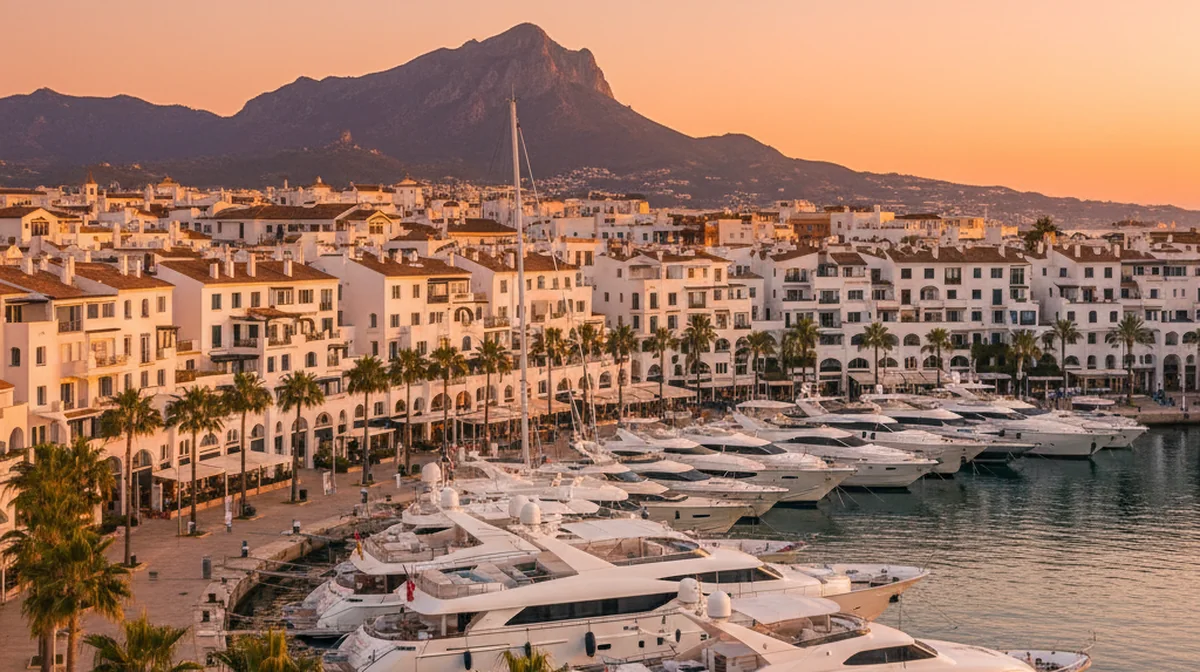
Cavmir markets Marbella around the year-round climate and corridor-specific product, not the generic Costa del Sol frame. We position La Zagaleta estates for the family-office segment, Golden Mile apartments for the European couple, and Nueva Andalucía villas for the golf-and-multi-gen market — each with its own photography library, distribution channel mix, and direct-booking architecture.
Marbella is an Andalusian coastal town founded in Phoenician times and fortified successively by Romans, Moors, and the Catholic Monarchs after the 1485 reconquest. For centuries it lived on fishing, iron smelting, and sugar-cane; the Old Town's whitewashed alleys, the Plaza de los Naranjos, and the 10th-century Moorish castle walls date from that long era. The modern luxury economy was effectively invented in 1954 when Prince Alfonso von Hohenlohe-Langenburg opened the Marbella Club Hotel on a stretch of coast that had been, until that moment, a fishing-village backwater.
Marbella Club's early guests — Audrey Hepburn, Cary Grant, the Rothschilds, the Rainiers from Monaco — established the Golden Mile as Europe's most exclusive coastal corridor. José Banús's construction of Puerto Banús in 1970 layered a yachting-and-nightlife destination on top of the hotel foundation. In the 1990s and 2000s, La Zagaleta's development above Benahavís turned Marbella into the sanctuary Europe's ultra-high-net-worth community uses most consistently — a private golf-and-equestrian estate community that Forbes has repeatedly ranked as the most exclusive gated community in Europe. The rentable villa pool across Marbella, Benahavís, and Estepona totals roughly 4,000–6,000 properties of material scale.
La Zagaleta, Sierra Blanca, and the Golden Mile frontline villas anchor the ultra-luxury tier at €1,200–€8,000 per night — with La Zagaleta estates above that for the full-service-staff tier. Puerto Banús penthouses, Nueva Andalucía golf-valley villas, and Los Monteros coastal properties run €800–€3,000 per night. Old Town apartments and inland hillside villas run €300–€900 per night. Summer peak and Starlite Festival weeks (July–August) drive pricing, but Marbella's longer shoulder supports premium rates through most of the year.
Medium seasonality; one of the longer Mediterranean seasons thanks to Marbella's microclimate. Peak: June through September. Super-peak: August bank holiday. Shoulder: April–May, October–November. Low: December–March (warm-winter market from UK, Scandinavian, and Northern European travelers softens the dip materially). Missed revenue: April and October where weather is excellent and corporate-event demand outruns marketing.
Andalusia's VUT (Vivienda de Uso Turístico) registration framework is medium-touch relative to Balearic or Catalan regimes. Operators require a VUT number displayed on every listing; the Junta de Andalucía administers registration and enforces compliance through platform data-sharing. Rental income taxed at Spanish IRNR rates (19% EU-resident, 24% non-EU) or resident progressive rates. Municipal tourist tax is not currently applied in Marbella (unlike Catalonia or the Balearics), which is a competitive advantage. La Zagaleta, Sierra Blanca, and other gated communities impose their own rental-operation rules layered on top of national framework — verify community bylaws before acquisition. New VUT registrations remain obtainable, unlike Mallorca's cap regime.
The Marbella strategic tip: segment the inventory by corridor, not by general 'Marbella' framing. La Zagaleta estates serve the family-office and UHNW-seclusion segment; Golden Mile apartments serve the European couple and repeat-summer family; Nueva Andalucía golf villas serve the fairway-adjacent multi-gen; Puerto Banús penthouses serve the nightlife-and-yachting crowd. Each segment has its own photography library, language mix, distribution channel, and pricing curve. Operators who market all of them under one generic 'luxury Marbella' header routinely underprice against peer inventory that segments properly.
Tactically: first, price the year-round climate advantage aggressively — the November-through-March warm-winter market from UK, Scandinavian, German, and Scottish travelers is under-served by operators who close for winter. Second, build the corporate-event infrastructure (corporate invoicing, event-capacity photography, private-chef relationships) — La Zagaleta and the Villa Padierna corridor serve the corporate-retreat segment that premium mainland European markets routinely lose to the Alps. Third, cultivate the Russian-successor GCC, Scandinavian, and US-buyer advisor channels explicitly. Fourth, invest in direct-booking infrastructure — the VUT regime is obtainable but enforcement is tightening, and direct relationships protect repeat business.
Marbella challenges: the 'Costa del Sol' brand still carries downmarket associations that luxury operators must actively counter-market. Peak-season traffic on the A-7 and the Nueva-Andalucía-to-Banús corridor is significant. Local political cycles have produced period ordinance churn on short-term letting, though Andalusia's VUT framework has been relatively stable. Building-permit complexity in La Zagaleta and Sierra Blanca slows investment. The Málaga airport (AGP) is world-class but peak-summer traffic to and from Marbella adds real arrival friction.
Spanish villa insurance domestic-market with Lloyd's capacity for estates above €5 million. Fire (particularly Andalusian summer wildfire exposure), liability, and storm coverage standard. Budget €3,500–€18,000 annually for luxury villas with adequate limits (€2–6 million building plus liability). Pool-liability and staff-workers'-comp riders standard.
Non-resident rental income taxed at Spanish IRNR: 19% for EU-residents (with expense deduction), 24% for non-EU (gross). Annual IBI property tax varies by municipality; Marbella has historically been mid-range. Andalusian Wealth Tax applied until 2022 but has been functionally eliminated by the region (100% bonificación), creating a meaningful tax advantage over Balearics and Catalonia. Acquisition ITP 7% (a cut to 6.75% is announced for 2027, not yet law). Spain's Golden Visa property route terminated April 2025.
Spanish mortgages for foreign buyers through Santander, BBVA, CaixaBank, Banco Sabadell, and Bankinter at 60–70% LTVs for non-residents. Marbella private-banking relationships at Santander, UBS Spain, and Julius Baer extract the best terms on premium inventory. Non-EU buyers face tighter documentation but the market is transactionally mature. La Zagaleta purchases are frequently cash given the pace of the competitive corridor.
Three layers decide whether a Marbella home can take paying guests in 2026, and the first two have changed since 2024. The Junta de Andalucía issues the licence itself: an entry in the Andalusian tourism register, filed as a sworn declaration (declaración responsable) under Decreto 28/2016 as rewritten by Decreto 31/2024. Spain sets the building and tax rules, from who in your block gets a vote to how a non-resident is taxed. The town hall controls planning, and as of July 2026 Marbella still accepts new applications with no blanket cap, while Málaga city paused new registrations in August 2025 in 43 neighbourhoods where tourist homes passed 8% of the housing. A study for the town hall by the University of Málaga, reported in February 2025, found only 32% of the homes registered as tourist lets in Marbella are marketed, so a registration number alone tells you little about a home's track record. Use what follows as the map, and confirm each point with the Junta, the Ayuntamiento de Marbella and a local lawyer before you sign.
Decreto 31/2024, in force since 22 February 2024, tightened the physical rules. A whole home can be licensed for no more than 15 guests, a home let by the room for no more than 6, and no bedroom may sleep more than 4. Space caps headcount as well: the decree asks for 14 square metres of built surface per guest with a floor of 25, so a full 15-guest licence needs about 210 square metres built. Bathrooms scale with guests, two once you pass 5 and three once you pass 8, so count them against the number you plan to advertise. If you let between May and August, the bedrooms and living room need cooling; between December and March, heating, and heaters that burn liquid or gas aren't allowed. Your registration code goes on every payment receipt. The declaration also states that the home complies with town planning, and the Junta can cancel a registration when a required licence is missing, so have your lawyer confirm the planning status before you rely on a licence. Homes registered before the decree had a year to meet several of the new requirements, and that grace period has run out.
Real Decreto 1312/2024 created a national registration number, the NRA, and made it a condition of advertising on platforms. On 19 May 2026 the Supreme Court, in ruling 620/2026 on an appeal by the Valencian regional government, annulled that registration procedure, and the decision became public on 21 May. What survives is the national digital window for rental data, the platforms' duty to pass data to the authorities and statistical transfers to the INE and Eurostat. For a Marbella owner the number that counts is the Andalusian one, and platforms still police it: EU Regulation 2024/1028 makes them ensure a registration number is shown on each listing, spot-check numbers and send activity data monthly, with national penalties due by 20 May 2026. Spain's consumer ministry has already fined Airbnb more than €64 million over 65,122 listings with missing or mismatched licence numbers. The building is the other national layer. Since 3 April 2025, under Ley Orgánica 1/2025, an owner in a community of owners needs the community's express approval before starting a tourist rental, and three-fifths of the owners, holding three-fifths of the shares, can approve, limit, condition or ban the activity, or raise a tourist flat's share of common costs by up to 20%. Those votes can't be applied backwards.
Andalusia still charges no tourist tax. In September 2026 Seville's mayor asked the regional tourism councillor for one and the councillor has spoken against a new tax, so there's nothing for Airbnb or Vrbo to collect on a Marbella stay and nothing for you to add to a direct booking. Income tax is where non-residents get caught. Spain taxes your rental income at 19% if you live in the EU, Iceland or Norway, and you can deduct costs tied directly to it; everyone else, which since Brexit includes UK owners, pays 24% on the gross with no deductions. You file on modelo 210, and Orden HAC/623/2026 moved the deadline: tax due on rentals is now paid in the first 20 days of April of the following year, for grouped annual returns from 2026 income and for separate returns from October 2026 income, while July to September 2026 income filed separately is due by 20 October 2026. Returns filed from 1 January 2027 carry a new annex itemising expenses. Add hotel-type services such as cleaning during the stay, laundry or meals and the tax agency treats the rental as a business with a permanent establishment, taxed at the 25% corporate rate. Treaties and personal situations vary, so have a local tax adviser set up your filings before the first booking.
Marbella's town-hall rules are the same from Guadalmina to Cabopino, so inside the municipality the address changes your guest and your building type, and the building type decides how exposed you are to a neighbours' vote. Apartments in large complexes carry the most risk and detached villas the least, though many gated estates run as owners' communities too. The other trap is the name itself. Sales listings often stretch Marbella to cover homes in Benahavís, Estepona or Mijas, each a separate town hall with its own planning rules, so check the municipality on the land-registry extract before you fall for the view. It's the read Cavmir starts from when we market a home here, because the area decides the story long before the photos do.
The Golden Mile runs west from the edge of town toward Puerto Banús, with beachfront apartment complexes, the big hotels and villas set back from the sea. It wins European couples and affluent families who rebook the same summer week, and it rewards a high-spec apartment in a well-run complex, provided the community hasn't voted against tourist lets, so ask for recent meeting minutes before you offer. Behind it, Sierra Blanca, Nagüeles and Cascada de Camoján are hillside villa areas, much of them behind gates, where families and groups pay for privacy, pools and the sea view. Here the decree does the limiting: a seven-bedroom villa still licenses at 15 guests at most, and only with the built area and bathrooms to match. The Old Town around the Plaza de los Naranjos is another product, townhouses and small flats for couples on short breaks and walk-to-dinner trips. Two cautions there. In February 2025 the town hall accepted, for future rollout, a proposal to stop ground-floor commercial premises being converted into tourist homes, so a cheap converted shop unit is a poor bet. And if an older house has no cooling in the bedrooms, you'll need to add it before a summer licence.
Puerto Banús sells the marina, the nightlife and the beach clubs to couples, friend groups and yacht-week visitors, mostly in frontline apartments and penthouses inside large complexes. That's the building type where a neighbours' vote is likeliest, and fast turnover makes the 24-hour police registration a daily task, so plan check-in staff or software from day one. Uphill, Nueva Andalucía's golf valley around Las Brisas, Los Naranjos and Aloha suits golf groups in spring and autumn and families in summer, in townhouses and villas where shared bedrooms run into the four-per-room limit; sell it by bedrooms and tee times. San Pedro de Alcántara, inside the Marbella municipality to the west, is the family town, with its pedestrian boulevard, Guadalmina's beaches and golf, Spanish families in August and long-stay northern Europeans in winter, at prices below the Golden Mile. Blocks with many year-round residents are where a no vote is most likely, so a villa or a townhouse with its own entrance is the safer licence.
East of town, Río Real, Los Monteros, Las Chapas and Elviria run out to the Artola dunes and the small port at Cabopino. It's beach-family country, with bigger plots and gardens, frontline complexes, quieter evenings and golf at Río Real, and it wins families on longer summer stays and couples who want the beach without the Banús crowd. Villas here often have the space for a full licence, while beachfront complexes need the same community check as anywhere else. Then mind the borders. Past Cabopino you're in Mijas, which has added its own conditions for tourist homes. La Zagaleta, El Madroñal and La Quinta sit in Benahavís, a separate town hall, so the estate's own rules and Benahavís planning apply. Further west, Manilva has paused new licences for three years. A listing that says Marbella doesn't tell you which rules you'll live under; when two homes look alike, the one inside the Marbella line, in a building whose owners are relaxed about tourist lets, is the easier licence.
Order matters, because the costly mistakes can't be fixed after completion: a building that has voted against tourist lets, a villa that fails the space rule, a tax return missed in your first season. Here's the sequence that keeps a foreign owner legal from the first booking, assuming your NIE and a Spanish bank account are already in place. It reflects the rules in force in October 2026, and four of them changed between 2024 and 2026, so recheck each step with your lawyer and tax adviser when you start.
Ask for the community statutes and recent minutes, and look for any three-fifths agreement on tourist lets or an extra charge of up to 20% on common costs. Read the land-registry extract and the cadastral record to confirm the municipality and the built area, and have your lawyer confirm the planning status, because the Junta can cancel a registration that rests on a missing licence. Do the decree's arithmetic: divide the built area by 14, cap the result at 15, then count bathrooms against it. Check for cooling in the bedrooms and living room if you'll let in summer, and heating for winter. Budget the purchase tax, too: Andalusia's transfer tax on a resale home is 7%, and the cut to 6.75% announced in September 2026 for the 2027 budget isn't law yet.
File the declaración responsable with the Junta to enter the Andalusian tourism register, then put the code on every listing, on your own website and on each guest receipt; regional rules require it in advertising, and the platforms check. Set up guest registration with the Interior Ministry before the first arrival: under Real Decreto 933/2021 you send each guest's details, including how they paid, within 24 hours, and keep the records for three years. If the home is in a community, keep the approval minutes on file before you list. Write house rules on noise, pool hours and parking, and share them with the community's administrator, because in a building that votes on tourist lets, goodwill is part of the licence. Shoot the photographs after any cooling or bathroom work, so the listing shows the home you declared.
Set the tax calendar with your adviser, filing modelo 210 for each rental period or grouped for the year. Either way, tax on income from October 2026 onward is paid in the first 20 days of April of the next year, and returns filed from 1 January 2027 itemise expenses in the new annex, so keep every invoice in your own name. If you live outside the EU, Iceland and Norway, remember the 24% falls on gross rent. Keep the service to accommodation, since hotel-type extras push you toward the 25% corporate rate. Then build direct demand. On bookings from your own website no platform is registering guests or checking numbers for you, so collect the police data at checkout and show the Andalusian code in the footer. A direct-booking site built that way is the kind of stack Cavmir builds, and it's what lets repeat Golden Mile families and winter long-stayers book you again without a platform fee.
Marbella through 2027 and beyond: the Andalusian tax regime (Wealth Tax 100% bonificación, moderate IBI, no tourist tax) is a durable competitive advantage over Balearics, Catalonia, and mainland France. The GCC buyer pipeline continues to compound. La Zagaleta's brand remains the European UHNW reference; expect continued extension (La Zagaleta Country Club, new phases). The 'Costa del Sol' brand is slowly rehabilitating toward luxury positioning; Starlite Festival and Marbella Luxury Weekend drive that visibility. Water scarcity in peak summer is a real risk. Pricing ceiling appears durable across all segments.
Marbella is the European luxury market with the clearest gap between brand perception and operating reality. The Costa del Sol still carries residual downmarket associations from the 1980s; the actual Marbella product today — Marbella Club, Puente Romano, Finca Cortesín, La Zagaleta, the Sierra Blanca corridor — is among the most uncompromisingly luxurious in Europe. That gap is the marketing opportunity. The villa operators who lead with the 2026 Marbella brand — not the 1985 version — unlock pricing power the generic 'Costa del Sol' category cannot reach.
What we love about marketing Marbella is how genuinely year-round the demand is. The microclimate (protected by the Sierra Blanca and the Sierra de las Nieves) supports 320 days of sun annually; the UK, Scandinavian, and Northern European warm-winter segment fills November–March at rates that would be inconceivable in Balearic winter. Hosts who build for the twelve-month calendar instead of the three-month summer see it in their occupancy curves. The market rewards patience and brand discipline.
The picks Cavmir recommends for Marbella welcome books — the details that separate resident-hosts from the generic Costa del Sol script.
The cobbled orange-tree square before the town wakes up. Coffee at Casa de los Naranjos, the 15th-century buildings as backdrop. The Marbella that predates the resort era.
The panoramic viewpoint above the Golden Mile. Mediterranean to the south, the mountain behind, the entire coast visible. The non-beach golden hour residents actually use.
The seven-kilometre promenade running the Golden Mile's entire length. The morning walk most visitors never take. Ends at Banús for coffee.
Three Michelin stars, tasting menu only. The Andalusian cuisine benchmark for the entire coast. A host who pre-books this owns the review.
The beach-chiringuito institution residents return to for weekends. Grilled fish, white wine, the Mediterranean an arm's-length away.
Sun, 20°C, empty beaches, golf at its best, rates at roughly half of summer. The quietest secret residents protect from the wider market.
The 90-minute drive up into the Serranía de Ronda to the cliff-top white village. Lunch at Pedro Romero, the Puente Nuevo bridge, wine from the nearby Bodegas. The day trip most Marbella visitors miss.
Guests with a booking inside La Zagaleta sometimes discover the gate doesn't admit uninvited arrivals. A host who pre-arranges community-gate registration in advance prevents the common first-hour arrival problem.
Guests who find a Marbella rental on Airbnb search its name afterwards, and the page they should land on is the owner’s own site. Cavmir builds vacation rental websites of 40 to 125 pages in the owner’s brand. For a home that only lists on Airbnb, that is a website for your Airbnb: your name and domain, your photos, your area guides and your reviews, with a button that sends guests to the listing. For homes on Hostaway, Guesty or Hospitable it is a direct booking website: live availability and prices from the PMS, the whole stay priced before checkout, and the booking completed in the PMS. Both start from the same vacation rental website design, run the TrollBuster™ compliance scan before launch, and are yours at launch: domain, code, content and photos.
The guide pages of a Marbella site can start with the picks on this page: Marbella Old Town Plaza de los Naranjos at 8 a.m., Mirador del Corzo in Sierra Blanca and Paseo Marítimo from Puente Romano to Puerto Banús. Each one is a search a guest makes before choosing a home, and each becomes a page that leads to the booking button.
Packages start at $1,475 for the Starter Website (40 pages, two to three weeks) and run to $3,732 for Full with Direct Booking (125 pages, booking synced with your PMS); the current prices are on the pricing page.
Representative Cavmir engagements in Marbella. Property identifiers redacted; figures composited from internal analytics and market benchmarks.
Architecturally strong hillside villa with Mediterranean view commoditized as 'Marbella luxury'; peak ADR capped at €3,800 despite a product meaningfully better than peer inventory.
Rebuilt the brand around the Sierra Blanca specificity — the Golden Mile proximity, the La Concha mountain backdrop, the private-villa-in-private-community positioning. Cinematic film across summer and winter seasons. Distribution through London, Stockholm, and Oslo advisor channels.
Peak-week ADR up to €5,900. Warm-winter long-stay revenue filled November–March at meaningful monthly rates. Total annual revenue up 41%.
Marina-facing penthouse competing against commodity Banús inventory on price. Flat summer demand, no winter strategy, no differentiation on the actual yacht-and-marina advantage.
Repositioned for the yachting-and-concert summer segment and the winter UK couple market. Photography emphasized the marina view and the sunset terrace. Welcome book with Starlite Festival schedule and named concierge.
Summer ADR up 34%. Winter occupancy climbed from 38% to 72%. The penthouse now commands premium against peer units with identical square footage.
Ultra-luxury La Zagaleta estate missing the family-office private-retreat and destination-wedding revenue streams peer corridor properties were capturing.
Three-product brand build. Wedding tear sheet distributed through Madrid, London, and Riyadh planners. Family-office private-retreat product. Editorial-location availability for automotive and watch-brand shoots.
Event and production bookings contribute a substantial share of annual revenue. A single six-night family-office retreat cleared €180,000. Leisure ADR climbed on the elevated brand.
Yes. Cavmir works with short-term rental owners and boutique hotels in Marbella and across Spain — property branding, listing optimization, photography direction, direct-booking websites, SEO, and paid campaigns. Properties near Puerto Banús Marina, Marbella Old Town and Golden Mile Promenade are exactly the kind of stays we market.
The market snapshot on this page shows average nightly rates around $315 with occupancy near 70% for Marbella. Treat those as directional market averages, not guarantees — the spread between a well-marketed property and a poorly marketed one in the same market is wide.
Marbella sees moderate seasonality — clear peaks, but respectable demand through the rest of the year. That shoulder-season demand is exactly where marketing earns its keep, because travelers have more choices and pick the property that looks the part.
Marbella sits in the middle of the regulatory spectrum — some registration or permit requirements typically apply. Rules change often in this industry, so confirm the current requirements with local authorities before you list. Cavmir handles the marketing side; we don't provide legal or permitting advice.
Give guests a way to book you without a platform in the middle: a fast direct-booking website, a complete Google Business Profile, and follow-up that brings past guests back. Cavmir builds that stack — see vacation rental SEO — so your repeat Marbella guests stop paying platform fees to find you.
It depends on scope. Current plans and one-time project pricing are on the pricing page — most owners start with a listing overhaul or the 12-step system. A conversation about your property costs nothing: contact Cavmir.
Send us the listing and we'll tell you what we'd change. Not a pitch deck — a straight read on your photos, your title, your rates against the Marbella comp set, and whether a direct-booking site would pay for itself.
You'll hear back from a person, usually inside one business day. If we don't think we can move your numbers, we'll say so. Cavmir is a short-term rental marketing agency — we position and market properties, we don't manage them.
Demand in Marbella peaks around June through August and runs quietest around January, February and November. Here is how the year actually books — and what to do about each stretch of the calendar.
Summer is the height on the Costa del Sol, with July and August running hard as families and the international set fill the coast, and the Starlite Festival stacking concert nights through the season. June is nearly as strong once the weather locks in. Set firm summer pricing with a weekly minimum on the best villas, and have the listing fully dialed by spring, because Marbella's summer fills early.
Spring and early autumn are gracious shoulders, and they are prime golf months, when the Costa del Sol's courses pull players who would rather skip the summer heat. May and September hold warm weather and lighter crowds, and June brings the Feria de San Bernabe. Market the golf angle and the calmer coast to couples and players, and these months stay busy without deep discounting.
November through February is the quiet stretch, mild by European standards but well off the summer pace. Snowbirds and long-stay visitors soften it, drawn by the winter sun and the golf that plays year-round here. Pitch longer stays, use the lull for maintenance and a fresh photo set of the pool and terrace, and price honestly for the season.
The best summer villas fill through the spring, with the peak weeks going first, while golf trips book a month or two ahead around course availability. Winter long-stays are often arranged well in advance by returning snowbirds. Set the summer weeks early, keep golf-season pricing competitive, and court the long-stay bookings before winter.
Summer runs on week-long villa and apartment stays, while the shoulder and winter mix golf trips, couples weekends and month-plus long stays. Marbella's year-round mild climate gives it a genuine off-season layer that most European beach markets lack, which rewards hosts who market to golfers and snowbirds as well as summer families.
The property that wins is a villa or apartment with a private pool and outdoor living, well-located for either the beach and marina or the golf courses depending on the guest. Pool and outdoor space are the first filters almost every guest applies. For the golf and winter markets, proximity to the courses and a comfortable interior for cooler evenings tips the decision.
Build the listing around the pool and the outdoor living, and position it clearly for either the beach-and-marina crowd or the golf market, with photography that sells the Costa del Sol lifestyle. Price the summer weeks and the Starlite season firmly, and market the golf shoulders hard, because Marbella's off-season is real and worth pursuing. Add a Google Business Profile for map searches and a direct-booking site for the returning summer families and snowbirds who come back every year. That is the marketing layer Cavmir builds for Marbella hosts, and this coast's year-round demand makes it pay off.
July and August are the clear height, with the Starlite Festival running all summer and June nearly as strong. Spring and autumn are busy golf shoulders on the Costa del Sol's courses, and November through February is the quiet, mild off-season softened by snowbirds.
The best summer villas fill through the spring, with the peak weeks going first, while golf trips book a month or two ahead around course availability. Winter long-stays are often arranged well in advance by returning snowbirds. Set the summer weeks early and keep the shoulder pricing competitive.
Most international guests fly into Malaga from the UK, Ireland and Northern Europe, led by London, Manchester, Dublin, Paris and Amsterdam, which is where paid marketing pays. The nearer Andalusian cities of Malaga, Gibraltar, Seville, Granada and Cadiz feed drive trips, worth naming in your listing and local SEO.
A private pool leads every list, followed by a proper terrace or outdoor living space and air conditioning for the summer heat. Proximity to golf or the beach depending on your guest, fast wifi and parking round out the essentials, and a barbecue suits the group and family stays.
Talk to Cavmir today. We'll show you exactly what your Marbella property is leaving on the table — and how fast we can change that.
Book a Free Strategy Call