


Morning
Praia do Amado surfcheck at 8 a.m.
The southwestern surf beach on the unprotected Atlantic coast. Consistent swell, uncrowded, coffee at the beach bar. The alternative morning to Vale do Lobo that most golf-visitors miss.

Expert short-term rental marketing to grow your bookings and nightly rate in Algarve, Portugal, Europe.
Sixteen services, one team. Everything below is built in-house and scoped to your property and market. Most owners start with the 12-Step System.
Every engagement is quoted to your portfolio. These are the ready-made scopes owners pick most — our Fall Special (55% off list or more) is already applied to the website, King Broker, Hotels and à la carte scopes. A clear proposal within 48 hours.
The work is public. Selected engagements and what changed — and reviews from the owners and managers behind them.
* Market averages from AirDNA and STR market reports. A single home's numbers depend on its size, its location and how it is marketed.
Cavmir is an Airbnb marketing agency. We build the brand, the direct-booking website and the marketing for short-term rentals in Algarve.
The Algarve is Portugal's golden corridor — a 100-mile southern coastline where Quinta do Lago and Vale do Lobo anchor the golf-villa luxury market, Vilamoura runs the marina-and-resort corridor, Lagos and the western coast hold the cliff-and-beach scenic inventory, and the eastern Ria Formosa delivers the wetland-and-island alternative. The Algarve's UK traveller base is structurally loyal and returns year after year; the newer North American, Scandinavian, and Brazilian markets are the growth edges, fed by Faro airport's expansion and the Golden Visa residence-investment pipeline that brought relocation demand with it.
The Algarve's STR regime runs through the AL (Alojamento Local) registration system administered by Turismo de Portugal, with municipal overlays tightening in some concelhos (municipalities). Quinta do Lago and Vale do Lobo sit inside private-estate frameworks with their own development covenants — rental operation is broadly permitted but estate-specific rules apply. Luxury villa rates at Quinta do Lago and Vale do Lobo routinely clear €1,500–€6,000 per night in peak summer; shoulder seasons strengthen materially with the golf and warm-winter-retreat segments.
Cavmir markets Algarve villas around the actual demand layers — the Quinta do Lago / Vale do Lobo golf family, the UK repeat traveler, the Scandinavian winter retreat, the Brazilian and North American Golden-Visa-adjacent long-stay — each with its own visual library, seasonality calendar, and distribution strategy. We pair that with direct-booking sites in English, Portuguese, German, and French that capture the repeat business the OTAs otherwise intermediate.
The Algarve — Portugal's southernmost province, stretching 100 miles from the Guadiana river on the Spanish border to Cabo de São Vicente — was settled by Phoenicians, Romans, and a 500-year Moorish presence that left deeper cultural traces here than anywhere else in Portugal. The province's name derives from the Arabic al-Gharb ('the West'). The 1755 Lisbon earthquake devastated the coast; the towns of Lagos, Faro, and Tavira were largely rebuilt after. Through the 19th and most of the 20th century the Algarve lived on fishing, cork harvesting, and an almond-and-fig agricultural economy that remained among the poorest regions of Western Europe.
Modern Algarve tourism began in the 1960s with Faro airport's opening and the construction of the first resort villages in Albufeira and Carvoeiro. The luxury corridor was effectively invented at Quinta do Lago (founded 1972) and Vale do Lobo (1962) — two adjacent private estate developments on the Ria Formosa coast that built the golf-and-villa real-estate template Portugal has since exported across the country. Vilamoura's marina (opened 1974) added the yachting-and-resort corridor. Today the Algarve rentable villa pool totals roughly 8,000–12,000 properties of material scale, with luxury inventory concentrated in Quinta do Lago, Vale do Lobo, Dunas Douradas, and the western cliff-villa corridor from Lagos to Sagres.
Quinta do Lago and Vale do Lobo frontline golf-and-beach villas anchor the ultra-luxury tier at €1,500–€6,000 per night in peak summer. Dunas Douradas, Albufeira's Pine Cliffs corridor, and the Lagos cliff-villa market run €700–€2,500 per night. Vilamoura marina apartments and Carvoeiro villas run €300–€900 per night. Winter long-stays compress pricing to €100–€400 per night but across 30–90 night bookings, which meaningfully smooths cash flow for owners.
Medium seasonality with genuinely long shoulders. Peak: July–August. Super-peak: August bank holiday. Shoulder: April–June, September–October. Warm-winter market: November–March (UK, Irish, Dutch, German, and Scandinavian long-stay travelers). Low: not really — the Algarve is one of very few European markets that operates meaningfully year-round. Missed revenue: April–May where golf, cycling, and warm-weather shoulder demand outruns most operators' marketing investment.
Portugal's AL (Alojamento Local) registration framework is administered by Turismo de Portugal, with municipal (câmara) overlays in some concelhos. Operators require an AL number displayed on every platform listing. Rental income taxed at progressive rates or the simplified regime (optional: 35% of gross AL revenue is taxable, 50% inside a containment area). Non-residents file IRS Modelo 3 with Portuguese-source income. Municipal tourist tax mostly €1–€2/guest-night, charged in seven Algarve concelhos as of 2026. The NHR (Non-Habitual Residency) tax regime, which had been a meaningful long-stay driver, was terminated for new applicants in 2023 but continues to apply to grandfathered registrants through 2033. Golden Visa property route terminated October 2023; indirect investment routes remain. The 2023 More Housing Law (Mais Habitação) tightened AL renewal rules but was partially rolled back under the new government in 2024. Quinta do Lago and Vale do Lobo sit inside private-estate frameworks with their own covenants — verify before acquisition.
The Algarve strategic tip: build for the year-round market, not just the August family. The Algarve is unique among European luxury destinations in that its shoulder and winter demand genuinely compound — UK and Irish golfers fill March–May and September–November at premium rates, Scandinavian long-stays fill November–February, and the summer family market is the consistent top. Operators who build marketing and operations for all of that significantly outperform peers who treat the Algarve as a 14-week summer market.
Tactically: first, price the golf calendar explicitly — Quinta do Lago and Vale do Lobo guests book 6–12 months ahead for specific tee times and tournaments, and operators who align inventory and rates around that calendar capture premium. Second, build the UK-Ireland distribution channel; those two markets drive disproportionate Algarve demand across every segment. Third, structure long-stay products (30–90 night) explicitly for the warm-winter segment, including discounted monthly rates, cleaning-cycle management, and utilities-included pricing. Fourth, cultivate the Dutch, German, and increasingly Brazilian repeat-traveler channels; Portugal's cultural and linguistic connection to Brazil is under-exploited in marketing.
Algarve challenges: Faro airport summer congestion, municipal regulatory variability across concelhos, terminated NHR and Golden Visa regimes (mostly priced in, but the long-stay demand tail is softening), and an increasingly politicized conversation about short-term-rental impact on long-term residential supply. Water scarcity in July–August is a real operational risk for pool-heavy villa inventory.
Portuguese villa insurance is domestic-market with European reinsurance capacity for larger estates. Fire (summer wildfire exposure in the interior), liability, and storm coverage standard. Budget €2,500–€12,000 annually for luxury villas with adequate limits (€1.5–5 million building plus liability). Pool-liability and staff-workers'-comp riders standard. Named-storm coverage is optional (Atlantic storm exposure is low relative to Caribbean markets).
Non-resident short-let (AL) income is business income (Category B): under the simplified regime 35% of gross revenue is taxed at a 25% special rate. Resident progressive rates under NHR (for grandfathered registrants) or standard IRS. Annual IMI property tax 0.3–0.5% of VPT (tax-assessed value), modest in practice. Acquisition IMT runs progressive 0–8% by purchase price plus 0.8% stamp duty. Portugal's Golden Visa property route terminated October 2023; investment-fund route remains active.
Portuguese mortgages for foreign buyers through Millennium BCP, Novo Banco, Santander Totta, and Bankinter Portugal at 60–70% LTVs for non-residents, rates tracking ECB plus spread. Private banking relationships in Lisbon and Porto extract better terms. Non-EU buyers face tighter documentation. Cash purchases are common at the Quinta do Lago / Vale do Lobo luxury tier.
Portugal rewrote its Alojamento Local (AL, the short-let registration) rules twice in two years, and the second rewrite is the one you buy under. The Mais Habitação package of 2023 froze new apartment registrations and put licences on a five-year clock, with a national review set for 2030. Decreto-Lei 76/2024, dated 23 October 2024 and in force since 1 November 2024, undid most of that: the general freeze on new apartment registrations was lifted, the five-year validity and the 2030 review were revoked, and the registration stopped being personal and non-transferable, so it no longer lapses when the property sells. The extraordinary AL contribution (CEAL) was revoked retroactively by Decreto-Lei 57/2024 of 10 September 2024 and never fell due. Power moved to the câmaras (town councils). The 2024 decree gave every council with more than 1,000 registrations 12 months to decide whether to write its own AL regulation, and in June 2026 the government approved a temporary decree stretching that to 31 December 2026, letting councils extend or reinstate a freeze on new registrations only for the time strictly needed to draft one. Existing registrations aren't touched.
The 2024 decree lets a câmara draw áreas de contenção (containment areas, for parishes already saturated with AL) and áreas de crescimento sustentável (sustainable-growth areas, for parishes it wants to watch). Inside them it can refuse new registrations on homes that were under a housing lease in the two years before, set limits and conditions on new registrations, and restrict the transfer of new moradia (house) and apartamento numbers on a sale. The tax bill moves too: the IRS simplified regime counts 50% of gross AL income as taxable inside a containment area, against 35% elsewhere. Two Algarve drafts show where this is heading. Faro's regulation for the sustainable management of AL went to a 30-day public consultation on 27 June 2025, with containment areas, sustainable-growth areas and a Provedor do Alojamento Local (AL ombudsman). Faro counted 1,016 AL units against 38,638 dwellings, 683 of them in the Sé and São Pedro parish that holds the old town, while inland Santa Bárbara de Nexe had the highest AL share of its housing at 4.49%. Lagoa, the council for Carvoeiro and Ferragudo, has posted a draft AL regulation too. Before you sign anything, ask the câmara whether your parish sits inside a draft zone.
Much of the coastal stock in Albufeira, Quarteira and Praia da Rocha is apartments in condominium buildings, so the condominium rules are the first ones to read. Since November 2024 a condominium can oppose AL in your unit only with a reasoned vote of more than half the building's permilagem (each unit's share of the building), based on repeated, proven disturbance; Mais Habitação had set two-thirds. The assembly can't cancel you itself. It asks the presidente da câmara (the mayor), who decides on cancellation and may first invite both sides to settle, with or without the AL ombudsman. A blanket ban written into the condominium regulation needs two-thirds of the permilagem and applies only to registrations requested after that vote, so read the regulation and the recent minutes before you buy. The national register (RNAL) shows the validity date of your mandatory insurance, and missing or lapsed cover is grounds for the câmara to cancel. Then the number itself: under the EU's short-term-rental data regulation, 2024/1028, which applies from 20 May 2026, hosts must display the registration number clearly in every listing, platforms must check numbers at random, and platforms send activity data to the authorities every month.
The taxa turística (tourist tax) is set council by council. Postal do Algarve's round-up of August 2026 lists seven Algarve councils charging it, mostly at €1 to €2 a night: Faro, Albufeira, Portimão, Vila Real de Santo António, Lagoa, Loulé and Olhão. Albufeira and Portimão charge €2 a night from April to October and €1 from November to March. Loulé, the council for Vilamoura, Quarteira, Vale do Lobo and Quinta do Lago, has charged since 1 November 2024: €2 a night from April to October and €1 from November to March, for guests aged 16 and over, up to five nights a stay. Lagos and Tavira weren't on the list. Platforms may collect the tax on their own bookings, but on a direct booking from your website the collection and the filing are yours. For a non-resident, AL income is business income (Category B). Under the simplified regime, 35% of gross receipts from a house or apartment is the taxable base, taxed at a 25% special rate, and you declare it on the annual Modelo 3 return with Anexo B. Councils revise these rates, so confirm the current figures with the câmara, and run your own numbers past a Portuguese tax adviser before you file.
The coast reads west to east in three stretches, and since 2024 each câmara writes more of its own rules, so the town you buy in sets your tourist tax, your exposure to a future containment zone and your guest. The far west sells cliffs, surf and walking. The middle, from Portimão through Albufeira to Vilamoura and the Golden Triangle, sells big beaches, marinas and golf. The east, from Faro to the Spanish border, sells the Ria Formosa lagoon, old towns and long, quiet stays. Match the property to the guest already searching for that stretch, and read that town's rules before you sign. It's the read Cavmir starts from when we market a home here.
Lagos is the western base town: a walled old centre, a marina, the long Meia Praia beach on one side and the cliff coves toward Ponta da Piedade on the other. It wins couples, walkers and younger groups, and the stock runs from old-town apartments and townhouses to cliff-top villas with sea views that suit families. Lagos wasn't on August 2026's list of councils charging a tourist tax, which keeps direct-booking paperwork lighter for now, though that's worth checking every season. West of Lagos the coast turns wilder. Sagres, in Vila do Bispo, and the beaches of Aljezur sit inside the Southwest Alentejo and Vicentine Coast Natural Park, where rules on new building are tight, so supply is mostly existing village houses and small farmhouses. The guests are surfers, Rota Vicentina hikers and longer-staying remote workers, and many of them travel outside July and August. Sell the board storage, the outdoor shower, the drying space and the drive time to the surf, and photograph the wood stove, because winter wind on this coast is part of the trip.
Albufeira is the volume market, still the third-largest AL municipality in Portugal in January 2024 after Lisbon and Porto, even after the Mais Habitação proof-of-activity deadline of 13 December 2023 cost about 2,500 holders their licences and took the count from about 9,000 to about 6,500. It wins families and groups: the old town and the Oura strip for younger crowds, Galé, Falésia and the big resort complexes for families. A lot of what you'll view is condominium apartments, so read the minutes on every one, and build the €2 high-season tax from April to October into your direct rates. Next door, Lagoa holds Carvoeiro, Ferragudo and the Benagil coast, where cliff-top villas sell to couples and families who come for the caves and coves, and where the council's draft AL regulation is the document to read before you buy. Portimão's Praia da Rocha is high-rise apartment country with the same seasonal €2 and €1 tax as Albufeira, a wide beach that suits families, and race-weekend demand from the Algarve International Circuit inland. Confirm the current tax figures with each câmara.
Loulé is the council behind the expensive end of the coast. Vilamoura sells the marina, the golf and walk-to-dinner apartments and townhouses to couples, golfers and families, and Quarteira next door is the everyday beach town in the same council. Vale do Lobo and Quinta do Lago, in the parish of Almancil, sell multi-generation family villas, golf weeks and repeat summers; there the estate's own rules come before any listing plan, so ask the seller whether the villa holds its own AL registration and get the estate's rental rules in writing. All of it carries Loulé's tourist tax, capped at five nights a stay, which matters on long family bookings. Faro is the airport city, with arrival and departure nights, business trips and old-town apartments in the Sé and São Pedro parish that holds 683 of the council's 1,016 AL units, the parish to watch if Faro adopts containment areas. Olhão, which charges a tourist tax, and Tavira, which wasn't on the August 2026 list, sell the Ria Formosa: ferries to the barrier islands, fish markets, tiled old towns and long winter stays by walkers and northern Europeans. Pitch monthly rates and a proper kitchen there.
Paperwork lapses cost licences here. About 2,500 holders in Albufeira lost theirs after missing one proof-of-activity deadline in December 2023, and while the 2024 decree removed the five-year expiry, a registration can still be cancelled on a grounded condominium complaint or a lapsed insurance policy. Treat the setup as part of the product: do it once, in order, keep it current, and keep copies where your accountant and your cleaning team can reach them.
Start with a NIF (the Portuguese tax number), and if you live outside the EU, ask your accountant whether you need a fiscal representative or can sign up for electronic tax notifications instead. Open the activity with Finanças (the tax office) under Category B before the first booking, so you can issue an invoice for every stay. Then file the registration with the câmara as a comunicação prévia com prazo (a prior notice the council can oppose within a set period), with proof of the mandatory insurance; your AL number comes from the national register. Put the complaints book (livro de reclamações) in place, fit the fire and safety kit the rules ask for, and set up SIBA, the online system for reporting foreign guests' stays. If the home is in a condominium, meet the administrator early and hand over a local phone number that answers at night.
Put the AL number on every platform listing, on your own website and in any printed advert, because from 20 May 2026 platforms must check numbers at random. Write house rules in English and Portuguese, plus German or French if those guests book you, covering quiet hours, rubbish, the pool and parking, and put them in the welcome book and the listing. Keep a simple log of any neighbour complaint and what you did about it. A condominium can only oppose you on repeated, proven disturbance, so a written record of a quiet, well-run unit is the best evidence you'll have if a vote is ever called. On the listing, name the town and parish, give the drive time to Faro airport and the beach, and say whether the tourist tax is in your direct price or charged on arrival.
If your council charges a tourist tax, register with it before the first stay, learn its seasons and night cap, and collect it yourself on direct bookings. On platform bookings, check booking by booking whether the platform collected it, because the filing is still yours. Issue the invoice for each stay under your NIF and keep the platform payout statements with them, since your gross receipts are the base the simplified regime works from. In the spring after your first year, file the Modelo 3 return with Anexo B, and ask your accountant early whether VAT applies at your turnover. Confirm the current figures with the câmara, and have a Portuguese tax adviser set your filing calendar before the first guest arrives.
Algarve through 2027 and beyond: the Quinta do Lago / Vale do Lobo luxury corridor is structurally scarce and continues to appreciate. The year-round climate and long shoulder-seasons are durable competitive advantages. Terminated Golden Visa and NHR regimes have softened relocation demand at the margin but not collapsed it. Portuguese political volatility on short-term letting warrants monitoring, though the Algarve's economic dependence on tourism makes draconian regulation politically difficult. Faro airport expansion and Portugal's general ascendance in the global lifestyle-migration narrative keep the demand pipeline healthy.
The Algarve is the European luxury market where shoulder-season depth actually outperforms peak. Most Mediterranean markets compress 90% of annual revenue into 14 summer weeks; the Algarve's climate, infrastructure, and repeat-guest demographics support a twelve-month operating calendar that almost no European peer can match. The August family is the table-stakes week. The March golfer, the October walker, the December warm-winter Scandinavian long-stay — these are the segments that separate the casually-operated Algarve villa from the seriously profitable one.
What we love about marketing the Algarve is how loyal the guest base actually is. The UK family that took the same Quinta do Lago villa for two decades is not a myth — it is the structural feature of the market. The operators who cultivate that repeat economy through direct-booking infrastructure, concierge depth, and welcome-book specificity build the kind of compounding revenue base that OTAs cannot replicate. The Algarve rewards patient, relationship-driven marketing more consistently than any other European luxury market we cover.
The picks Cavmir recommends for Algarve welcome books — the details that separate resident-hosts from the generic 'Portugal golf coast' script.
The southwestern surf beach on the unprotected Atlantic coast. Consistent swell, uncrowded, coffee at the beach bar. The alternative morning to Vale do Lobo that most golf-visitors miss.
The dramatic sea-stack-and-grotto headland south of Lagos town. Sunset lights the ochre cliffs from below. Walk the clifftop footpath 45 minutes before dusk.
The Roman bridge, the castle ruins, the tiled parish churches. The eastern Algarve town most central-Algarve visitors never reach — and the one that best preserves pre-tourism Portugal.
Vila Joya (two Michelin stars) for the Mediterranean-terrace occasion. Gusto by Heinz Beck at Conrad Algarve for the modern Italian counterpoint. The two benchmarks residents actually cite.
The traditional copper-pot Algarvian seafood stew. A Ruína on Albufeira beach is the institution; O Alfredo in Vale do Lobo for the refined version. A host who explains the cataplana ritual is signalling Algarve fluency.
Pre-peak pricing, peak climate, post-Easter quiet. The two weeks UK repeat-guests have been quietly booking for decades.
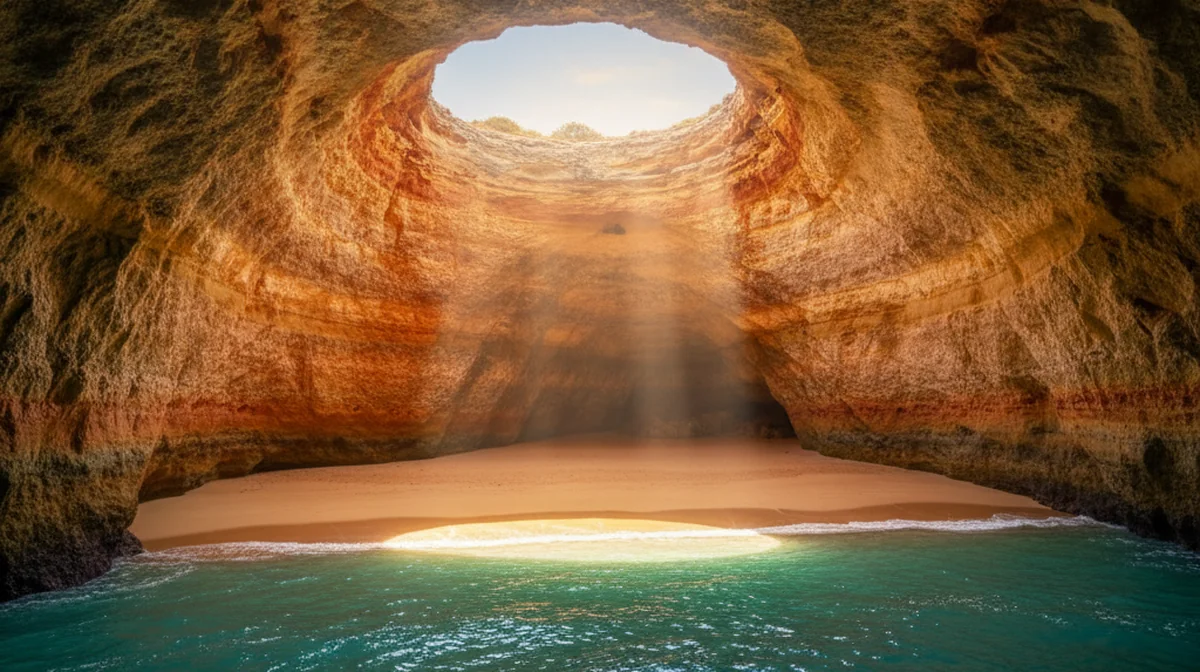
The iconic golden-arched sea cave at Benagil, reachable by kayak from Carvoeiro. Book the 7 a.m. tour to have the cave alone — the Instagram cliché becomes a private experience with the right timing.
August Faro airport is chaotic; the 45-minute drive to Quinta do Lago extends to 90 in peak. A host who pre-arranges the Mercedes transfer and briefs the driver on the property gate code saves the first-day friction that shows up in reviews.
Guests who find an Algarve rental on Airbnb search its name afterwards, and the page they should land on is the owner’s own site. Cavmir builds vacation rental websites of 40 to 125 pages in the owner’s brand. For a home that only lists on Airbnb, that is a website for your Airbnb: your name and domain, your photos, your area guides and your reviews, with a button that sends guests to the listing. For homes on Hostaway, Guesty or Hospitable it is a direct booking website: live availability and prices from the PMS, the whole stay priced before checkout, and the booking completed in the PMS. Both start from the same vacation rental website design, run the TrollBuster™ compliance scan before launch, and are yours at launch: domain, code, content and photos.
The guide pages of an Algarve site can start with the picks on this page: Praia do Amado surfcheck at 8 a.m., Ponta da Piedade cliffs at Lagos and Tavira Old Town bridge-to-castle loop. Each one is a search a guest makes before choosing a home, and each becomes a page that leads to the booking button.
Packages start at $1,475 for the Starter Website (40 pages, two to three weeks) and run to $3,732 for Full with Direct Booking (125 pages, booking synced with your PMS); the current prices are on the pricing page.
Representative Cavmir engagements in the Algarve. Property identifiers redacted; figures composited from internal analytics and market benchmarks.
Quinta do Lago villa booking at €2,400/night peak, losing to larger peer inventory in search. Shoulder-season and winter demand flat; golf positioning under-developed.
Repositioned around the golf calendar — Quinta do Lago South, Laranjal, San Lorenzo tee-time integration. Welcome book with pre-booked rounds and named pro-shop relationships. Distribution through UK and Irish golf-travel advisors.
Shoulder-season occupancy climbed from 52% to 81%. Peak-week ADR up to €3,600. A three-generation UK family book emerged filling four consecutive weeks annually.
Cliff-edge villa with Atlantic view competing against Ponta da Piedade-adjacent inventory on price. The cliff-specific view and walk-to-beach advantage wasn't marketed.
Led photography with the sunrise cliff frame. Welcome book built around the Ponta da Piedade coastal walk. Distribution through German and Dutch walking-and-hiking agencies plus UK family-travel channels.
Occupancy climbed from 58% to 77%. Shoulder-season ADR up 31%. The cliff-walk positioning attracts a different, longer-staying guest than the golf-villa brand.
Ultra-luxury beachfront estate missing the destination-wedding and warm-winter long-stay revenue streams peer properties were capturing. Pure peak-summer positioning.
Three-product brand build. Wedding tear sheet distributed through Lisbon and London planners. Warm-winter long-stay product for Scandinavian and UK professional remote-workers. Editorial-location availability.
Winter long-stay revenue now fills five consecutive months. Wedding buyouts contribute a meaningful annual-revenue share. A single four-month winter corporate long-stay booking cleared €120,000.
Yes. Cavmir works with short-term rental owners and boutique hotels in the Algarve and across Portugal — property branding, listing optimization, photography direction, direct-booking websites, SEO, and paid campaigns. Properties near Quinta do Lago Golf, Vale do Lobo Beach and Lagos Old Town are exactly the kind of stays we market.
The market snapshot on this page shows average nightly rates around $245 with occupancy near 72% for the Algarve. Treat those as directional market averages, not guarantees — the spread between a well-marketed property and a poorly marketed one in the same market is wide.
the Algarve sees moderate seasonality — clear peaks, but respectable demand through the rest of the year. That shoulder-season demand is exactly where marketing earns its keep, because travelers have more choices and pick the property that looks the part.
the Algarve sits in the middle of the regulatory spectrum — some registration or permit requirements typically apply. Rules change often in this industry, so confirm the current requirements with local authorities before you list. Cavmir handles the marketing side; we don't provide legal or permitting advice.
Give guests a way to book you without a platform in the middle: a fast direct-booking website, a complete Google Business Profile, and follow-up that brings past guests back. Cavmir builds that stack — see vacation rental SEO — so your repeat the Algarve guests stop paying platform fees to find you.
It depends on scope. Current plans and one-time project pricing are on the pricing page — most owners start with a listing overhaul or the 12-step system. A conversation about your property costs nothing: contact Cavmir.
Send us the listing and we'll tell you what we'd change. Not a pitch deck — a straight read on your photos, your title, your rates against the Algarve comp set, and whether a direct-booking site would pay for itself.
You'll hear back from a person, usually inside one business day. If we don't think we can move your numbers, we'll say so. Cavmir is a short-term rental marketing agency — we position and market properties, we don't manage them.
Demand in the Algarve peaks around June through August and runs quietest around January, November and December. Here is how the year actually books — and what to do about each stretch of the calendar.
July and August are the height, when the region fills with UK and Irish families and anything with a pool near the beach is booked well ahead. June and September ride nearly as high on warm water and lighter crowds. Set firm summer pricing with a weekly minimum on the best villas, and have the listing fully dialed by spring, because the Algarve's summer fills early and rewards it.
Spring and autumn are prime golf months and a genuine second season, when the region's courses pull players from Northern Europe who would rather skip the summer heat. May and October hold warm, mild weather and thinner crowds, and the beaches stay pleasant. Market the golf angle to players and the calmer coast to couples, and these months stay busy without deep discounting.
December through February is the quiet stretch, mild by European standards but well off the summer pace. A winter-sun and long-stay layer of Northern Europeans softens it, drawn by the climate and the golf that plays year-round here. Pitch longer stays, use the lull for maintenance and a fresh photo set of the pool and coastline, and price the off-season honestly.
The best summer villas fill through the spring, with the peak weeks going first, while golf trips book a month or two ahead around course availability. Winter long-stays are often arranged well in advance by returning snowbirds. Set the summer weeks early, keep golf-season pricing competitive, and court the long-stay bookings before winter.
Summer runs on week-long family beach stays, while the shoulder and winter mix golf trips, couples weekends and month-plus long stays. The Algarve's mild climate and year-round golf give it a genuine off-season layer that most European beach markets lack, which rewards hosts who market to golfers and snowbirds as well as summer families.
The property that wins is a villa or apartment with a private pool and outdoor living, well-located for either the beach in summer or the golf courses in the shoulders. Pool and outdoor space are the first filters almost every guest applies. For the golf and winter markets, proximity to the courses and a comfortable interior for cooler evenings tips the decision.
Build the listing around the pool and outdoor living, and position it clearly for either the beach families or the golf market, with photography that sells the coastline and the Algarve lifestyle. Price the summer weeks firmly and market the golf shoulders hard, because the region's off-season is real and worth pursuing. Add a Google Business Profile for map searches and a direct-booking site for the returning families and snowbirds who come back every year. That is the marketing layer Cavmir builds for Algarve hosts, and this coast's year-round demand makes it pay off.
July and August are the clear height for UK and Irish beach families, with June and September nearly as strong. Spring and autumn are busy golf shoulders on the region's courses, and December through February is the quiet, mild off-season softened by winter-sun visitors and snowbirds.
The best summer villas fill through the spring, with the peak weeks going first, while golf trips book a month or two ahead around course availability. Winter long-stays are often arranged well in advance by returning snowbirds. Set the summer weeks early and keep the shoulder pricing competitive.
The region draws heavily from the UK and Ireland, who fly into Faro, led by London, Dublin, Manchester, Birmingham and Northern Europe, which is where paid marketing pays. The regional towns of Faro, Albufeira, Lagos, Vilamoura, Portimao and Tavira are what guests search, worth naming in your listing and local SEO.
A private pool leads every list, followed by a proper terrace or outdoor living space and air conditioning for the summer heat. Proximity to golf or the beach depending on your guest, fast wifi and parking round out the essentials, and a barbecue suits the group and family stays.
Talk to Cavmir today. We'll show you exactly what your Algarve property is leaving on the table — and how fast we can change that.
Book a Free Strategy Call