


Morning
Breakfast at Passion Café or Wild Beets
Passion for the wellness-smoothie-bowl breakfast; Wild Beets for the raw-and-vegan version. Both pull the wellness audience; neither is clubbing-adjacent.

Expert short-term rental marketing to grow your bookings and nightly rate in Ibiza, Spain, Europe.
Sixteen services, one team. Everything below is built in-house and scoped to your property and market. Most owners start with the 12-Step System.
Every engagement is quoted to your portfolio. These are the ready-made scopes owners pick most — our Fall Special (55% off list or more) is already applied to the website, King Broker, Hotels and à la carte scopes. A clear proposal within 48 hours.
The work is public. Selected engagements and what changed — and reviews from the owners and managers behind them.
* Market averages from AirDNA and STR market reports. A single home's numbers depend on its size, its location and how it is marketed.
Cavmir is an Airbnb marketing agency. We build the brand, the direct-booking website and the marketing for short-term rentals in Ibiza.
Ibiza is simultaneously Europe's most iconic party destination and one of its most beautiful Mediterranean islands. The White Island's UNESCO World Heritage-listed old city of Dalt Vila, the crystal waters of Cala d'Hort overlooking Es Vedrà, the luxury villa culture of San José, and the creative, bohemian spirit of the island's interior create an experience of extraordinary range. Luxury travelers here are among the highest-spending in the world.
Ibiza's STR market is intensely seasonal (June–September) but commands rates that can reach €1,000+ per night for luxury villas during peak summer. The spring and fall shoulders are increasingly popular as villa travelers seek privacy and authentic island experience outside festival season. International marketing — particularly to UK, German, and Middle Eastern luxury travelers — is essential.
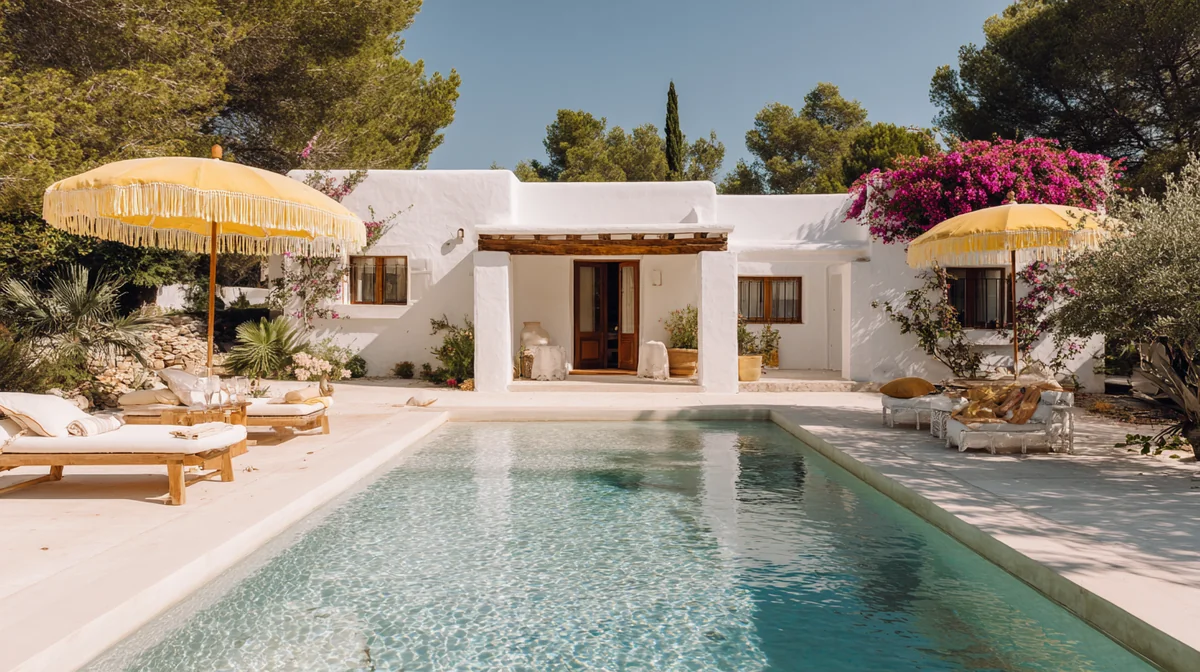
Cavmir's influencer marketing expertise is particularly powerful in Ibiza, where a single post by the right talent can book your villa for an entire season. We combine that with editorial photography, luxury brand positioning, and a distribution strategy that reaches every relevant international booking platform.
Ibiza has been a travel destination for 2,500 years. Phoenicians established Ibiza Town (Ibosim) around 654 BCE as a salt-trading port; Roman, Islamic, and Catalan periods each left architectural and cultural layers. Dalt Vila — the UNESCO-listed medieval old city — is one of the most continuously occupied fortified settlements in the Mediterranean. The modern tourism era began in the 1930s with artists and intellectuals fleeing mainland European instability; the 1960s counterculture movement made Ibiza globally famous as a bohemian-hippie retreat; the 1980s electronic music scene (Pacha, Amnesia, Privilege) established the island's contemporary nightlife identity. Today's luxury-villa culture layers on top of all of this.
The Ibiza STR market is distinctive: luxury private villas dominate inventory value. Purpose-built finca-style estates in San José, Santa Eulària, and San Juan can achieve €100,000–€300,000+ weekly rates during peak summer for 6–10 bedroom properties. The market is intensely seasonal (June–September), intensely international (UK, Germany, Netherlands, Italy, Middle East), and operates with specific villa-rental-management service expectations distinct from urban Airbnb culture.
Ibiza pricing is a narrow peak-season game. June–September is the earning window; the other eight months of the year generate limited revenue at best. Within peak, rates escalate through July and peak in August. Villa category is highly segmented — authenticated luxury finca-style properties with privacy, sea views, and concierge service command rates that generic large villas cannot approach. Proximity to specific beaches (Salinas, Es Cavallet, Cala d'Hort) and restaurants (Amante, Nagai, Es Boldado) drives premium. Town-based apartments in Ibiza Town serve a different (nightlife-focused) guest at much lower rates.
Extreme seasonality. Peak: mid-June through mid-September. Super-peak: first three weeks of August. Shoulder: May and late September/early October (growing 'pre-season' and 'post-season' villa market for privacy-seekers). Off-season: October–April is essentially closed for most traditional STR inventory. Recent growth in off-season wellness retreat, corporate retreat, and yoga-retreat demand extends shoulder months modestly.
Spain's 2025–2026 regulatory reset affects Ibiza significantly. Organic Law 1/2025 allows HOAs (comunidades de propietarios) to prohibit tourist rentals with a 3/5 majority vote — many Ibiza condominium buildings have exercised this. National registration (Registro Único de Arrendamientos, Royal Decree 1312/2024) lost its registration procedure when the Supreme Court annulled it on 19 May 2026; the Balearic tourist registration number is the one adverts must carry. Annual activity reports due each February. The Balearic Islands (Illes Balears) have layered regional regulation on top of national rules.
Ibiza-specific: the Balearic government imposes a moratorium on new tourist-rental licenses in most zones; existing licenses (ETV — Estancias Turísticas en Viviendas) trade with the property and carry significant transfer value. Only properties with ETV licensure can legally advertise as tourist rentals. The Balearic Impuesto de Turismo Sostenible (sustainable tourism tax) is charged per guest per night; Spanish IVA applies only where hotel-type services are offered (then at 10%). Airbnb was fined about €64 million nationally in December 2025 for continuing to advertise unlicensed listings — a major market-wide signal of enforcement intensity.
Ibiza's decisive tip: license status is the asset. A property with valid ETV licensure trades at significant premium over an identical property without. New licenses are essentially unavailable under the moratorium. When acquiring, verify ETV status in writing with the Balearic authority, not just with the seller. A mistake here can mean purchasing a property that cannot legally operate as a tourist rental.
Second — the luxury villa market is concierge-service-driven, not self-service-driven. Guests at €10,000+ weekly rates expect pre-arrival provisioning, private chef arrangement, boat-charter booking, DJ table reservations, and on-call staff. Properties marketed without these services earn significantly less than comparable properties with concierge relationships. Third — invest in professional photography and video. Ibiza is Instagram-driven; aerial drone footage, golden-hour sea views, and aspirational lifestyle content convert directly to bookings. Fourth — cultivate the UK market aggressively. British travelers historically drive a plurality of Ibiza villa bookings; Brexit has complicated flows but British demand remains foundational.
Moratorium on new licenses limits market-entry. HOA/comunidad restrictions expanding under 2025 law. Water scarcity on the island is a growing operational issue. Noise ordinances increasingly enforced in residential zones, especially near clubs. Sargassum seaweed and occasional water-quality events affect beach experience. And the club-scene economy has evolved post-pandemic — some historic venues have closed or changed character.
Spanish property insurance (seguro de hogar) with tourist-rental endorsement. ETV licensure typically requires proof of insurance as a condition. Budget €800–€4,500+ annually depending on villa size and value. Flood coverage for coastal properties. Liability coverage scaled to guest-capacity.
Spanish income tax on rental income — non-resident flat rate 19% (for EU/EEA residents) or 24% (non-EU/EEA, including US), with expense deductions only for EU, Iceland and Norway residents. IVA-exempt unless hotel-type services are offered (then 10%). Wealth tax (Impuesto sobre el Patrimonio) may apply to high-value holdings. Non-resident Model 210 filings required. Impuesto de Turismo Sostenible guest-collected.
Spanish mortgages for foreign buyers available through major Spanish banks (Santander, BBVA, Sabadell). Non-resident lending typically capped at 60–70% LTV. Local Ibiza/Mallorca specialist brokers essential for villa-tier acquisition. Rate premiums vs. primary-residence lending. Cash transactions common at higher price points.
Almost every Ibiza guest lands at the airport, so Aena's passenger count tells you who your website is talking to. Ibiza airport handled 9,138,224 passengers in 2025, and of the 5,345,383 on international flights the biggest groups came from the United Kingdom (1,870,796), Italy (968,861), Germany (694,734) and the Netherlands (578,690). IBESTAT's tourist count agrees: of 3.7 million visitors to Ibiza and Formentera in 2025, 2.8 million came from abroad, with Britain the leading market and Italy standing out for growth, and those visitors spent €908 million in apartments and villas. Build the direct-booking website around those four flight lists plus the Spanish mainland, and the language, currency and page decisions follow from them.
Publish full versions in English, Italian, German, Dutch and Spanish, each on its own URL with hreflang tags (en-GB, it-IT, de-DE, nl-NL, es-ES), written or edited by someone who speaks the language. A translate widget gives search engines one page to index where you need five, and an Italian couple reading machine Italian about a finca in Sant Joan de Labritja can tell. Quote in euros and add a sterling estimate for British visitors, because that's the currency a London group splits the bill in. The Spanish data regulator, the AEPD, classes a language or currency choice the visitor makes as a technical cookie that needs no consent, so remembering it won't trip your banner. Let the questions in your inbox decide what each version leads with: the British page might lead with the taxi time to Playa d'en Bossa, the Dutch and Italian pages with the beach and the Formentera crossing, the German page with how quiet the lane is at night. The island's official tourism portal, ibiza.travel, already runs in eight languages, Catalan and Portuguese included, so guests are used to reading about the island in their own.
Start with the Balearic tourist registration number. Under Decreto-ley 4/2025 of 11 April 2025, advertising tourist stays in a residential home with no declaration filed carries a fine of €30,001 to €50,000, the very serious bracket now reaches €500,000, and owners and platforms are both liable. Put the number in the footer of every page, on each property page and in the booking confirmation. EU Regulation 2024/1028, applying from 20 May 2026, has platforms display a registration number on every listing and spot-check it, and after the Supreme Court annulled the national register's procedure on 19 May 2026, the Balearic number is the one to display. The €64 million fine Spain's consumer ministry signed against Airbnb in December 2025 covered 65,122 listings with missing or mismatched licence numbers. Then the tax: the Balearic sustainable tourism tax (ITS) on a tourist home is €2 per guest per night from May to October and €0.50 from 1 November to 30 April, halved from the ninth night, with under-16s exempt. On a direct booking you collect it and issue the receipt, so show it as its own line before payment and make the total on screen the total charged. State your cancellation terms before checkout too, because the statutory cooling-off right doesn't cover accommodation booked for fixed dates. The cookie banner answers to the GDPR, Spain's LOPDGDD and the LSSI, enforced by the AEPD, whose guidance since 11 January 2024 puts “reject” on the same level as “accept”. Have a Balearic lawyer or gestor check the wording once.
Guests search Ibiza by municipality and beach, so give each its own page: Santa Eulària des Riu and Cala Llonga, Sant Josep with Cala d'Hort and the Es Vedrà sunset, the north around Sant Joan de Labritja and Portinatx, Sant Antoni's sunset strip, Eivissa town with Dalt Vila and Talamanca, and Playa d'en Bossa for the club crowd. Add a getting-here page from Ibiza airport with drive times in minutes to the villa and to Dalt Vila, plus the ferry options from Barcelona, Valencia and Dénia for guests bringing a car. The details guests filter on here are specific: air conditioning in every bedroom for August nights, the pool's size and whether it's fenced, the sunset view from the terrace, the last stretch of unpaved track to a country finca (photograph it so nobody is surprised in a small hire car), parking for two cars, minutes on foot to the nearest cala, and how far the house sits from the club strip. Event pages for the opening and closing parties and the May medieval fair complete the structure.
GEO (generative engine optimization) is the work of getting your villa quoted when a traveller asks ChatGPT, Gemini or Google's AI Mode where to stay. On this island the question comes from Britain first. MMGY Travel Intelligence's 2026 Portrait of European Travellers found that 52% of UK travellers now use AI to plan trips, up from 40% in 2025, with ChatGPT the most used tool at 35% and inspiration the main job, named by 47%. Those are the same travellers who fill Ibiza's busiest flight routes. Cavmir's July 2026 study of 550 Google AI answers across 15 U.S. markets found independent and regional operators took 82% of citations, while Airbnb or Vrbo appeared in 17% of answers. The study covers U.S. markets only, so read it as evidence that answer engines do cite independent sites.
Travellers ask in full sentences, and here the sentences carry place names and dates. A London group asks for a villa for twelve within a short taxi of Playa d'en Bossa for the closing weekend in late September. A couple from Milan asks, in Italian, for a quiet house near Cala Comte with a sunset view and an easy morning ferry to Formentera. A family from Düsseldorf asks, in German, whether Santa Eulària is calmer than Sant Antoni and which beaches suit small children. A Dutch group asks what the tourist tax adds to a week in August. Each answer is assembled from pages that state those things outright, in that language. A villa site that only says “minutes from the best beaches” gives the engine nothing to repeat, while one that gives the real drive in minutes to a named cala does.
Write the quotable facts once and repeat them word for word on your site, Airbnb, Booking.com and Vrbo: the Balearic registration number; how many guests the licence covers, which is set by its registered places (plazas) whatever the bed count; bedrooms and bathrooms; minutes by car to Ibiza airport, to Dalt Vila and to the nearest named cala; minutes on foot to the beach if it's walkable; the ITS line (€2 per guest per night from May to October, €0.50 from November to April, under-16s exempt, half rate from the ninth night); the cancellation rule in one sentence; and why you ask for passport details at check-in, since Royal Decree 933/2021 has hosts pass guest data to the authorities within 24 hours. Mark each property page up with schema for the rental, its address and its FAQ, so a crawler reads the same numbers a guest does. When the registration number on your site matches the one on every listing, the engine sees one consistent fact instead of three competing ones.
Answer engines lean on sources they already trust about the island. Start with ibiza.travel, the official tourism portal, and keep your area, event and beach details consistent with what it says. Then the local press that islanders read: Periódico de Ibiza y Formentera, which also publishes English-language news, Diario de Ibiza, Nou Diari and La Voz de Ibiza. In English, Ibiza Spotlight has published island guides and event calendars for years, and Welcome to Ibiza covers the annual fairs and festivals. Digital PR here means a story the local papers want, such as a restored finca's history, a pool that runs on collected rainwater or a boat partner that anchors off the Posidonia meadows, plus an Italian or German angle for travel titles in those markets. Keep your name, municipality and registration number identical across Airbnb, Booking.com, Vrbo and your own pages, because one mismatched address splits the citation in two.
Content marketing for an Ibiza villa runs on the island's calendar. The ITS moves to its summer rate on 1 May and back to the winter rate on 1 November, the clubs open and close the season, the old town holds its medieval fair in May, and summer guests decide months ahead. Publish each page well before the moment it serves, date the facts on it, and update the same page every year so it keeps the links and citations it has earned. This is the order in which the pages build on each other.
Start with a tourist tax, licence and cancellation page: the registration number, the €2 and €0.50 ITS rates, the half rate after the eighth night, and a worked example such as two adults and two under-16s for seven nights in July paying 2 × €2 × 7 = €28. It's the page an engine quotes when someone asks what a week in Ibiza costs on top of the rent. Second, a getting-here page built on the airport's 9.1 million passengers in 2025: which British, Italian, German and Dutch airports fly in, the drive from the terminal to your door, whether guests need a hire car, and the ferry from Eivissa port to Formentera. Third, the area page for the villa's own municipality, with walking and driving minutes to named calas, the nearest supermarket and the nearest pharmacy.
Next come the dated pages. Eivissa Medieval, the town hall's fair in Dalt Vila, held its 26th edition from 7 to 10 May 2026 with 120 stalls; put the next edition's page up in early spring marked “dates to be confirmed” until the Ajuntament d'Eivissa announces them, and add parking and walking advice for the old town, where traffic is restricted during the fair. Build an opening-parties page for late April and May and a closing-parties page for late September and October, each with drive times to Playa d'en Bossa, Sant Rafel and Eivissa town, and refresh them as the clubs announce dates. Add an August page on the Festes de la Terra in Eivissa town and Sant Bartomeu in Sant Antoni for guests who want the island's own fiestas. Every event page should name the venue, the date and the minutes from your door.
Finish with the pages that widen the season. A November-to-April page sells the €0.50 winter ITS, coastal walks, the almond blossom around Santa Agnès de Corona and longer remote-work stays. A families page explains the under-16 exemption and which beaches have shallow water. A Formentera day-trip page covers the crossing through the Ses Salines natural park. Then publish the five strongest pages in Italian, German and Dutch as full hreflang versions, Italian first given its growth. Each page should carry one fact nobody else states as precisely, because that's what gets a page cited.
Ibiza through 2027 and beyond: moratorium keeps legal-license supply fixed, supporting rate growth on compliant properties. Enforcement will continue to tighten. HOA/comunidad restrictions will expand. Environmental sustainability (water, Posidonia, waste) will shape longer-term development rules. UK visitor demand will likely stabilize post-Brexit turbulence. New-luxury-villa construction is limited by protected zones; existing licensed inventory consolidates value. The concierge-level service expectation will continue rising.
Ibiza is a market where brand is the entire business. The guest is buying an experience brand — clubbing Ibiza, wellness Ibiza, family Ibiza, yacht Ibiza, design-retreat Ibiza — and a listing that fails to commit to one of those brands ends up competing on price in a market where price competition is a losing game. The marketing opportunity most Ibiza listings miss is the specific identity of the north (quiet, hippie-heritage, wellness) versus the south (clubbing, yacht, party-scene) versus the old town (cultural, design, family). Each audience is enormous; each requires different photography, different copy, different distribution.
What we love about marketing Ibiza is the international guest volume and the premium-rate ceiling. A well-marketed Ibiza property pulls from London, Berlin, Milan, New York, São Paulo, and Dubai with enormous willingness-to-pay during peak July and August. The work is getting the brand precision right — committing clearly to an audience, photographing at the light Ibiza is actually known for (golden-hour, low sun through bougainvillea, the Mediterranean-turquoise morning), and distributing through the networks the specific audience actually uses.
The picks Cavmir recommends for Ibiza welcome books — precisely calibrated to the specific Ibiza the property serves, not generic island positioning.
Passion for the wellness-smoothie-bowl breakfast; Wild Beets for the raw-and-vegan version. Both pull the wellness audience; neither is clubbing-adjacent.
The iconic Ibiza photograph. Timing is narrow; parking is tight. A host who flags arrival-timing (90 minutes before sunset) and alternative-parking logic is indispensable.
UNESCO-heritage walled town above the harbour. Evening walk up through the old town, dinner at the top, the photograph guests don't know they want.
Sa Capella for the converted-chapel dinner; La Paloma for the garden-terrace aesthetic; Casa Jondal for the beach-club lunch-pivots-into-dinner.
Hippie-market heritage merged with contemporary design vendors. The real north-of-the-island Saturday scene.
Before the clubbing-peak crowds and after them. Weather is summer, prices haven't spiked or have dropped from peak. A knowledgeable-Ibiza guest books these windows intentionally.
The smaller, quieter island thirty minutes by ferry. White sand, turquoise water, no clubbing. A legitimate day trip that changes the mood of an Ibiza week.
The two logistical puzzles of an Ibiza trip. A host with pre-arranged relationships — a charter contact, a table-booking concierge — earns five-star reviews in July and August.
Representative Cavmir engagements in Ibiza. Client details removed; numbers composited from internal analytics and AirDNA benchmarks.
Beautiful traditional finca whose marketing attempted to appeal to all Ibiza audiences simultaneously, converting well for none of them.
Committed entirely to the wellness-retreat audience. Rebuilt the brand around yoga-retreat infrastructure, wellness photography, a retreat-leader partnership program. Dropped clubbing-adjacent messaging deliberately.
Retreat-booking revenue grew to the majority of annual revenue. ADR during retreat weeks 3.1× baseline. Peak season (July-August) now books to 8+ month retreat leaders who return annually.
Party-adjacent villa with reviews suffering from guest-profile mismatch. Marketing was attracting families to a clubbing-adjacent location.
Rebuilt entirely for the clubbing-traveller audience. Honest positioning about the neighborhood's actual character. Partnership with three nightlife concierge services. Minimum-stay and deposit structure calibrated to the specific audience segment.
Review score climbed from 4.2 to 4.81. ADR up 44%. Damage and complaint volume dropped substantially as the guest-property match clarified.
Ultra-premium property with fragmented marketing. Missing the wedding, private-event, and production-location revenue that peer properties were capturing.
Three distinct product brands from the same inventory: private-hire vacation rental, wedding venue, and production-location — each with dedicated tear sheets, distribution, and pricing. Partnerships with two Ibiza wedding planners and two European production-services firms.
Wedding and production bookings now generate a majority of annual revenue. A single three-day production cleared €75K. Annual revenue up 112% year-over-year.
Yes. Cavmir works with short-term rental owners and boutique hotels in Ibiza and across Spain — property branding, listing optimization, photography direction, direct-booking websites, SEO, and paid campaigns. Properties near Dalt Vila (UNESCO), Es Vedrà and Ses Salines Natural Park are exactly the kind of stays we market.
The market snapshot on this page shows average nightly rates around $420 with occupancy near 65% for Ibiza. Treat those as directional market averages, not guarantees — the spread between a well-marketed property and a poorly marketed one in the same market is wide.
Demand in Ibiza is distinctly seasonal — a strong peak stretch carries much of the year, which makes pricing discipline and early-calendar marketing matter more, not less. The properties that win are the ones already visible before the peak begins.
Yes — Ibiza is a heavily regulated short-term rental market. Expect permit or registration requirements and zoning restrictions, and confirm the current rules with local authorities before you list. Cavmir handles the marketing side; we don't provide legal or permitting advice.
Give guests a way to book you without a platform in the middle: a fast direct-booking website, a complete Google Business Profile, and follow-up that brings past guests back. Cavmir builds that stack — see vacation rental SEO — so your repeat Ibiza guests stop paying platform fees to find you.
It depends on scope. Current plans and one-time project pricing are on the pricing page — most owners start with a listing overhaul or the 12-step system. A conversation about your property costs nothing: contact Cavmir.
Send us the listing and we'll tell you what we'd change. Not a pitch deck — a straight read on your photos, your title, your rates against the Ibiza comp set, and whether a direct-booking site would pay for itself.
You'll hear back from a person, usually inside one business day. If we don't think we can move your numbers, we'll say so. Cavmir is a short-term rental marketing agency — we position and market properties, we don't manage them.
Demand in Ibiza peaks around June through August and runs quietest around January, February and November. Here is how the year actually books — and what to do about each stretch of the calendar.
July and August are the whole game, when the island runs flat out, the clubs are at full throttle and anything with a pool and a view is booked well ahead. Demand is deep enough to hold a weekly minimum and premium pricing if the property earns it. Have the listing fully dialed by spring, because Ibiza fills its summer early and the best villas go first.
May, June and September are strong shoulders tied directly to the club calendar. The famous opening parties light up May and early June, the closing parties run through late September into early October, and the weather stays warm on both ends. Market the version of Ibiza that suits each: the buzzing club season to younger groups, and the calmer, more beautiful island to couples who want September over August.
November through March is genuinely dead, an island that all but closes down once the season ends and the clubs shut. There is little demand to chase, so use the off-season for maintenance, villa upgrades and a fresh photo set of the pool and sea views before the spring openings. Only a small core of year-round locals and visitors keeps any calendar ticking.
The peak July and August villas book the furthest out, often months ahead, and the opening and closing party weekends fill early too. Shoulder stays move inside a few weeks to a couple of months. Set the summer weeks and the party bookends early and firm, then keep May and September pricing responsive.
Ibiza runs almost entirely on week-long summer villa stays, with a mix of shorter group trips built around specific club nights. The shoulders add couples and wellness stays of varying length. It is a market that lives and dies on roughly five months, so the pricing and presentation of the summer and the club-season bookends decide the year.
The villa that wins has a private pool, a view or a sense of seclusion, and a location that fits its target guest, close to the club scenes for the party market or tucked away for the couples and families. Pool and setting are the first filters. The sunset-and-pool moment is the product here, so the outdoor space and the view have to carry the listing.
Build the listing around the pool, the view and the outdoor scene, shot at sunset, and position it clearly for either the club crowd or the couples-and-families market. Price the summer weeks and the opening and closing party weekends deliberately and early, because they behave nothing like ordinary dates. Add a Google Business Profile for map searches and a direct-booking site for the groups and families who return to the same villa every summer. That is the marketing layer Cavmir builds for Ibiza hosts, and this island's loyal, season-driven audience makes it pay off.
July and August are the clear height, when the clubs and the island run at capacity. May, June and September are strong shoulders tied to the opening and closing parties, and November through March is effectively dead once the season ends.
The peak July and August villas book months ahead, and the opening and closing party weekends fill early too. Shoulder stays move inside a few weeks to a couple of months. Set the summer weeks and the party bookends early and firm, then keep May and September pricing responsive.
Nearly everyone flies in through Ibiza airport, led by London, Milan, Paris, Amsterdam and the US, which is where paid marketing scales. On the island, guests search using the towns of Ibiza Town, San Antonio, Santa Eulalia, Playa d'en Bossa and Sant Josep, worth naming in your listing and local SEO.
A private pool leads, followed by a sea or sunset view and a genuinely usable terrace for outdoor living. Air conditioning, fast wifi and parking are close to mandatory for the summer crowd, and a good sound system suits the group and party stays this island attracts.
Talk to Cavmir today. We'll show you exactly what your Ibiza property is leaving on the table — and how fast we can change that.
Book a Free Strategy Call