A four-bedroom Airbnb in Nashville just charged $440 a night — more than the Marriott down the street. It was fully booked for six consecutive weekends. The Marriott had vacancies. That's not luck. That's positioning.
The mistake most hosts make is trying to compete on price. They see a Hilton Garden Inn at $189 and slash their rate to $175, thinking they'll win on value. They won't. They'll just earn less and attract guests who were never right for their property in the first place.
The actual opportunity is different: position your property so that the hotel comparison becomes irrelevant. You're not cheaper. You're better — in ways that matter more to the right guest. Here's how to build that case.
Where Hotels Actually Hold the Advantage
Before you can outmaneuver hotels, you have to understand where they genuinely win. Loyalty points are real — a business traveler who stays 80 nights a year isn't giving up Marriott Bonvoy status for your two-bedroom loft, no matter how charming your exposed brick is. Don't chase that guest.
Hotels also win on consistency. A Hyatt in Cincinnati and a Hyatt in Denver deliver the same reliable experience. For some travelers — especially corporate or anxious first-time visitors — that predictability is worth a premium. That's not your customer either.
And hotels have breakfast, 24/7 front desk, on-site gyms, and valet. For certain trip types, these amenities are genuinely decision-making factors. A solo traveler on a three-night conference trip? Hotel almost always wins.
The insight here isn't to copy hotels. It's to know which segments they dominate so you can stop bleeding your energy trying to serve them.
Source: Airbnb Guest Survey, 2024 / STR Global Demand Report
Where Airbnb Genuinely Wins — and Why It Matters for Rate
Space is the non-negotiable differentiator. A family of four paying $400/night at a Marriott gets two queen beds in a 350-square-foot room. That same $400 at your three-bedroom house gets them a kitchen, a backyard, separate bedrooms for the kids, and a couch where Dad can actually stretch out. The value proposition isn't even close.
But space only justifies a premium if you frame it correctly in your listing, your photos, and your communication. "3 bedrooms, 2 baths, full kitchen" is a spec sheet. "Enough room that your family actually gets to relax — not just survive the trip" is a value proposition.
When writing your competitive positioning, describe the problem the hotel stay creates — cramped space, eating every meal out, kids sharing a bed — then position your property as the obvious answer. Guests don't compare specs. They compare how each option makes them feel.
Kitchen access is the second major winner. Airbnb guests with a kitchen spend 40% less on food per trip — a family of four saving $200–$300 on a five-night stay changes the entire price calculation. Build this into your value narrative explicitly: "Save on dining — the full kitchen means breakfast on your terms."
Local character is the third. Hotels, by design, feel the same everywhere. Your property feels like the city it's in — or it should. Local art, neighborhood guide, the actual coffee shop around the corner, the rooftop your guests won't find on TripAdvisor. That experience has real monetary value to a traveler who books Airbnb specifically because they want to feel like a local.
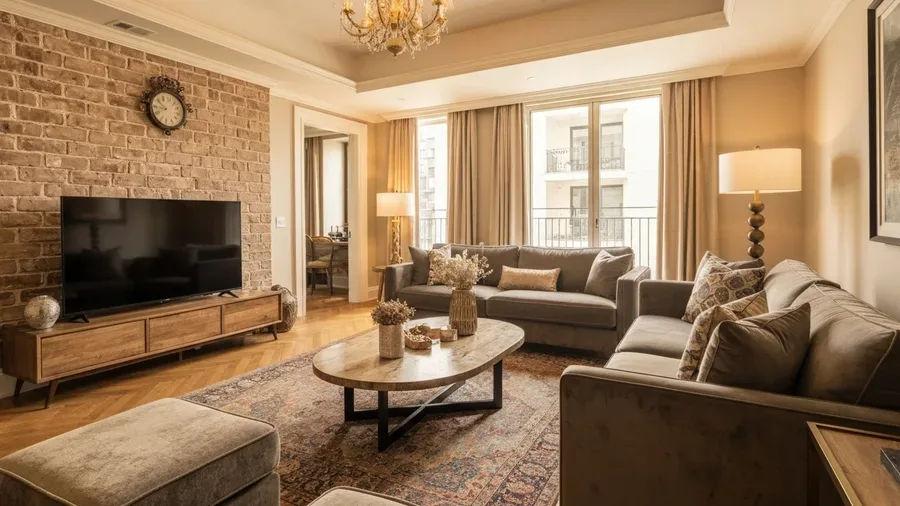
Same price point, completely different experience. The guest who values character will pay more for it.
Competitive Benchmarking: How to Find Your Real Number
Most hosts set rates by comparing other Airbnbs. That's the wrong benchmark for competitive positioning. You should also be running a hotel comp set.
Here's the framework: Go to Google Hotels or Expedia and filter for the same market, same dates, and hotels in the 3–4 star range. Note average rates. Then calculate the "space premium" — how much additional square footage and bedrooms your property offers vs. the hotel's average room. A property with 2x the space and 3x the sleeping capacity at 1.3x the hotel rate is priced to win.
Now calculate the "group discount." If your property sleeps 6 and each hotel room sleeps 2, your guests need 3 hotel rooms at $200 each = $600/night total. Your property at $380/night saves them $220 per night. That framing — not a raw price comparison — is what converts group travelers.
savings per night for a group of 6 choosing a well-priced Airbnb over three hotel rooms — that's $1,100 on a five-night trip. Build this math into your listing.
The benchmark to care about most: the hotel's "comparable" rate for peak dates. When a Marriott is charging $280 on New Year's Eve, your four-bedroom property should be at $480–$600 with full confidence. Guests doing the math will see the obvious value. Guests who don't do the math need you to do it for them — which is what great listing copy does.
Writing Your Unique Value Prop (Without Sounding Like Every Other Host)
Here's what most Airbnb hosts write in their property description: "Cozy home with great amenities! Close to everything. Perfect for families." That language competes with 4 million other listings. It doesn't compete with hotels at all.
Effective value prop language is specific and comparative. Not "great amenities" — "a full kitchen that means your family eats breakfast together instead of paying $80 at the hotel restaurant." Not "close to everything" — "12 minutes to the French Quarter and 3 blocks from a neighborhood coffee roaster that doesn't show up on tourist maps."
The goal is to make a hotel stay feel like the obvious downgrade. You're not asking guests to choose you over a hotel. You're making them realize they'd be choosing a hotel over you — and why would they do that?
Strong positioning lines to model:
- "More space, more private, more you — at less per person than you'd spend on hotel rooms."
- "No lobby. No checkout line. No one knocking at 9 AM. Just your group, your space, your schedule."
- "Hotels sell rooms. This is a home — and the difference shows up in every part of your trip."
See how Cavmir's branding service builds value prop language specifically designed to push back against hotel-level pricing pressure for STR properties.
The Booking Decision: When Guests Choose Airbnb and When They Don't
Understanding the actual decision tree helps you stop wasting effort on the wrong segment. Guests choose Airbnb over hotels when:
- The trip is 4+ nights (longer stays favor home-like accommodations)
- They're traveling in groups of 3+
- Children or pets are part of the trip
- The trip purpose is leisure, celebration, or connection
- Local immersion matters to them
- They've done it before and had a good experience
Guests choose hotels when the trip is 1–2 nights, solo or couples, business-related, or when the destination is entirely secondary to the purpose of travel. Don't optimize for those guests. Let hotels have them.
Your marketing — your photos, copy, pricing, and channel selection — should signal clearly to the first group: "This is for you." The fastest way to improve your comp set performance isn't a price adjustment. It's tightening the message so the right guests find you faster. Read our guide on Airbnb Plus and Luxe qualification to understand how elevated positioning changes the guest pool entirely.
The Segment Breakdown: Where Hotels Win, Where You Win
Once you know your segment clearly, you stop justifying your rate against the wrong benchmark. A family of six comparing your four-bedroom house to three hotel rooms isn't really thinking about your rate at all — they're thinking about how much better their trip will be. Help them see that, and the pricing conversation becomes secondary.
For a look at how traditional hospitality operators have adapted — and what you can borrow from them — read our post on what boutique hotels do better than Airbnb (and the lessons that go both ways).
The Bottom Line
You don't win against hotels by pricing lower. You win by being clearly, demonstrably better for the right guest — and charging accordingly. The 73% of guests who book Airbnb specifically for more space aren't price-sensitive; they're segment-specific. When your property, listing, and marketing speak directly to them, the rate question answers itself.
Run your hotel comp set. Build your value prop language around space, kitchen, and local character. Price like you believe your product is better — because for the right guest, it genuinely is.