
This guide is for owners who rent out a houseboat, a floating home or a boat that stays tied up in a marina slip, on Airbnb or on their own website. Floating stays get attention fast, but they raise questions a land rental never does: who regulates you, what your insurer will cover, and what a guest needs to know before sleeping on the water for the first time.
Work through it in order and you'll know which rules apply to your kind of floating stay, what to ask your marina, city and insurer, which photos to shoot, what to paste into your listing and arrival message, and whether the monthly numbers work. Rules and policies here are current as of October 2026.
- Airbnb accepts boats as home listings, but every home listing, boats included, must stay stationary during the reservation and offer overnight stays. A cruise with guests aboard is a different business.
- Once paying guests ride on a running boat, federal passenger-for-hire law applies: under 100 gross tons, up to 6 passengers with a Coast Guard-licensed operator (the OUPV or six-pack license), or up to 12 on a true bareboat charter.
- Your marina and city often decide the answer first. Seattle tells owners not to use a floating residence as a short-term rental (under 30 days) and prohibits short-term rentals in all over-water locations.
- Airbnb's Host liability insurance ($1 million per stay) includes a listed boat used as lodging while docked or on a mooring, but recreational boat policies usually exclude rental periods. Get rental use confirmed in writing.
- Before the first guest: a wearable life jacket for every person (child sizes too), a carbon monoxide alarm in every sleeping area, a pump-out plan, and listing copy that explains motion, sounds and the toilet.
Floating Home, Houseboat or Moored Boat
Start by naming what you have, because the label decides who regulates you. A floating home on a float answers mostly to the city and the moorage. A boat that can leave the dock also answers to federal boating law, and the moment it carries paying guests away from the dock, it's in a different business altogether.
The clearest line comes from the Supreme Court. In Lozman v. City of Riviera Beach, decided January 15, 2013 by a 7-2 vote, the Court held that a floating home was not a vessel. It had no rudder or steering, no engine of its own, moved only when towed, and depended on shore connections for its utilities. The test the Court set: whether a reasonable observer, looking at the structure's physical characteristics and activities, would consider it designed to a practical degree for carrying people or things over water.
That case settled one structure under federal law. Your city can still sort floating residences its own way. Seattle recognizes four kinds, each with its own code section: floating homes, floating on-water residences, house barges and vessels containing a dwelling unit.
| Floating stay | What it looks like | Rules that lead | Fits an Airbnb home listing |
|---|---|---|---|
| Floating home on a float | A house on a float or barge, no engine or helm, plugged into shore power and water | City zoning, building and short-term rental rules; your moorage agreement | Yes, as a home that stays put |
| Houseboat kept moored for stays | Hull, engine and helm, used as lodging at a dock or slip | Marina rules, your insurer, city rules; ask the Coast Guard about guests aboard | Yes, if it stays stationary for the whole reservation |
| Cabin boat in a marina slip | A sailboat or cruiser with berths, a galley and a head | Marina liveaboard and guest rules, your insurer, city rules | Yes, if it stays stationary |
| Boat that takes guests out | Paying guests aboard while it runs | Federal passenger-for-hire law: licensed operator, charter limits, passenger counts | No, home listings must stay stationary |
| Houseboat on a National Park Service lake | A private boat kept on a lake inside a park unit | Park rules on business activity, plus everything above | Only after the park confirms a private rental is allowed |
Write Down Your Category
Put one sentence at the top of your rental file: "This is a floating home (or houseboat, or boat), moored at a named marina or dock, and it does not leave the dock during stays." You'll paste that sentence into your emails to the marina, the insurer and, if the boat has an engine, the Coast Guard. Every answer you get back depends on it, so make it accurate.
If the boat has an engine you plan to use between stays, say so. An insurer or a marina will treat "moored all season" and "moored during stays, used on weekends" differently, and you want their written answer to match how you use the boat.
If your city keeps a floating-residence registry, find your residence's category and registration number before you call anyone. Seattle's building department asks for the verification or registration number when you ask which rules apply to your residence.
Coast Guard Rules When Guests Pay to Be Aboard
Federal law turns on one phrase: passenger for hire. Under 46 U.S.C. 2101, a passenger is an individual carried on the vessel, with exceptions such as the owner or an individual charterer. A passenger for hire is one for whom consideration is contributed as a condition of carriage, whether it flows directly or indirectly to the owner, charterer, operator, agent or anyone else with an interest in the vessel.
Consideration is a wide net. The Coast Guard's regulation at 46 CFR 24.10-1 defines it as an economic benefit, inducement, right or profit, including payment, accruing to an individual, person or entity. A nightly rate is consideration. So is a boat ride bundled into a paid stay.
The Passenger Counts That Change the Rules
The statute sorts boats that carry paying passengers by tonnage and head count. For most houseboats and cabin boats, which measure under 100 gross tons, these are the lines that matter:
- Uninspected passenger vessel: carrying not more than 6 passengers, at least one of them for hire, or chartered with a crew the owner provides or specifies and carrying not more than 6 passengers. At 100 gross tons and up, the figure is 12.
- Small passenger vessel: carrying more than 6 passengers with at least one for hire, chartered with owner-provided crew and more than 6 passengers, or chartered with no crew provided or specified by the owner and more than 12 passengers. This class carries far heavier requirements, so stop and call a maritime lawyer if you're anywhere near it.
A self-propelled uninspected passenger vessel must be run by an operator the Coast Guard has licensed for that type of vessel, under 46 U.S.C. 8903.
For most small boats that credential is the Operator of Uninspected Passenger Vessels (OUPV) endorsement, often called the six-pack license. Under 46 CFR 11.467, it covers vessels of less than 100 gross tons carrying six or fewer passengers. A seventh passenger moves you into a different license and a different class of boat.
What the numbers say
Most for an uninspected passenger vessel under 100 gross tons with a paying guest aboard.
Most on a bareboat charter with no crew provided or specified by the owner.
The size line where the uninspected limit moves from 6 to 12 passengers.
Source: 46 U.S.C. 2101, read October 2026
Bareboat Charters
A bareboat charter is the other legal route for a paying group to take a boat out. The renter charters the boat with no crew provided or specified by the owner, and the statute lets that charter carry up to 12 passengers before the boat becomes a small passenger vessel. The whole structure rests on the owner not running the trip. If you pick the captain, require a captain from your own list, or fold the captain into your price, the owner has provided or specified the crew, and the 6-passenger limit and license rules come back.
Boats That Stay at the Dock
Airbnb takes cruising off the table for home listings. Its Prohibited and restricted homes policy says all home listings, including boats and camper vans, must remain stationary during the reservation, and that home listings must offer overnight accommodation. Airbnb may issue warnings, suspend or remove listings, or suspend accounts that break the policy.
What the statute doesn't settle in plain words is whether a guest sleeping aboard a boat that never leaves the slip is "carried on the vessel." If your boat has an engine and a helm, don't guess. Ask the local Coast Guard Sector office in writing, keep the reply in your rental file, and have a maritime lawyer read your listing and rental terms once. Then make the stationary rule part of every stay: engines off, lines tied, no guest operation, all of it written into your house rules.
A "free" sunset cruise for paying lodging guests is the classic trap. If the ride only happens because they paid for the stay, it can count as consideration for carriage. Keep stays and boat trips apart unless a licensed operator and a maritime lawyer have set the trip up properly.
Marina, City and Lake Rules to Check Before You List
Most floating stays get their real yes or no from three places: the marina or moorage, the city or county, and the agency that runs the water. Airbnb's policy sits on top of all three, since it says hosts must follow all applicable laws and regulations.
Your Marina or Moorage
Your slip lease or moorage agreement is a contract, and many were written with owners in mind, not paying guests. Ask whether the marina's liveaboard policy covers guest stays too, and get every answer in writing before you build a listing. This email asks everything in one go.
Email to your marina manager
Subject: Paying overnight guests at slip [slip number]

Hi [Marina manager name],

I'd like to host paying overnight guests aboard [boat name] at slip [slip number], booked through Airbnb [and my own website]. The boat would stay tied up for every stay and would not leave the dock with guests aboard. Before I list it, could you confirm in writing:

1. Whether my slip agreement allows paid overnight guests, and any limit on nights or guest numbers.
2. Whether your liveaboard policy applies to guest stays.
3. Where guests park and how they get gate access.
4. Quiet hours and any dock rules guests must follow.
5. Pump-out options and how often you expect the holding tank emptied.
6. Any fee, permit or insurance certificate you need from me.

Thank you,
[Your name]
[Phone number]
Seattle and Other City Rules
Seattle is the clearest example of a city rule that decides the matter. The city's floating residences page tells owners not to use a floating residence as a short-term rental, meaning a stay under 30 days. It treats short-term rentals as a commercial use, prohibited in all over-water locations and in nearly all of Seattle's shoreline district. Liveaboards on conventional recreational vessels are exempt from the city's verification requirements, but the short-term rental ban as written covers every over-water location, so a boat in a Seattle marina is no way around it.
So in Seattle, the only floating stay to ask about is one of 30 nights or more, which falls outside the city's short-term definition; Airbnb can handle that with a minimum-stay setting. The city's page doesn't say monthly stays are allowed for every residence, so confirm your residence's category and plan with the Seattle Department of Construction and Inspections before you list, and read our Seattle vacation rental market guide for the land-side rules.
Elsewhere, search your city or county short-term rental page for the words "floating," "houseboat," "vessel" and "moorage," then call the planning office with your one-sentence category. If the code is silent, ask for the answer in an email.
Federal Lakes and Parks
If your houseboat sits on a lake run by the National Park Service, read 36 CFR 5.3 before you list. It prohibits engaging in or soliciting any business in park areas unless it's done under a permit, contract or other written agreement with the United States, or a special regulation for that park allows it. Lake Powell, in Glen Canyon National Recreation Area, is the best-known houseboat lake in this group. Ask the park office in writing whether a private short-term rental of a privately owned boat is allowed at all.
Sewage and the Holding Tank
Any boat with an installed toilet on U.S. navigable waters needs a working, Coast Guard-certified marine sanitation device under Section 312 of the Clean Water Act, according to the EPA's vessel sewage FAQ (updated September 18, 2026). Type III devices are holding tanks. It is illegal to discharge raw or insufficiently treated sewage within three miles of shore or in a no-discharge zone, and holding tanks must be pumped out at an onshore or mobile facility. With guests aboard, the tank fills faster than it does on a weekend boat, so book pump-outs to match your stay lengths.
| Layer | The rule | Who to ask |
|---|---|---|
| Airbnb | Home listings, boats included, stay stationary; overnight stays only; follow local law | Airbnb Help Center |
| Your marina | Slip agreement, liveaboard policy, guest parking, quiet hours, pump-out | Marina manager, in writing |
| Seattle | No short-term rentals (under 30 days) in floating residences; short-term rentals barred in all over-water locations and nearly all of the shoreline district | Seattle Department of Construction and Inspections |
| National Park Service lakes | No business in park areas without a permit, contract or other written agreement | The park office |
| Any boat with a toilet | Certified marine sanitation device; no raw sewage within three miles of shore or in a no-discharge zone | EPA, your state, your marina |
| Paying guests underway | Licensed operator up to 6 passengers for hire, or a bareboat charter up to 12 | Local Coast Guard Sector, a maritime lawyer |
Where Houseboat Stays Cluster
Houseboat vacations in the U.S. center on a few big lakes and a few city waterfronts. Kentucky Tourism calls Lake Cumberland the "Houseboating Capital of the World" and says it has the country's largest fleet of rental houseboats, with houseboats available from marinas on lakes across the state. Lake Powell on the Arizona and Utah line is another well-known houseboat lake. Seattle's floating home neighborhoods draw attention too, under the 30-day rule above.
In fleet markets, guests can already rent a houseboat from a marina and run it themselves. Your stationary stay sells something different: a night on the water with no boat to drive, no lines to handle and no fuel to buy. Say that plainly in your title and first lines. Our Lake Cumberland market guide covers the land-side demand there.
Insurance for a Houseboat Airbnb
Two kinds of cover matter: Airbnb's own host liability coverage and your marine policy. They do different jobs, and neither one replaces the other.
Airbnb's Host liability insurance provides $1 million in coverage for the rare cases where a host is found legally responsible for a guest's injury, damage to or theft of a guest's property, or damage a guest causes to common areas. It excludes damage or injury from intentional acts, and it doesn't cover damage guests do to your own place or belongings; that goes through Host damage protection, a separate program.
The fine print matters for boats. Airbnb's Host Liability Insurance Program Summary says accommodations can include watercraft that are parked and used as an accommodation. It also excludes bodily injury or property damage connected in any way to watercraft, with a few exceptions, including watercraft listed on Airbnb while used as an accommodation and docked or on a mooring. The summary says the current term runs to at least June 30, 2027, and the $1,000,000 limit is the total available per Airbnb stay.
In practice, the boat you list, while docked or moored and used as lodging, sits inside that coverage, subject to the policy's other terms. A kayak, paddleboard or dinghy you lend guests is a separate watercraft, and the exception doesn't name it. Treat those as a question for your own insurer, or don't offer them.
Your Marine Policy
Recreational boat policies are written for owners using their own boats. A BoatUS Seaworthy piece reprinted by Scuttlebutt Sailing News in April 2016 warned that recreational marine policies, BoatUS Marine Insurance included, don't cover a boat during a rental period because that's commercial use, even when it's rented only as sleeping quarters. For regular rentals it pointed owners to a commercial charter policy. Policy wording changes, so get today's answer from your own insurer, in writing, before the first booking.
Comes with stays booked through Airbnb, and only those stays.
- $1 million per stay for your legal liability to guests and others
- Includes a listed boat used as lodging while docked or moored
- Doesn't pay for damage to your own boat
- Doesn't follow you to direct or other-platform bookings
Bought from a marine insurer, priced for your boat, marina and use.
- Can cover the hull, machinery and your own belongings
- Covers every booking source if written for rental use
- Can include lent watercraft if you ask for it
- Ask whether your marina wants a certificate that names it
One note on the right-hand card: what a marine policy covers depends on the wording you buy. Use the email below so the answer is specific to your boat and your plan. Our Airbnb insurance guide for hosts covers the land-side policies in more depth.
Email to your marine insurer or broker
Subject: Rental use of [boat name], policy [policy number]

Hi [Agent name],

I plan to rent [boat name], a [length]-foot [floating home / houseboat / cabin boat], to overnight guests through Airbnb [and my own website]. It stays tied up at [marina name], slip [slip number], for every stay and never leaves the dock with guests aboard.

Please confirm in writing:
1. Whether my current policy covers the boat, my liability and guest injuries during paid stays, or whether I need a rental or commercial endorsement or a separate policy.
2. What that rental or commercial cover would cost a year, and its liability limit.
3. Whether watercraft I lend guests (kayaks, paddleboards, a dinghy) are covered.
4. Any conditions you require, such as safety gear, alarms, surveys or a written rental agreement.

Thanks,
[Your name]
[Phone number]
Safety Gear and House Rules on the Water
Guests on a floating stay face risks a cabin in the woods doesn't have: deep water a step from the door, slippery decks, ladders, and engine or generator exhaust. Your safety setup protects them, and it's also the first thing an insurer, a marina or Airbnb will ask about after an incident.
Life Jackets
Federal rules for recreational boats at 33 CFR 175.15 require at least one wearable life jacket on board for each person, plus one throwable device on boats 16 feet or longer. Children under 13 must wear an approved life jacket while the boat is underway unless they're below decks or in an enclosed cabin, and a state can set its own age instead. A moored stay may never be underway, but treat these numbers as your floor. Stock adult and child sizes, and keep them where guests see them on the way in.
Carbon Monoxide
Houseboats have a documented carbon monoxide problem. A CDC report on Lake Powell from 2000 counted 111 boat-related CO poisonings there from 1990 to 2000, 74 of them on houseboats, and 9 of the 111 were fatal. With generators running, CO under the rear deck measured 6,000 to 30,000 parts per million, and it tends to collect above the water near the swim platform. The CDC's advice: every boat should have CO detectors, and occupants should never disable the alarms.
What the numbers say
Counted on Lake Powell from 1990 to 2000.
Two in three of the cases happened on a houseboat.
Of the 111 poisonings in the review.
Source: CDC, MMWR, Houseboat-Associated Carbon Monoxide Poisonings on Lake Powell, 2000
Turn that into three rules aboard. Put a CO alarm in every sleeping cabin and the main cabin, and test them before each stay. Ban swimming at the stern and near the swim platform whenever a generator or engine runs. If your boat has a generator, ask a marine mechanic whether its exhaust vents away from the deck and swim area.
The Rest of the Kit
Add smoke alarms, a fire extinguisher where guests can reach it, and a one-page safety sheet by the door that shows where everything is. Walk the boat at night with a flashlight: the boarding ramp, the dock path and any stairs to an upper deck should be lit and railed. Gates on deck openings matter most for families with small children.
Write the rules in plain words and repeat the key ones in the arrival message. Our Airbnb house rules guide explains how to word and enforce them on the platform.
House rules for a floating stay
1. The boat stays tied to the dock for your whole stay. Please do not start the engines, untie any lines or try to move the boat.
2. Children wear a life jacket on deck and on the dock at all times. Adult and child sizes are in [location].
3. No swimming from the back of the boat or the swim platform while the generator or engines run.
4. Never switch off or cover the carbon monoxide or smoke alarms.
5. Toilet paper only in the marine toilet. Anything else blocks the holding tank.
6. Quiet hours are [start time] to [end time], following marina rules.
7. Up to [number] guests overnight. Please ask before inviting visitors aboard.
8. No glass on deck. Grills and open flames: [your rule].
9. Pets: [your rule].
10. In an emergency, call 911, then message me.
Photos That Sell a Floating Stay
The water is the product, so lead with it. The most common mistake is opening with interior shots of a compact cabin, which makes the stay look cramped before the guest has seen where it sits. Your cover photo should show the boat on the water, and your first five should include the view guests wake up to.
Then show the interiors with the water still in frame. A bedroom with the marina visible through the window does more work than the same bedroom shot against a wall. After that, answer the practical worries in pictures: the galley, the head, the boarding ramp, the safety gear. Our listing photo guide covers lighting, order and captions.
| Shot | Why guests need it | How to get it |
|---|---|---|
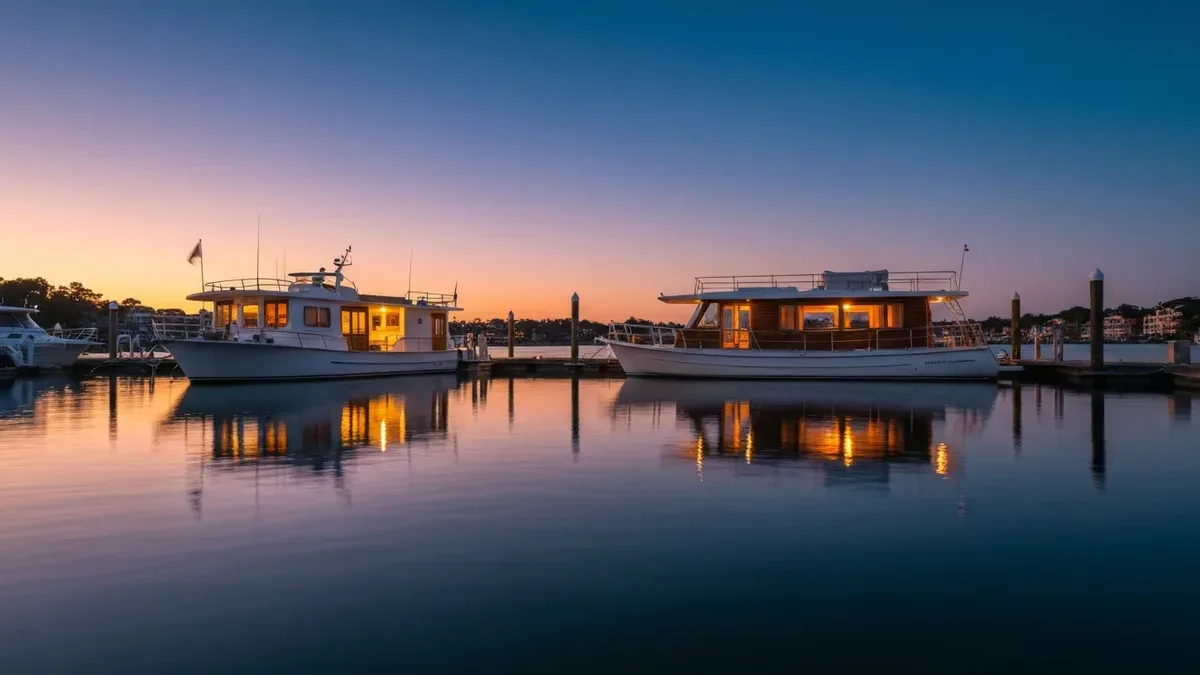
| Boat on the water at dusk, lights on | Sets the scene; your cover photo | From the dock or another boat, just after sunset |
| View from the bed or main window | Shows what they wake up to | Shoot at the hour the light is on the water |
| Deck seating with water behind | Where guests spend the day | Wide, from a corner, horizon level |
| Main cabin with water in the windows | Shows the space isn't cramped | Lights on, expose for the windows |
| Galley | Answers whether they can cook a full meal | Stove, fridge and counter in one frame |
| Each head and shower | The first worry for most first-timers | Clean, lid down, toilet sign visible |
| Each sleeping cabin | Bed size and headroom | One wide shot from the door |
| Safety gear in view | Reassures parents and groups | Adult and child life jackets on a rack by the door |
| Boarding ramp and dock walk | Shows the step aboard and the distance | From the parking side, as guests arrive |
| Parking and marina gate | Cuts arrival calls | One clear daylight shot |
| Stairs, ladder and railings | Shows who can get around safely | Show the full height of each climb |
Write a one-line caption for the head, the ramp and the safety gear. "Marine toilet, toilet paper only" and "Seven steps from the dock to the deck" answer questions before guests have to message you.
Listing Copy for Guests New to the Water
Most guests have never slept on a boat. They want the novelty and they worry about the details: does it move, what will they hear, how does the toilet work. A listing that answers those questions in plain words removes the reason to keep scrolling.
Start with the property type and title. Airbnb's guide to choosing a property type says to select the option that best describes your place, as you'd describe it to someone who has never seen it, and you can change it later. Then put the plain description in the title too: "Floating home with lake views," "Moored houseboat, marina views," not a pun.
The Questions Your Description Must Answer
| Guest question | What to write |
|---|---|
| Does it move | How it's moored, how much it rocks in normal weather, what changes in wind |
| What will I hear at night | Water on the hull, rigging, birds, neighbors, marina quiet hours |
| How does the toilet work | Marine toilet, holding tank, toilet paper only |
| Is there enough power and water | What can't run at once on shore power, dock or tank water, shower length |
| Where do I park | Parking spot, gate code timing, walk length, number of steps |
| Is it safe for kids | Railings, gates, child life jackets, the supervision rule |
| What about bugs and weather | Screens, repellent, covered deck, what happens in a storm |
| Can we swim or take the boat out | Your swim rules; the boat stays at the dock |
Fill in the paragraph below and paste it into the description's "The space" section. It answers the top questions in the order guests ask them. Our listing description formula shows how to build the rest of the description around it.
Listing description for a floating stay
[Boat name] is a [length]-foot [floating home / houseboat / cabin cruiser] tied up at [marina name] on [lake, river or bay]. It stays at the dock for your whole stay, so you get a night on the water with no boat to drive.

What to expect on the water: [the float sits on pilings and barely moves / you will feel a gentle rock when other boats pass, a bit more in a strong wind]. At night you will hear [water against the hull, rigging, gulls, the odd passing boat]. The marina is quiet after [time].

How things work aboard: the toilet is a marine toilet that empties into a holding tank, so only toilet paper goes in it (there is a sign). Power comes from the dock, so [the hair dryer and the heater should not run at the same time]. Fresh water comes from [the dock / a tank of [number] gallons], so please keep showers short.

Getting aboard: park at [parking area], walk [distance] along [dock name] and step aboard by the [ramp / swim step]. There are [number] steps and no elevator. Life jackets in adult and child sizes are by the door.

A good fit for [couples, small families, anyone who wants to sleep on the water]. Not a good fit for [guests who need step-free access, or very young children who cannot be watched near the edge].
Keep the tone warm and factual. A guest who knows the boat rocks a little and books anyway won't complain about it in a review. A guest who finds out on arrival might.
Monthly Costs and Pricing for a Houseboat Rental
A floating stay carries costs a land rental doesn't: the slip or moorage fee, a marine policy with rental use, shore power, pump-outs, and the repairs that come with a hull in the water, from bottom work to haul-outs and winterizing. Those costs run every month whether you book or not, so the first number to know is how many nights cover them.
Use the calculator with your own quotes from the marina and insurer. Put in your nightly payout after platform fees, not the price guests see, so the result reflects money you keep.
Monthly costs against nightly income for a floating stay
Change the numbers to match your boat and marina. Nothing leaves your device.
Example inputs only, not market averages. Use your own marina, insurer and utility figures.
Example: a made-up houseboat pays out $250 a night after fees and books 14 nights a month. Slip $900, insurance $3,000 a year ($250 a month), utilities and pump-outs $350, repair reserve $300. Fixed costs come to $1,800 a month against $3,500 of income, leaving $1,700 before cleaning. Break-even is 8 nights, because 7 nights at $250 is only $1,750.
Setting the Nightly Rate
Price against the waterfront stays near you, not against inland apartments. A marina houseboat competes for the same guest as a waterfront condo or a hotel room with a water view, so pull five to ten of those for your dates and compare what they include. Then price the parts only you offer, like the deck on the water and the sunset from the bed, and account for what you lack, like an elevator or a full-size kitchen.
Plan your calendar around the water season. On many lakes, demand follows the boating season, and a boat that's winterized can't host. Decide early whether you'll host in the cold months, and if you're in Seattle, build the calendar around stays of 30 nights or more. The lake house marketing guide covers seasonal pricing on lakes in more depth.
Your Launch Plan for This Week
Here's the order that saves the most time: permissions first, then safety, then systems, then the listing. Tick items as you go. If something in the first group comes back as a no, you'll know before you've paid for photos.
Houseboat listing readiness checklist
Tick items off as you finish them. Your progress stays on this device.
- Permissions and paperwork
- Safety aboard
- Systems
- Listing
The Arrival Message
Send this through the platform's messaging before arrival day. It covers the questions that otherwise come in as phone calls from the parking lot.
Arrival message for a floating stay
Hi [Guest first name],

Welcome to [Boat name]. Here is everything you need for [arrival date].

Parking: [where to park, and any permit or pass].
Gate: the dock gate code is [code]. The marina office is [location], open [hours].
Finding the boat: walk down [dock name] to slip [number]. Look for [hull color and boat name].
Boarding: step aboard at the [ramp / swim step / gate]. Hold the rail and take your time with luggage.
Life jackets: adult and child sizes are [location]. Please keep them on children whenever they are on deck or on the dock.
Toilet: it is a marine toilet, so toilet paper only, please.
Power and water: [what not to run at the same time]. Fresh water comes from [the dock / the tank].
Safety: the carbon monoxide and smoke alarms are in [locations]. Please never switch them off. No swimming near the back of the boat while the generator or engines run.
The boat stays tied up for your whole stay, so please do not start the engines or untie any lines.

In an emergency, call 911. For anything else, message me here and I will reply within [time].

[Your name]
Direct Bookings Without Breaking Airbnb's Rules
Your own website, Google listing and social accounts can bring guests who book with you directly. Guests who found you on Airbnb stay Airbnb guests. Airbnb's Off-Platform and Fee Transparency Policy bans asking or encouraging them to move current, future or repeat bookings off Airbnb, offering discounts to book off Airbnb, and using their contact details for marketing, and repeated or severe violations can get listings deactivated.
So keep the arrival message, the safety sheet and everything aboard free of booking offers. Our direct booking strategy guide covers how to build demand from people who find you first.
Where to Get Help
A floating stay is easy to love and easy to undersell. If you'd like help with the website, the listing or getting found in Google and AI answers, Cavmir™ works with owners of unusual stays, and our houseboat owners page shows how.
Start by checking your current listing with the listing grader. You can compare packages on our published prices, or book a call to talk it through.
Sources
Every figure in this guide comes from these sources, checked in October 2026.
- Airbnb Help Center, "Prohibited and restricted homes", October 2026: airbnb.com
- Airbnb Help Center, "Off-Platform and Fee Transparency Policy", October 2026: airbnb.com
- Airbnb Help Center, "Host liability insurance", October 2026: airbnb.com
- Airbnb, "Host Liability Insurance Program Summary", October 2026: airbnb.com
- Airbnb Resource Center, "How to choose a property type", October 13, 2025: airbnb.com
- U.S. Code, 46 U.S.C. 2101, Definitions (via Legal Information Institute), October 2026: law.cornell.edu
- U.S. Code, 46 U.S.C. 8903, Uninspected passenger vessels (via Legal Information Institute), October 2026: law.cornell.edu
- Code of Federal Regulations, 46 CFR 24.10-1, Definitions (via Legal Information Institute), as amended November 24, 2025: law.cornell.edu
- Code of Federal Regulations, 46 CFR 11.467, Requirements for a national endorsement as Operator of Uninspected Passenger Vessels of less than 100 GRT (via Legal Information Institute), October 2026: law.cornell.edu
- Code of Federal Regulations, 33 CFR 175.15, Personal flotation devices required (via Legal Information Institute), October 2026: law.cornell.edu
- Code of Federal Regulations, 33 CFR 175.25, State requirements for children to wear PFDs (via Legal Information Institute), October 2026: law.cornell.edu
- Code of Federal Regulations, 36 CFR 5.3, Business operations (via Legal Information Institute), October 2026: law.cornell.edu
- U.S. Supreme Court, "Lozman v. City of Riviera Beach", January 15, 2013 (via Legal Information Institute): law.cornell.edu
- City of Seattle, Department of Construction and Inspections, "Floating Residences", October 2026: seattle.gov
- U.S. EPA, "Vessel Sewage Frequently Asked Questions", updated September 18, 2026: epa.gov
- CDC, MMWR, "Houseboat-Associated Carbon Monoxide Poisonings on Lake Powell, Arizona and Utah, 2000", December 2000: cdc.gov
- Kentucky Department of Tourism, "Houseboats", October 2026: kentuckytourism.com
- Scuttlebutt Sailing News (from BoatUS Seaworthy), "Beware of Insurance Risks", April 20, 2016: sailingscuttlebutt.com