
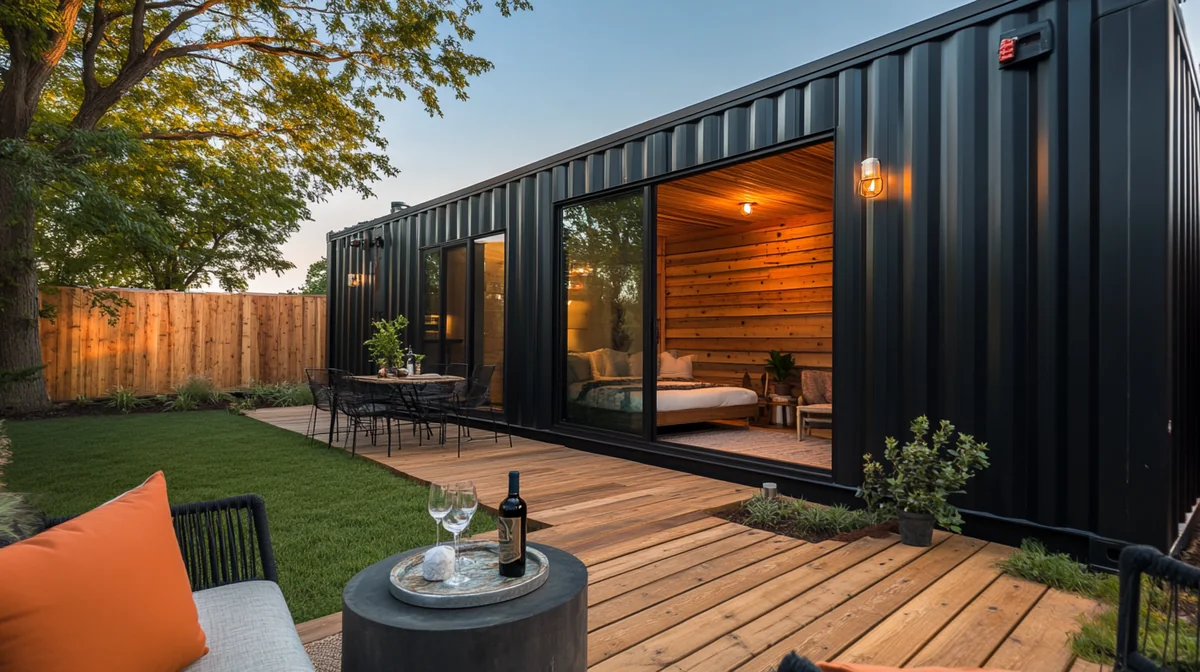


This page is for owners and builders of shipping-container vacation rentals. A container stay sells on three things at once: the design, the setting and the story of the build. It also carries doubts a regular cabin does not, about heat, cold, width and whether the county approved it. Good marketing answers those doubts as plainly as it shows the steel.
Below are the code, zoning and permit questions to settle before you build or buy, the insulation and climate details guests ask about, how to reach the guests who book on design, a photo shot list, listing copy, a pricing method built on your own comparison set, the insurance questions to ask, and how direct booking fits inside platform rules. Rules and fees change and vary by place, so confirm each one with the local office or your own advisor.
What Makes a Container Stay Sell
Do not market a container rental against the three-bedroom house down the road. The guest is choosing a building, a place and a story, and the listing has to deliver all three. Price still matters, but the first question in the guest's mind is whether the stay looks like the one they came for, and the second is whether it will be comfortable.
The Design
The steel is the brand. Guests who search for a container stay want to see the corrugated walls, the cut openings and the cargo doors that tell them where the building came from. When a build hides every trace of the container behind drywall and siding, the marketing loses its main asset, and the guest has no reason to choose it over a cabin. Where local rules allow, leave at least one wall, the ceiling ribs or the exterior recognizably a container, and make everything the guest touches warm: wood, linen, soft light, a good mattress.
The Width
Every design decision starts from one number. Ocean Network Express lists the inside width of its standard 20-foot and 40-foot high cube containers at 7 feet 8 inches, and notes that individual containers differ. The 40-foot high cube gives 8 feet 10 inches of inside height against 7 feet 10 inches in the standard 20-foot box, a foot of headroom that counts once the ceiling is insulated.
Example: the same source lists the 40-foot high cube at 39 feet 6 inches long inside, so the bare floor is about 303 square feet. If insulation plus finish takes 3 inches on each wall and each end, the room becomes 7 feet 2 inches by 39 feet, about 280 square feet. Plan the layout around that width from day one: a galley kitchen along one wall, the bed across the far end, and a wall of glass or a deck that makes the room read wider.
The Setting
A container on a suburban lot is a box. The same container facing a canyon, a forest edge or open water is a frame for the view. The setting does much of the selling, so the listing, the photos and the website should show what the container looks out on, how far away the neighbors are and what the drive in is like. If the site has no view, the build has to carry the stay with an outdoor room: a deck, a fire pit, an outdoor shower or a tub. Owners who mix containers with tents or cabins on one site will find more on our glamping and eco retreats page.
The Build Story
Guests who book design-led stays like to know how the place came to be: who designed it, how many containers it took, what was cut out and why, how it was insulated, where the timber came from. Tell that story once, plainly, on the website and near the top of the listing, and keep photos from the build. A clear build story gives editors, creators and word of mouth something to repeat, and it shows the guest that the owner thought about comfort, not only about looks.
Building Codes, Zoning and Permits for Container Homes
A container home needs three separate yeses, and each office can say no for a different reason. Zoning decides whether the building and the rental use are allowed on the land. The building department decides whether the structure is safe to sleep in. A short-term rental permit or registration, where your town or county requires one, decides whether you can take paying guests. Settle all three before you buy land or containers.
What the Building Code Says
The 2021 edition of the International Building Code has a section on shipping containers used as buildings. The Matanuska-Susitna Borough in Alaska, for example, states that 2021 IBC Section 3115 and other applicable sections apply, that construction documents must contain information to verify the dimensions and establish the physical properties of the container's steel and wood floor components, and that a structural analysis meeting IBC Section 3115.8.4 must be provided to the building official.
Two things follow for an owner. First, the container is treated as a building material that someone has to document and analyze, so budget for a design professional who has done container work before. Second, each state, county or city adopts its own code edition with its own amendments, and editions change over time. Ask the building department which edition applies to your parcel and whether it wants stamped drawings for a container dwelling.
Questions to Ask Zoning and Building Staff
- How does the code classify a container here? Ask whether it counts as a single-family dwelling, an accessory dwelling or a storage structure in your zone. A use approved for storage is not a use approved for sleeping, so get the answer before you buy.
- Is short-term rental allowed, and what does it require? Ask about permits, registration numbers, lodging tax accounts, inspections, guest caps and parking. Our report on the state of short-term rental permits in 2026 is a starting point; the local office has the final word.
- What do water, wastewater and power need? Ask what the parcel needs before a dwelling permit is issued: a septic design, a well permit, a utility letter or an approved off-grid system.
- What foundation and design loads apply? Ask what foundation, anchoring, wind and snow design the county expects, since those set the engineer's scope and part of the site cost.
- Which energy code applies? Its insulation and window requirements decide how thick the walls get, and so how much of the 7-foot-8-inch width you keep.
- Are there appearance rules? Ask whether the zone requires siding, a pitched roof or other finishes on dwellings, since that decides how much of the container guests will see.
- Are there private rules on the land? Read the deed and any association covenants for limits on rentals and exterior materials.
Get each answer in writing, with the name of the person who gave it and the date. Staff change, and a written answer is easier to rely on when you apply for the permit, the loan or the insurance.
Zoning, building and rental rules vary by state, county and town, and they change. Treat this section as a list of questions, not legal advice, and confirm each answer with the local office or a land-use lawyer before you commit money.
Insulation, Heat and Condensation in a Steel Box
Temperature is the doubt guests bring to a container listing, and it is the complaint a container build can least afford. Steel conducts heat readily. A bare box in full sun heats the room under its roof, and on a cold night the walls pull warmth out of the room. When warm, humid inside air meets cold steel, water condenses on it, and that moisture ends up in the walls, the ceiling and the bedding unless the build is designed to stop it.
What the Build Needs
- Continuous insulation. Insulate the walls, ceiling and floor, and cover the ribs, corner posts and door frames so no bare steel faces the inside air. Check the corners and door ends, where gaps are easy to leave.
- Air sealing and vapor control. Ask your designer to specify how the wall handles moisture in your climate, and seal every cut, window and pipe penetration.
- Shade. A second roof, a shade sail, trees or a light exterior color reduce the sun load on the steel.
- Ventilation. A bathroom fan and a kitchen hood that vent outside remove moisture before it reaches a cold surface.
- Heating and cooling sized for the site. The Department of Energy says that in moderate climates heat pumps can be an energy-efficient alternative to furnaces and air conditioners, and it lists ductless mini-splits among heat pump types. In hotter or colder places, ask the HVAC contractor to size the equipment for your climate rather than guess.
- Quiet in the rain. Rain and hail are loud on bare steel. Insulation and a second roof help, and if the sound remains, say so in the listing.
What to Tell Guests
Airbnb's page of shipping container rentals in the United States offers air conditioning as one of its popular amenity filters, so tag it if you have it. Then write the climate setup into the listing: what heats and cools the home, where the controls are, how the home handles a heat wave or a cold snap, and how the bathroom stays dry. One sentence about the insulation and one photo of the equipment answer the question before it turns into a review.
Seasons matter as much as comfort. Write each season into the listing: what the home is like on the hottest and coldest nights, and what guests can do outside at that time of year. A guest who books in the off-season wants to know the home is comfortable then too, so add photos from a second season when you can.
How to Market a Container Home to the Right Guests
A container stay draws two kinds of interest. One is the guest who has saved the place for months because the design is the reason for the trip. The other is curiosity: people who like the idea but are unsure about the size, the heat and the bathroom. Both book, and both review. Speak to the first group and answer the second group's doubts, because a guest who books on novelty and finds the space tight writes the review that costs you the next design-minded guest.
Who Books Container Stays
- Design-minded couples and solo travelers. They book the building and the setting, read the whole listing and notice details. Show them materials, light and the view.
- Small families and groups of friends. Airbnb's U.S. container page has its own section for family-friendly container rentals. For these guests the sleeping layout, the number of bathrooms and what is safe for children decide the booking.
- Guests marking an occasion. A birthday, an anniversary, a proposal. They look for the tub, the fire, the photo spot and the privacy.
- Remote workers on longer stays. Market to them only if the build has a real desk, fast internet and room to live in for a week. Airbnb lets you set weekly and monthly discounts, covered in the pricing section below.
- People planning their own container home. Architects, builders and future owners may book to see how it was done. The build story and a page on how the home works are written for them.
Channels That Fit a Container Stay
Short video suits this property type. The cargo door swinging open onto the view, the tub at night, a storm on the steel roof heard from a warm bed. Post where design-minded travelers spend time, and point every clip to the property's own website, where the full story lives. Give design and travel editors a press kit with the build story, plans, design credits and high-resolution photos, so the property is easy to cover. Keep the message the same everywhere: the building, the setting, the comfort.
Creator Stays and Disclosure
Hosting a travel creator for free is one way to get a container stay seen. The FTC says influencers must disclose a financial, employment, personal or family relationship with a brand, that free or discounted products or services count, and that in a video the disclosure belongs in the video itself, not only in the description. Put the disclosure, the deliverables and the posting dates in a written agreement, and judge the result by website visits and bookings rather than likes. Our host guide to influencer stays covers the terms.
The Photo Shot List for a Container Home
A container home sells on curiosity, and the photos have to settle it fast. The guest wants proof that this is a comfortable house, not a novelty they will regret at 2 a.m. Skip the gallery that shows the exterior five times and the bed once. Brief the photographer on this list, in this order:
- The exterior at dusk, with the interior lit through the glass. This is the frame that stops the scroll.
- The setting: what the container looks out on, the approach and the distance to neighbors.
- The main room from the entrance, wide, so the guest sees the whole living space in one look.
- The bed, made tight, with the window and the headroom visible.
- The bathroom, with the shower, the toilet and the size made plain.
- The kitchen in use: coffee set up, a cutting board out, the real appliances.
- The climate equipment: the mini-split or stove, the insulated ceiling, the shade structure.
- The outdoor room: deck, patio, fire pit or tub. Airbnb's U.S. container page groups rentals with a patio and with outdoor seating, so show yours clearly.
- The build details: welded seams, cut steel, the original doors, the container markings if you kept them.
- Scale: one frame with a person or a familiar piece of furniture, so the width reads correctly.
Shoot the scale plainly. A wide lens that makes a 300-square-foot room look like a loft produces the review you do not want. Let the drama come from the setting and the light. Shoot the steel on an overcast day as well as at golden hour, because soft light shows paint and patina evenly. Our guide to Airbnb listing photos that book covers shot lists and photo order.
Write a one-line caption for every photo that answers a question: "Mini-split heats and cools the whole room," "Queen bed under the canyon window, blackout shade." Captions do the reassuring a photo cannot.
Writing the Container Home Listing
The title names the build, the setting and the standout feature. Guests looking for this kind of stay search by building type, so the words shipping container or container home belong in the title and the first line, not deep in the amenities.
Example: a title such as "Shipping container home on desert acreage, outdoor tub, stargazing deck" tells the guest the building, the place and the reason to book in one line.
Pick the Property Type With Care
On Airbnb's U.S. shipping container page, most listings are labeled Shipping container, while others in the same collection carry labels such as Cabin, Tiny home or Treehouse. Choose the type that matches how guests will search for your place, and put the word container in the title either way, so the listing reads correctly wherever it appears.
Answer the Doubts in Order
The first lines describe the moment the build makes possible: the glass wall open to the canyon, the tub under the stars, the whole house warm on a cold night. After that, answer the questions that cause complaints, in the order guests ask them:
- Size. Square footage, inside width, ceiling height and bed sizes.
- Heat and cold. What heats and cools the home and how it handles local extremes.
- Bathroom and water. A full bathroom or a composting toilet, hot water, and the water supply if the site is off-grid.
- Power and internet. Grid or solar, internet speed and cell signal.
- The road in. Surface, slope, and whether a regular car can make it in every season.
- Noise and neighbors. Rain on the roof, nearby units, the road.
Tag every amenity that reassures: heating and air conditioning, the kitchen or its exact appliances, wifi, parking, the patio and outdoor seating. A container home that is upfront about being small or off-grid attracts the guest who came for that and filters out the one who did not. The listing optimization service rewrites and tags the full set across platforms.
Pricing a Container Home Without Guesswork
A single average nightly rate for container homes would mislead you, because the category runs from one 20-foot box on farmland to a multi-container house on the coast. Price from your own comparison set instead, and let your booking data correct you.
- Build a comparison set. Pick 8 to 12 stays a guest would weigh against yours: the same area or the same drive from the same city, the same guest count, a similar design standard. Include cabins and tiny homes; Airbnb's own container collection mixes them in, so guests see them side by side.
- Read their calendars. Note which dates book weeks ahead and which sit open, weekends against weekdays, season by season.
- Set a floor and a ceiling. The floor covers cleaning, utilities, supplies, platform fees and a return on your time. The ceiling is what comparable stays of your standard get on their best nights.
- Use the pricing tool inside your limits. Airbnb's Smart Pricing uses hundreds of factors about your listing and your area to adjust the nightly price, within a minimum and maximum you enter, and you can change prices or turn it off at any time. Weekly, monthly and trip-length discounts override it.
- Review every month. Compare your booked nights and lead times with the set, and move the floor or the ceiling before you change the whole plan.
Know What the Platform Keeps
Airbnb's service fee page says most hosts on the split-fee structure pay 3% while guests pay a service fee of 14.1% to 16.5% of the booking subtotal. On the single-fee structure the whole fee comes out of the host payout, and most hosts pay 15.5%. The page says the single fee applies to hosts who use property management software and that Airbnb is moving all home hosts to it, as of October 2026. Run your own numbers in our Airbnb host fee calculator before you set the floor.
Price the experience, not the square footage. A container home is usually small, and a per-square-foot comparison with a large house says little about what a guest will pay for the setting, the tub and the design.
Insurance Questions for a Container Rental
Start with the policy you already have. The NAIC says most homeowners or dwelling insurance policies are not designed to cover accidents arising from short-term rentals, and that homeowners policies usually exclude or limit coverage for running a business in the home. It points hosts to options such as a landlord policy, added coverage on an existing policy, on-demand coverage where a state allows it, and insurance that some rental platforms offer.
Platform protection has limits of its own. Airbnb's AirCover for Hosts lists host damage protection that can reimburse costs up to $3 million and $1 million in liability insurance, and Airbnb presents it as available only on Airbnb. Read its terms and exclusions, and arrange separate cover for stays booked through your own website or other platforms.
Questions to Put to Your Agent
- How do you classify a container dwelling? Ask whether steel container construction changes eligibility, price or the inspection the insurer wants.
- Are paid nightly stays covered? Get the business-use and short-term rental wording in writing.
- What does liability cover? Ask about guest injuries on decks, stairs, roof terraces, tubs and fire pits, the outdoor features you advertise.
- Does permit status matter? Ask how an unpermitted structure or an unpermitted rental use would affect a claim.
- Is lost income covered? If a storm or a burst pipe closes the rental, ask what replaces the cancelled bookings.
- What about gear you lend? Bikes, kayaks and similar equipment: the NAIC notes that liability coverage for such items may be limited or nonexistent.
Our directory of STR insurance and damage protection providers is a place to start comparing. Insurance rules and products vary by state, so confirm terms with a licensed agent, and ask your state insurance department which companies offer home-sharing coverage, as the NAIC suggests.
Direct Booking for a Container Home
When a guest discovers your container home in a video, an article or a friend's photos, searches for it by name and lands on a platform listing, you pay the platform's fee on a booking your own content created. A website with the property's name on the domain, the same photos and a booking calendar gives that guest a direct way to book. Compare the numbers in the direct-booking calculator.
What the Website Needs
- The build story. Told once and plainly, with the designer and builder credited.
- How the home works. Heating and cooling, water, power, internet and the road in.
- A full gallery. Every frame from the shot list above, with captions.
- The setting by season. What there is to do nearby, and what the home is like in each season.
- An easy booking flow. Clear rates, fees, house rules and cancellation terms, as easy to use as the platforms.
- Press and creator coverage. Linked, so new visitors see that others have stayed and written about it.
Stay Inside the Platform Rules
Airbnb's Off-Platform and Fee Transparency Policy bars hosts from asking or encouraging guests to move current, future or repeat bookings off Airbnb, from offering discounts to book off Airbnb, from asking for contact information before booking, and from using guest contact information for marketing. So the website serves guests who find you on their own, through search, AI answers, press, social media and referrals. Keep the two channels separate.
AI answers are one of those routes. In Cavmir's July 2026 study of 550 Google AI answers across 15 U.S. markets, independent and regional operators got 82% of citations, and Airbnb or Vrbo appeared in 17% of answers, as the AI-search visibility study shows. A container home with its own site, clear facts and press coverage gives those answers something to cite. For other places to list an unusual stay, the booking platforms comparison lays out the options.
How Cavmir Works With Container Homes
Cavmir is a marketing agency for distinctive vacation rentals, not a builder or a property manager. For a container home that means photography direction built on the shot list above, listing copy and setup across platforms, a direct-booking website that tells the build story and explains how the home works, SEO for the searches guests type, GEO so AI answers can name the property, digital PR with design and travel editors, social video, and paid ads aimed at the guests most likely to book. The work follows Cavmir's 12-Step System.
Every container home starts from a different place, so we do not promise a percentage. We record your starting numbers before the work begins and report progress against them. Results depend on the rules, the setting and the build as much as on the marketing.
Frequently Asked Questions
Questions owners ask about this property type, answered from public sources checked in October 2026.
Is a shipping container home a good short-term rental?
It can be, when three things line up: the zoning and rental rules allow it, the setting gives the container something to frame, and the build handles heat, cold and moisture. Airbnb runs a dedicated browse page for shipping container rentals in the United States, so guests can look for the type by name. The main risks are permits, the narrow inside width and a climate build that falls short, so check all three before you buy.
Do container homes need a building permit?
Assume so until the local building department says otherwise. The 2021 International Building Code includes a section on shipping containers used as buildings. Alaska's Matanuska-Susitna Borough, for one, applies that section and asks for construction documents that establish the dimensions and properties of the container's steel and wood floor, plus a structural analysis. Codes, editions and local amendments vary, so confirm the rules with your county or city building department before you buy land or containers.
How much room is inside a shipping container home?
Ocean Network Express lists the inside of its 40-foot high cube container at 39 feet 6 inches long, 7 feet 8 inches wide and 8 feet 10 inches high, and notes that individual units differ. Its standard 20-foot container is 19 feet 4 inches long and 7 feet 10 inches high inside, with the same width. Insulation and wall finishes take inches off each side, so plan the layout around the narrow width or join containers for more room.
Do shipping container rentals get too hot or too cold?
A bare steel box heats up in the sun, loses warmth fast on a cold night, and can collect condensation on cold steel. A build with continuous insulation, sealed openings, ventilation, shade, and heating and cooling sized for the local climate is designed to prevent that. The Department of Energy notes that in moderate climates heat pumps can be an energy-efficient alternative to furnaces and air conditioners. Say in the listing how the home is heated and cooled.
How do I market a container home Airbnb to the right guests?
Lead with the design, the setting and the build story rather than novelty. Show the steel, the view and the comfort, state the size and climate setup plainly, and use short video that points to your own website. Give design and travel editors a press kit with the build story, plans and photos. Guests who book on design read the details, so every doubt answered in the listing protects the reviews that attract the next one.
Should I host influencers at my container tiny house?
It can work if the creator's audience matches your guests and you agree in writing what they will post and when. The FTC says influencers must disclose a financial, employment, personal or family relationship with a brand, that free or discounted products or services count, and that in a video the disclosure belongs in the video itself, not only in the description. Judge the result by website visits and bookings, not likes.
How should I price a container home rental?
Build a comparison set of stays a guest would weigh against yours, including cabins and tiny homes in the same area, read their calendars, and set a floor and a ceiling. Airbnb's Smart Pricing adjusts nightly prices inside a minimum and maximum you set, and weekly and monthly discounts override it. Account for the platform fee: Airbnb says most hosts on its single-fee structure pay 15.5%. Review the numbers every month.
Does homeowners insurance cover renting out a container home?
Often it does not. The NAIC says most homeowners or dwelling policies are not designed to cover accidents arising from short-term rentals and usually exclude or limit coverage for running a business in the home. Options include a landlord policy, added coverage, or on-demand coverage where your state allows it. Airbnb presents AirCover for Hosts as available only on Airbnb. Ask your agent how the insurer treats a steel container dwelling, and get the rental terms in writing.
Can a container home take direct bookings?
Yes, through its own website, for guests who find you through search, AI answers, press, social media or referrals. Airbnb's Off-Platform and Fee Transparency Policy bars hosts from encouraging guests to move bookings off Airbnb, offering discounts to book off Airbnb, asking for contact details before booking and using guest contact information for marketing. Keep the channels separate, and give the website the build story, the full gallery and an easy booking flow.
Is Cavmir a marketing agency for modular and prefab homes?
Cavmir markets vacation rentals, including container, modular and prefab builds that are rented by the night. The work covers websites and direct booking, SEO, GEO for AI answers, digital PR, content, social media, paid ads and photography direction. Cavmir does not build, sell or manage homes, so construction stays with your builder and day-to-day guest operations stay with you or your property manager.