The Economics of Tiny Home Airbnbs
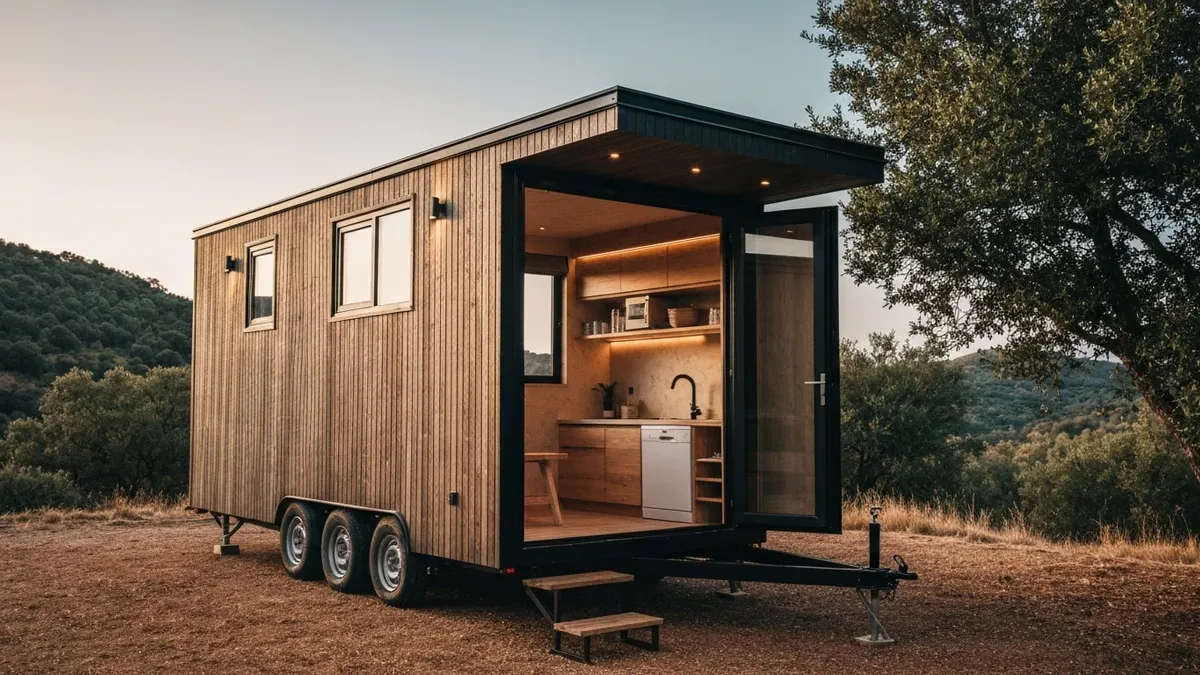
Tiny homes — typically defined as structures under 400 square feet — are counterintuitive as STR investments because the price-per-square-foot logic that governs conventional real estate doesn't apply. A 300-square-foot tiny home in a compelling setting can and does command more per night than a 1,500-square-foot conventional rental in the same market. The comparison that matters is not square footage. It's guest experience and the scarcity of the category.
The economics work when three conditions are met: the design is excellent (compact spaces are unforgiving of poor design decisions), the setting is distinctive (a tiny home in a backyard of a suburban neighborhood is not the same product as a tiny home on a private wooded lot), and the listing is positioned as a design-forward unique stay rather than as a budget option that happens to be small.
Operators who treat tiny home STRs as a low-cost entry into the market — buying a basic pre-fab tiny home and listing it for $85 per night — are leaving 60–80% of potential revenue on the table. The operators who understand that the tiny home category attracts premium guests when executed well are hitting $180–$320 per night on the same or smaller structures.
Design Decisions That Drive Revenue
In a tiny home, every design decision is visible. There's no room to hide poor choices behind square footage. The design has to be intentional, functional, and visually coherent — and it should lean into the constraints of small space rather than apologizing for them.
The design elements that consistently generate the strongest review language and justify premium pricing: exposed structure (timber frames, visible rafters, shiplap that acknowledges the building's character), large windows that make the interior feel connected to the landscape, a sleeping loft with dramatic proportions and quality bedding, and a bathroom that punches above its weight with stone tile, a rain shower, and considered lighting.
Built-in furniture is not just a space-saving technique — it's an aesthetic signal. A dining banquette built into the corner, a bed platform with integrated storage underneath, shelving that wraps a reading nook: these tell guests that someone designed this space with genuine thought. That thought is what they're paying the premium for.
The kitchen in a tiny home STR does not need to be large, but it needs to be complete and functional. Guests who pay $200+ per night expect to be able to cook a real meal. A two-burner induction cooktop, a compact oven or convection toaster oven, a full-size refrigerator (not a bar fridge), and quality cookware are the minimum for this price tier.
Location and Positioning
Tiny home Airbnbs succeed in two distinct location contexts: urban or near-urban settings where the design-forward aesthetic attracts architecture-interested travelers who want something different from a hotel, and rural or natural settings where the tiny home's small footprint is a feature rather than a limitation — it sits lightly on the land, surrounded by forest or desert or farmland, with views that a larger building would interrupt.
The positioning language differs by context. Urban tiny homes: "An architect-designed retreat in the heart of the city — 280 square feet of considered space, no wasted room." Rural tiny homes: "A cabin at the scale of what you actually need — no excess, nothing between you and the forest."
Location also determines your guest segment. Urban placement attracts design-tourism and workcation guests. Rural placement attracts couples, solo travelers, and wellness-seeking guests. Your amenity choices, pricing structure, and minimum stay requirements should reflect which segment you're optimizing for.
Revenue Optimization for Tiny Homes
Tiny homes should never be priced on square footage — not by the operator and not in comparison to larger properties in the same market. Price on experience, category, and guest segment.
Apply minimum stay requirements strategically. A two-night weekend minimum is standard. But tiny homes attract longer-stay workcation guests at rates that are often more profitable than a constant rotation of weekend bookings — lower turnover costs, lower OTA fees as a percentage of revenue, and guests who form stronger attachments to the property and leave longer reviews. Consider pricing structures that reward 5–7 night stays with modest discounts.
Listing Optimization for Tiny Home STRs
The first thing to address in your listing title and description is the size — not defensively, but confidently. "Thoughtfully designed 280 sq ft cabin" is better than avoiding the size entirely and having guests surprised by it. Guests who book tiny homes knowing they're small are forgiving of the constraints. Guests who discover the size isn't what they expected write reviews about it.
Photography should use wide-angle lenses judiciously to show the full interior without distortion. Straight-on shots of the main living area, ideally shot from a corner with windows visible, are more useful than extremely wide shots that make the space look larger than it is. Honesty in photography for small spaces is a trust investment that pays in review quality.
Include a floor plan in your listing photos. This is underused in STR listings generally and particularly valuable for tiny homes where guests want to understand spatial organization before booking. A clean, simple floor plan drawing — even hand-sketched and photographed — reduces booking hesitation and decreases post-booking cancellations.
Operations at Small Scale
Tiny homes turn over quickly — 2-hour cleaning windows are tight but manageable. Establish a precise turnover checklist because in 280 square feet, a single missed item (an unwashed coffee cup, a tangled throw blanket) is immediately visible. Build buffer time between checkout and check-in: 3–4 hours minimum.
Guest communication should include a specific note about the size-is-by-design nature of the property. "This home is 280 square feet — every inch is intentional. It's ideal for two guests, not four. Please review the floor plan and photos carefully before booking to ensure it suits your needs." This pre-screens inappropriate bookings and creates alignment before arrival.
The Bottom Line
Tiny home Airbnbs are a case study in how positioning and design quality determine revenue more than property size. The operators hitting $200–$320 per night in this category didn't get there by having a big property. They got there by having a distinctive one — a space where every square foot was considered, photographed honestly, and marketed to the guest who understands what a well-designed small space actually means. That guest is less price-sensitive, more review-generous, and more likely to return than the guest who books primarily on size and price.
Was this article helpful?
Thanks for your feedback!