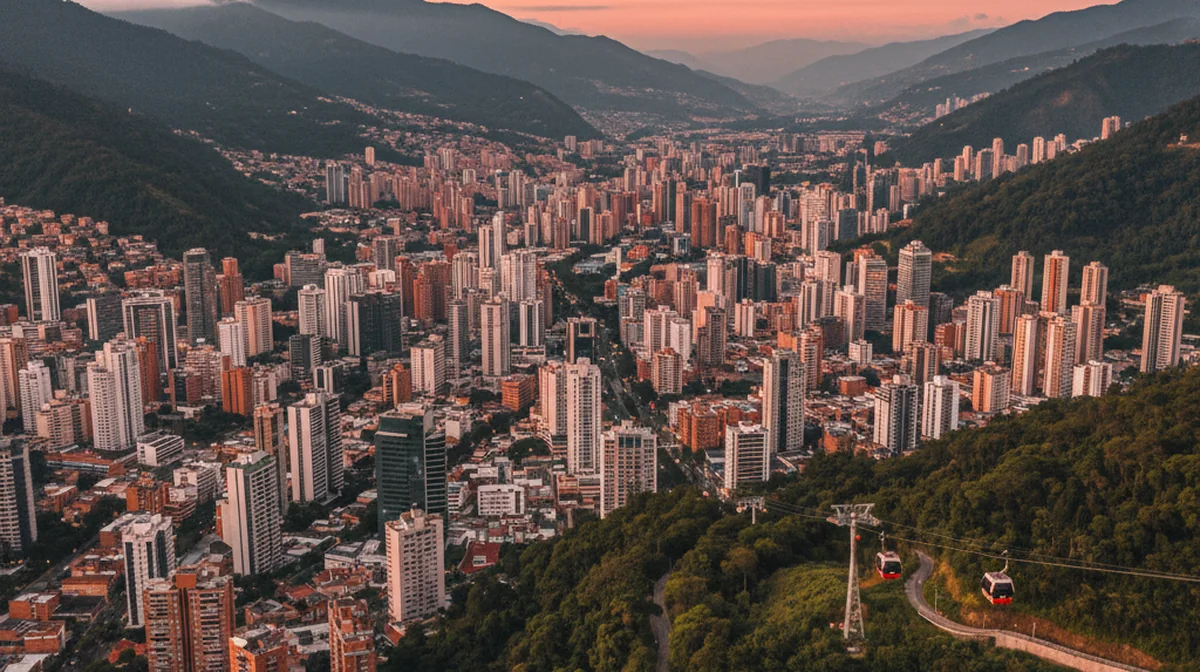
Five years ago, Medellin was a market that cautious investors skipped. The city had transformed, but the perception lag was real. Today, Medellin is one of the fastest-growing STR markets in Latin America — and the driver isn't tourists in the traditional sense. It's digital nomads, remote workers, and long-stay travelers who've discovered that a city with eternal spring weather, 600 Mbps fiber internet, world-class coffee shops, and a walkable nightlife scene is an extraordinary place to live and work for two to three months at a time.
The $95 average daily rate understates the opportunity. The correct way to read Medellin's economics is by looking at the 62% of guests who stay 7+ nights — and what the monthly rate economics look like for that segment. The hosts building real revenue here aren't optimizing for weekend bookings. They're building long-stay machines.
The Market Data
Source: AirDNA Colombia Market Report 2024
That 81% occupancy figure is exceptional for a $95 ADR market. It reflects the structural advantage of long-stay demand: when guests are staying 14–30 days, your calendar fills up faster and your turnover costs drop dramatically. A host running a 2-bedroom El Poblado apartment at $2,200/month (30-day rate) with zero cleaning turnover is generating better net revenue than the same host chasing $95/night short stays at 70% occupancy.
El Poblado vs Laureles vs Envigado
Medellin's STR market is heavily concentrated in three neighborhoods, each with a distinct character and guest profile:
El Poblado: The international epicenter. Most expats, most digital nomads, highest concentration of bars and restaurants, most English-friendly. Also the most competitive and the most expensive neighborhood to own or rent property. ADRs here are the highest in the city — $85–$130/night for a well-presented 1BR. The audience is international and they're specifically choosing El Poblado for the community and infrastructure, not just the apartment.
Laureles: The emerging alternative. More Colombian in character, quieter, slightly lower costs. Attracting a more experienced type of traveler — people who've been to Medellin before, who've done El Poblado, and who now want something more local. ADRs of $70–$100/night, but lower competition and often better value per dollar on the property ownership side. Laureles is the neighborhood to watch for the next three to five years.
Envigado: The quietest and most residential. Popular with families, solo digital nomads who want to avoid El Poblado's nightlife, and guests on extended stays (1–3 months). ADRs of $60–$85/night, but monthly rate economics are strong. The metro line connecting Envigado to the city center makes it genuinely practical for longer-term guests.
Laureles is increasingly the preferred neighborhood for experienced Medellin visitors — properties here benefit from lower competition and a more authentic local positioning.
The Digital Nomad Wave: Building for Long Stays
of Medellin Airbnb bookings are for 7+ nights — nearly double the global average — reflecting the city's structural appeal to digital nomads and extended-stay travelers.
The digital nomad segment is Medellin's defining STR demand driver. These guests are making a choice between Medellin and competing cities — Lisbon, Chiang Mai, Tbilisi, Buenos Aires. What tips the decision toward Medellin: cost (your dollar goes much further), internet quality (fiber is widespread and fast in El Poblado and Laureles), climate (the "City of Eternal Spring" isn't marketing copy — it's genuinely 65–75°F year-round), and the community (the expat and nomad community in El Poblado is active and self-reinforcing).
To capture this segment, your listing needs to signal explicitly that you're set up for it. That means: documented WiFi speed (test it and post the screenshot), a dedicated ergonomic workspace not just a dining table, blackout curtains for daytime work, a monthly rate that represents meaningful savings versus nightly, and copy that speaks to the 30-day lifestyle rather than just the weekend getaway.
The hosts who capture the most digital nomad bookings in Medellin have also mastered a simple tactic: they include a brief neighborhood guide in the listing that covers the best co-working spaces, the coffee shops with reliable power outlets, the grocery options, and the closest laundry service. This isn't just hospitality — it's a direct signal that you understand what this type of guest actually needs.
The Spanish Marketing Advantage
Most Medellin STR hosts marketing to international guests write their listings in English only. That's a missed opportunity for Colombian domestic demand, which is significant and year-round. Bogotá residents, Cali travelers, and guests from other Colombian cities represent consistent weekend and holiday demand that most foreign-owned listings fail to capture because their listing copy doesn't speak to them.
A bilingual listing (Spanish and English) gets indexed better in Spanish-language search on Airbnb, reaches domestic Colombian demand, and builds credibility with international Latin American guests from Brazil, Argentina, and Chile who may not be fully English-comfortable. The effort is one afternoon of translation work, and the upside is access to an entirely separate demand pool.
See our social media service for how we build bilingual content strategies for Latin American market properties.
Luxury Segment Growth: What's Working at the Top
Medellin's luxury STR segment is growing faster than the mid-market. The influx of wealthier remote workers and HNWI visitors — often coming from the US, Europe, and now Middle East — has created demand for properties at $200–$400/night that barely existed three years ago. The penthouse and hilltop villa segment in El Poblado is now genuinely competitive with other Latin American luxury STR markets.
The differentiators at this price point in Medellin are specific: rooftop terraces with city and mountain views, heated pools or jacuzzis (evenings are cool in Medellin even in peak season), and concierge services — car with driver, private chef dinner, experience curation. These guests aren't just choosing a property; they're buying an executive lifestyle package for the duration of their stay.
Partner with one local private chef and one reliable driver service, and list both explicitly as add-ons in your listing. In Medellin specifically, these two amenities convert luxury segment guests who are comparing your property to boutique hotels — the hotel has concierge, and now you do too.
Distribution Strategy: Going Beyond Airbnb
Airbnb dominates Medellin's STR discovery, but a multi-channel strategy is essential for maximizing occupancy, particularly for the long-stay segment. VRBO reaches a different demographic — typically older, higher-spend North American guests on 7–14 night leisure trips. Booking.com reaches European guests who may not default to Airbnb. And direct booking infrastructure becomes increasingly valuable as you accumulate repeat guest relationships.
Read our multi-channel distribution strategy guide for the full framework on platform prioritization — and review our 2025 best STR investment markets guide for how Medellin compares to other emerging markets in the global comparison.
The Bottom Line
Medellin's STR market in 2025 is a long-stay optimization game. The $95 ADR is only part of the story — the real opportunity is in the 62% of guests staying 7+ nights, and the monthly-rate economics that make Medellin genuinely exceptional for hosts who position for extended stays. The city's fundamentals — infrastructure, climate, cost structure, community — make it structurally attractive to digital nomads and remote workers in a way that can't be easily replicated by other markets.
The hosts who are struggling in Medellin are optimizing for the wrong metrics: they're chasing 2-night occupancy at top dollar when the market rewards 30-night stays at smart monthly rates. Rethink the model, invest in the workspace and WiFi infrastructure, build the bilingual listing, and Medellin becomes one of the most reliable STR markets in the Americas.