
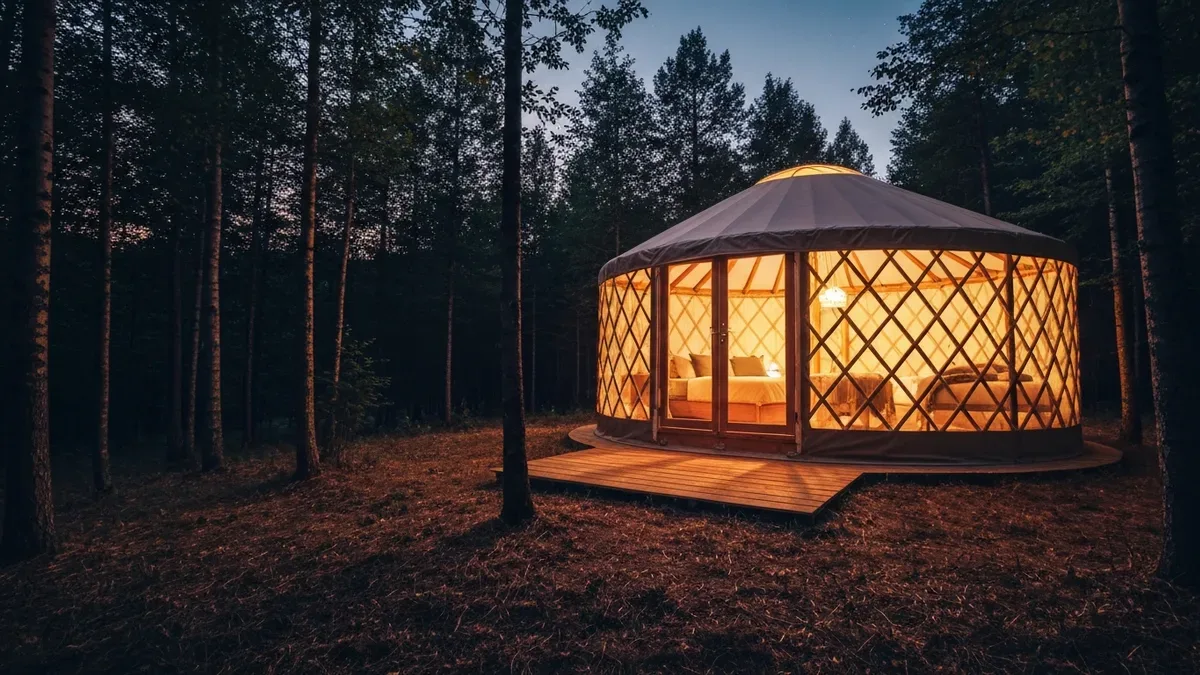
Why Yurts Work as a Commercial STR Product
Yurts occupy a specific and defensible niche in the unique stay market. They're not as visually dramatic as treehouses or geodesic domes, but they deliver something those structures don't: an immediate sense of cultural heritage and meditative simplicity that resonates deeply with guests who are burned out on both mainstream tourism and conventional glamping.
The circular geometry of a yurt is not incidental — it shapes the interior experience in ways that rectangular structures can't replicate. There's no "front" or "back" to a yurt. Every position in the space has the same relationship to the walls and to the central skylight above. Guests consistently describe yurt stays in terms of stillness and presence. That's a marketing asset you can build a brand around.
Commercially, yurts have excellent economics. A quality 30-foot yurt platform with interior finishing and basic utilities can be built for $25,000–$45,000, significantly less than equivalent glamping structures. They perform best in the $175–$350 per night range, and in strong markets with good setting and amenities they've hit higher. Annual gross revenue of $55,000–$90,000 from a single well-positioned yurt is realistic and represents exceptional return on investment.
Getting the Setup Right
The central skylight — the tono or crown — is the signature architectural element of a yurt and should be treated as the primary design feature. Placing the bed directly below the crown so guests can lie on their back and look up at stars through the clear panel, or rain on the covered version, is the single most powerful experiential element you can provide. Every five-star review of a well-run yurt mentions lying in bed looking up at the sky.
Platform height matters more than most operators realize. A yurt raised 24–36 inches above grade on a pressure-treated platform with perimeter decking feels significantly more intentional and livable than a yurt at ground level. The deck creates an outdoor living area, improves ventilation, and prevents moisture intrusion in wet climates. It also makes for dramatically better photography because you can shoot the yurt exterior with the deck foreground at a level that shows the full structure.
Insulation is a technical requirement, not a luxury. Modern yurt covers include an insulation layer, but floor insulation on the platform is critical in cold climates and a radiant floor system, while expensive, dramatically improves the winter guest experience and extends your booking season. A yurt that's warm in February commands a different market than one that's seasonal.
The bathroom situation should be private and covered. An outdoor shower 15 feet from the yurt with a clear-polycarbonate roof over it can be genuinely beautiful and functional. A distant composting toilet down a dirt path is not an acceptable solution for a property trying to hit $200+ per night.
Marketing the Yurt Experience Specifically
Yurt marketing needs to address two distinct guest motivations. The first group comes for the outdoor and nature connection — they're hikers, campers-who-want-comfort, and wellness travelers who find conventional hotels disconnecting. The second group is seeking something culturally specific — they know the history of yurts as the homes of Central Asian nomadic peoples and find that history meaningful. Both are valid marketing angles; the best yurt listings speak to both.
Your title should establish the structure type and the setting immediately. "Luxury Yurt | Mountain Forest | Private Hot Tub" covers the essentials. If your yurt has any culturally specific elements — traditional Mongolian furnishings, a central wood stove in the original design position, hand-knotted rugs — mention them explicitly because they matter to a segment of your audience.
In your description, lead with the skylight. Describe exactly what guests will see looking up from bed: stars through the acrylic crown on clear nights, rain patterns on rainy nights, the sound of wind in the lattice walls on windy nights. These details are utterly unique to yurt stays and convert guests who have been imagining this specific experience.
Managing Seasonal Demand
Yurt STRs have a more nuanced seasonal pattern than most property types. Summer peak is obvious. But yurts in cold-climate markets have a secondary peak in late fall and early winter that many operators miss because they don't lean into it aggressively enough in their marketing.
The combination of a wood stove, heavy blankets, rain on the canvas, and stars through the crown on a clear cold night is one of the most compelling indoor/outdoor experience combinations in the STR market. Market explicitly to this: "snow falling on the canvas, wood fire lit, king bed directly under the stargazing crown" is a distinct offer that converts guests who aren't looking for summer glamping.
Operations and Maintenance Specifics
Yurt cover fabric — whether canvas or polyester — requires inspection twice yearly for UV degradation, tears, and seam separation. Most commercial yurt covers have a 15–20 year lifespan in good conditions, but the lattice-wall connections and the roof compression ring require annual inspection for structural integrity. Build a relationship with a yurt manufacturer's service network, not just a general handyman.
Wood stove operation requires a clear guest tutorial, a pre-arrival firewood delivery protocol, and fire safety documentation that meets your local requirements. Many guests have never operated a wood stove. Your welcome guide should include a one-page illustrated instruction sheet for lighting the fire safely — this reduces guest support calls, prevents dangerous improvisation, and shows up positively in reviews.
Canvas insulation and condensation: in humid climates, yurt interiors accumulate moisture from guest respiration overnight. Ensure the ventilation flap at the tono is functional, provide a dehumidifier in humid-climate settings, and air the yurt thoroughly between guest stays by opening the lattice wall's air gap points. Mold on canvas is both a maintenance and a review-score problem.
The Bottom Line
Yurts have excellent revenue economics relative to build cost and offer a genuinely distinctive experience that guests can't get from standard glamping or conventional properties. The marketing levers are specific: lead with the skylight and the circular space, address the warmth and comfort questions directly, and build seasonal marketing around the yurt's year-round potential rather than treating it as a summer product. Operators who understand the cultural dimension of yurt stays — and who reflect that understanding in how they furnish and describe their properties — consistently command higher rates and generate stronger repeat booking rates than those who treat it as just another glamping structure.
Was this article helpful?
Thanks for your feedback!