


Portugal's Mais Habitação law, passed in October 2023, was supposed to kill the Lisbon STR market. It nearly did — but not in the way most people predicted. Supply dropped by roughly 40% in central Lisbon as unlicensed operators were forced out and new licenses were effectively suspended in urban areas. For the hosts who survived — those with grandfathered licenses, legally compliant setups, or rural exemptions — what happened next was a rate surge. Fewer listings competing for the same volume of tourists means the remaining properties are performing better than they were before the law passed.
If you're operating a legal Lisbon STR in 2025, this is actually a good market. If you're considering entering, the picture is more complicated. Here's what you need to know.
The Mais Habitação Law: What Actually Changed
Source: Associação do Alojamento Local em Portugal (ALEP) 2024, AirDNA Portugal
The Mais Habitação law (Law 56/2023) suspended new AL (Alojamento Local) licenses in urban areas designated as "pressured zones" — which includes all of Lisbon municipality. Existing licensed properties could continue operating under grandfathered status. Properties that had been operating without a license were required to cease STR activity. New licenses are effectively unavailable for central Lisbon apartments unless through an appeal process that is rarely successful.
What's still legal: properties with existing valid AL licenses, properties in interior Portugal (outside pressured zones), rural tourism operations (turismo rural and agro-tourism categories have separate licensing), and entire buildings converted to tourism use under a different legal structure.
The practical result: a licensed Lisbon property in 2025 is a genuine asset. The scarcity of legal supply in prime neighborhoods has pushed compliant hosts' occupancy and rates higher even as the overall tourist volume to Lisbon continued to grow.
Alfama vs Chiado: Neighborhood Positioning in 2025
Within compliant supply, neighborhood matters enormously for rate positioning:
Alfama: Lisbon's oldest and most atmospheric neighborhood. The fado houses, historic tiles, and castle proximity make this the most photographically appealing area for international tourists. A licensed Alfama apartment with character — original azulejos, arched ceilings, vintage tile work — can command €200–€280/night during summer peak. The trade-off: narrow streets, no easy parking, some noise from fado bars. Guests who love it, love it intensely. Reviews here are either 5-star or 3-star — rarely in between.
Chiado / Bairro Alto: The premium lifestyle area. Guests here are typically 35–55, design-oriented, and shopping/restaurant-focused. Modern apartments with rooftop terraces or river views can reach €220–€300/night in summer. Lower noise complaints than Alfama, more accessible for guests with luggage. The most consistent high-rate zone in compliant Lisbon supply.
LX Factory / Alcântara: The emerging creative district. Not yet at Chiado ADRs, but growing fast as the industrial-cool aesthetic attracts a design-conscious guest segment. Properties here can differentiate strongly through a brand identity tied to the neighborhood's creative scene.
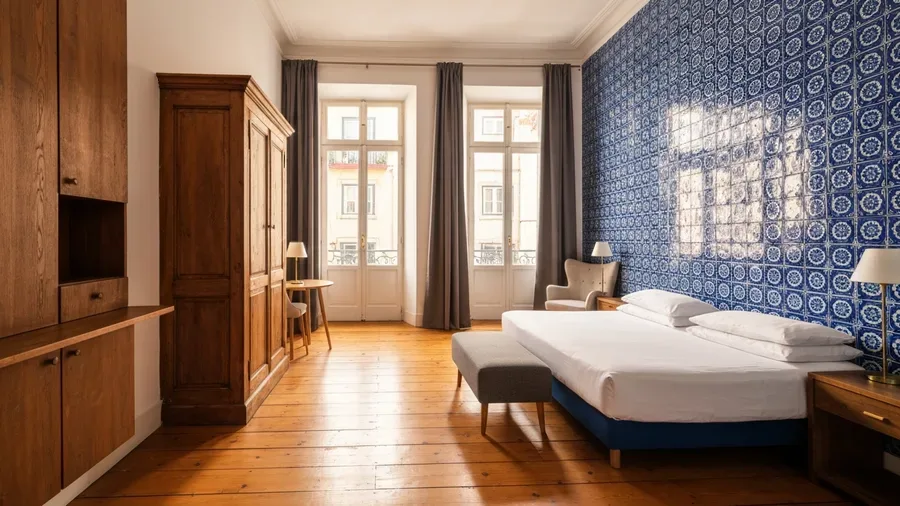
Chiado properties that lead with original architectural details — hand-painted tiles, wrought iron balconies, parquet floors — consistently outperform modernized apartments at equivalent price points.
Where Opportunity Lives: What's Still Legal for New Entrants
fewer active STR listings in central Lisbon since Mais Habitação — meaning the hosts still operating legally are sharing the same tourist demand among significantly fewer competitors.
For new market entrants, the opportunity in Portugal's STR landscape has shifted significantly since 2023. The realistic paths forward:
Buy a property with an existing AL license: Licensed Lisbon apartments now trade at a premium above equivalent unlicensed units because the license itself has value. The premium varies by neighborhood but typically runs 8–15% above unlicensed comparable units. This is a legitimate arbitrage if you're buying for investment purposes — the license is a genuine asset.
Interior Portugal: Properties in the Alentejo, Douro Valley, Minho, and Algarve (outside urban pressured zones) can still obtain new AL licenses. This is where growth-oriented STR investors are focusing attention. The Douro Valley wine region, in particular, is seeing strong international tourist demand with limited supply — a profile similar to what Lisbon looked like in 2018.
Rural tourism licenses: If you have a property that qualifies as rural tourism (typically requiring a rural setting and traditional character), the rural tourism (TER) license process is separate from the AL system and available in more locations. ADRs for quality rural properties can be exceptional — €180–€300/night for a well-presented quinta (farmhouse estate).
The Digital Nomad Opportunity
Portugal's D8 Digital Nomad Visa (launched 2022) has brought a significant population of location-independent workers to Lisbon, Cascais, and the Algarve — and this segment is the best shoulder-season demand driver the Portuguese STR market has. Digital nomads typically want 30–90 day stays, reliable WiFi, a dedicated workspace, and a neighborhood feel rather than tourist-central location.
For Lisbon hosts, the monthly rate market has become a meaningful revenue stream outside of June–September peak season. A property that achieves €185/night during summer can book at €2,200/month during October–April to digital nomad guests — roughly €73/night equivalent, but with zero turnover costs and predictable occupancy. Profitability per booking is often higher on the monthly stays.
The direct booking website becomes especially valuable for this segment — digital nomads specifically look for direct booking options that allow custom stay durations and direct communication with hosts, rather than being constrained by OTA booking minimums.
List your Lisbon property on Flatio and HousingAnywhere in addition to Airbnb — these platforms specifically target medium-term renters (1–6 months) and are the primary discovery channel for digital nomads. A 30-day minimum on those platforms during October–April can fill your off-peak calendar without competing on short-stay pricing.
Lisbon STR Market Snapshot
Key Insights
- 40% supply reduction since 2023 Mais Habitação law has pushed ADRs and occupancy higher for compliant licensed properties
- Interior Portugal (Alentejo, Douro Valley) is the highest-opportunity zone for new entrants — new AL licenses still available outside urban pressured zones
- Digital nomad monthly stays are the most effective shoulder season strategy, targeting Oct–Apr occupancy gaps with 30–90 day bookings
The Bottom Line
Lisbon's STR market in 2025 rewards the hosts who did their legal homework. The supply constraint created by Mais Habitação has made compliant properties more valuable, not less. If you hold a valid AL license, you're operating in a better competitive environment than you were two years ago. If you're looking to enter the market, the path runs through buying a licensed property, looking at interior Portugal, or exploring rural tourism licensing — not through shortcuts that ignore the regulatory reality.
The marketing fundamentals haven't changed: properties that lead with architectural character, neighborhood specificity, and high-quality photography convert best. What's changed is the bar for listing quality, because the remaining supply in Lisbon includes the best-presented, most professionally operated properties — that's who you're competing against.
Explore the Lisbon market guide for neighborhood-level data, review the STR permits guide for the licensing framework, and see our direct booking system guide for building the infrastructure that captures digital nomad demand.