Art de Vivre buys, sells and rents homes across Rio de Janeiro — and runs a short-stay operation alongside it. Cavmir is building the entire platform that ties it together: a 200-plus page agency website, a live Guesty PMS integration, a guest app, and a secure client backend.
Charlie came to Cavmir with a problem most growing agencies eventually hit: the business had outgrown its website. Art de Vivre was doing three things at once — selling Rio real estate, renting furnished homes for a season or a year, and hosting guests on short stays — and none of it lived in one place a client could actually find.
Buyers were sent to one link, renters to another, and short-stay guests to a patchwork of listing pages that didn’t look or feel like the same company. The brand existed, but it wasn’t holding the whole operation together. The brokerage credibility, the design sensibility, the local knowledge of Copacabana, Ipanema, Leblon and beyond — all of it was there, and none of it was compounding.
The mandate we agreed on was deliberately large. Not a brochure site and not a single listings feed, but a complete web platform: an agency website substantial enough to carry a real brokerage catalog, a booking layer wired directly into the property-management system the team already trusts, and the guest-facing and back-office tools that turn a website into a business you can run from your phone.
We also agreed on a principle that shaped every decision after it: everything converges on one Art de Vivre domain. Buyers, renters, short-stay guests, and the team itself should all move through the same brand, the same design language, and the same infrastructure — so that every marketing dollar, every backlink, and every returning visitor builds one asset instead of five.
What follows is what that looks like in practice: the website, the Guesty integration, the app, and the backend that Cavmir designed, built, and now maintains for Art de Vivre. You can open the live site in a new tab and follow along.
Cavmir took on the whole thing — brand, website, the Guesty booking layer, the app and the backend — as a single engagement, and that was deliberate. When one team owns every layer, the pieces actually fit: the app looks like the site, the site reflects what’s really available in Guesty, and the backend the staff use every day speaks the same language as everything the public sees. Nothing is bolted on, and there’s no finger-pointing between three vendors when something needs to change.
Before a line of the site was built, Cavmir set the brand. Art de Vivre — the art of living — needed a mark and a design language that could sit next to a multi-million-real sale listing and a three-night stay without cheapening either. The answer was restraint.
The identity is a clean monogram — the A, D and V drawn as three simple geometric shapes — paired with an emerald-and-brass palette pulled straight from Rio itself: the deep green of the hills, the warm metal of its Art Deco era. Typography is quiet and confident, photography is given room to breathe, and there is not a stray card grid or boxed-in section anywhere. Every screen looks like it was made by the same hand, because it was.
That discipline is what lets the brand carry three very different audiences at once. A buyer researching Ipanema, a family renting for a season, and a couple booking a long weekend in Copacabana all meet the same calm, considered Art de Vivre — on the website, inside the app, and even on the login screen the team uses to run it.
Emerald & brass · the art of living
Rio real estate is a serious purchase, and the site had to read that way from the first scroll — cinematic, calm, and unmistakably local.
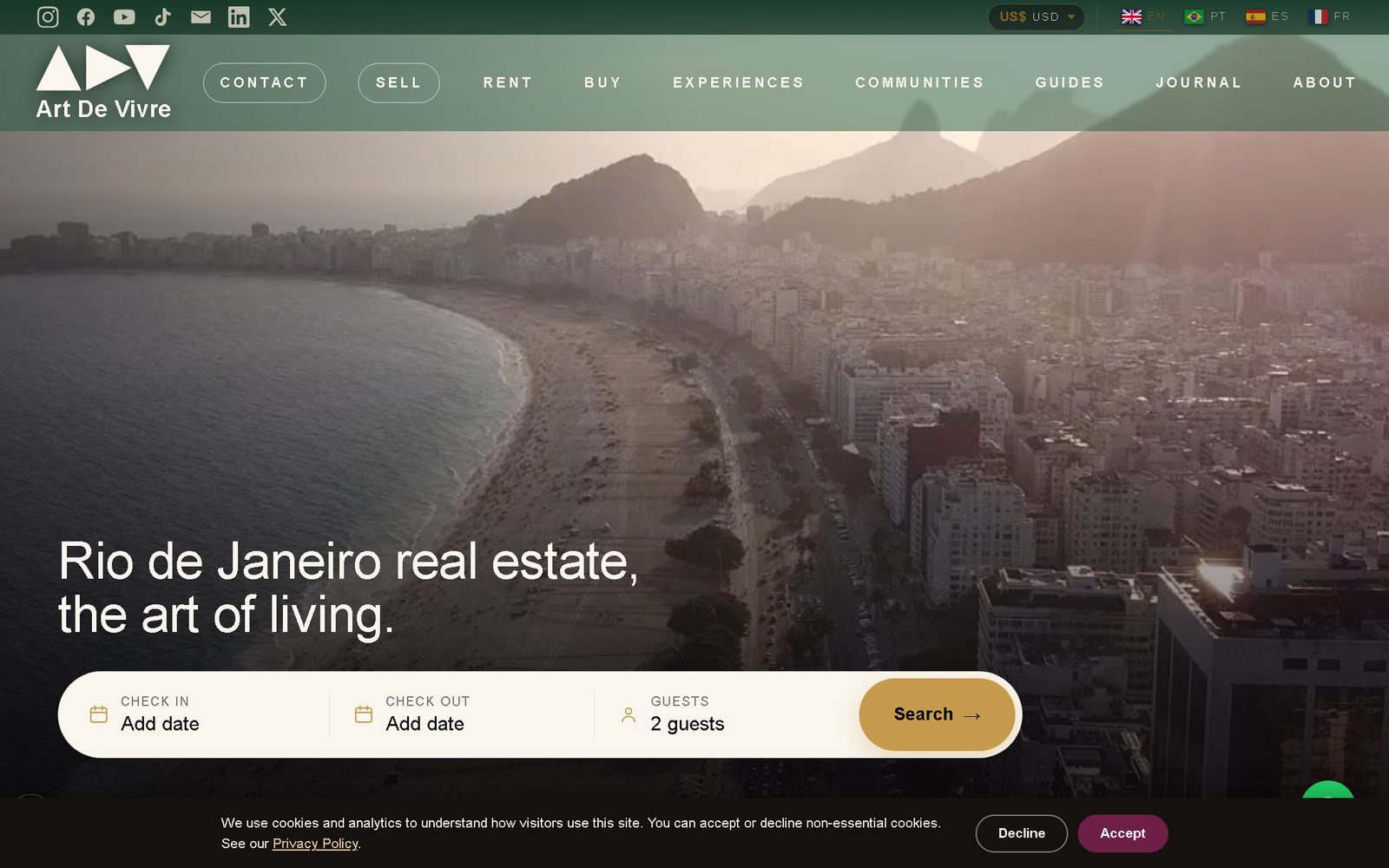
The homepage opens on the city itself — a full-bleed aerial of Copacabana under the headline “Rio de Janeiro real estate, the art of living.” A guest can start a date search immediately, a buyer can move straight into the sales catalog, and the whole thing carries the same restrained, high-end design language on every page. Nothing about it reads as a template.
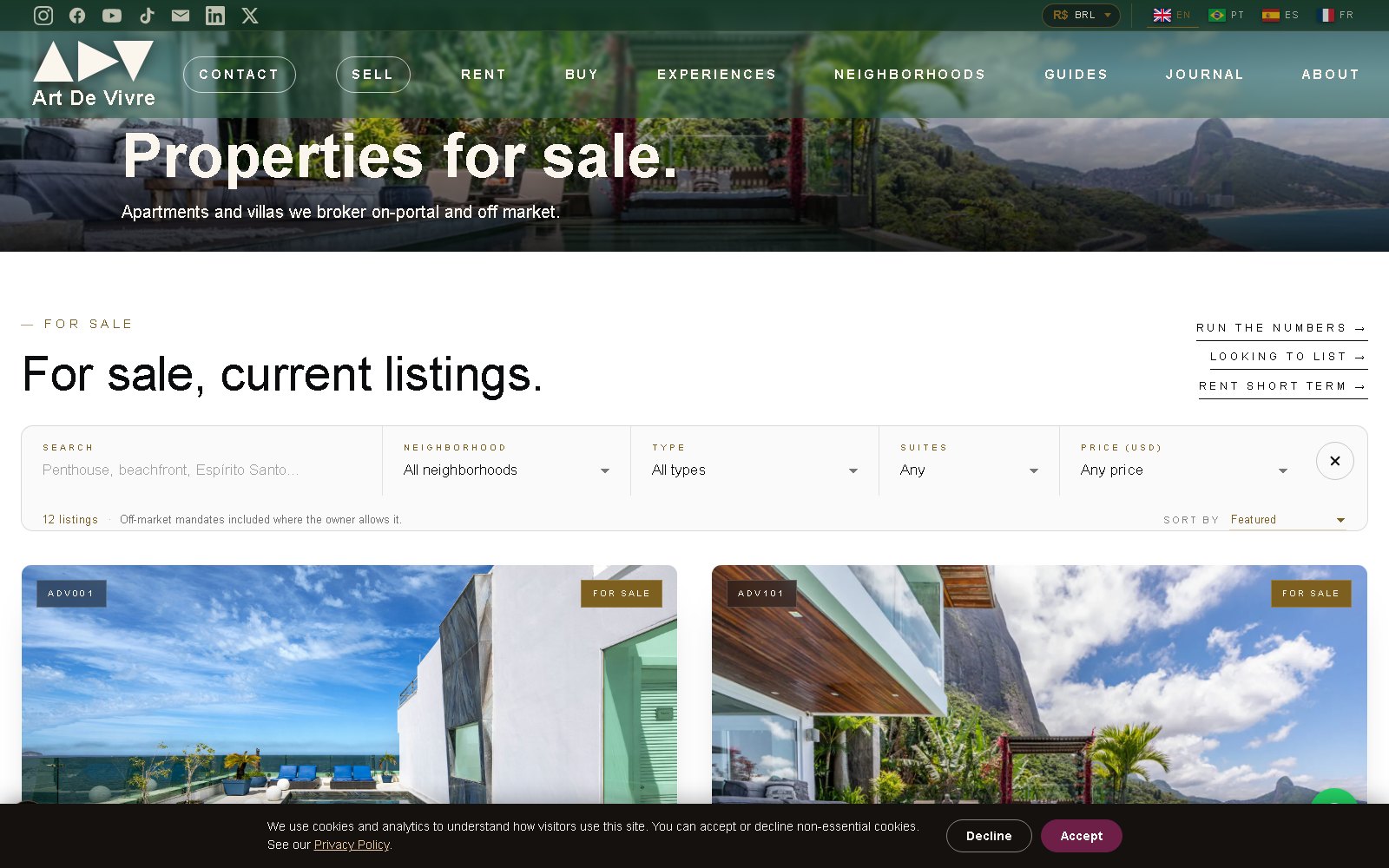
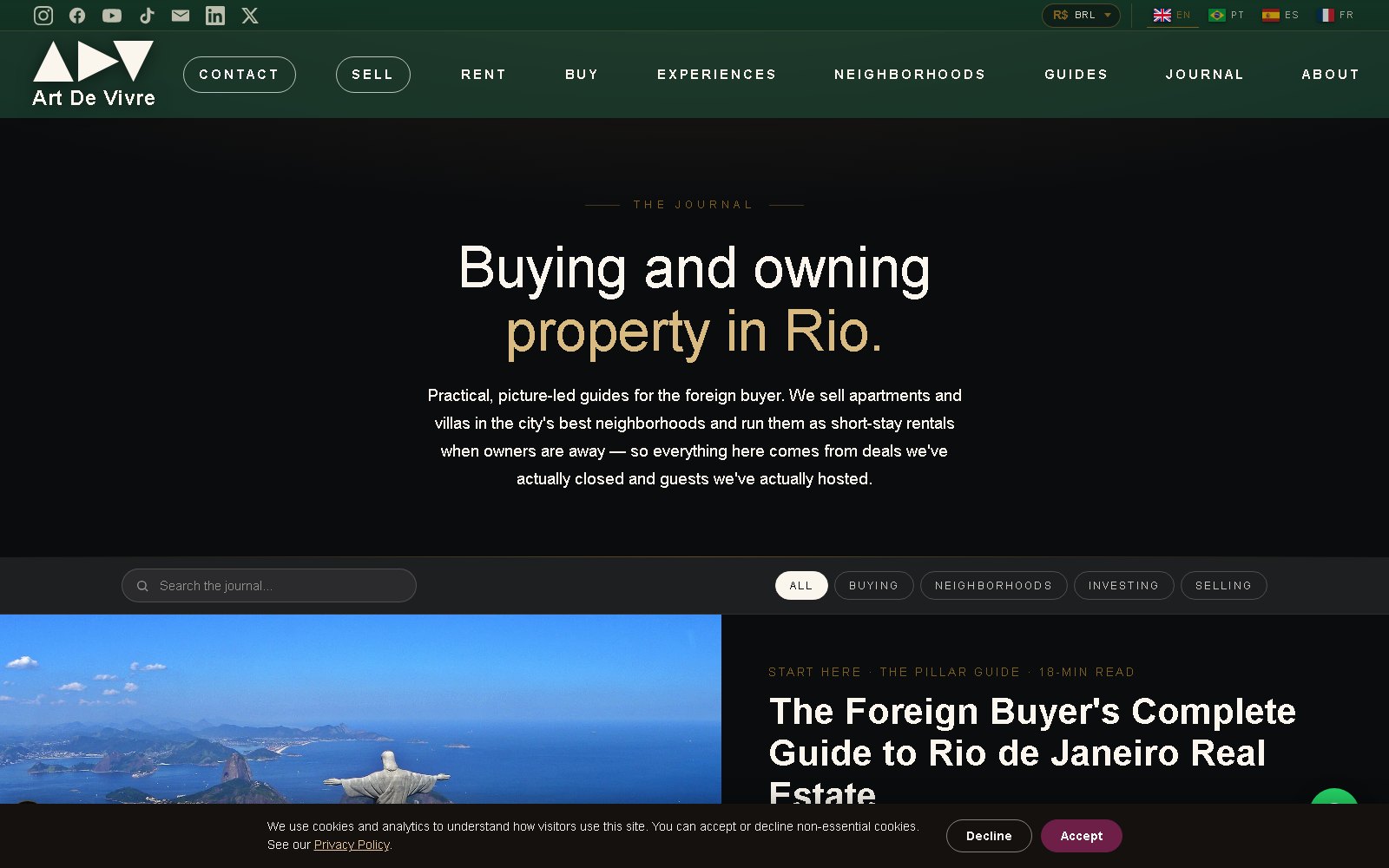
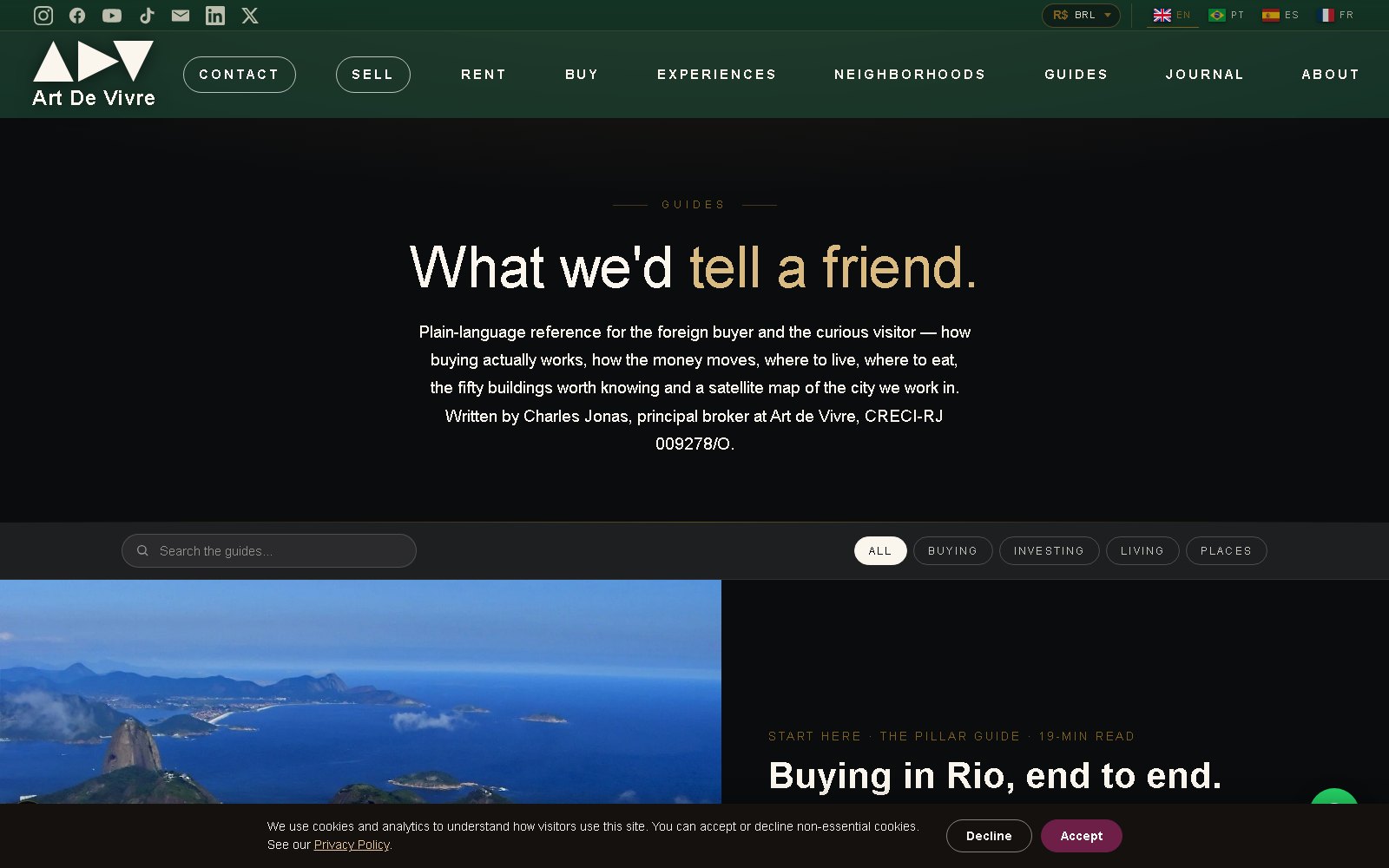
Underneath that calm surface, the site is genuinely large. It spans well past two hundred pages: the sales catalog, the furnished-rental catalog, a short-stay collection, neighborhood and building guides for the areas Art de Vivre knows best, an experiences section, a journal, and the standard trust pages a real agency needs. Several different content systems sit behind those sections — a listings database, a building-and-neighborhood library, and an editorial system for guides and the journal — and Cavmir stitched them into one coherent site so a visitor never feels the seams.
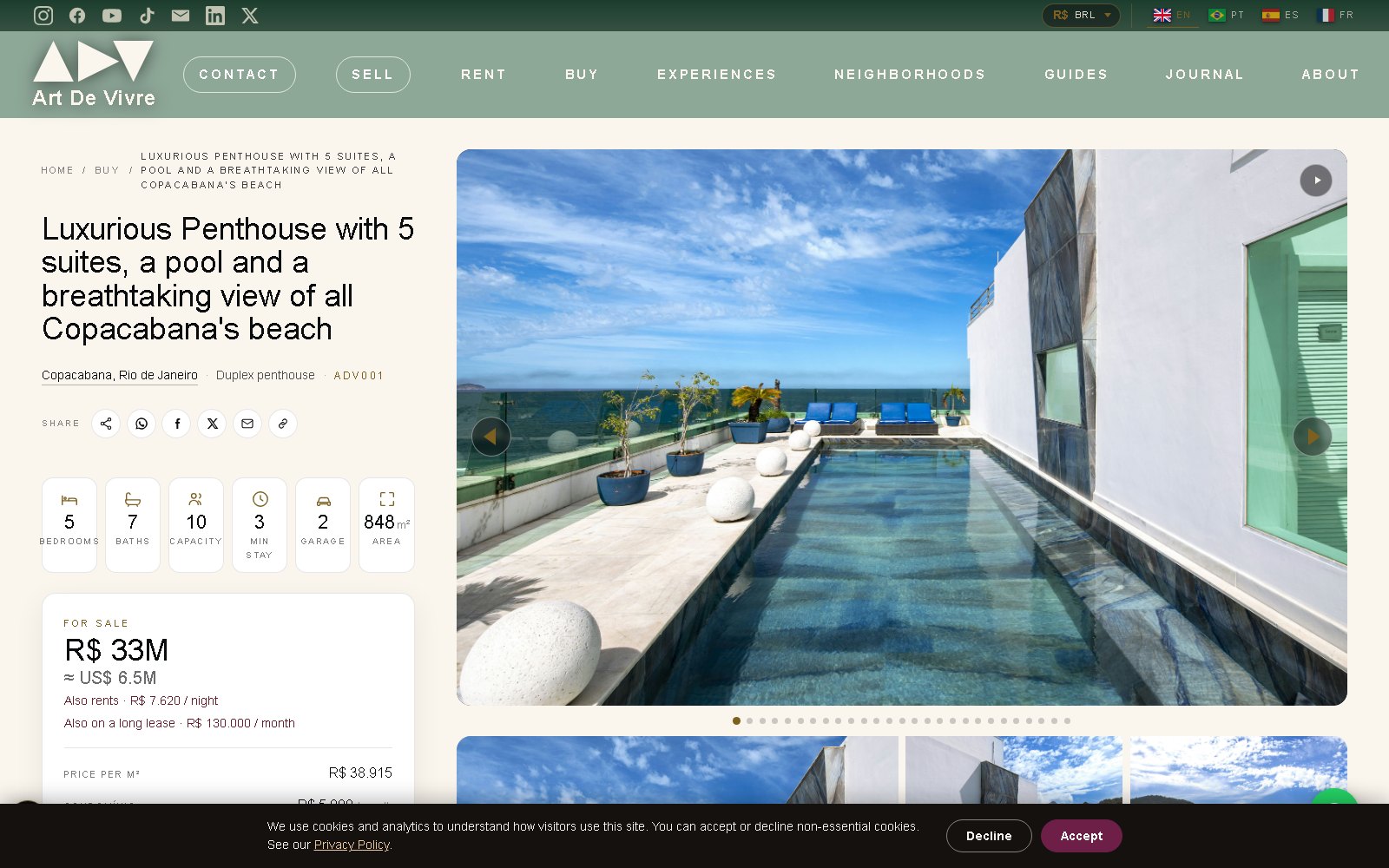
The rental catalog is a good example of the platform doing real work. “Your place in Rio, for as long as you want it” leads into furnished apartments and villas that a guest can filter and book for a night, a season, or a year — and a listing that is also for sale simply carries an “also for sale” flag, so a single home can serve a renter and a buyer without being duplicated or managed twice.
The sales side carries the same weight. Buyers move through a proper brokerage catalog with room for the detail a serious purchase demands — neighborhoods, buildings, and the context that makes a Rio address make sense to someone who doesn’t live there yet. The point was never volume for its own sake; it was to give every kind of client a real reason to stay on one site instead of bouncing out to a portal.
Short-stay operators live inside their property-management system. We didn’t ask the team to leave theirs — we connected it.
Guesty is the property-management platform that runs Art de Vivre’s short-stay operation — the single source of truth for which homes exist, what they cost, and which nights are open. It also acts as the channel manager that keeps Airbnb and the other listing sites in sync. The last thing anyone wanted was a second place to maintain all of that by hand.
So Cavmir built a direct integration. Listings, photos, nightly rates and live availability flow out of Guesty and onto the Art de Vivre site automatically. When a home is booked on Airbnb, those dates close on the website; when the team updates a price or adds a property in Guesty, the change appears on the brand’s own pages without anyone touching HTML. The website becomes a true direct-booking channel that sits alongside the OTAs instead of competing with the team’s workflow.
That’s the quiet win of this build. Every direct booking that comes through artdevivre.com.br is a booking that doesn’t pay a platform commission — and because availability is authoritative, the calendar a guest sees is the calendar that’s actually open.
It also means the team’s day doesn’t change. They keep working in Guesty exactly as before — the tool they know, with its calendars, its messaging and its channel connections — and the website simply reflects it. There’s no double entry, no reconciling two systems, and no risk of the site quietly drifting out of date. The integration does the boring, important work in the background so the brand out front always tells the truth.
Listings, rates and availability live in the PMS the team already runs every day.
Our integration pulls inventory and open dates onto the Art de Vivre domain, on brand.
The site shows real availability and takes the reservation — commission-free.
Guesty closes those nights everywhere, so the calendar is never double-booked.


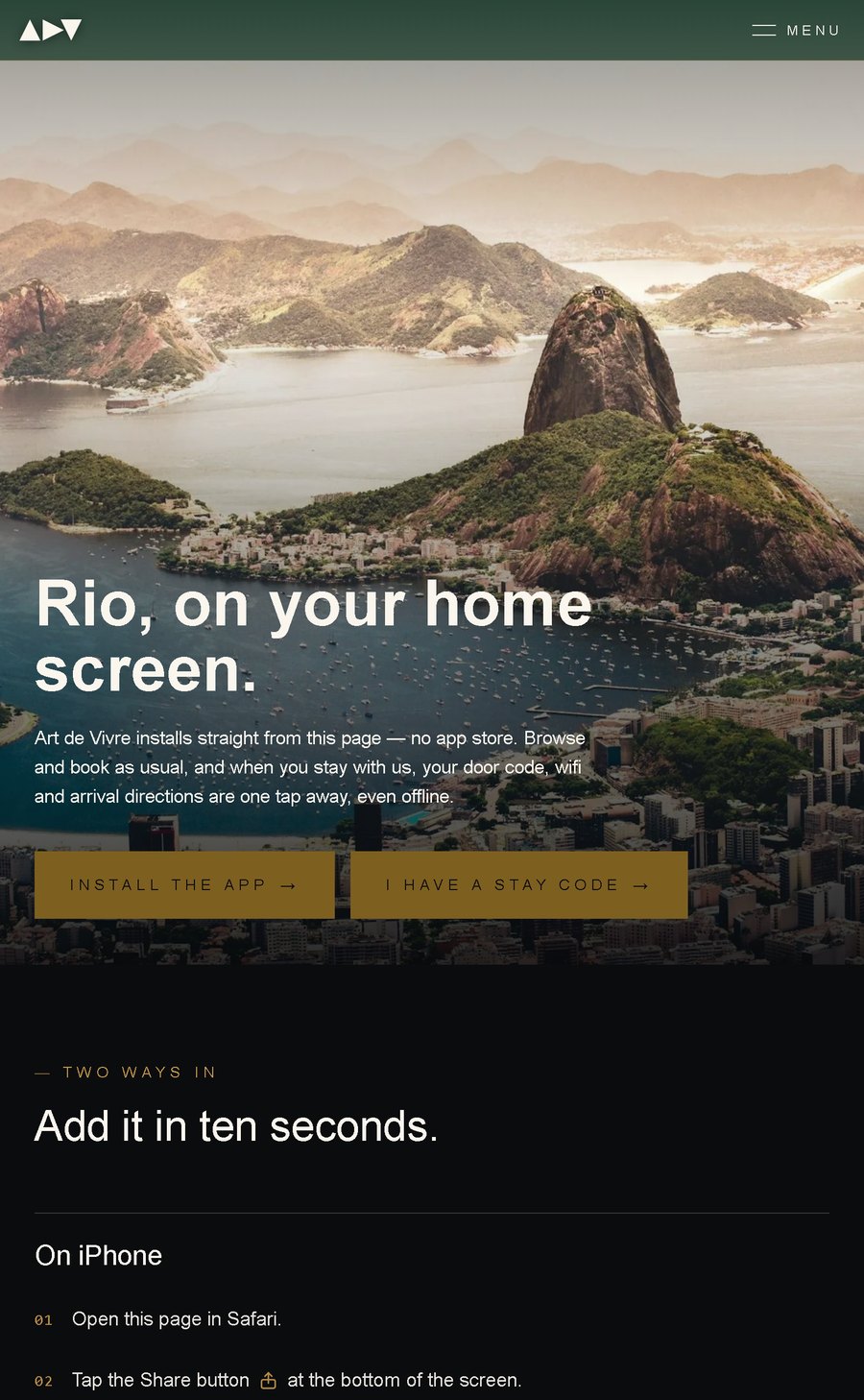
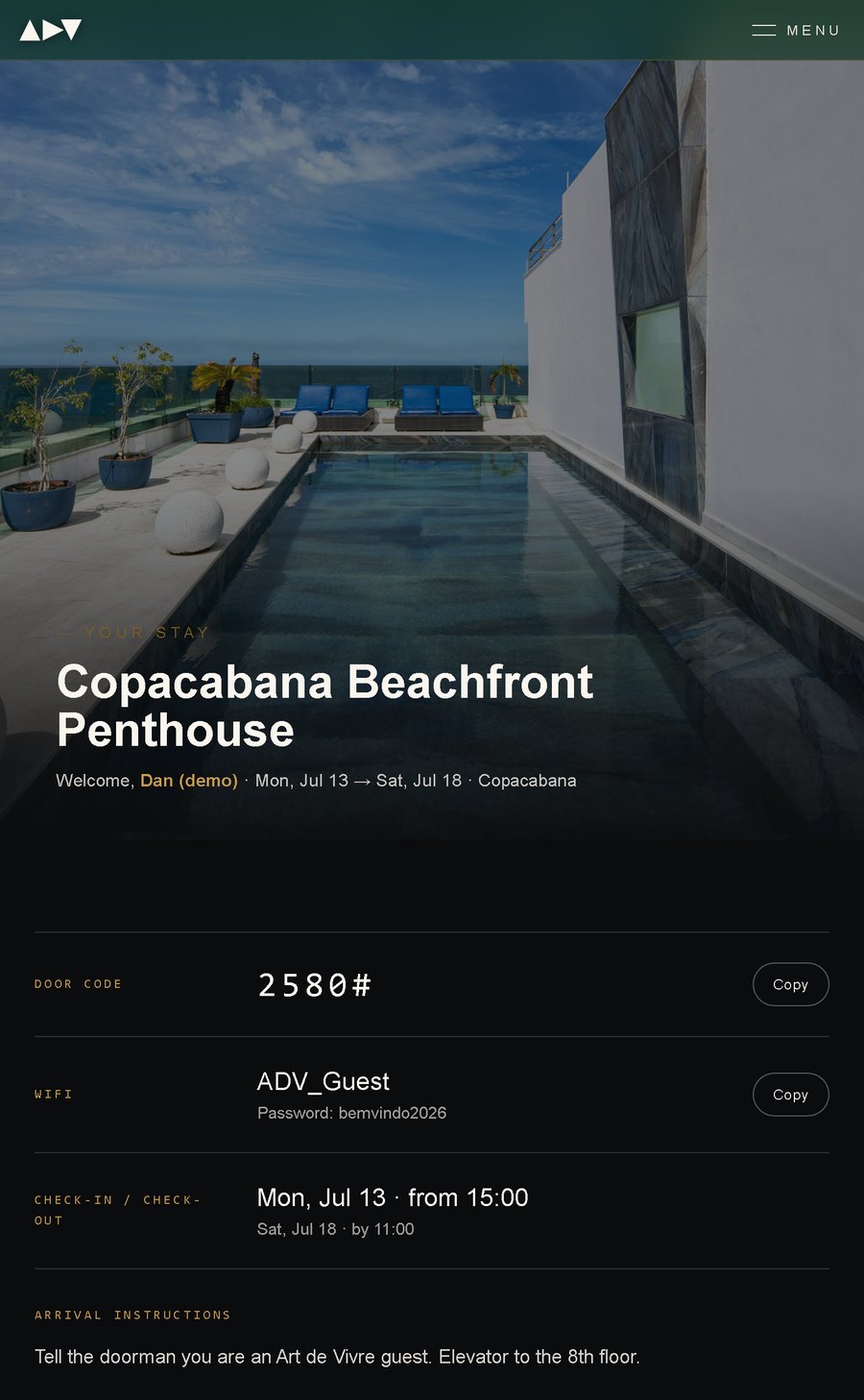
Left: install straight from the site, no app store. Right: the in-stay guide — door code, wifi and directions, one tap away.
The newest piece of the platform is an app — and it installs straight from the website. No app store, no download friction, no waiting on a review queue. A guest taps “install” and Art de Vivre lands on their home screen in about ten seconds, as a proper progressive web app.
Before a trip it’s a fast, beautiful way to browse and book. During a stay it becomes something more useful: a private in-stay guide keyed to the guest’s own reservation. The door code, the wifi network and password, arrival directions, and the essentials for the specific home they’re in are all one tap away — and because it’s built to work offline, they’re there even when a guest steps off the plane with no signal yet.
For Art de Vivre, the app is also a direct line to the guest that no listing platform can interrupt. A booking made through an OTA belongs partly to the OTA; a guest with Art de Vivre on their home screen belongs to Art de Vivre. Next time they want Rio, the brand is already in their pocket — which is exactly how a short stay turns into a returning guest, and eventually into someone who rents for a season or buys a home.
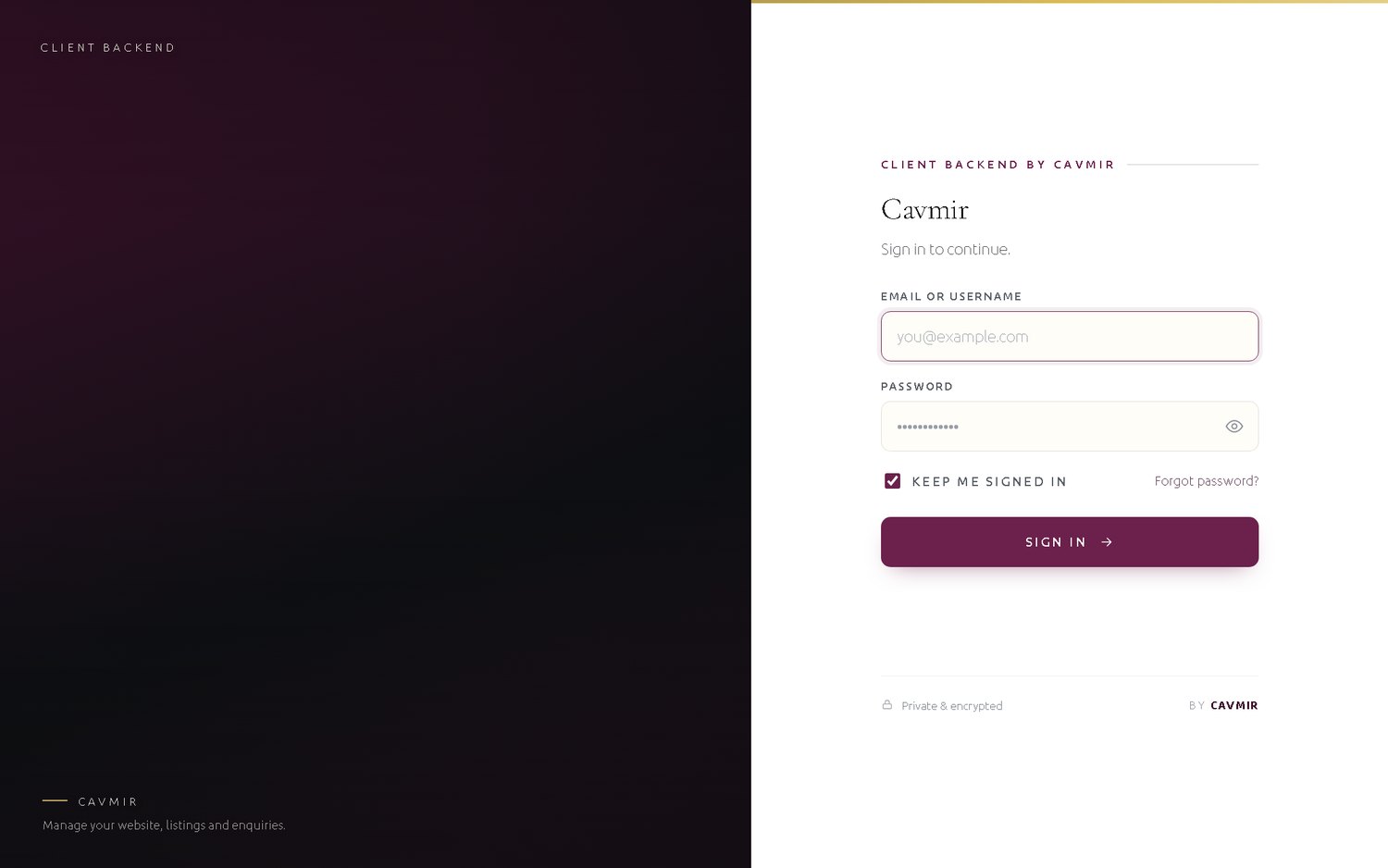
A platform this size can’t depend on a developer for every small change. So Cavmir built Art de Vivre a private back office — the Client Backend by Cavmir — behind a secure, two-factor sign-in.
From there the team edits listing details and photos, updates page copy, and reviews the enquiries coming in from the site, all through a clean interface that speaks their language rather than a database’s. Nothing about it exposes the machinery underneath: it’s “update this listing, publish this note, read this lead,” not a wall of fields. Everything is private and encrypted, and the publishing flow pushes approved changes live safely.
It matters more than it sounds. A brokerage that has to email a developer to change a headline moves slowly and pays for every edit; a team that can update its own listings, sale prices and page copy in minutes moves at the speed of the market. Cavmir built the backend so Art de Vivre owns its own content — and so the site never goes stale waiting on someone else. The short-stay side stays where it belongs, in Guesty, so the two systems never fight over the same number.
A booking is the start of the relationship, not the end of it. The rest of the build is what turns a website into an operation.
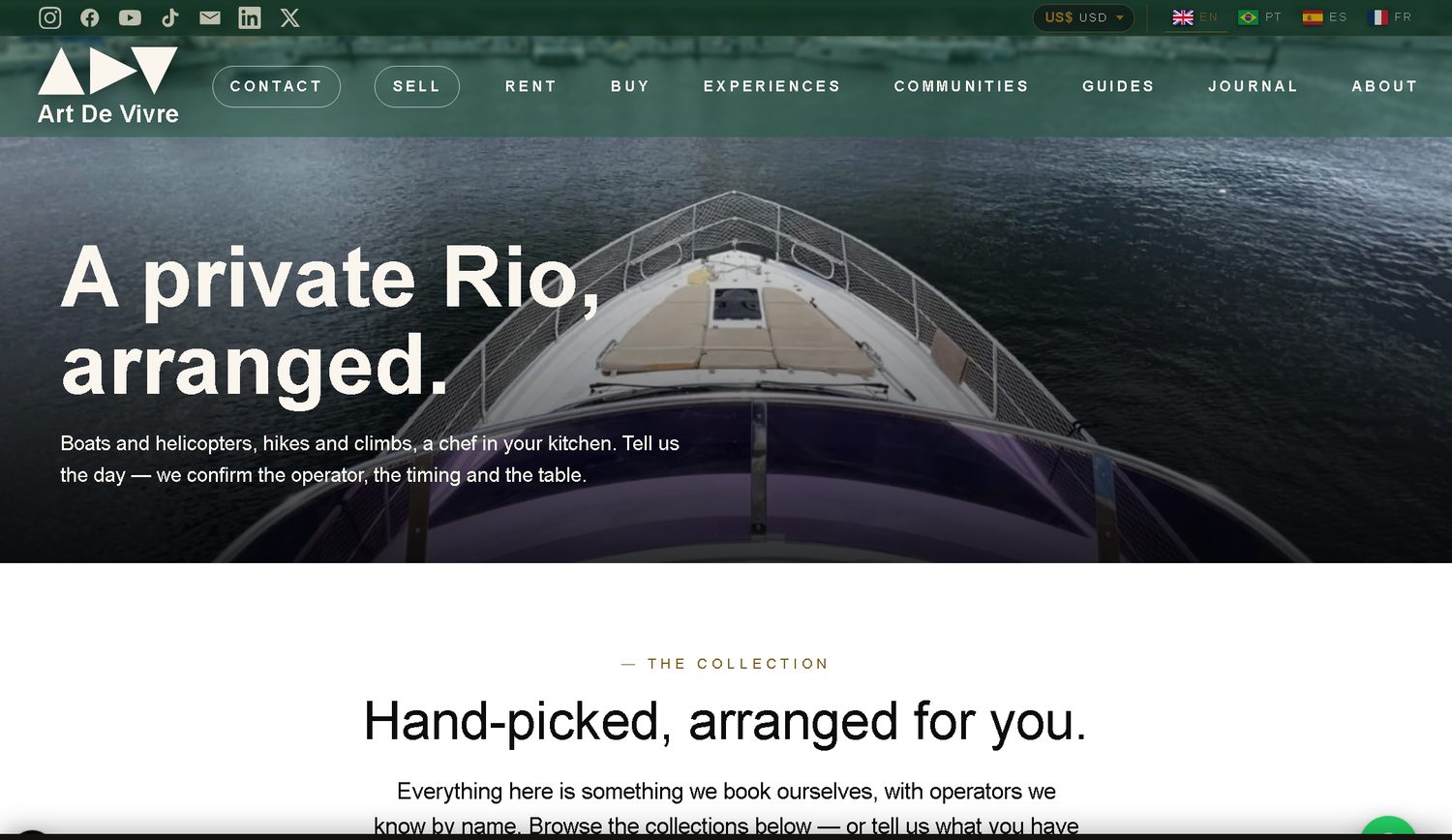
Under “A private Rio, arranged,” guests can request the things that make a trip memorable — a boat day, a helicopter over the Christ statue, a guided climb, a chef in the kitchen. Each one is hand-picked and booked on enquiry, so the team keeps control of quality and the operator relationship while the site captures the intent.
Every form on the site — a booking question, a valuation request, an experience enquiry — is routed into the backend and to the team, so nothing sits unanswered in an inbox no one checks. The website doesn’t just look like a business; it feeds one.
The whole platform is engineered for search from the ground up — clean URLs, unique titles and descriptions, structured metadata, a sitemap, and the neighborhood and building guides that answer the questions buyers and renters actually type into Google. Rio real estate is competitive; the site is built to earn its place in the results, not buy its way there.
Art de Vivre’s buyers and guests come from everywhere, so the site speaks English, Portuguese, Spanish and French, with the right language served to the right visitor and the correct hreflang signals underneath. A buyer in São Paulo and a guest in Paris meet the same brand in their own words.
A 200-page site that takes bookings and holds guest details has to be quick and dependable everywhere its audience is — not just on the office wifi.
The whole platform runs on Cloudflare’s global network, so pages load from an edge close to the visitor whether they’re in Rio, São Paulo, New York or Paris. Images are compressed and served in modern formats, and heavy media loads only when it’s needed, so the site stays fast even though it’s image-forward by design.
Security and privacy were part of the build, not an afterthought. The site ships with the full set of modern security headers, every account in the backend is protected by two-factor authentication, and guest and enquiry data is handled privately and encrypted in transit. Because Art de Vivre serves visitors in Brazil, Europe and North America, the platform carries a proper privacy policy and a cookie-consent layer that holds analytics until a visitor agrees — the practical shape of LGPD, GDPR and CCPA compliance, rather than a checkbox bolted on at the end.
The result is infrastructure the business can grow into. More listings, more languages, more traffic, another neighborhood — none of it means starting over, because the foundation was built for a platform, not a pamphlet.
One engagement, one team, one platform — from the logo to the login screen.
The Art de Vivre mark, palette and design language — the calm, high-end look that carries across every page and into the app.
200+ pages across sales, rentals, short stays, guides and journal, with several content systems stitched into one seamless site.
A direct connection that syncs listings, photos, rates and live availability from Guesty onto the brand’s own domain.
Buy, rent and stay catalogs with real availability search — commission-free reservations alongside the OTAs.
Installs from the site with no app store, plus a per-stay guide — door code, wifi, directions — that works offline.
A two-factor back office for editing listings and content and reviewing enquiries, with an approve-and-publish flow.
A curated, book-on-enquiry experiences section, with every form on the site routed to the team so no lead is lost.
Search-ready structure and content in English, Portuguese, Spanish and French, built to compete for Rio real estate intent.
Brand, platform and integrations under one roof
Buy, rent and stay finally live at one address — and the whole operation runs from a phone. The brief, delivered
Not vanity numbers — the structural change. Three businesses, one brand, on infrastructure built to scale.
Cavmir didn’t hand over a folder of files and walk away. We built Art de Vivre’s platform to be run — and we keep running it with them. New listings, new guides, seasonal changes and fresh photography move through a publishing pipeline we maintain, so the site is always current without the team ever opening a code editor.
That’s the difference between hiring an agency and buying a template. The brand, the website, the Guesty connection, the app and the backend all come from one team that understands how they fit together — and that’s on hand when the business wants to add a market, launch a campaign, or try something new. The platform grows as Art de Vivre grows.
One team for the brand, the site, the booking engine, the app and the back office — so nothing falls between the cracks.
Why clients consolidate with Cavmir
The best way to understand the work is to walk through it live. Open the site, browse the homes, install the app — then tell us about your property and we’ll map the same kind of platform for you.