
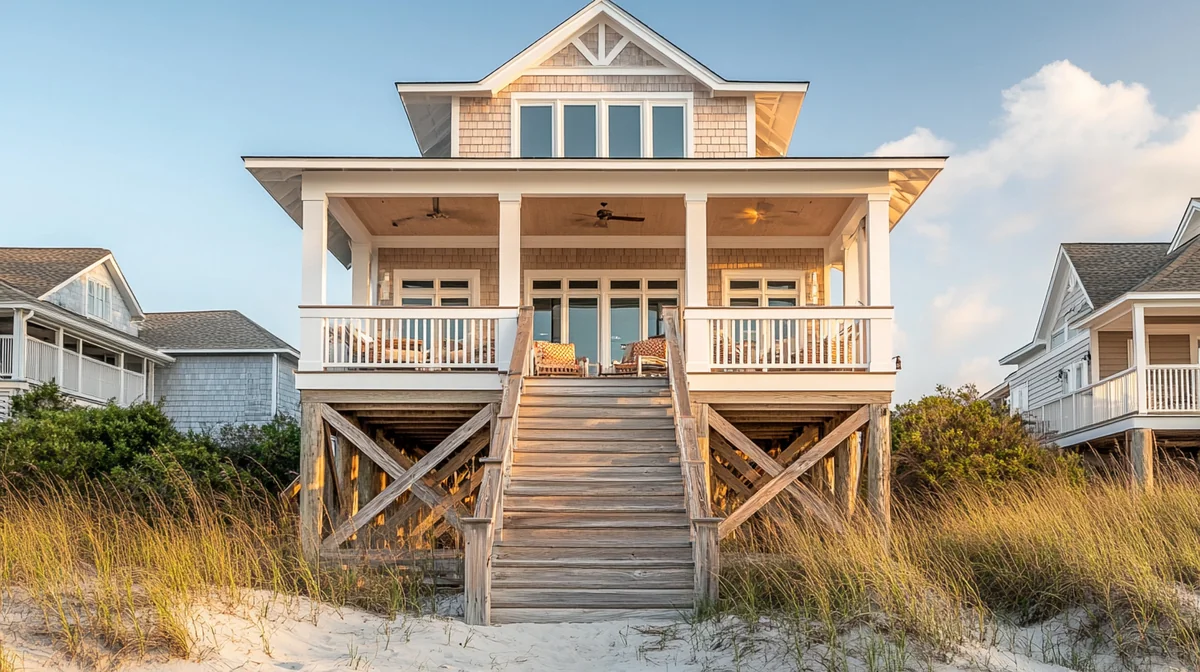




If you're a real estate broker with a rentals desk, an agent who co-hosts for your buyers, or an administrator running a portfolio of short-term rentals for their owners, this page is for you — whether that portfolio is a handful of units or a few dozen. Cavmir builds the marketing side of your operation: the portfolio website, the direct-booking engine on top of your PMS, the content that ranks, and the brand that wins the next mandate.
There's a specific kind of operator the vacation-rental industry keeps forgetting. You're too big for the advice written for a host with one apartment. You're too small for the enterprise agencies that want a property-management company with a hundred doors and a marketing department to talk to. You sit in the middle: a licensed broker whose owners kept asking you to rent their places out, an agent who picked up co-hosting one unit and now runs fourteen, an administrator whose whole business is other people's keys. Your calendar is full of ownership, cleaning schedules, check-ins, and statements. Marketing is the thing you know you should be doing and never get to.
"The marketing side" deserves a definition, because in this industry the phrase gets used for everything from a logo to a Facebook ad. We mean the demand infrastructure: the brand the whole portfolio stands under, the website where every property lives and books, the integration that lets that site sell real nights from your real calendars, the content that pulls travelers out of search results, and the owner-facing presence that wins the next mandate. Operations — keys, cleaners, guests, pricing decisions — stay entirely yours. Cavmir is a marketing agency, never the property manager.
Cavmir works with exactly this operator. Two of the builds on this page — a CRECI-licensed brokerage in Rio de Janeiro and a real estate company's rental division on St. Croix — are live, real, and shown below in detail, because the fastest way to explain what we do for brokers and administrators is to show the work.

Who This Page Is For
Three operators keep landing in our inbox with the same problem wearing different clothes.
You sell property, and buyers started asking you to rent out what they bought. Now a short-stay operation runs alongside the brokerage — but it lives on Airbnb under a host profile that says nothing about your firm, and the two halves of your business never feed each other.
One owner trusted you, then their neighbor, then a referral. Now you run a whole portfolio from your phone. Every listing is a separate island with its own photos and reviews — and nowhere on the internet does the whole operation stand together as one thing.
The administradora in Latin America and Europe; the local manager in the US who never called themselves a "management company." A real portfolio under informal mandates, entirely dependent on the platforms. You're a small hospitality company — and nothing about your marketing says so.
What all three share: the portfolio is real, the operations work, and the demand side runs entirely on rented ground. Airbnb decides what your storefront looks like. The OTA fee comes off the top of every single booking across every single unit. Guests belong to the platform, so a repeat guest is a coincidence instead of an asset. And when you pitch the next owner, you're pitching from a host profile that looks exactly like the eight other people they're interviewing.
Cavmir's job is to put the demand side on ground you own. What that looks like in practice is below — twice, with real clients.
Art de Vivre, Rio de Janeiro
Charles Jonas runs Art de Vivre, a CRECI-licensed brokerage in Rio de Janeiro that buys, sells, and rents homes, with a short-stay operation running alongside the brokerage. He is exactly the operator this page describes: a broker whose rentals desk grew into a real hospitality business, with properties spread across Rio's best neighborhoods and a sales catalog running in parallel.
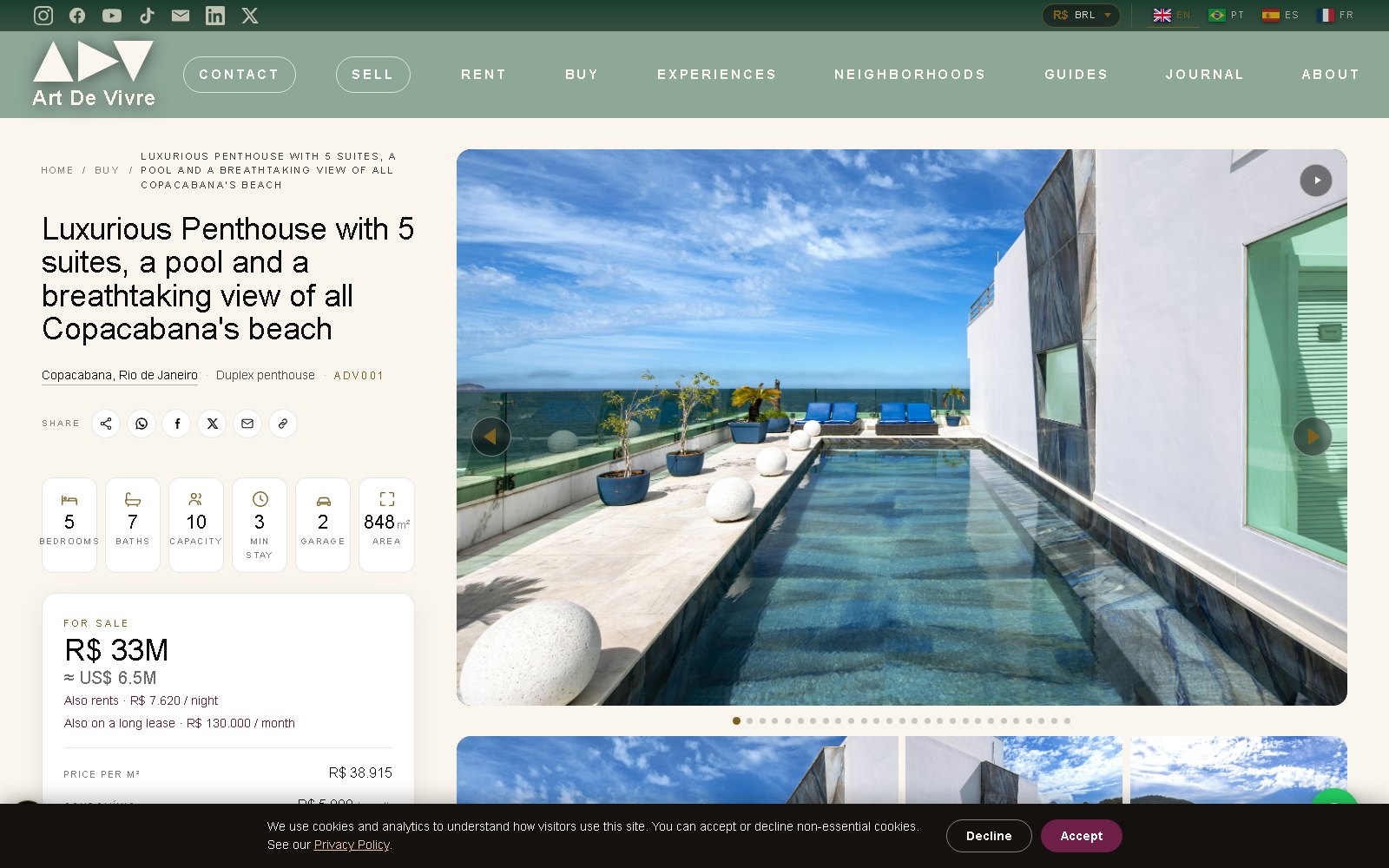
Cavmir built the whole demand side of that business on one domain: a website of more than 200 pages in four languages — English, French, Portuguese, and Spanish — where the sales catalog, the rentals, direct booking, experiences, and lead capture all converge. A visitor lands in their own language and sees every price converting live between reais, dollars, and euros. A single search covers the whole model: browse to buy, to lease, or to book a short stay.
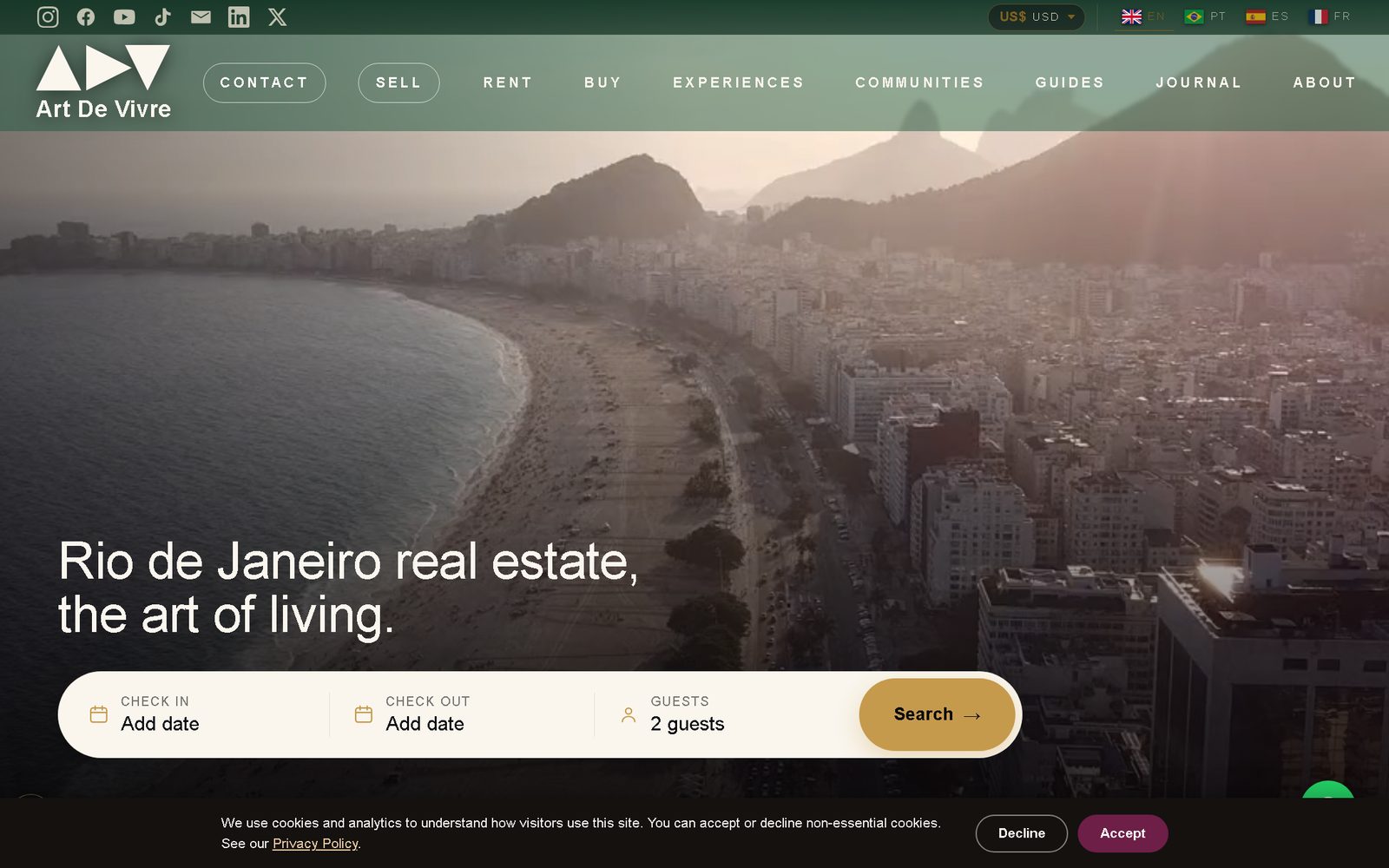
The part that matters most for a broker: one listing, three ways. The same Rio home can be for sale, open to a long lease, and bookable for a weekend — on one page, with each price converting live between three currencies. The brokerage catalog is searchable by neighborhood, property type, suites, and price, and off-market mandates show only where the owner allows it. The rental side runs on a Guesty integration, so the calendars, rates, and bookings stay in the PMS that already runs the operation. Cavmir didn't replace a single operational tool. We built the layer that none of those tools ship: the brand, the site, the languages, the content, and the funnel.
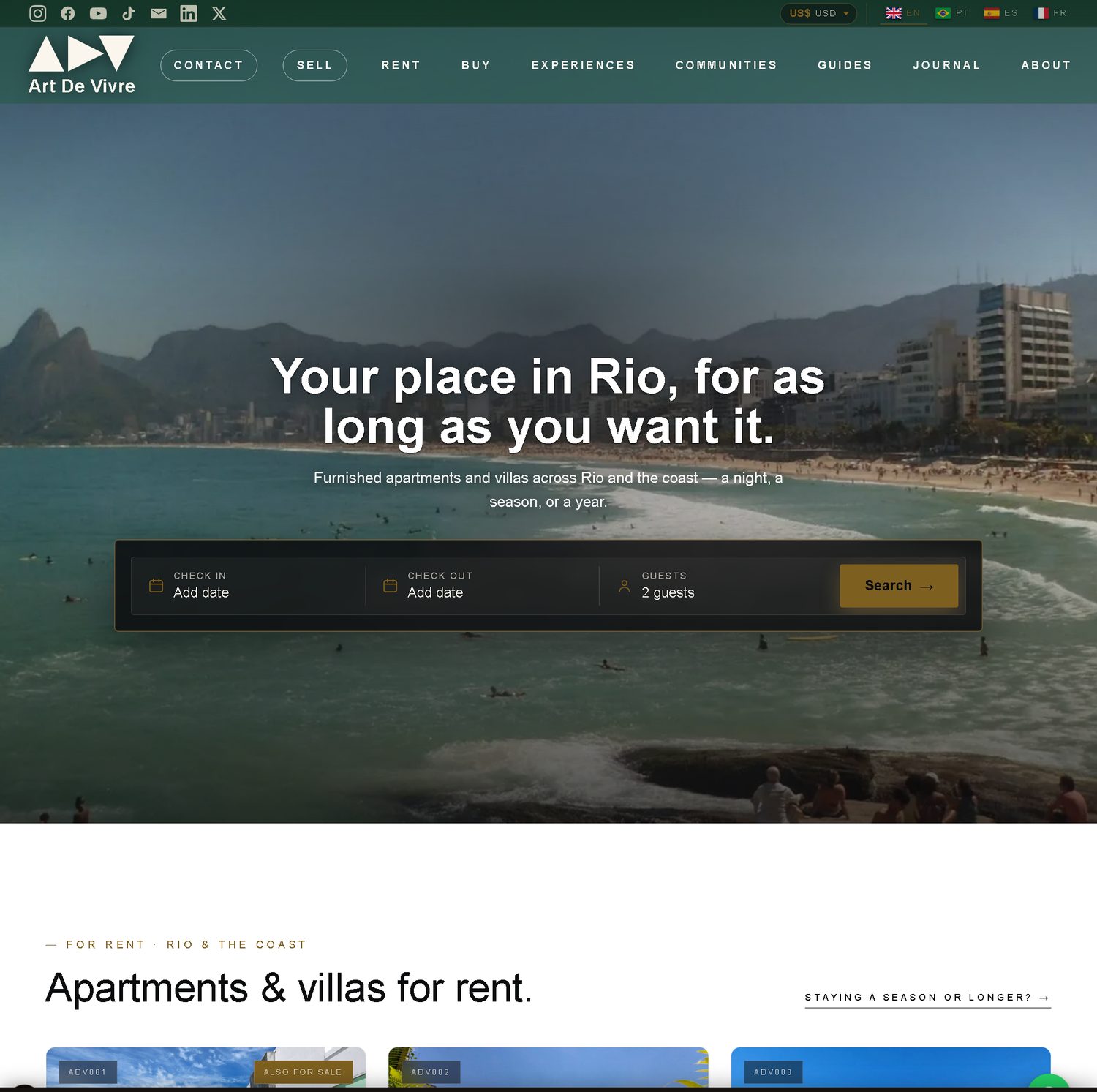
The rentals side goes further than listings. Rio itself is bookable on the site — boats and helicopters, hikes and climbs, private experiences — arranged and reserved alongside the stay, which turns a booking into a trip and the brokerage into the guest's one point of contact for the city. That's a revenue layer and a positioning layer at once: no Airbnb listing can offer it, and every owner evaluating administrators sees it.
Behind the public site sits a custom backend where Charles manages listings, photos, and translations, works a CRM of six and a half thousand records, and publishes the live site himself in one click. That last detail matters more than it sounds: a broker who can update a price, swap a photo, or push a new mandate live without waiting on a webmaster owns his operation in a way no agency-dependent site allows. Every guest who books gets an installable app with their door code, wifi, and arrival details — online or offline, which in Rio's patchy-signal moments is the difference between a smooth arrival and a locked-out guest. Most agencies would have stitched this together from rented software: a site builder here, a CRM subscription there, a booking widget, a translation plugin, each with its own monthly bill and none of it owned. We built one system instead, so Art de Vivre owns every layer of it.
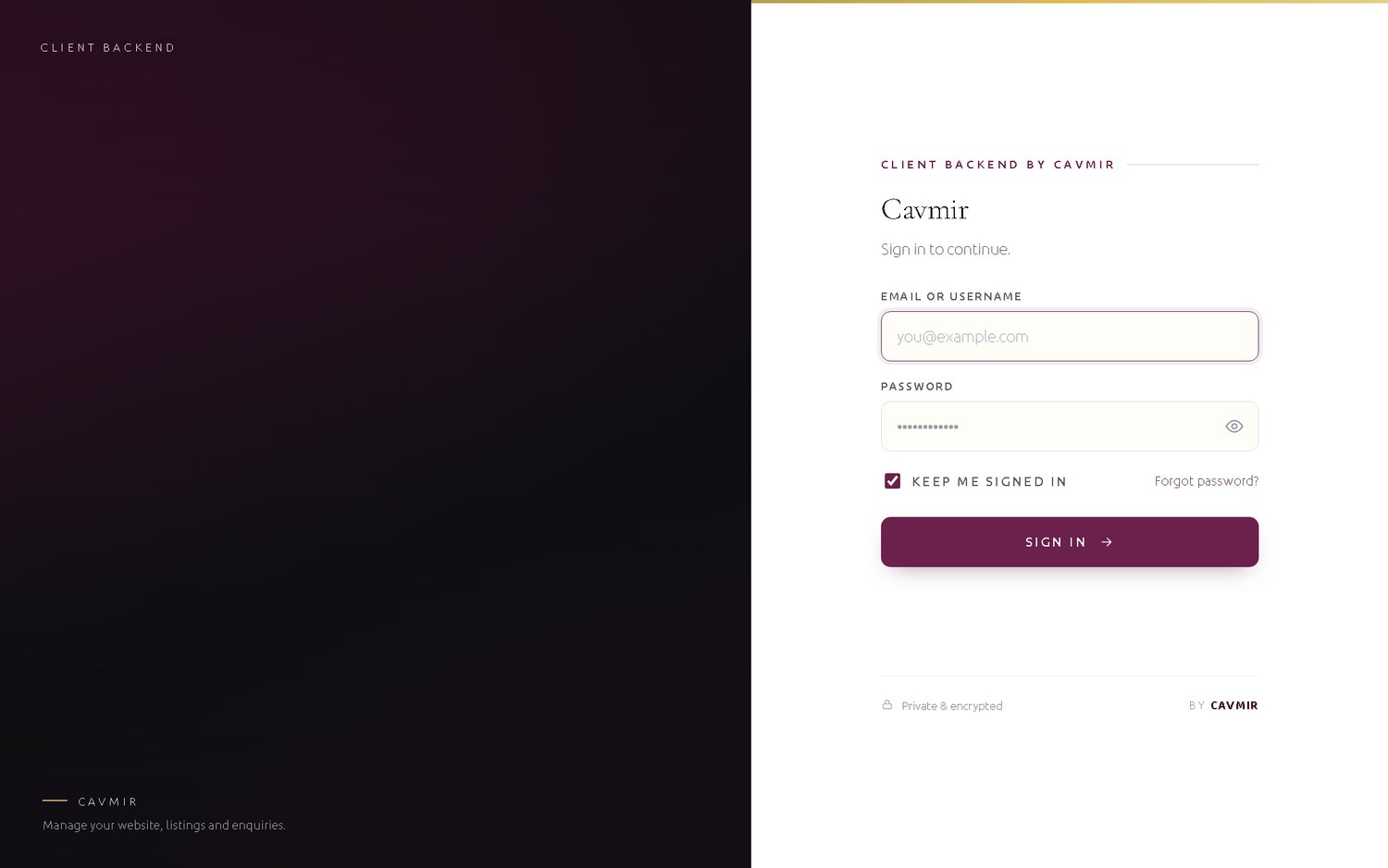
The site is live at artdevivre.com.br, and the full build is documented in the Art de Vivre case study.
Sterling Point Real Estate, St. Croix
Sterling Point Real Estate is a local company on St. Croix, in the U.S. Virgin Islands. Rich Watrous and his team sell real estate on the island, and — like almost every good island brokerage — they ended up administering a portfolio of vacation rentals for their owners. That portfolio became SP Vacations, the vacation-rental division of Sterling Point: twelve villas and condos across the island, from beachfront to hillside, every one of them bookable direct with the local team instead of through a third-party platform.
A portfolio like this is too much to market one listing at a time, and nowhere near enough to interest an enterprise agency. What Cavmir built for it is a full portfolio platform: a site of more than 260 pages where every villa has its own page wired into the Hostaway booking engine the team already uses, so availability, rates, and reservations flow through their existing operation — and the booking, when it comes, is theirs. No OTA in the middle.
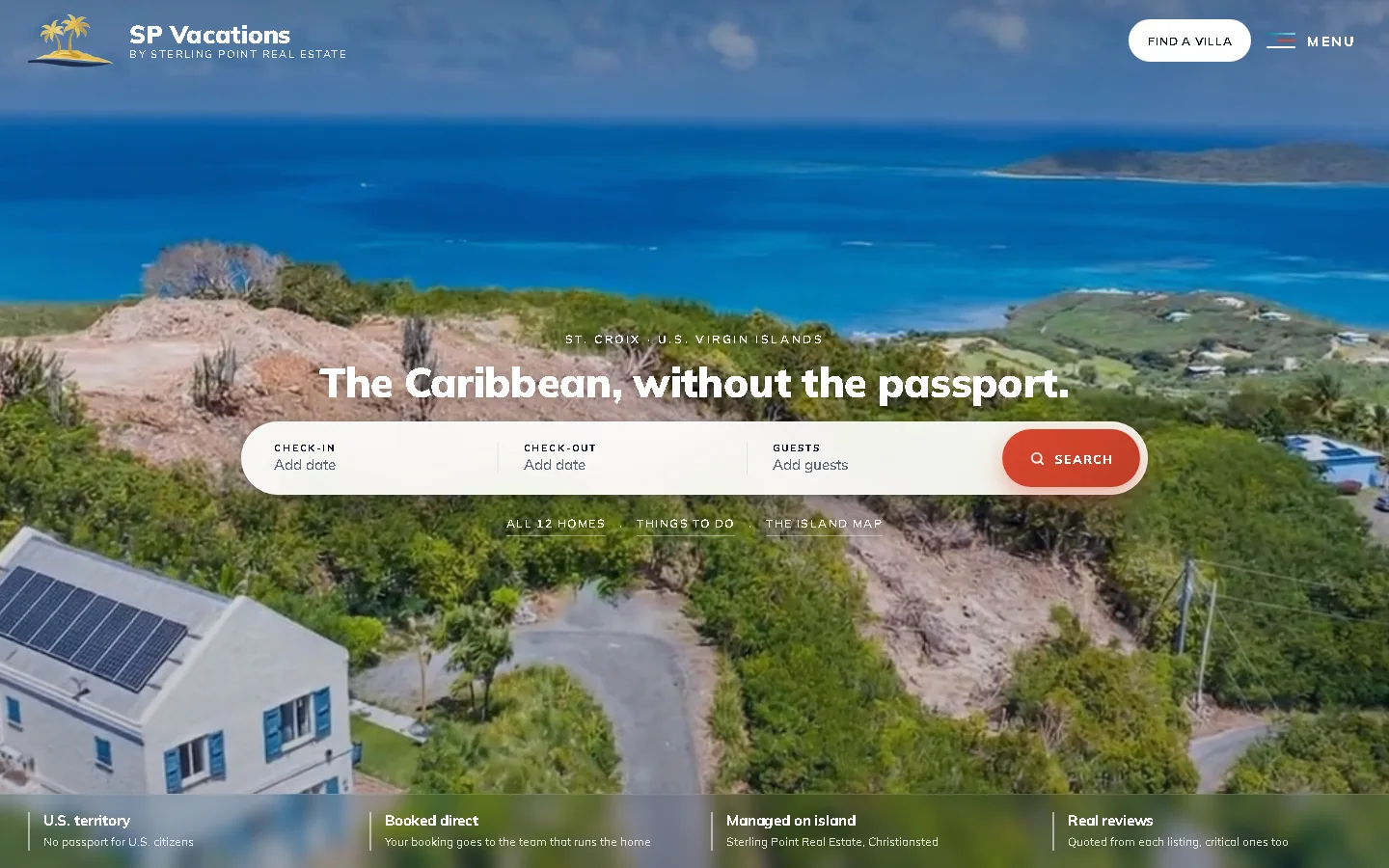
Around those twelve property pages sits the reason the site ranks: a content engine built for one island. A journal that carries the company's long-running blog, rebuilt at magazine depth. A library of St. Croix guides — beaches, snorkeling, diving, Christiansted, Frederiksted, Buck Island — researched and written to thousands of words each, with sources. A 27-page destination-comparison section that puts St. Croix side by side with every major Caribbean alternative, from Aruba to Barbados, using verified travel-advisory levels and the US-territory advantages (no passport for US citizens, the CBP exemptions) that make the island an easy sell. Every one of those pages exists to catch a traveler researching a Caribbean trip and hand them to a Sterling Point villa.
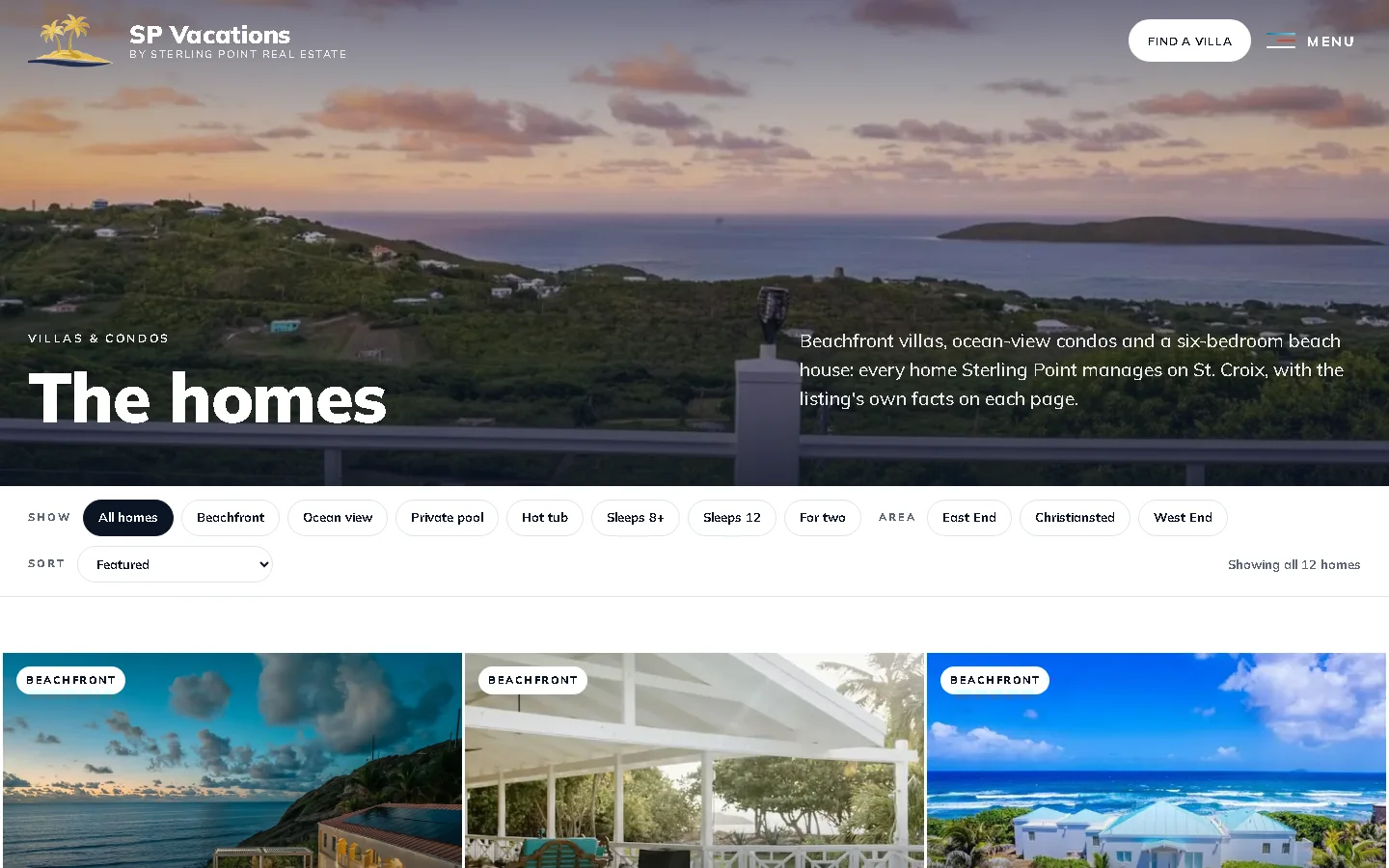
The portfolio itself spans beachfront villas, ocean-view condos, and a six-bedroom beach house — every home Sterling Point manages on the island, each page carrying that listing's own facts and quoting from its real guest reviews, critical ones included. That last choice was deliberate. A portfolio site that hides its imperfect reviews reads like advertising; one that quotes them reads like a company confident in its homes. The trust markers guests actually weigh sit right in the hero: a US territory, so no passport for US citizens; booked direct with no booking fees; managed on the island by Sterling Point Real Estate in Christiansted, so the team that takes the reservation is the team that holds the keys.
The demand side reaches all the way back to the guest's departure city: the site carries "getting here" pages for the routes travelers actually fly — New York, Miami, Chicago, Atlanta, Boston, and a dozen more — because a family deciding between islands starts with "how do we even get there," and the operator who answers that question first tends to get the booking. It's the same lesson as the comparison pages: meet the traveler at the top of their research, and walk them all the way down to a villa.
The brand on the site reads "SP Vacations · by Sterling Point" — the rental division standing on its own, with the brokerage's name behind it. That's the administrator's version of the broker's dual mandate: the rentals get a real hospitality brand, and every page of it quietly builds the case for the parent company. When an owner on St. Croix is deciding who should administer their villa, one look at that platform settles the question of who takes the portfolio seriously.
You can browse the build at the SP Vacations site.
Why a Growing Rental Portfolio Is Its Own Problem
Almost everything written about short-term rental marketing assumes one of two readers: the host with a single listing, or the management company with a marketing budget and a hundred doors. The administrator in the middle inherits the worst of both. You have the complexity of a company and the tooling of a host.
The fee math stops being a rounding error. On one apartment, the OTA's cut is an annoyance. Across fifteen units it's one of the largest line items in the whole operation — a percentage of every night, every unit, all year, taken before your management fee is calculated. Airbnb publishes its service-fee structure; run your own portfolio's gross bookings against it and the number you get is usually the size of a salary. A single host can shrug at that. An administrator reading their consolidated statements can't.
The portfolio never compounds. This is the quiet one. A guest who stays in one of your units this year and leaves a five-star review would happily book a different unit from you next year — if there were anywhere for "you" to exist. On the platforms there isn't. The review sits on one listing. The guest belongs to the OTA, which will cheerfully remarket them your competitor's calendar. Fifteen listings run this way are fifteen separate small businesses that share nothing except your labor. The single most valuable structural asset an administrator has — one brand over many roofs, with cross-sell between them — never gets built.
The next mandate is won on appearances. Portfolios grow by referral: an owner tells another owner. But between the referral and the signed mandate, that new owner looks you up. What they find is either an Airbnb host profile that looks like everyone else's, or a portfolio platform with your name on it that looks like a hospitality company. One of those wins the listing at your fee. The other wins it at whatever fee survives the negotiation.
Marketing time doesn't exist. Every administrator we've worked with says a version of the same sentence: the day goes to the operation. Checkouts, cleaners, a hot-water heater, an owner statement, a guest who can't find the lockbox. Marketing is a Sunday-night activity, which means it doesn't happen. This is the actual reason the demand side stays on rented ground — never a lack of understanding, always a lack of hours.
None of this is solved by working harder inside the platforms. It's solved by building the layer above them once, properly, and letting it compound. That layer is what Cavmir builds.
The OTA Math at Portfolio Scale
Run the numbers on your own portfolio before you take anyone's word for anything — including ours. The arithmetic is short.
Take a worked example, with round numbers standing in for your real ones: fifteen units averaging $200 a night at 60% occupancy is roughly 3,285 booked nights and about $657,000 in gross booking revenue a year. Airbnb publishes its service-fee schedule; the host-only fee most professional operators are on sits around 15–16% of the booking subtotal (check the current published schedule for your setup — it varies by program and region). Apply that to the example and the platform's share is close to $100,000 a year. That's the demand-side bill for a fifteen-unit operation before you've paid a cleaner, an accountant, or yourself.
Nobody moves a portfolio off the platforms entirely, and nobody should try — the OTAs are a real distribution channel and they fill calendars you couldn't fill alone. The question is the mix. Every booking that arrives through your own site instead is a booking where that percentage stays in the operation. Shift even a fifth of the example portfolio's volume to direct and the recovered margin is the kind of number that funds the entire marketing program that produced it, with room left over. That's the entire commercial logic of this page, and it scales with every unit you add.
There's a second layer that only administrators see: the fee comes out before your management percentage is calculated, or it comes out of the owner's side and shows up on the statement you have to explain. Either way, lower channel costs make your owner statements better — and better statements are their own retention program. An owner who watches their net improve after you moved bookings direct has one more reason never to shop for another administrator.
If you'd rather see the arithmetic on your own numbers before talking to anyone, our free direct-booking calculator does exactly this: your nightly rates, your occupancy, your unit count, and what the OTA percentage costs the operation each year. Ten minutes with your last annual statement gives you the figure this entire page is built around — and whether it justifies a platform is a question the number answers better than any agency can.
What a Repeat Guest Is Worth to a Portfolio
A single-unit host and a portfolio administrator get completely different value from the same returning guest — and this is the structural advantage most administrators never cash in.
For the single host, a repeat guest can only rebook one property, on the dates it happens to be free. For you, a guest who loved their week in one unit is a warm prospect for every unit you run. Different size next trip, different area, different price point, different season — somewhere in a fifteen-unit portfolio there's a fit for almost any return visit. Cross-sell inside the portfolio is the closest thing this industry has to a hotel's loyalty economics, and it only exists if the portfolio exists somewhere as one thing: one brand, one website, one guest list.
The guest list is the asset that makes it work. Booked through the platforms, guests are the platform's customers; their contact details and their future trips belong to the OTA's remarketing engine, which is just as happy to fill your competitor's calendar. Booked through your own site — or converted after an OTA stay with a simple "book direct next time" motion — they're yours: an email list of people who have already stayed with you, already trust you, and already know what your properties are like. Season after season, that list compounds. It's also, quietly, one of the most valuable line items if you ever sell the business.
Portfolio seasonality plays into this too. Units that peak at different times — beach-facing in high season, in-town year-round, the big house that only moves for holidays and groups — can feed each other's shoulder seasons when one brand markets them together. None of that coordination is possible when each listing is an island on someone else's platform.
Owning the Ground Under the Business
Every administrator whose demand side lives entirely on the platforms is running a business on rented land, and the landlord can change the terms without asking. Fee structures change. Ranking algorithms change. Cancellation-policy rules change. A single account issue — a dispute gone wrong, a policy trip, an identity-verification snag — can take a whole portfolio dark on that channel while you work through support queues. None of this is a reason to panic; it's a reason to diversify the one thing you can't rebuild quickly: where your demand comes from.
A portfolio platform is that diversification. Your domain can't be de-ranked out of existence by a policy change, your guest list can't be repossessed, and your brand doesn't need anyone's permission to exist. The OTAs become what they should have been all along — one channel among several, used deliberately for what they're best at, which is introducing you to guests you haven't met yet.
There's an endgame consideration here as well. Administrators build businesses that eventually get sold — to a larger manager, to a partner, to the next operator. A book of informal mandates and an Airbnb profile is hard to price. A branded operation with its own domain, a functioning direct-booking channel, a guest list, and a content asset that ranks is a company someone can buy. The marketing infrastructure isn't just demand generation; it's enterprise value.
What Cavmir Builds for a Broker or Administrator
The deliverable is a portfolio platform — one domain that carries every property, takes bookings through the systems you already run, and gives the whole operation a brand. The two builds above are the pattern. Here is what goes into it.
One site, every property
Each unit gets its own page: gallery, specs, rates, availability, reviews, and a booking path. The portfolio gets a searchable index — by area, sleeps, amenities, price — so twelve or twenty properties read as one collection instead of a scatter of listings. Sterling Point's twelve St. Croix homes and Art de Vivre's Rio portfolio both work this way.
Direct booking on your PMS
We wire the site into the property-management system you already use — Guesty on the Art de Vivre build, Hostaway on the Sterling Point build, and we work across the mainstream platforms. Calendars, rates, and reservations stay in your system of record. The difference is where the booking comes from: your domain, with no OTA in the middle.
Content that ranks for your market
A portfolio site with twelve pages competes with nothing. A portfolio site wrapped in a real content engine — area guides, a journal, comparison pages, the questions travelers actually research — catches search traffic and hands it to your calendar. The Sterling Point build carries more than 260 pages for one island. That depth is the moat.
A brand over the whole portfolio
Name, mark, palette, photography direction, and a voice — applied consistently across the site, the listings, and everything an owner or guest sees. "SP Vacations · by Sterling Point" is a brand decision: the rentals stand on their own while the brokerage's credibility stands behind them. This is also the asset that wins mandate pitches.
Languages where your guests are
The Art de Vivre build runs in English, French, Portuguese, and Spanish with live currency conversion between reais, dollars, and euros — because Rio's guests arrive from everywhere. If your market books internationally, your site should read natively in the languages your guests search in. Most site builders can't do this well. We build it in.
The listings, brought up to standard
The OTA listings don't go away — they get better. Consistent titles, rewritten copy, photo audits, amenity completeness, across every unit instead of just the flagship. The platforms stay your busiest channel for a long time; they should be working as hard as the site does.
Around the platform, the rest of Cavmir's stack is available as your portfolio needs it: SEO, AI search optimization so assistants like ChatGPT cite your properties, paid ads, social, brand design, and the direct-booking build itself. If you run on a specific platform, we keep dedicated pages on how we work alongside it:
What a Property Page Has to Do
The property page is where the whole platform either earns its keep or doesn't — it's the page a guest lands on from a search result, a guide, or a shared link, and it has one job: get a qualified guest to a booking without making them think about Airbnb. Every property page we build carries the same load-bearing parts.
The facts, complete and specific. Sleeps, beds, baths, the real amenities, the real location context, and the quirks a guest would otherwise have to email about — stairs, road noise, the shower with personality. On the Sterling Point build, every home's page carries the listing's own facts, down to pulling from real reviews for that specific property, critical ones included. Guests can tell the difference between a page written about a property and a template filled in around one, and so can search engines.
Live availability and rates, from the PMS. A page that says "enquire for availability" loses the booking to whichever tab already shows a calendar. The integration work — Guesty on one build, Hostaway on the other — exists so the page can answer the guest's two real questions, dates and price, without a phone call and without a second system for your team to maintain.
A gallery that sells the stay. Photography ordered to tell the property's story, sized and compressed so the page still loads fast on a phone on hotel wifi. Speed is a ranking factor and a conversion factor, and image discipline is most of speed.
The booking path, short and boring. Dates, guests, price, book. Every extra step is a percentage of abandoned bookings. Where deposits and payment flows are involved we wire the engine your operation already trusts, so reservations land in the same system your team lives in.
The machine-readable layer. Schema markup for the property, the reviews, and the FAQs; clean URLs; proper titles and descriptions — the plumbing that turns each unit's page into its own small search asset. Fifteen properties done this way is fifteen more doors into the portfolio, on top of the content engine around them.
Why Content Works Differently for a Portfolio
Here's an economic asymmetry that works entirely in your favor: destination content is expensive to do well, and its cost doesn't change with the number of properties it feeds. A guide to the best beaches in your market takes the same research and the same writing whether it hands its readers to one calendar or to fifteen. The single host can rarely justify that investment. An administrator can — which is why a portfolio site wrapped in real content is the moat mid-size operators can build and their smaller competitors can't.
The Sterling Point build is the demonstration. Around twelve property pages sits an island's worth of editorial: beach guides, diving and snorkeling guides, town guides for Christiansted and Frederiksted, trip-planning content, a journal, and a 27-page section comparing St. Croix with every major Caribbean alternative. Each piece is researched, sourced, and written to a depth that thin AI-generated filler can't imitate — because search engines have gotten very good at telling the difference, and so have travelers.
Every one of those pages works the same shift: a traveler researching the destination finds a genuinely useful answer, and the answer happens to sit one click from a portfolio of places to stay. Multiply by hundreds of pages and years of compounding, and content becomes the portfolio's steadiest source of commission-free demand.
The newest reason to take this seriously is AI search. When someone asks ChatGPT or Google's AI where to stay in your market, the assistants cite sourced, substantial pages — and a portfolio site with real depth is exactly what they cite. We build for that explicitly; it's why AI search optimization is part of the Cavmir stack. Being the operator whose site the assistant quotes is the 2026 version of ranking first, and in most mid-size markets that position is still unclaimed.
Your Airbnb Listings Don't Go Away
A worry we hear on almost every first call: "we can't afford to walk away from Airbnb." Agreed — and nothing on this page suggests you should. The platforms are where guests who've never heard of you go to look. Walking away from them would be walking away from your own top of funnel.
The strategy is a division of labor. The OTAs do what they're structurally best at: introducing your properties to strangers. Your platform does what the OTAs structurally won't: keeping those guests as yours. First stay through the channel that found them; the relationship, the review follow-up, the "next time, book direct" motion, and every future stay through infrastructure you own. Acquisition rented, retention owned.
In practice the OTA side of your operation usually improves when the platform work starts, because the listings finally get portfolio-level attention: consistent naming so the properties read as one professional operation, copy rewritten unit by unit, photo audits, amenity data completed, review responses handled with one voice. The platforms reward complete, well-run listings, and a rising OTA presence and a rising direct channel aren't in tension — they feed each other. The listing introduces the guest; the brand keeps them.
Brokers: Sales and Rentals on One Domain
If you hold a real estate license, your rental portfolio is also a sales pipeline — and almost nobody's website reflects that. The industry default is two disconnected presences: a brokerage site with static sale listings, and an Airbnb profile for the rentals. The guest never meets the brokerage. The buyer never meets the rentals. Every crossover opportunity between the two halves of your business leaks away.
The Art de Vivre build shows what it looks like when the two halves share one roof. The same property can be for sale, open to a long lease, and bookable for a short stay — on one page. A buyer browsing the sales catalog sees that the brokerage also runs a serious short-stay operation, which answers the investor's first question ("who will rent this out for me?") before they ask it. A guest who falls for the apartment finds the sales catalog one click away. An owner deciding whether to list their property for sale learns you can rent it profitably while it waits for the right buyer.
The mechanics matter here, and they're where most attempts at this fail. Sale prices and nightly rates are different systems with different sources of truth — a listing catalog on one side, a PMS calendar on the other. We build the site to respect that: the rental pricing flows live from the PMS, the sales catalog runs on its own data, and the visitor's intent decides what they see. Off-market and discreet mandates stay discreet, showing only what each owner allows.
For brokers who want the full version of this — the market-dominating brokerage-plus-rentals platform — the scope is our King Broker package. Ask about it in the form below and we'll scope it to your market.
Markets, Languages, and the International Administrator
The mid-size administrator is a global species, and the shape of the business changes with the market. In much of Latin America the role has a formal name and often a license behind it — Art de Vivre operates under a CRECI registration in Rio, where broker, administrator, and short-stay operator are one continuous profession. In the Caribbean, island brokerages like Sterling Point grow rental divisions because owners live off-island and need one trusted local operation for everything. In Europe, the same operator runs city apartments under registration regimes that change by municipality. In US drive-to and snowbird markets, it's the local agent who became the area's de facto manager one referral at a time.
What changes with geography is who the guests are and what language they book in — and this is where most site builders quietly fail the international operator. A Rio portfolio takes bookings from New York, Paris, Buenos Aires, and Lisbon; the Art de Vivre build answers in four languages with every price converting live between reais, dollars, and euros, because a French guest quoted only in reais is a guest doing mental arithmetic instead of booking. Multilingual isn't a translation plugin bolted on at the end; it's structure — per-language pages search engines can index, written by people who can tell when a translation reads wrong.
Cavmir covers 113 markets across six continents — the full index is on our locations page — and the two builds on this page sit in two of the trickier ones: a four-language South American metro and a US territory with its own travel logic. If your market is quirkier than average, that's normal here.
Growing the Portfolio: What Wins the Next Owner
Ask an administrator where their last three owners came from and the answer is almost always referral. Ask where the next ten will come from and the answer is a shrug. Guest marketing and owner marketing are different disciplines, and the second one is where a 12-unit operation becomes a 25-unit operation.
Here's what actually happens when an owner is choosing an administrator. They ask around and get two or three names. They look each one up. And then they make a judgment that is mostly aesthetic and entirely rational: whoever presents their existing portfolio best will probably market my property best. Your platform is your pitch. A prospective owner who browses a branded portfolio site — where every current property is photographed well, written up properly, and bookable direct — has effectively watched your sales presentation before you've said a word.
We build the owner-facing side into the platform: a page that speaks to owners rather than guests, explains how you work, shows the portfolio as proof, and captures the enquiry. On the Sterling Point build, owners have their own path on the site for exactly this reason. For operations ready to push harder, we add owner-targeted content and campaigns — the case for professional administration, the case against self-managing, the local data an owner researching their options actually searches for.
The compounding loop is the point. A better platform wins more owners; every new owner adds a property page, more content, and more booking volume to the same domain; the domain gets stronger; the next pitch gets easier. That loop runs for years, and it belongs to you. It's also the difference between growth you chase and growth that arrives: the administrator with the strongest presence in a market eventually becomes the default answer when any owner in that market asks around.
What Cavmir Is and Isn't
Worth stating plainly, because the roles get confused in this industry.
Cavmir is a marketing agency. We build brands, websites, booking infrastructure, content, and campaigns for people who run short-term rentals. That's the whole job.
Cavmir is never the property manager. We don't administer properties, hold keys, message guests, set prices, schedule cleaners, or take owner mandates. You are the administrator; we make your operation easier to find, easier to book, and easier to grow. Your owners are yours. Your guests are yours. Your operation is yours.
We don't take a cut of bookings. Flat retainers and scoped builds, quoted to your portfolio. No revenue share, no per-booking fees, no percentage of your management fee. When we shift a booking from an OTA to your website, all of the recovered margin is yours.
We work on top of your stack. Your PMS stays. Your channel manager stays. Your guest-comms tools stay. We've built on Guesty and Hostaway for the two clients on this page, and we're tool-agnostic across the mainstream platforms. If you don't run a PMS yet, we'll help you pick one before we build on it.
How an Engagement Runs
It starts with the portfolio, on a call. Number of units, where they are, what they run on, where bookings come from today, and what the operation should look like in two years. If you're a broker, we look at the sales side in the same conversation. From that, a scoped quote — every engagement is priced to the portfolio, and the tiers on our property-manager programs page give you the shape of it (a 10-to-20-unit operation lands in the Foundation range).
The build comes first. Brand, site, booking integration, and the first layer of content. You review real pages as they're built, and nothing ships until the details are right — pricing pulling live from your PMS, every unit's page checked against the actual property, the owner path working end to end. The two builds on this page are the standard to expect.
Then the compounding starts. Content waves for your market, listing improvements across the portfolio, search performance tracked in your own analytics, and campaigns where they earn their keep. Marketing for a rental portfolio is cumulative: the site gets deeper, the domain gets stronger, and the share of bookings that arrive commission-free grows. We report on what a principal actually wants to know — where bookings came from, what direct is worth, what's ranking, and what's next.
You own everything, permanently. Domain, site, brand, content, photography, the email list. If we part ways, all of it stays with you. We build assets, not dependencies — the Art de Vivre principle, applied to every client: own every layer of your own demand.
The First 90 Days, Concretely
Timelines vary with portfolio size and integrations, so treat this as the shape of a typical build rather than a promise — the binding version goes in your quote. But "how does this actually start?" deserves a concrete answer.
Weeks 1–2: the portfolio on the table. Every unit inventoried — photos, copy, reviews, rates, seasonality, which listings perform and which coast. Your PMS access set up. Brand direction agreed: name and mark (kept, refreshed, or built), palette, and how the operation should present — "SP Vacations · by Sterling Point" was a positioning decision made exactly at this stage. If you're a broker, we map the sales side into the structure now, because retrofitting a catalog later is the expensive way to do it.
Weeks 3–6: structure and the first real pages. The site's architecture goes up — portfolio index, property-page template, owner path, the content plan for your market. The first property pages get built against real data from your PMS, and you review actual pages, on a real URL, wired to your actual calendars. Corrections happen here, while they're cheap.
Weeks 7–10: every unit, every listing. The rest of the portfolio comes onto the platform page by page. In parallel, the OTA listings get their pass — naming, copy, photos ordered properly, amenity data completed — so both channels rise together rather than the new one cannibalizing the old.
Weeks 11–13: launch, wired for the long run. The compliance layer ships with the site — privacy policy, cookie consent, accessibility — plus analytics you own, search-engine setup, and the first content wave live. Launch is deliberately unglamorous: by then the site has been reviewed piece by piece for weeks, and going live is a switch, not a reveal.
From there the engagement shifts into the monthly motion described above — content waves, listing improvements, measurement, and the owner-facing work — with the build compounding underneath it.
What to Ask Any Agency You Interview
You should shop this decision, including against us. Marketing agencies are easy to start and hard to judge from the outside, and the vacation-rental niche has attracted plenty of template resellers wearing agency branding. Six questions separate builders from resellers, whoever you're talking to.
"Show me a live portfolio build with the booking engine working." Screenshots and mockups don't count. Ask for a URL, go to a property page, and try to start a booking. If every example they show is a brochure site with a contact form where the booking engine should be, you've learned what you needed to. (Ours are at the top of this page.)
"How does the site talk to my PMS?" The wrong answer is a rented widget iframed into a page, with your rates maintained by hand in a second system. The right answer names your platform and explains where availability, rates, and reservations live. Double-entered calendars die within a month, and a site that isn't wired to the PMS becomes a brochure by default.
"Who owns the domain, the site, and the content if we part ways?" The only acceptable answer is you, all of it, with no export fee and no proprietary platform holding it hostage. A surprising share of agency offers in this niche are subscriptions dressed as builds — the monthly fee stops and the website vanishes.
"Do you take a percentage of bookings?" Some agencies price as a booking commission, which sounds aligned until you notice you've traded one OTA fee for another. Know what you're comparing.
"Who writes the content, from what sources?" If the plan is AI-generated area guides with no research behind them, the pages will read like everyone else's and rank accordingly. Ask to read something they've written for a market like yours, and check whether it says anything a local would recognize as true.
"What happens in month seven?" A build without an ongoing motion goes stale. A serious agency can tell you concretely what the retainer produces in an ordinary month — content shipped, listings improved, what got measured, what changed because of it. Vague answers about "optimization" mean the real answer is nothing.
Any agency worth hiring answers all six without flinching, in specifics rather than adjectives. If you put these questions to us on a call, you'll get exactly that — live URLs, named platforms, real timelines, and the two clients on this page as the working references.
Talk to us about your portfolio.
Tell us how many units you run and where. We'll come back with what we'd build, what it costs, and what the two clients above would tell you about working with us.
Start the ConversationQuestions Brokers and Administrators Ask
The ones that come up on nearly every first call.
Is Cavmir a property management company?
No. Cavmir is a marketing agency. We build the brand, website, direct-booking infrastructure, and content for your operation — we never administer properties, message guests, or take owner mandates. You stay the administrator of record for everything you manage.
Everything we have runs through Airbnb. Why do we need a website?
Airbnb stays in the mix — we usually improve your listings as part of the work. The website exists for what the platforms structurally can't give you: a brand that spans the whole portfolio, repeat guests who book you direct instead of re-searching the open market, commission-free bookings, a professional face for owner pitches, and an asset that's yours no matter what any platform changes. Across 10–20 units, those add up to real money and a more sellable business.
Which booking systems do you integrate with?
The two builds on this page run on Guesty (Art de Vivre) and Hostaway (Sterling Point), and we work across the mainstream PMS platforms — see our PMS comparison for the landscape. Your PMS remains the system of record for calendars, rates, and reservations; the site we build feeds it. No PMS yet? We'll help you choose one first.
Do you take a commission on bookings?
No. Builds are scoped and quoted; ongoing marketing is a flat retainer sized to the portfolio. We take no share of bookings, no per-reservation fee, and no cut of your management fee. The margin we recover from OTA commissions is entirely yours.
What does this cost for a portfolio of 10 to 20 rentals?
Every engagement is quoted to the portfolio, so the real answer comes from a call. For shape: a 10-to-20-unit operation lands in the Foundation range on our programs page, with the build scoped separately from the ongoing retainer. Brokers who want the sales-plus-rentals platform should ask about the King Broker scope.
Who owns the website, the brand, and the content?
You do — domain, design, content, photography, and the guest email list, permanently. On the Art de Vivre build the client also runs his own backend and publishes the live site himself. We build assets you own, not subscriptions you rent.
Can the same site sell property too?
Yes — that's the Art de Vivre model: sales catalog, long leases, and short stays on one domain, with the same property showing all three where the owner allows it. It's the strongest version of the platform for licensed brokers, because each side of the business feeds the other.
Will this help us win more owner mandates?
That's one of the main jobs of the platform. Prospective owners judge you by how you present the portfolio you already have, and a branded site with every property professionally presented is the best pitch document an administrator can own. We also build a dedicated owner path — a page that speaks to owners, shows the portfolio as proof, and captures the enquiry.
Our market isn't in the US. Can you work with us?
Yes. The two clients on this page operate in Rio de Janeiro and the U.S. Virgin Islands, and we cover 113 markets across six continents — see the locations index. Multilingual builds are a specialty: Art de Vivre runs in four languages with live currency conversion.
How long does the build take?
It depends on portfolio size, integrations, and languages, so we put a timeline in the quote and hold to it. The sequence is consistent: brand and site structure first, then property pages wired to your PMS, then the content engine in waves. You see real pages early and throughout — no six-month silence followed by a reveal.
We're bigger than 25 doors. Is this still the right page?
The thinking holds, but the program changes — dedicated team, multi-market SEO, owner-acquisition campaigns at a different scale. Our property managers page covers programs from 25 to 500+ doors.
We already have a website. Do we start over?
Not necessarily. We audit what exists first: the domain and any search equity it has earned are usually worth keeping, and sometimes the brand is too. What typically can't survive is a template site with no booking engine and no content depth — in that case we rebuild on your existing domain so the history carries over. The audit tells us which situation you're in before anyone commits to anything.
Do you handle photography?
We audit, brief, and direct rather than shoot. Across a portfolio we identify which units have the biggest photo gap, project-manage local photographers (yours or ones we source), and handle post-production so everything lands listing-ready and visually consistent across the portfolio. Inconsistent photography is one of the most common tells of an unbranded operation, and one of the cheapest to fix.
Can you run our social media too?
Yes — social and automated social are part of the stack, and for a portfolio they work best fed by the platform: property features, area content, and owner-facing material drawn from the site rather than invented weekly from nothing. Social is usually a later addition, after the site and listings are earning; we'll tell you plainly if we think it's not the next dollar's best home.
Where do bookings and enquiries actually land?
In your systems. Reservations flow through your booking engine into your PMS; owner and guest enquiries go to your inbox. Cavmir never sits between you and your guests or owners — we build the pipes, you own what flows through them.
Tell Us About Your Portfolio
A few details and we'll come back with a scoped recommendation — usually within one business day. Prefer talking? Book directly through the contact page or call (786) 751-3426.
