€80
Avg. Nightly Rate
62%
Avg. Occupancy Rate
€1,500
Avg. Monthly Revenue
6-9%
Est. Cash-on-Cash ROI
MEDIUM
Seasonality
MEDIUM
Regulatory Burden

* Market averages. Properties marketed by Cavmir typically exceed these figures by 25–45%. Data sourced from AirDNA, STR market reports, and Cavmir internal analytics.

The Market

Why Bratislava is One of the World's Premier STR Markets

Bratislava is the capital that gets skipped, and for an operator that is the opportunity rather than the problem. It sits about 55 kilometres from Vienna — the closest pair of national capitals in Europe — which means a large share of its visitors arrive as a day trip from somewhere else and leave without spending a night. Converting even a fraction of that into stays is what this market is actually about. The numbers underneath are healthy and unusually professional for a city this size: an average rate near €80 at around 62% occupancy, roughly €1,500 a month per active listing, with Staré Mesto running near 69% occupancy, and entire-home listings making up about 92.6% of active supply. The regulatory position is the lightest of any capital on this list, and it has a known expiry date. Regulation (EU) 2024/1028 has applied since 20 May 2026, but it harmonises national schemes rather than creating a European number, and Slovakia's own scheme does not begin until 2027 — so there is currently nothing to register with. Slovakia's own registration regime arrives in 2027, not 2026: existing hosts have until 28 February 2027 to register, and anyone starting from 1 March 2027 must register before their first guest. There is no nights cap, no minimum-stay rule and no ban-zone map. What there is, and what catches foreign owners, is that hotel-like accommodation requires a trade licence — a živnosť — because this is a service, not a letting.

Bratislava's demand has three sources and most listings are written for only one of them. The first is the Old Town day-trip market spilling out of Vienna: an hour by train, an hour by Twin City Liner along the Danube, and an enormous flow of people who see the castle, the Blue Church, Michael's Gate and the coronation cathedral, and go home. The second is business travel, which is substantial and consistently underserved — Slovakia's automotive industry, the shared-services and technology employers, and a capital-city administrative base all produce Monday-to-Thursday demand into a market that markets itself as a weekend break. The third is the weekend group and stag economy, historically significant here, still lucrative and still the fastest route to a hostile building. Blended rates run near €80 with occupancy around 62%, and Staré Mesto sits near 69% at a rate close to €76 — which is the interesting number, because the Old Town's occupancy premium is bigger than its rate premium, and that gap is where a well-positioned property makes its money. Small pensions and boutique hotels in the Old Town's baroque houses compete for the same guests, and the Small Carpathians wine villages begin fifteen minutes north.

Top Attractions & Landmarks

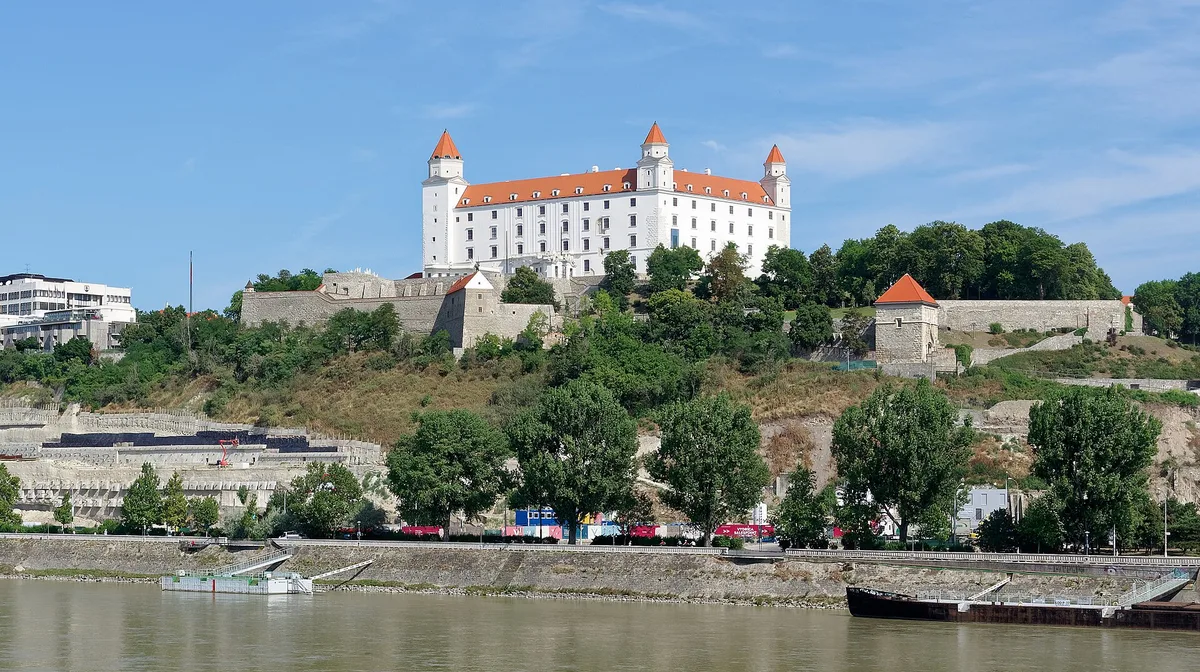
  • Bratislava Castle above the Danube
  • St Martin's Cathedral, coronation church of the Kingdom of Hungary
  • Michael's Gate and the Old Town's baroque streets
  • The Blue Church of St Elizabeth
  • The UFO observation deck on the SNP Bridge
  • Devín Castle at the meeting of the Morava and the Danube
  • The Small Carpathians wine villages at Svätý Jur, Pezinok and Modra

Nearby Markets: Budapest  |  Prague  |  Ljubljana

Airbnb marketing services in Bratislava, Slovakia, Europe
Why Cavmir

The Cavmir Advantage
in Bratislava

Cavmir wins in Bratislava by selling the second night. This is a city where the marketing problem is not attracting visitors — they are already arriving from Vienna in large numbers — but giving them a reason to stay, and almost nothing in the market is written to do that. We build the case explicitly: the wine villages of the Small Carpathians fifteen minutes north, Devín Castle where the Morava meets the Danube, the Old Town in the evening after the day-trippers have gone, and a restaurant scene that is materially cheaper than Vienna's for the same quality. We write for the business traveller too, because Bratislava's automotive, technology and shared-services employers produce steady midweek demand and virtually every listing here is priced as a weekend product. We handle the compliance runway honestly, since Slovakia's own registration regime lands in 2027 with a 28 February deadline for existing hosts, and the trade licence catches owners who assumed they were landlords. We photograph the castle and the Danube in evening light rather than the pedestrian streets at midday. And for the Old Town's pensions and boutique hotels we build direct-booking websites with corporate-rate pages and Vienna-comparison packages, because a guest who is choosing between two capitals an hour apart should be given the argument rather than left to guess. We help position and market your property. We never manage it or touch your keys.

State of the Industry · History

The Bratislava STR Market — Past & Present

Bratislava has been three cities under three names, and the confusion is the point. As Pressburg it was a Habsburg town; as Pozsony it was the capital of the Kingdom of Hungary for more than two centuries after the Ottomans took Buda, which is why eleven Hungarian monarchs were crowned in St Martin's Cathedral between 1563 and 1830 — a small church for such a large job, with a gilded replica of the Hungarian crown on its spire. As Bratislava it became the capital of an independent Slovakia only in 1993, which makes it one of the youngest capitals in Europe attached to one of the older towns. The Old Town's baroque palaces come from the coronation era, when the Hungarian nobility needed somewhere to stay; the Blue Church, Ödön Lechner's Art Nouveau confection finished in 1913, comes from the last years before the empire ended.

The twentieth century treated the city roughly and the socialist period treated it worse: the SNP Bridge was driven through the Jewish quarter in the 1970s, destroying a large part of the historic fabric below the castle, and the vast Petržalka housing district went up across the Danube. What has happened since 1993 is a genuinely rapid rebuild of both the city and its economy. The Old Town was restored and pedestrianised, the castle was rebuilt, the Danube waterfront was developed, and Slovakia became one of the most automotive-intensive economies in the world per head, bringing engineering and shared-services employment into a capital that had not had it before. Tourism arrived on the back of Vienna's proximity, budget flights, and a period as a stag destination that the city has spent a decade moving on from. The rental economy grew inside that with almost no regulation and, unusually for the region, professionalised early: entire-home listings account for around 92.6% of active supply, which is a market of operators rather than spare rooms.

Pricing Strategy & Seasonality

Pricing, Seasonality & When to Capture ROI

Pricing Strategy

Bratislava's rate map is small and readable, which is itself an advantage. Staré Mesto, the Old Town, is the core: about 69% occupancy at a rate near €76, and the crucial feature is that its occupancy premium exceeds its rate premium, so a well-presented property here fills more reliably than it charges more. The castle side and the streets below it carry a view premium and a quieter, older guest, and photograph far better than anywhere else in the city. The Danube waterfront and Eurovea is the modern tier — new apartments, a promenade, the concert hall and the business district — and it is where corporate midweek demand actually wants to be. Petržalka, across the river, is the value district: a very large housing estate with excellent transport, tram and bus connections into the centre, and a guest who will take it happily if the listing is honest about what it is rather than pretending otherwise. Ružinov and the eastern districts serve longer stays, relocations and the automotive and technology employment corridor. Blended, the city runs near €80 a night at about 62% occupancy and roughly €1,500 a month per active listing.

Seasonality & ROI Windows

Bratislava's year is moderate rather than dramatic, which suits an operator who wants predictability. Spring builds from April and May and June are strong, with the Danube terraces open and Coronation Days filling the Old Town in June. July and August are the volume peak but softer than in the bigger capitals, because the city empties somewhat and the heat pushes locals out to the lakes. September and October are the best-balanced months of the year, with ideal weather, the wine harvest in the Small Carpathians, and the business calendar back at full strength. November is the softest month. December is a genuine second peak: the Christmas markets on Hlavné námestie and Františkánske námestie are well regarded across the region and fill the centre for a month. January and February are quiet but held up by corporate demand.

Regulation & Licensing · 2026

What the Law Requires in Bratislava

Bratislava currently has the lightest regime of any capital on this slate, with a clearly dated end to it — which makes the next eighteen months the window in which to get properly set up rather than caught out.

Regulation (EU) 2024/1028 has applied since 20 May 2026 and is the most widely misdescribed rule in this industry. It works on an opt-in basis: it sets common standards for the registration procedures Member States choose to operate, and it creates no European registration number, obliges no Member State to introduce a scheme, and does not by itself require any host to register. Slovakia does not operate one yet. Registration becomes mandatory in 2027: hosts already trading have until 28 February 2027, and anyone starting from 1 March 2027 must register before their first guest. What does apply today is the trade licence (živnosť), which providing hotel-like accommodation requires.

Slovakia's own regime arrives in 2027. The approved rules require every host offering short-term accommodation to hold a registration number before listing a property. Existing hosts have until 28 February 2027 to register; anyone starting from 1 March 2027 must complete registration before welcoming a first guest. That is a real deadline with a real consequence, and it is far enough out that most owners have not begun.

The structural point that catches foreign owners is older than either. Providing hotel-like accommodation in Slovakia requires a trade licence — a živnosť — because it is a service rather than a residential letting, and that classification carries fire, sanitary, guest-reporting and record-keeping expectations with it. Owners who treat short-term letting as passive rental income are usually wrong about their legal status.

The accommodation tax is a collection duty, not a cost: €3.50 per person per night in Staré Mesto and €3.00 in the other city districts, charged to the guest and remitted by you, with Bratislava operating an automated collection arrangement with Airbnb. As of the first half of 2026 there is no nationwide cap on nights, no universal minimum-stay requirement, and no citywide ban-zone map of the kind Barcelona or Amsterdam publish. Building-level rules still apply: the owners' association can restrict short-term letting, and that is enforceable regardless of national timing.

Market-Specific Tips & Challenges

Local Tips & Unique Market Challenges

Tips That Actually Move Revenue in Bratislava

Sell the second night, because that is the entire Bratislava problem. Enormous numbers of people arrive from Vienna for a few hours and leave, and almost no listing in this city gives them a reason not to. Build it explicitly: the Small Carpathians wine villages fifteen minutes north, Devín Castle where two rivers meet, the Old Town in the evening after the coaches have gone, and a restaurant bill that is a fraction of Vienna's for comparable cooking. Price midweek separately, because the automotive, technology and shared-services employers generate steady Monday-to-Thursday demand into a market that is almost entirely marketed as a weekend break. Start your Slovak registration now rather than in February 2027 — the deadline is fixed, the queue at the end will not be pleasant, and being registered early is a selling point while competitors are not. State the accommodation tax clearly at €3.50 or €3.00 per person per night so it is not a surprise at check-in. Photograph the castle and the Danube at dusk. And if you own in Petržalka, be honest and specific about the transport connection rather than implying a central address.

Unique Bratislava Challenges

The core structural problem is that Bratislava is an hour from a more famous capital, and a very large share of its potential guests treat it as an afternoon rather than a stay. That is a marketing problem more than a market problem, but it is a real one, and it caps rates: €80 blended is well below Prague or Ljubljana. The city is small, which limits how much a single property can differentiate, and the market has professionalised early — with entire-home listings at around 92.6% of supply, you are competing against operators rather than casual hosts. The stag legacy still shapes some buildings' attitudes and some owners' associations are hostile as a result. The 2027 registration deadline is a genuine administrative task that many owners will leave too late. And Old Town stock brings the usual old-building issues: no lifts, original risers, water-escape risk and conservation constraints on what may be altered.

Two Capitals, One Commute
Bratislava and Vienna sit about 55 kilometres apart, which makes them the closest pair of national capitals in Europe and among the closest anywhere in the world. You can take a train between them in roughly an hour, or a catamaran along the Danube in about seventy-five minutes. On a clear day you can see Austria from the ramparts of Devín Castle, and the border runs through the confluence of two rivers just below it. For most of the twentieth century that same short distance was one of the hardest borders on the continent.
Finance Essentials — Bratislava
🛡️

Insurance

Standard Slovak homeowner cover does not contemplate paying guests, and because accommodation here is legally a service rather than a letting, an insurer treating the property as a private residence may decline on that basis. Ask specifically for accommodation cover, confirm public liability for guests on communal stairs, and check the position on the building's shared parts. The Bratislava-specific exposures are old Old Town buildings with original risers, where water escape into a neighbouring flat is the most common expensive claim, and — for anything close to the river — the Danube, which has produced serious flood events in this city within living memory and is worth a specific conversation rather than an assumption.

🧾

Property & Income Tax

Slovak income from an accommodation service is business income rather than passive rental income once you hold the trade licence, which changes the treatment of costs, the social and health insurance position and the paperwork. VAT registration becomes relevant above the statutory turnover threshold, with accommodation carrying a reduced rate. The accommodation tax is separate and is a collection obligation rather than a tax on you — €3.50 per person per night in Staré Mesto and €3.00 elsewhere in the city, charged to the guest and remitted to the municipality, with an automated arrangement in place between the city and Airbnb that does not remove your responsibility for direct bookings. Ask a Slovak accountant to confirm your structure before the 2027 registration deadline rather than after it.

🏦

Mortgages & Financing

Slovak lenders assess short-term rental income conservatively and typically underwrite against long-term market rent rather than platform revenue. Slovakia is in the eurozone, which removes the currency question that complicates Poland, Czechia and Hungary for a foreign buyer, and entry prices in Bratislava are lower than in Vienna by a wide margin — the proximity of the two capitals is as relevant to the purchase decision as it is to the marketing. The practical constraints are the owners' association position and the 2027 registration deadline, both of which are easier to verify before a purchase than to fix after one.

Future Outlook · 2027 & Beyond

Where Bratislava is Headed Next

Two dates define Bratislava's next two years. The first is 28 February 2027, when existing hosts must hold a Slovak registration number, with new entrants required to register before their first guest from 1 March. That will do here what e-Turista is doing in Czechia: make the market visible, attributable and countable for the first time, and remove a layer of informal supply that competes on price without carrying cost. The second is less a date than a direction — once a city can see exactly what is operating where, caps and zoning restrictions become administratively possible, and every comparable capital in the region has moved that way within a few years of getting the data. Bratislava has shown no appetite for it yet and publishes no ban-zone map, so this is a runway rather than a cliff. On the demand side, the structural story is Vienna. Two capitals 55 kilometres apart, connected by train and river, with a substantial price differential between them, is a permanent commercial fact that Bratislava has never fully exploited. The operators who build a genuine second-night proposition — wine country, the river, Devín, an evening Old Town that the day-trippers never see — are the ones with something durable when the registration regime arrives.

From the Desk of Sofie Sinag

Why We Love Marketing in Bratislava

We love Bratislava because it is a small city that has been an important one, and it wears the mismatch well. A cathedral where eleven Hungarian monarchs were crowned, standing on a street you can cross in fifteen seconds. Baroque palaces built for nobility who needed somewhere to sleep during a coronation, now with cafés in the ground floors. A castle on a rock that has been rebuilt so many times it is essentially a statement of intent. And then a 1970s bridge with a flying saucer on top of it, driven straight through the old town, which nobody can decide whether to be ashamed of or fond of. What makes it interesting to work in is that the city is genuinely underrated and knows it. There is no pretence here, no performance of being a destination — you get an Old Town that empties in the evening when the Vienna day-trippers leave, a wine region fifteen minutes north that almost no visitor finds, and a river that is doing serious work rather than being scenery. For a marketing desk that is a good problem: the raw material is better than the reputation, and closing that gap is the whole job.

Cavmir's Bratislava Cheat Sheet

The Picks We Recommend for Your Welcome Book

The picks we send Bratislava guests — mostly the case for staying the night rather than catching the last train back to Vienna.

Coffee & First Light

The Old Town before the coaches arrive

Bratislava's centre belongs to day-trippers from about eleven in the morning, which makes the first two hours completely different — empty baroque streets, the cathedral open, and cafés serving locals. Send guests out at eight and they will see a town rather than an attraction.

The Splurge Table

A serious kitchen in the Old Town or on the waterfront

The interesting comparison is with Vienna an hour away, and it is not close on price for the same quality — Slovak cooking has moved a long way past the tourist version, with game, freshwater fish and Small Carpathians wine lists that deserve attention. Book a week ahead for a weekend.

Local Obsession

Small Carpathians wine, especially the open cellars

The wine villages at Svätý Jur, Pezinok and Modra start fifteen minutes north of the city and produce genuinely good whites that almost never leave the country. The open-cellar weekends in autumn are the local event of the year, and they are the single best reason to sell a guest a third night.

Shoulder Season Secret

Devín Castle in late September

Ruins on a crag where the Morava runs into the Danube, with Austria on the far bank and the border running through the water below. Twenty minutes from the centre by bus or boat, spectacular in autumn light, and a far better photograph than anything on the pedestrian streets.

Weekend Escape

The Twin City Liner to Vienna and back

A catamaran down the Danube to Vienna in about seventy-five minutes, which turns the city's biggest competitive disadvantage into an amenity. Guests staying in Bratislava can do Vienna as the day trip rather than the other way round, at a fraction of the accommodation cost.

What Guests Ask For

Whether it is worth more than a day

This is the Bratislava question and it should be answered in the listing rather than left to the guest. Give them the second-night case explicitly — wine villages, Devín, the evening Old Town, the price difference with Vienna — and you will convert the day-tripper who was going to catch the last train back.

Local Work · Composite Case Vignettes

What Cavmir Has Done for Bratislava Properties

A few composite engagements drawn from how Cavmir typically works in this market. The details are illustrative and consistent with Bratislava, not pulled from a single named client.

One-bedroom apartment · Staré Mesto
The Brief

A well-kept Old Town flat took mostly one-night bookings from guests passing between Vienna and Budapest, ran a single flat rate all week, and had nothing in the listing that gave anyone a reason to stay a second night.

What We Did

Cavmir rewrote the listing around the second-night case — the Small Carpathians open cellars, Devín Castle, the Old Town after the day-trippers leave — split the calendar into business midweek and leisure weekend pricing, and added a wine-country and river guide to the welcome material.

The Result

Average stay lengthened from one night toward two and three, which improved margin far more than any rate change would have, and midweek began filling with business guests the owner had never thought to address.

24-room boutique hotel · below the castle
The Brief

An independent hotel took nearly all bookings through platforms, had no corporate-rate page despite sitting in a city with substantial automotive and technology business travel, and competed with Vienna on nothing but price.

What We Did

Cavmir built a direct-booking website with a published best-rate guarantee and a corporate-rate page aimed at the local employers, packaged Christmas market and wine-harvest stays, and built an explicit Vienna comparison into the site — same region, an hour apart, a materially different bill.

The Result

Midweek corporate occupancy rose because the hotel was finally visible to the segment already travelling to the city, the December weeks filled earlier, and direct bookings took a meaningful share off the commission line.

Two-bedroom apartment · Petržalka
The Brief

A comfortable flat across the river was marketed as if it were central, disappointed guests who expected the Old Town on the doorstep, and collected reviews about the location rather than the property.

What We Did

Cavmir repositioned it honestly around what it is — a larger, quieter, better-value apartment with a fast tram and bus connection, stated in minutes, and a riverside walk into the centre — targeted families and longer-staying guests rather than one-night city breakers, and reshot it to show the space rather than imply a location.

The Result

The location complaints stopped because expectations were set before booking, average stay lengthened considerably, and the property began earning on space and value instead of losing on a comparison it was never going to win.

Ready to Grow in Bratislava?

Let's Put Your Bratislava
Property on the Map

Talk to Cavmir today. We'll show you exactly what your Bratislava property is leaving on the table — and how fast we can change that.

Book a Free Strategy Call