The Market
Why Ljubljana is One of the World's Premier STR Markets
Ljubljana is the market on this list with the clearest deadline, and 2026 is the year to act on it. Slovenia's Hospitality Act introduces municipal caps on how many nights an apartment may be let short-term — a band running from 30 to 270 nights a year, with high-risk municipalities defaulting to 60. Those caps do not take effect until 1 January 2027, and Ljubljana's mayor has repeatedly signalled that the 60-day figure is expected to apply in the capital. If that lands as expected, every apartment operator in this city goes from selling roughly 226 nights a year at 62% occupancy to selling 60, and the entire economics shift from filling a calendar to maximising the value of each night on it. That is a different business, and the operators who start rebuilding for it now will be a year ahead of the ones who wait. The rest of the picture is steady: around 2,467 rentals at about 62% occupancy and €114 a night, with the Old Town the most consistent year-round performer at roughly 61% and €113. Regulation (EU) 2024/1028 has applied since 20 May 2026; it harmonises the national schemes Member States choose to run, and Slovenia already operates one. And letting short-term requires the consent of all owners and co-owners of the unit — a point that stops purchases here more often than any tax does.
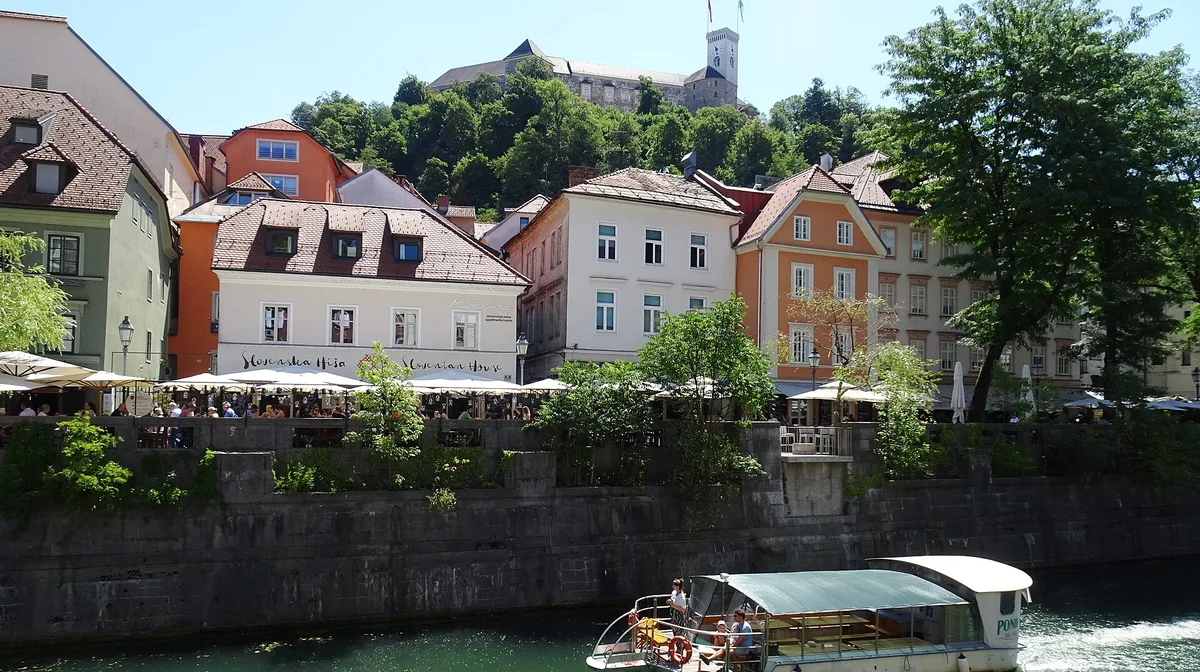
Ljubljana is small, extremely walkable and unusually well liked by the people who visit it, which produces a market with less volatility than its size suggests. The centre is closed to cars — the city was European Green Capital in 2016 and the pedestrianisation is genuine rather than cosmetic — so the whole core is a fifteen-minute walk end to end, with the Ljubljanica running through the middle of it and Jože Plečnik's bridges, embankments and market colonnade lining the banks. Those works were UNESCO-inscribed in 2021, which gives the city a heritage anchor most visitors do not know it has. Demand is broad rather than deep: European city-break couples, a substantial share of guests using Ljubljana as a base for Bled, Postojna and the coast, a growing conference and business base, and a summer flow moving between the Alps and the Adriatic. The Old Town runs the most consistent year-round occupancy in the country at around 61% and €113 a night. Small guest houses and boutique hotels in the centre compete for the same guest, and — importantly given what is coming in 2027 — the licensed hotel sector is not subject to the apartment night caps at all.
Top Attractions & Landmarks
- Ljubljana Castle and the funicular up to it
- The Triple Bridge and Plečnik's riverside embankments, UNESCO-inscribed in 2021
- Prešeren Square and the Franciscan Church
- The Dragon Bridge and the city's dragon emblem
- Plečnik's Central Market colonnade along the Ljubljanica
- Tivoli Park and the walk up Rožnik hill
- Metelkova, the city's autonomous cultural quarter
Nearby Markets: Lake Bled | Zagreb | Bratislava