€80
Avg. Nightly Rate
55%
Avg. Occupancy Rate
€1,340
Avg. Monthly Revenue
6-9%
Est. Cash-on-Cash ROI
MEDIUM
Seasonality
MEDIUM
Regulatory Burden

* Market averages. Properties marketed by Cavmir typically exceed these figures by 25–45%. Data sourced from AirDNA, STR market reports, and Cavmir internal analytics.

The Market

Why Zagreb is One of the World's Premier STR Markets

Zagreb is the Croatian market that nobody buys, and that is precisely what makes it interesting. Almost all the country's short-term rental capital goes to the coast, where the season is fourteen weeks long and the flat tax per bed now runs up to €300 a year in the top tier. Zagreb is a working capital of eight hundred thousand people with a business economy, a university, a government and a genuine year-round demand base — and a December that has been voted the best Christmas market in Europe three years running. The regulatory picture is Croatian rather than local. The flat tax per bed is set by each municipality inside national bands, and the published coastal tiers do not cover Zagreb, so the continental figure has to be checked with the city rather than assumed. The optional holiday-home tax has been replaced by a mandatory property tax that every Croatian municipality must levy on residential property that is neither a permanent home nor long-term let, which lands directly on short-term rental stock. Sojourn tax runs through eVisitor at up to €2.00 per guest per night in season. Regulation (EU) 2024/1028 has applied since 20 May 2026, but the Ministry of Tourism and Sport has confirmed there is currently no obligation to hold a Croatian registration number; that arrives in 2027 with the new Hospitality Activity Act. Zagreb is not capped, not moratoriumed and not saturated.

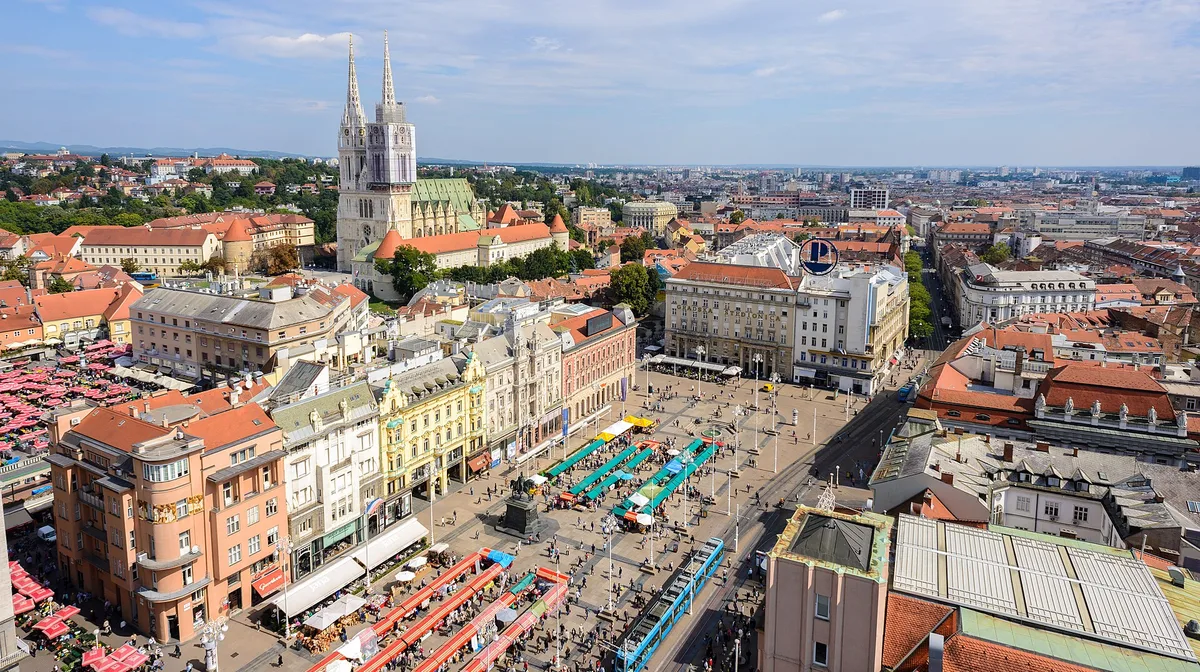
Zagreb's demand runs on a completely different engine from the Croatian coast, which is the whole argument for being here. The city has government, a large university, a business and conference economy, and the national institutions — none of which take the summer off. It sits at the crossing point of central European road and rail routes, with Ljubljana, Budapest, Vienna and Belgrade all within a comfortable drive, so it collects a steady flow of regional weekend traffic alongside international city breaks. The historic core divides cleanly: the Upper Town on its hill, with St Mark's tiled roof, the Stone Gate and a cannon that has been fired from Lotrščak Tower at noon every day since 1877; and the Lower Town below, an Austro-Hungarian grid built around the Green Horseshoe of parks and museums. Dolac market sits between them. In December, Advent takes over the whole of it, and the city has the European awards to prove the market is genuinely good rather than merely local. Blended rates sit near €80 at around 55% occupancy — modest numbers against the coast's headline rates, but earned across twelve months rather than three. Small boutique hotels and guest houses in the Lower Town compete for the same guest.

Top Attractions & Landmarks

  • St Mark's Church and its tiled coat-of-arms roof in the Upper Town
  • Lotrščak Tower and the Grič cannon, fired daily at noon since 1877
  • Dolac market, the city's open-air food market
  • The Stone Gate and the Upper Town's cobbled lanes
  • The Green Horseshoe of parks and museums in the Lower Town
  • Tkalčićeva street and its terraces
  • Maksimir Park and Jarun lake

Nearby Markets: Ljubljana  |  Budapest  |  Dubrovnik

Airbnb marketing services in Zagreb, Croatia, Europe
Why Cavmir

The Cavmir Advantage
in Zagreb

Cavmir wins in Zagreb by selling twelve months instead of three. Every Croatian marketing instinct is coastal and seasonal, and it is exactly wrong for this city — Zagreb's business, conference, university and government demand runs Monday to Thursday all year and almost no listing here is written for it. We split the calendar and put a desk, a stated connection speed and the walk to the business districts into the listing. We price Advent properly: a Christmas market voted the best in Europe three years running fills the entire centre for a month, and it is the single densest block in the Zagreb year. We write the two-town geography honestly, because Upper Town and Lower Town are genuinely different products — one is cobbled, hilly, atmospheric and hard work with a suitcase; the other is flat, elegant and five minutes from the station — and guests choosing blind end up in the wrong one. We handle the earthquake question plainly where it applies, since the March 2020 quake damaged parts of the Upper Town and the cathedral and restoration is visible; guests notice, and an honest sentence beats a surprised arrival. And for the Lower Town's boutique hotels and guest houses we build direct-booking websites with corporate-rate pages and Advent packages, because in a year-round market the returning business guest is the most valuable asset you can own. We help position and market your property. We never manage it or touch your keys.

State of the Industry · History

The Zagreb STR Market — Past & Present

Zagreb began as two rival hilltop settlements that spent several centuries disliking each other across a stream. Kaptol was the bishop's town, walled and ecclesiastical, built around the cathedral; Gradec was the free royal town on the neighbouring hill, granted its charter in 1242 after the Mongol invasions. The stream between them ran roughly where Tkalčićeva street now is, and it was a boundary rather than a feature — the two towns had separate governments, separate defences and a long habit of armed disagreement. They were formally united as Zagreb only in 1850. What survives of that period is the Upper Town: St Mark's with its extraordinary tiled roof bearing the coats of arms of Zagreb and of the triune kingdom, the Stone Gate with its shrine, and Lotrščak Tower, from which a cannon has been fired at noon every single day since 1877.

The city that most visitors actually walk around is younger and Austro-Hungarian. After the devastating earthquake of 1880, Zagreb rebuilt and expanded downhill into a planned grid organised around the Green Horseshoe — a U of parks, pavilions and museums laid out in the 1880s that is one of the more successful pieces of nineteenth-century urban planning in Central Europe. Yugoslavia followed, then independence in 1991 and a war that Zagreb experienced but was not fought over. Croatia joined the European Union in 2013 and then, on a single day — 1 January 2023 — both the eurozone and the Schengen area, which removed the currency and border frictions that had shaped travel here for decades. On 22 March 2020 a magnitude 5.5 earthquake struck the city, damaging the cathedral and a great deal of the Upper Town; restoration is ongoing and visible. Through all of it the rental economy stayed small relative to the coast, because Croatian short-term rental capital goes almost entirely to the Adriatic — which is why Zagreb remains uncapped, unsaturated and largely unnoticed.

Pricing Strategy & Seasonality

Pricing, Seasonality & When to Capture ROI

Pricing Strategy

Zagreb's rate map is really a two-town map with a business layer underneath it. The Upper Town (Gornji grad) is the atmospheric tier — cobbles, gas lamps, St Mark's, and a hill that guests with suitcases discover the hard way — and it takes the strongest leisure rates, particularly during Advent. The Lower Town (Donji grad), the Austro-Hungarian grid around the Green Horseshoe, is the practical premium: flat, elegant, five minutes from the main station, and the natural base for business and conference demand as well as leisure. Tkalčićeva and the streets between the two towns carry the restaurant and bar economy, price well at weekends and carry the corresponding noise. Trešnjevka and the western districts are the value tier, well connected by tram and materially cheaper to buy into. Maksimir and the eastern approaches serve longer stays, families and relocations near the park. Blended, Zagreb runs near €80 a night at roughly 55% occupancy — figures that look ordinary against a Dalmatian headline rate until you remember they are earned across twelve months rather than concentrated into fourteen weeks.

Seasonality & ROI Windows

Zagreb's year is the flattest in Croatia and that is its commercial point. Spring is strong from April, with the parks in use and the conference calendar running. May and June are the best leisure months, warm without the July heat. July and August are, unusually, the softest leisure weeks of the summer half-year, because the entire country goes to the coast and Zagreb empties — an inversion that catches owners who price it as peak. September is excellent: the weather holds, the university returns and business travel comes back at full strength. October and November run on conferences and city breaks. December is the peak of the whole year, with Advent filling the centre for a month. January and February are the quiet months, held up by business travel and the ski traffic passing through toward Slovenia and Austria.

Regulation & Licensing · 2026

What the Law Requires in Zagreb

Zagreb has no city-specific short-term rental licence, no nights cap and no moratorium. What applies here is the Croatian national framework, which changed substantially in 2025 and changes again in 2027, and a lot of published guidance has not caught up.

The flat tax per bed per year is now set by each municipality inside national bands that are tiered by tourism intensity. The figures that circulate widely as coastal "categories" do not survive checking: Dubrovnik and Split, supposedly in different bands, both adopted the same zoned structure of €250 per bed in the core, €150 in the middle ring and €100 in the outer settlements. What the statute actually sets is a national range of €20 to €300 per bed per year, banded by the index of tourism development, with the top class running €100 to €300. Zagreb is continental and not on that coastal list at all. The continental municipalities set their own figure inside the national band, and it must be confirmed with the city rather than inferred from a coastal table.

The larger change is the property tax. The old optional Tax on Holiday Homes was replaced by a mandatory property tax that every Croatian city and municipality is required to levy on residential property that is neither a permanent dwelling nor let long-term — which means it falls squarely on short-term rental stock, and it is no longer a matter of local discretion whether it exists.

Sojourn tax runs through the national eVisitor system, at up to €2.00 per guest per night in season and €1.30 off-season on 2026 tourist-board decisions; eVisitor also handles guest registration, and it is the operator's duty. Regulation (EU) 2024/1028 has applied since 20 May 2026 and is the most widely misdescribed rule in this industry. It works on an opt-in basis: it sets common standards for the registration procedures Member States choose to operate, and it creates no European registration number, obliges no Member State to introduce a scheme, and does not by itself require any host to register. Croatia's own number does not exist yet: the Ministry of Tourism and Sport publicly confirmed there is currently no obligation for owners of rooms, apartments, studio apartments or holiday homes to obtain one, and the requirement takes effect in 2027 with the new Hospitality Activity Act. What is required today is the categorisation decision, the blue plaque and eVisitor guest registration. A new Hospitality Industry Act is drafted for 1 January 2027 and would introduce a registration number for each accommodation unit. Building-level rules apply throughout, and in the Upper Town the post-earthquake restoration adds a further constraint on what may be altered.

Market-Specific Tips & Challenges

Local Tips & Unique Market Challenges

Tips That Actually Move Revenue in Zagreb

Sell twelve months, not three. Every marketing instinct in Croatia is coastal and seasonal and it is wrong for Zagreb — this is a capital with government, a university, a conference calendar and a business economy that runs Monday to Thursday all year, and almost no listing here addresses it. Put a desk, a stated connection speed and the walk to the business districts in the listing and price midweek separately. Price Advent in September: a Christmas market voted the best in Europe three years running fills the entire centre for a month and the good rates go early. Do not price July and August as peak, because the whole country goes to the coast and Zagreb is at its emptiest — that is the single most common pricing error in this market. Name your town: Upper or Lower, because they are different products and the hill is real. Be honest about earthquake restoration if it is visible near your property; guests notice scaffolding and an unmentioned surprise costs more than a mentioned one. And model the flat tax per bed and the mandatory property tax before you add another bed, because both are fixed annual costs.

Unique Zagreb Challenges

Zagreb's problem is attention rather than competition: it is a capital that most people passing through Croatia treat as an airport, and the entire national marketing apparatus points at the coast. That means demand has to be built rather than caught. The summer inversion catches owners repeatedly — July and August are the softest leisure weeks of the warm half-year because the country empties toward the Adriatic. Croatia's fixed annual costs are unusual and unforgiving: the flat tax per bed and the mandatory property tax both apply regardless of occupancy, so an under-occupied property loses money in a way it would not in Poland or the Baltics. Seismic risk is genuine and under-insured, with visible restoration continuing in the Upper Town after the 2020 earthquake. The Upper Town's cobbles and gradient are a real accessibility issue. And a new Hospitality Industry Act in 2027 will add per-unit registration on top of everything already in place.

The Cannon That Sets The Clocks
At noon every day since 1877, a cannon has been fired from Lotrščak Tower in Zagreb's Upper Town. It was originally there to synchronise the bells of the city's churches, which had been keeping their own approximate time and ringing whenever it suited them. It has fired through two world wars, three states and an earthquake, and it still goes off at exactly twelve. Visitors standing on Strossmayer promenade at 11:59 with no idea it is coming provide a reliable daily entertainment for everybody who does know.
Finance Essentials — Zagreb
🛡️

Insurance

Standard Croatian homeowner cover does not contemplate paying guests, and in Zagreb there is a specific exposure that most of Europe does not share. The city sits in an active seismic zone: a magnitude 5.5 earthquake on 22 March 2020 damaged the cathedral and a great deal of the Upper Town, and restoration is still visible. Check that your policy covers earthquake explicitly rather than assuming it, particularly for older Upper Town and Lower Town buildings. Beyond that, ask for accommodation cover rather than residential cover, confirm public liability for guests on cobbled and steeply sloping approaches in the Upper Town, and check the position on shared parts in nineteenth-century buildings where original risers make water escape the common large claim.

🧾

Property & Income Tax

Croatia adopted the euro on 1 January 2023, so there is no currency question for a foreign owner. The Croatian short-term rental tax structure is unusual: alongside ordinary income taxation there is a flat tax per bed per year set by the municipality inside national bands, and a mandatory property tax that every city must now levy on residential property that is neither a permanent home nor long-term let. Together they mean a Croatian short-term rental carries meaningful fixed annual cost per bed regardless of how many nights it actually sells — which is why bed count, rather than floor area, is the number to model. The coastal tier tables that circulate online do not cover Zagreb. Confirm the continental figure with the city and ask a Croatian accountant to model the fixed annual charge against your realistic occupancy before you buy.

🏦

Mortgages & Financing

Croatian lenders assess short-term rental income conservatively and generally underwrite against long-term market rent rather than platform revenue. Croatia is in the eurozone and in Schengen, both since 1 January 2023, which has simplified purchase and management for EU buyers considerably. Entry prices in Zagreb are far below the Dalmatian coast for comparable quality, which is the fundamental arbitrage this market offers — the same capital buys more building in a city that earns across twelve months rather than fourteen weeks. The costs to model carefully are the fixed annual ones: the flat tax per bed and the mandatory property tax apply whether or not the property sells a single night.

Future Outlook · 2027 & Beyond

Where Zagreb is Headed Next

Zagreb's next two years are shaped by national rules rather than local pressure, which is a comfortable position to be in. The Hospitality Activity Act would put a registration number on every accommodation unit in Croatia during 2027, which makes the whole market visible and attributable for the first time. In coastal towns that visibility is the prelude to caps, and Dubrovnik has already shown what that looks like. In Zagreb the pressures that drive caps simply are not present: the city is large, the visitor density is low, the housing-loss argument has not taken hold, and the rental sector is small relative to the population. The demand outlook is quietly good. Advent has built an international reputation that keeps growing, the conference and university calendars are stable, the eurozone and Schengen accession of January 2023 removed real friction for regional travel, and post-earthquake restoration is gradually returning the Upper Town and the cathedral to full condition. The most likely 2028 is a bigger, registered, still uncapped market where the operators who learned to sell a twelve-month city rather than a summer one hold the advantage.

From the Desk of Sofie Sinag

Why We Love Marketing in Zagreb

We love Zagreb because it is the one Croatian city that is not selling you a coastline. There is no sea, no ferry timetable, no fourteen-week season — just a capital that goes to work, with two old towns on two hills that spent centuries feuding, an Austro-Hungarian grid built around a horseshoe of parks, a food market in the middle of it that people actually shop at, and a cannon that goes off at noon whether or not anyone is listening. It has the qualities that make a city good to live in rather than good to photograph, which is a much better basis for a rental business than it sounds. The December market is genuinely excellent and has the European awards to say so. The coffee culture is a serious daily ritual rather than a performance. And because every euro of Croatian rental capital goes to the Adriatic, Zagreb has stayed uncrowded, uncapped and unnoticed while the coast argued about caps and moratoria. For a marketing desk that is a rare and welcome brief: a good market that nobody is fighting over, where the work is building demand rather than fighting for a share of it.

Cavmir's Zagreb Cheat Sheet

The Picks We Recommend for Your Welcome Book

The picks we send Zagreb guests — the twelve-month city rather than the summer stopover, with the two-town geography made plain.

Coffee & First Light

A terrace on Tkalčićeva or Cvjetni, mid-morning

Zagreb's coffee culture is a genuine institution — people sit for an hour and it is not considered idle. Saturday morning špica, when the whole city dresses up and occupies the terraces around Cvjetni and Tkalčićeva, is the single most local thing a visitor can do here and costs the price of a coffee.

The Splurge Table

Continental Croatian cooking in the Lower Town

This is not the Adriatic — the cooking here is central European, with game, freshwater fish, turkey with mlinci, štrukli, and wines from Slavonia and the Plešivica hills that visitors never encounter on the coast. The standard is high and the bill is well below Ljubljana or Vienna. Book a week ahead.

Local Obsession

Dolac market, in the morning

The open-air market on the terrace between the two old towns, red parasols and all, where Zagreb actually buys its food. Send guests before ten for cheese, cured meat, fruit and the flower section, and tell them to go down into the covered hall underneath, which most visitors never find.

Shoulder Season Secret

The Green Horseshoe in the second half of September

The U of parks and pavilions laid out in the 1880s, running from the station up through the Botanical Garden and the museum squares, at the point in the year when the leaves start turning and the students are back. Free, flat, twenty minutes end to end, and a better photograph than the Upper Town cobbles.

Weekend Escape

Advent, if the timing allows

For a month from late November the entire centre turns over to it — the parks, the Upper Town, Tkalčićeva, the ice rink on King Tomislav Square — and it has been voted the best Christmas market in Europe three years running. If a guest is choosing dates and has any flexibility, this is the answer.

What Guests Ask For

Upper or Lower Town, and how steep it is

Zagreb enquiries repeat this, and it matters more than guests realise. The Upper Town is cobbled and genuinely hilly; the Lower Town is flat and five minutes from the station. Say which one you are in, state the gradient honestly, and mention the funicular — and you will avoid the arrival that begins with a suitcase and a complaint.

Local Work · Composite Case Vignettes

What Cavmir Has Done for Zagreb Properties

A few composite engagements drawn from how Cavmir typically works in this market. The details are illustrative and consistent with Zagreb, not pulled from a single named client.

One-bedroom apartment · Lower Town
The Brief

A flat five minutes from the main station ran a flat annual rate, priced July and August as peak when the city was at its emptiest, and sat unbooked every Monday to Thursday in a capital full of conference and government travel.

What We Did

Cavmir split the calendar into business midweek and leisure weekend pricing, corrected the summer assumption by repricing July and August against the actual demand curve, added a desk and a stated connection speed, and wrote the walk to the ministries, the university and the congress venues into the listing.

The Result

Midweek filled with a guest the owner had never targeted, the summer months stopped being priced against demand that had gone to the coast, and the property began earning across twelve months rather than chasing a season that does not exist here.

16-room boutique hotel · near the Green Horseshoe
The Brief

An independent hotel took most bookings through platforms, had no corporate-rate page despite sitting a few minutes from the government and university quarter, and treated Advent as a busy month rather than as the commercial event of the year.

What We Did

Cavmir built a direct-booking website with a published best-rate guarantee and a corporate-rate page, packaged Advent stays and priced them from September, added an autumn conference offer, and set up a post-stay sequence inviting returning business guests to book direct.

The Result

Advent sold out earlier and at materially better rates than the previous year, autumn midweek occupancy improved, and the hotel gained a direct corporate pipeline in a market where year-round business demand is the most valuable thing available.

Two-bedroom apartment · Upper Town
The Brief

An atmospheric flat on a cobbled lane collected repeated complaints about the hill and the suitcase carry, said nothing about visible post-earthquake restoration work nearby, and lost bookings to Lower Town listings that were simply easier to reach.

What We Did

Cavmir rewrote the listing to state the gradient, the cobbles and the funicular honestly, mentioned the restoration plainly rather than leaving guests to discover it, repositioned the property on atmosphere and Advent proximity, and targeted couples rather than families with heavy luggage.

The Result

Arrival complaints stopped because expectations were set before booking, the review scores recovered, and the property began attracting guests who had chosen the Upper Town deliberately for what it is rather than assuming it was a flat walk.

Ready to Grow in Zagreb?

Let's Put Your Zagreb
Property on the Map

Talk to Cavmir today. We'll show you exactly what your Zagreb property is leaving on the table — and how fast we can change that.

Book a Free Strategy Call