The Market
Why Split is One of the World's Premier STR Markets
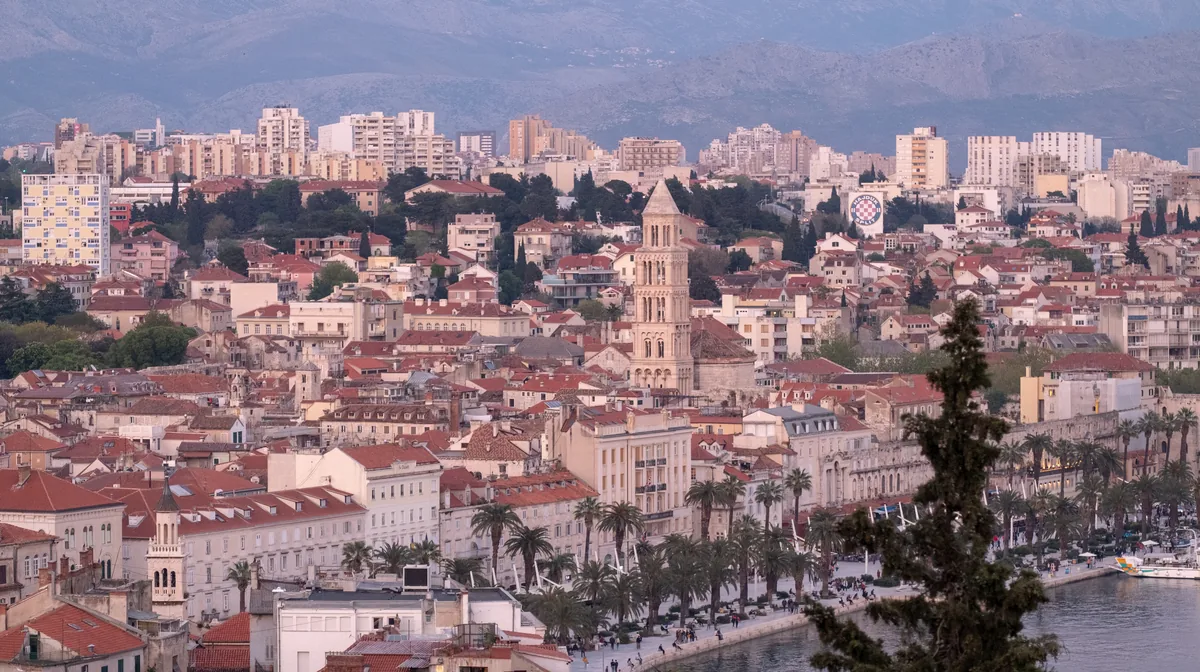
Split is the busiest short-term rental market in Croatia and one of the most concentrated in Europe, and the numbers around it are unusually unreliable — depending on which listing universe you count, the city runs somewhere between 5,441 listings at 46% occupancy and around €150 a night, and 6,903 listings at 75% occupancy and €116. What is not in doubt is the density. This is a city where the historic core is a Roman emperor's retirement palace, built around 305 AD, still inhabited, UNESCO-inscribed since 1979 — and where a very large share of the apartments inside those walls now serve visitors rather than residents. Unlike Dubrovnik, Split has not imposed a bed ceiling or a moratorium. What it has is the Croatian national framework, which is heavier than most owners realise, and a set of city figures that are steeper than the guides suggest: Split adopted its own flat-rate income tax per bed with effect from the start of 2025 — €250 a bed in zone I, the old town core, €150 in zone II across the other city districts, and €100 in zones III and IV covering Stobreč, Kamen, Slatine and the outlying settlements — payable whether or not the bed is ever sold. The mandatory property tax applies on top to any residential property that is neither a permanent home nor long-term let, and tourist tax runs through eVisitor. One point worth settling immediately, because a great deal of what circulated in 2026 was wrong: the Ministry of Tourism and Sport has confirmed there is currently no obligation to hold a rental registration number in Croatia. That arrives in 2027 with the new Hospitality Activity Act. The costs here are fixed and per-bed; the season is short. That combination decides everything.
Split does two jobs at once and the second one is the reason it fills. It is a destination in its own right — Diocletian's Palace, the Riva promenade, Marjan hill, Bačvice beach — and it is Croatia's principal passenger port, the gateway to Hvar, Brač, Vis, Šolta and Korčula. An enormous share of the people who sleep here are doing so because of a ferry timetable rather than because of the city, which is a commercial fact almost no listing uses. They arrive late, leave early, need somewhere to put luggage, and will happily add a night at either end if somebody gives them a reason. Rates blend somewhere near €140 at around 55% occupancy across five to seven thousand listings depending on the count, and the spread is wide: inside the palace walls commands the premium and the noise, Varoš and Radunica sell stone lanes and quiet, Bačvice sells the beach, Žnjan's rebuilt waterfront offers new construction and parking to families who want neither stairs nor noise, and the Kaštela and Podstrana ends sell space. Layered over all of it is an events calendar that behaves like a fourth business: Ultra Europe brings tens of thousands of festivalgoers each July, the Split Summer Festival has staged opera and theatre across the old town since 1954, and the yacht-charter fleets swap crews on Saturdays all summer, producing a weekly wave of guests who need a bed either side of a boat. The season is brutally concentrated between June and September. Small boutique hotels and guest houses inside the palace compete for the same guest, and several of them handle the noise problem better than the apartments do.
Top Attractions & Landmarks
- Diocletian's Palace, built around 305 AD and still inhabited
- The Peristyle and the cathedral in the emperor's mausoleum
- The Riva waterfront promenade
- Marjan hill, its paths and viewpoints
- Bačvice beach and the local game of picigin
- The ferry port and the crossings to Hvar, Brač and Vis
- The Roman ruins of Salona at Solin
Nearby Markets: Dubrovnik | Zagreb | Kotor