€135
Avg. Nightly Rate
54%
Avg. Occupancy Rate
€2,220
Avg. Monthly Revenue
5-8%
Est. Cash-on-Cash ROI
HIGH
Seasonality
HIGH
Regulatory Burden

* Market averages. Properties marketed by Cavmir typically exceed these figures by 25–45%. Data sourced from AirDNA, STR market reports, and Cavmir internal analytics.

The Market

Why Lake Bled is One of the World's Premier STR Markets

Lake Bled is the most photographed place in Slovenia and, from 1 January 2027, potentially one of the most restricted. Slovenia's Hospitality Act gives municipalities the power to cap how many nights an apartment may be let short-term, on a statutory band from 30 to 270 nights a year, with municipalities identified as high-risk defaulting to 60. Bled is widely expected to be one of them, alongside Piran, Izola, Kranjska Gora and Ljubljana. The caps do not apply in 2026 — this year is the runway — but the arithmetic is worth confronting now: a property currently selling around 197 nights a year at 54% occupancy would be selling 60, and the business would stop being about filling a calendar and start being about what each remaining night is worth. Rates here already sit at the top of the Slovenian range, near €135 a night, and Bled's lakeside promenade is named among the best-performing submarkets in the country. Two other things apply today and catch buyers: letting short-term requires the consent of all owners and co-owners of the unit, and the property must be entered in the RNO, Slovenia's register of accommodation establishments run by AJPES, with guests reported through eTurizem and the accommodation identification number stated when you advertise. The tourist tax, at a reported €3.13 per person per night, is among the highest in Slovenia.

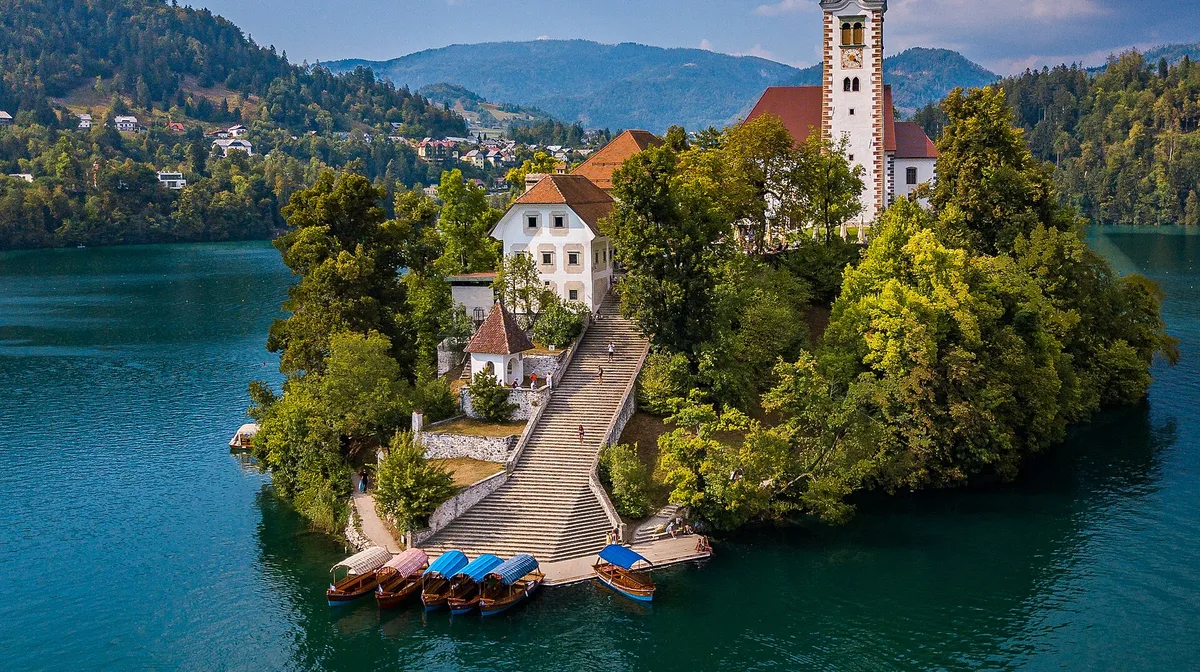
Bled sells one image and a great deal more than one product. The island in the middle of the lake with its church, the castle on the cliff above, and the ring of Julian Alps behind it is among the most reproduced views in Europe, and it draws an enormous day-visit flow from Ljubljana, less than an hour away, plus coach traffic from Italy, Austria and Croatia. Converting that flow into overnight stays is the commercial question, and the answer is almost always about the times of day and year the day-trippers are not there. Rates run near €135 a night at around 54% occupancy — the high rate and the modest occupancy together tell you this is a seasonal market with a strong peak and thin edges. Summer is dominated by international leisure and by Triglav National Park hiking; autumn is the best walking and the best light; winter is quiet except when the lake behaves dramatically. Supply skews toward guest houses, apartments in villas, and a set of long-established lakeside hotels that have been serving this view since the era when Bled was a Yugoslav state resort. Those hotels are also, from 2027, in a category the apartment caps do not touch.

Top Attractions & Landmarks

  • Bled Island and the Church of the Assumption at the top of 99 steps
  • Bled Castle on its cliff, first recorded in 1011
  • The pletna boats, hand-rowed under hereditary licence
  • The lakeside walking path, about six kilometres around
  • Vintgar Gorge and its timber walkways
  • Triglav National Park and the Julian Alps
  • Lake Bohinj, larger, quieter and half an hour further in

Nearby Markets: Ljubljana  |  Zagreb  |  Bratislava

Airbnb marketing services in Lake Bled, Slovenia, Europe
Why Cavmir

The Cavmir Advantage
in Lake Bled

Cavmir wins at Bled by selling the hours and the seasons that the day-trip crowd never sees, and by getting owners ready for 2027 before it arrives. The specific work: photographing the lake at dawn and at dusk from the walking path rather than at noon from the same spot as every coach, writing the shoulder seasons honestly because late September and early October are genuinely better here than August, and building the case for a stay of four or five nights — Vintgar Gorge, Bohinj, the Julian Alps, Triglav National Park, Ljubljana as a day trip in reverse — rather than the two nights most listings settle for. We model the night cap with owners now, because a property that has to earn its year in 60 nights needs a different rate structure, a different guest and probably a different length of stay, and 2026 is the only year in which that can be tested without consequence. For some owners the right answer is to move to the licensed guest house or small hotel category, which the apartment caps do not cover — a conversation almost nobody in this market is having. And for Bled's lakeside hotels and guest houses we build direct-booking websites and repeat-guest programmes, because their competitive position is about to improve and they should be positioned to take the share. We help position and market your property. We never manage it or touch your keys.

State of the Industry · History

The Lake Bled STR Market — Past & Present

Bled has been somebody's resort for a very long time. The castle above the lake is first recorded in 1011, when the German emperor Henry II granted the estate to the Bishops of Brixen, and it is generally described as the oldest castle in Slovenia; the bishops held it, remotely, for more than eight hundred years. The island had a pre-Christian sanctuary before it had a church, and the Church of the Assumption at the top of its ninety-nine steps became a pilgrimage site with a bell that visitors still ring for a wish. In 1740 Empress Maria Theresa granted local families the exclusive right to ferry pilgrims across to the island, and that right became hereditary — the pletna boats you see today, flat-bottomed and rowed standing up with two oars, are operated under a limited number of licences that still pass down through the same families.

The modern resort dates from the middle of the nineteenth century, when the Swiss hydrotherapist Arnold Rikli arrived and began treating patients with sun, air and cold water, turning Bled into a health destination for the Austro-Hungarian middle classes. The railway followed, then the grand hotels. After 1945 Bled became a Yugoslav state resort — Tito had a villa here and received foreign heads of state on the lake, which is why the town has a scale of hotel infrastructure that its permanent population could never have generated on its own. Independence in 1991 turned a domestic institution into an international destination, and the image of the island with the Alps behind it did the rest; by the 2010s Bled was carrying day-visit volumes that a small lakeside town was never designed for. Slovenia's response, arriving in 2027, is the Hospitality Act's municipal night caps — and Bled, alongside Piran, Izola and Kranjska Gora, is widely expected to be treated as high-risk and default to 60 nights a year for apartments.

Pricing Strategy & Seasonality

Pricing, Seasonality & When to Capture ROI

Pricing Strategy

Bled's rate map is drawn almost entirely by the view and the walk. The lakeside promenade and the properties with an unobstructed island view are the top of the market and among the best-performing submarkets in Slovenia — this is the single asset that justifies a premium here, and a photograph either proves it or does not. The castle side and the northern shore price close behind, with the advantage of morning light on the island and a quieter approach. The town centre behind the promenade is the practical tier: a two-minute walk to the water, no view, and a guest who will accept that trade if the listing is honest about it rather than implying otherwise. Mlino and the southern shore trade slightly lower and are the better base for the walking path and the pletna jetties. Ribno, Bodešče and the villages a few kilometres out are the value tier and the family tier, and they need to be sold on space, quiet and parking rather than on proximity. Blended, Bled runs near €135 a night at roughly 54% occupancy — a high rate with modest occupancy, which is the signature of a market with a sharp peak and thin edges.

Seasonality & ROI Windows

Bled has a pronounced season and two genuinely underrated shoulders. June through August is the peak, with international leisure demand, Triglav National Park hiking at its busiest and the lake warm enough to swim in. September is the best month of the year and most owners price it as though it were the end of summer: warm days, cold clear mornings, the coach traffic thinning and the Alpine walking at its finest. October holds that quality with autumn colour around the lake and is the best photography month by a distance. May is the spring equivalent, green and quiet before the crowds. November and early December are genuinely soft. Winter is quiet but not empty — Bled sits within reach of the Slovenian ski areas, and in the years the lake partially freezes the town has a spectacle that fills it at short notice.

Regulation & Licensing · 2026

What the Law Requires in Lake Bled

Bled's regulatory position is defined by a date that has not arrived yet, and by a requirement that already stops purchases.

The date is 1 January 2027. Slovenia's Hospitality Act introduces municipal caps on the number of nights an apartment may be let short-term, on a statutory band from 30 to 270 nights a year, with municipalities identified as high-risk defaulting to 60. Bled is widely expected to be treated as high-risk, alongside Piran, Izola, Kranjska Gora and Ljubljana. Nothing is capped during 2026. The scale of the change deserves to be stated plainly: a property currently selling around 197 nights a year at 54% occupancy would be limited to 60, which is not a pricing adjustment but a different business model — one built on yield per available night and on longer stays that use fewer nights to earn the same money.

The requirement that already applies is consent. Letting short-term requires the consent of all owners and co-owners of the unit, and in a converted villa or an apartment building that is a genuine obstacle rather than a formality. It should be documented before a purchase, not investigated after one.

Regulation (EU) 2024/1028 has applied since 20 May 2026 and is the most widely misdescribed rule in this industry. It works on an opt-in basis: it sets common standards for the registration procedures Member States choose to operate, and it creates no European registration number, obliges no Member State to introduce a scheme, and does not by itself require any host to register. Slovenia does operate one: RNO registration through AJPES, eTurizem guest reporting, and the accommodation identification number shown when advertising, with additional RNO data called for by 30 June 2026. The tourist tax at Bled is reported at €3.13 per person per night, payable on arrival — noticeably higher than Ljubljana's and worth stating clearly in the listing so it is not a surprise. Finally, Triglav National Park and the protected landscape around the lake constrain what may be built or altered; verify before assuming any extension or conversion is possible.

Market-Specific Tips & Challenges

Local Tips & Unique Market Challenges

Tips That Actually Move Revenue in Lake Bled

Model your property against 60 nights this year, while it costs nothing to be wrong. If the numbers work, rebuild the rate structure around yield per night and test it during 2026. If they do not, look seriously at the licensed guest house route, which the apartment caps do not cover and which almost nobody in this market is discussing. Sell September and October properly: they are the best months at Bled — warm days, clear mornings, autumn colour, the best hiking and the best light — and most listings price them as the end of summer. Photograph the lake at dawn from the walking path, not at midday from the same viewpoint as every coach, because the day-trip photograph is the one thing every competing listing already has. Build the four-and-five-night case explicitly with Vintgar Gorge, Bohinj, Triglav National Park and Ljubljana in reverse, since longer stays are about to be worth disproportionately more. State the €3.13 per person per night tourist tax up front so it is not a doorstep surprise. And get the co-owners' consent documented now, because it is already required and it is the thing that stops sales here.

Unique Lake Bled Challenges

The 2027 night cap is the defining risk and it is not incremental: an apartment going from roughly 197 sellable nights to 60 is a different business, and any owner underwriting on current occupancy is underwriting a model with a known expiry date. The co-owner consent requirement stops purchases and is frequently discovered late. Day-visit pressure is enormous relative to the size of the town, which compresses the hours in which the lake is actually pleasant and makes the standard listing photograph identical to everyone else's. Seasonality is sharp: a high rate with 54% occupancy means the peak carries the year, and November through March is genuinely thin. Alpine property brings snow load, freeze risk and heating systems that need documenting. And the licensed hotel sector — well established here since the Yugoslav resort era — is about to be handed a structural advantage over the apartments competing with it.

The Boats That Are Inherited
The flat-bottomed pletna boats that row visitors to Bled Island are not a tourist revival. In 1740 Empress Maria Theresa granted a number of local families the exclusive right to ferry pilgrims across the water, and that right became hereditary. The licences are still limited and still pass down through the same families, and the boats are still rowed standing up, with two oars, by a single person — no engines have ever been permitted on the lake. It is one of the very few commercial privileges in Europe still operating under an eighteenth-century imperial decree.
Finance Essentials — Lake Bled
🛡️

Insurance

Alpine lakeside property carries risks a city policy does not contemplate. Snow load, freeze damage in a property left empty through a quiet November, and water exposure close to the lake are the recurring items, and older converted villas frequently have heating and electrical systems that an insurer will want to see documented. Ask for accommodation cover rather than residential cover, confirm public liability for guests on steep paths, steps and jetties, and check what unoccupied-property conditions apply during the soft months — which matters far more here than in a city, and will matter more again if a 60-night cap means the property is legally empty for most of the year.

🧾

Property & Income Tax

Slovenia is in the eurozone, so there is no currency complication for a foreign owner. How short-term letting income is taxed depends on how the activity is structured, and at Bled that question is unusually consequential because of what happens on 1 January 2027 — if apartments are capped at 60 nights and licensed accommodation is not, the choice of category is a tax decision and a business-model decision at the same time. The tourist tax is a separate collection obligation, reported at €3.13 per person per night and payable on arrival, borne by the guest but collected, remitted and recorded by you. Ask a Slovenian accountant to model the apartment and licensed-accommodation routes against a 60-night scenario before the end of 2026, because the answer may change what your property should legally be.

🏦

Mortgages & Financing

Slovenian lenders assess short-term rental income conservatively and underwrite against long-term market rent rather than platform revenue, which at Bled is now closer to realistic than to cautious given the 2027 cap. EU and EEA buyers purchase without restriction; buyers outside that group face reciprocity requirements worth checking early. The two things that should be verified before the mortgage conversation are whether all co-owners will consent to short-term letting, and whether the property makes sense at 60 sellable nights — because a lakeside apartment bought on 2026 economics and operated under 2027 rules is a materially different investment from the one on the spreadsheet.

Future Outlook · 2027 & Beyond

Where Lake Bled is Headed Next

Bled after January 2027 is likely to look quite different from Bled today, and the direction is reasonably clear. If a 60-night cap applies, the apartment supply on the platforms contracts sharply, remaining nights become scarce and expensive, and demand moves toward the licensed sector — the lakeside hotels and registered guest houses that the caps do not touch, several of which have been here since the Yugoslav resort era and have the capacity to absorb it. That is a substantial competitive advantage for anyone already licensed, and a strong argument for some apartment owners to change category during 2026 rather than after the deadline. The second effect is on stay length and season: when nights are rationed, a five-night booking in September is worth far more than two two-night stays in August, which should push the whole market toward the shoulder seasons that are genuinely better here anyway. Demand itself is not in question — the view is not going anywhere, Triglav National Park is a growing draw, and Bled's day-visit volumes suggest latent overnight demand rather than a shortage of it. The most likely 2028 is a smaller, more expensive, more seasonal apartment market and a materially stronger licensed one.

From the Desk of Sofie Sinag

Why We Love Marketing in Lake Bled

We love Bled because it is a genuinely famous view attached to a genuinely ordinary small town, and the gap between those two things is where all the good work is. Everybody arrives having seen the photograph — island, church, castle on the cliff, Alps behind — and most of them take the same photograph from the same place at the same time of day and leave. What they miss is the six-kilometre path around the water at seven in the morning with mist coming off it, the boats that have been rowed by the same families since an empress signed a piece of paper in 1740, the gorge twenty minutes away with timber walkways bolted to the rock, and the fact that Bohinj — bigger, wilder, emptier — is half an hour further and almost nobody goes. For a marketing desk that is an unusually clean brief: the destination sells itself and the visit does not, so the whole job is turning a photograph into a stay. And there is real urgency to it now. A night cap arriving in 2027 will make every booked night at Bled scarce, which means the work of lengthening stays and shifting them into the better seasons has stopped being an optimisation and become the plan.

Cavmir's Lake Bled Cheat Sheet

The Picks We Recommend for Your Welcome Book

The picks we send Bled guests — mostly the hours and the seasons the coaches never see, and the two lakes rather than one.

Coffee & First Light

The lakeside path at dawn

The whole character of Bled changes before eight in the morning: mist on the water, the island half-hidden, the path empty and the pletna boats still tied up. Send guests out with a flask before the first coach arrives and they will understand why people stay here rather than visit. It is also the only time the photograph is theirs alone.

The Splurge Table

A lakeside dining room with the island in the window

Bled's grand hotels have been feeding people with this view since the Habsburg spa era and the good kitchens take Slovenian produce seriously — lake fish, Alpine cheese, Karst prosciutto, and Brda wines that deserve far more attention abroad than they get. Book well ahead in summer.

Local Obsession

Kremšnita, the Bled cream cake

A square of vanilla custard and cream between two sheets of pastry, standardised at the Hotel Park in 1953 and unchanged since. It is a genuinely local institution rather than a tourist invention, and the correct instruction to a guest is to eat it on a terrace looking at the island and not to attempt two.

Shoulder Season Secret

The lake in the second week of October

The forest ring around the water turns, the mornings are cold and clear, the coaches have thinned and the light is the best of the entire year. It is the best week at Bled by some distance and it is routinely priced as the end of the season. Send guests then and they will come back at the same time next year.

Weekend Escape

Lake Bohinj and Vintgar Gorge

Bohinj is half an hour further into the mountains, several times larger, wilder and far emptier, sitting inside Triglav National Park. Vintgar Gorge is twenty minutes the other way, with timber walkways pinned to the rock above the water. Between them they turn a two-night stay into a five-night one.

What Guests Ask For

The view, the walk and the tourist tax

Bled enquiries repeat these three. Answer them in the listing — exactly what is visible from which window, the walking time to the lakeside path, and that the tourist tax is about €3.13 per person per night payable on arrival — and you will avoid both the view disappointment and the doorstep surprise that produce most of the poor reviews here.

Local Work · Composite Case Vignettes

What Cavmir Has Done for Lake Bled Properties

A few composite engagements drawn from how Cavmir typically works in this market. The details are illustrative and consistent with Lake Bled, not pulled from a single named client.

Two-bedroom apartment · lakeside promenade
The Brief

A flat with a genuine island view sold almost entirely on two-night summer bookings, discounted through September and October as though the season had ended, and had done no modelling against the 60-night cap expected from January 2027.

What We Did

Cavmir modelled the property against 60 sellable nights, repriced September and October as the best weeks of the year rather than the end of the summer, reshot the view at dawn and in autumn colour, and rebuilt the listing around four and five-night stays with Bohinj, Vintgar and Triglav written in.

The Result

Average stay lengthened materially before the cap arrived, the autumn months stopped being discounted and started outperforming August on rate, and the owner went into 2027 with a tested yield-per-night structure rather than an improvised one.

10-room guest house · castle side
The Brief

A licensed guest house above the northern shore took nearly all bookings through platforms, had no direct-booking route, and had not recognised that the 2027 apartment caps would leave its category untouched and hand it a competitive advantage.

What We Did

Cavmir built a direct-booking website with a published best-rate guarantee, packaged autumn walking stays and the Christmas and New Year block, positioned the house explicitly as licensed accommodation, and set up a post-stay sequence for guests who return in the same week each year.

The Result

Direct bookings took a meaningful share off the commission line, the shoulder-season packages filled weeks that had previously been discounted, and the owners entered 2027 with a growing category and a guest list they controlled.

Family house · Ribno, outside the town
The Brief

A larger property a few kilometres from the lake was priced apologetically for not having a view, competed badly against promenade listings, and attracted only price-led summer bookings in a market where its actual advantages went unmentioned.

What We Did

Cavmir repositioned it around space, quiet and parking for families and walking groups, built the case for Triglav National Park and Bohinj rather than for the lakeside promenade, targeted longer stays outside high summer, and stated the drive and the walking options honestly.

The Result

Summer bookings lengthened from three nights toward a week, the property began filling in September and October when the walking is at its best, and it stopped competing on a view it was never going to have.

Ready to Grow in Lake Bled?

Let's Put Your Lake Bled
Property on the Map

Talk to Cavmir today. We'll show you exactly what your Lake Bled property is leaving on the table — and how fast we can change that.

Book a Free Strategy Call