€78
Avg. Nightly Rate
64%
Avg. Occupancy Rate
€1,500
Avg. Monthly Revenue
6-9%
Est. Cash-on-Cash ROI
MEDIUM
Seasonality
MEDIUM
Regulatory Burden

* Market averages. Properties marketed by Cavmir typically exceed these figures by 25–45%. Data sourced from AirDNA, STR market reports, and Cavmir internal analytics.

The Market

Why Warsaw is One of the World's Premier STR Markets

Warsaw is the largest short-term rental market in Central Europe that still has no licence to apply for, and that is about to stop being true. Around 8,980 listings compete here across a city of 1.8 million, and the rules governing them are lighter than almost every guide claims: Poland still has no national short-term rental register. The act that would create one has been drafted for years and is not yet law, and Regulation (EU) 2024/1028, which began to apply on 20 May 2026, harmonises the registration schemes Member States choose to run rather than creating one of its own. Poland's own act is the second half of that story and it has not landed yet. The Ministry of Sport and Tourism's draft would classify any let under 31 days as an accommodation service, put every property in a National Register of Tourist Accommodation Facilities with an individual ID on every offer, and hand municipalities the power to designate zones where short-term rental is restricted outright. Fines of up to PLN 50,000 have been reported. It was still moving through the legislature in August 2026, and the municipal zone powers phase in after the rest — which means guides describing a live Polish register are ahead of the law. What all of this rewards is the operator who is already running a real business. Warsaw is not a postcard city that sells itself; it is a working capital where the guest is choosing a district, a metro stop and a purpose. The listings that win here explain all three.

Warsaw's demand has two engines and they run on different weeks, which is the commercial fact most owners miss. Monday to Thursday the city fills with business travel — Poland's banking, legal and technology capital, the Warsaw Stock Exchange, the corporate belt around Rondo Daszyńskiego and the Mokotów office district — and those guests book late, stay two or three nights, and care about wi-fi, a desk and a metro entrance more than about a view. Friday to Sunday the mix flips to couples and groups: Old Town weekends, restaurant and club demand along Nowy Świat and around Plac Zbawiciela, stag and hen traffic that some buildings welcome and most do not. Nightly rates average around PLN 330 with a median near PLN 285 — roughly €78 blended — at occupancy reported between 60% and 68%, and the spread inside that is enormous. Śródmieście carries a 30% to 50% premium over the outer districts, and the Old Town and Powiśle stretch runs PLN 400 to 550 on the right weekend. Two airports feed the city: Chopin, eight kilometres out and on the metro-and-bus network, and Modlin, forty kilometres north, which is where the budget carriers land and where a badly written arrival paragraph costs you a review. Aparthotels and small boutique hotels are a serious part of supply here and compete for exactly the same midweek guest.

Top Attractions & Landmarks

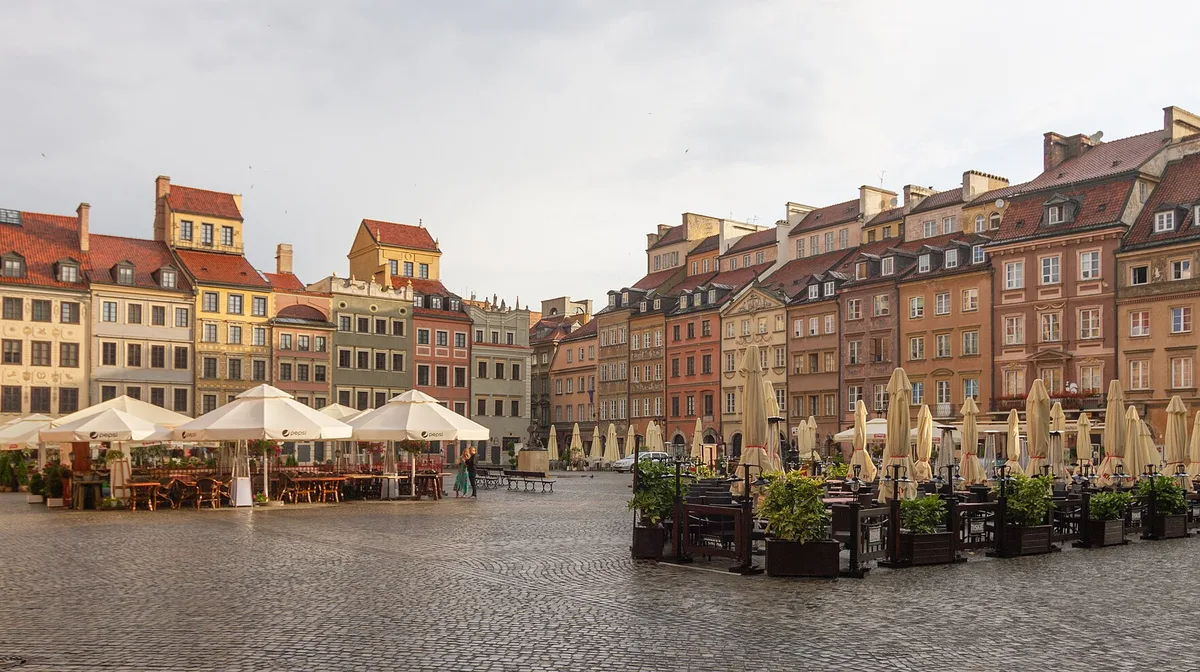
  • The rebuilt Old Town and Market Square, UNESCO-inscribed in 1980
  • Łazienki Park and the Palace on the Isle
  • The Palace of Culture and Science
  • POLIN Museum of the History of Polish Jews
  • Wilanów Palace and its baroque gardens
  • The Vistula boulevards and the wild Praga riverbank
  • The Fryderyk Chopin Museum at Ostrogski Palace

Nearby Markets: Kraków  |  Gdańsk  |  Wrocław

Airbnb marketing services in Warsaw, Poland, Europe
Why Cavmir

The Cavmir Advantage
in Warsaw

Cavmir wins in Warsaw because this is a district market wearing a city market's clothes, and almost every listing describes itself as simply "central." We write the actual geography: which metro line, how many stops, whether the walk home at midnight goes past the river or past a construction site, and what is genuinely a ten-minute walk versus what the map claims. We split the calendar in two and price it that way, because a flat weekly rate in Warsaw leaves the corporate Tuesday underpriced and the Saturday undersold. We photograph interiors in a city where most stock is either post-war reconstruction, communist-era, or built since 2015 — three completely different visual languages that need three completely different treatments, and a phone camera flattens all of them into the same beige. We build a real winter product, because Warsaw does not empty out the way a leisure city does — the museums, the concert halls and the Christmas market carry December, and January and February belong to business travel that books regardless of the weather. For Warsaw's aparthotels, guest houses and small boutique hotels we build direct-booking websites and corporate-rate pages, because a consultant who comes eight times a year should not arrive through a platform every time. We help position and market your property. We never manage it or touch your keys.

State of the Industry · History

The Warsaw STR Market — Past & Present

Warsaw's whole identity is that it was rebuilt. The city became Poland's capital around 1596 when Sigismund III moved the court from Kraków, grew through the eighteenth century into a European capital with the Royal Castle at its centre, then spent 123 years partitioned out of existence, ruled from Saint Petersburg, before Poland reappeared in 1918. What happened next is the thing every visitor is standing inside. By early 1945 roughly 85% of the city's buildings were gone, and the historic core had been demolished almost deliberately. The decision to rebuild the Old Town rather than clear it produced something without real precedent: architects and students worked from surviving fragments, measured drawings, and the eighteenth-century cityscapes of Bernardo Bellotto, who painted Warsaw so precisely that his canvases could be used as construction references. The Market Square, Castle Square, the burgher houses and eventually the Royal Castle itself came back between 1949 and the 1980s. In 1980 UNESCO inscribed the result — unusually, not for being old, but as an outstanding example of near-total reconstruction and of a community's will to rebuild.

The rest of the city grew on a different logic. The Palace of Culture and Science went up between 1952 and 1955, a Soviet gift that Varsovians have argued about ever since and that remained the tallest building in Poland for nearly seventy years. The socialist decades filled the districts with housing estates, and then 1989 turned Warsaw into a construction site that has not really stopped. Rondo Daszyńskiego went from post-industrial to Poland's densest office district inside fifteen years; Varso Tower topped out in 2022 at 310 metres to the tip of its spire, the tallest building in the European Union; the Vistula boulevards were rebuilt into a public riverfront where there had been a road; and Praga, on the east bank, kept the pre-war brick that the west bank lost and became the city's most photographed district precisely because it was neglected long enough to survive. The rental economy grew inside all of that with essentially no rules — no licence, no register, no cap. That is the era that is now ending, and it is ending by regulation from Brussels before Warsaw's own parliament finishes its bill.

Pricing Strategy & Seasonality

Pricing, Seasonality & When to Capture ROI

Pricing Strategy

Warsaw's rate map is a metro map with a river running through it. The Old Town, New Town and Castle Square sit at the top on weekends and weekend-adjacent nights, where PLN 400 to 550 is achievable for a well-presented apartment with a square view, and where midweek can fall away sharply if the listing is not also written for business guests. Powiśle and the Vistula boulevards are the current darling — university library gardens, riverfront bars, a fifteen-minute walk into the centre — and price close behind the Old Town with a younger, longer-staying guest. Śródmieście proper, from Nowy Świat down through Plac Trzech Krzyży and around Plac Zbawiciela, is the reliable core: a 30% to 50% premium over outer districts, strong on both engines, and the safest place to buy occupancy. Wola and Rondo Daszyńskiego are the corporate tier, where a modern one-bedroom five minutes from the M2 earns its money Monday to Thursday and needs a different pitch entirely at weekends. Praga Północ — Ząbkowska, the Koneser complex, Stara Praga — trades at a discount that is narrowing every year, and the honest sell is character, brick and a two-stop metro ride rather than a pretence of being central. Blended, the city runs near €78 a night at roughly 64% occupancy.

Seasonality & ROI Windows

Warsaw's year has a genuine floor, which is rare this far north, because the business calendar does not care about weather. January and February are the quiet months on leisure but hold occupancy on corporate and conference demand. Spring builds fast from April, and May is the first strong month — Museum Night, the Orange Warsaw Festival, and long light by the river. June through August is the leisure peak, with the Vistula boulevards open late, Nocny Market running from May into September, and the free Chopin concerts in Łazienki every Sunday. September is the best-balanced month of the year: warm, busy, and with the corporate calendar fully back. October and November soften on leisure while conferences hold the line, and December rebuilds around Christmas markets and the illuminations on Krakowskie Przedmieście.

Regulation & Licensing · 2026

What the Law Requires in Warsaw

Warsaw is, as of August 2026, one of the lightest-regulated capital-city rental markets in the European Union — and that is a statement with a short shelf life. There is no Warsaw short-term rental licence, no city register, no nights cap and no zoning restriction specific to short lets. What changed this year came from Brussels, not from Poland. Regulation (EU) 2024/1028 has applied since 20 May 2026, and it is one of the most widely misdescribed pieces of law in this industry. It works on an opt-in basis: it sets common standards for the registration procedures that Member States choose to operate, and it does not create a European registration number, does not oblige any Member State to introduce a scheme, and does not by itself require a single host to register anywhere. Poland does not currently run one. There is therefore no Polish registration number to obtain or to display today, whatever a host-tools blog may tell you. It does not cap your nights. It does make you visible.

Poland's own act is the part that will bite, and it has not passed. The draft prepared by the Ministry of Sport and Tourism defines short-term rental as a stay of under 31 days and reclassifies it as an accommodation service, which drags it into the same fire-safety, sanitary and building-compliance regime as the rest of the tourism sector. It creates a municipal register feeding a National Register of Tourist Accommodation Facilities, issues an individual identification number that must appear in every offer, and — the provision that matters most for anyone buying — gives municipalities the power to designate zones in which short-term rental is restricted. Permits of up to ten years have been described, along with administrative fines reported up to PLN 50,000. The bill was still in the legislature as of August 2026 and the municipal zone powers are drafted to phase in after the registration machinery. A number of secondary guides state the Polish register as an existing requirement; it is not one yet. Building-level rules are a separate and very real layer: a housing community can and does restrict short-term letting through its own statutes, and that is enforceable regardless of what the national act eventually says. Confirm the current position with the city and with your building's administration before you commit.

Market-Specific Tips & Challenges

Local Tips & Unique Market Challenges

Tips That Actually Move Revenue in Warsaw

Price the week in two halves. The single largest recoverable sum in Warsaw is the gap between a flat rate and a calendar that charges business rates Monday to Thursday and leisure rates Friday to Sunday — most listings in the city still run one number and lose on both ends. Write the metro line and the number of stops into the first two lines of the listing, not the amenity list, because that is the filter guests actually apply. Name the airport explicitly and tell Modlin arrivals what the transfer actually involves; the reviews that damage Warsaw listings most often are logistics reviews, not property reviews. Photograph the building entrance and the staircase — in a city with this much post-war and communist-era stock, guests are quietly anxious about what is behind the door, and showing them converts. Put a real desk in the frame if you want the corporate midweek. For any address east of the river, sell Praga on what it is — brick, Koneser, Ząbkowska, the neon — rather than apologising for what it is not. And do not buy a service offering to obtain your Polish registration number, because there is no Polish register to join yet.

Unique Warsaw Challenges

Warsaw is competitive in a way that punishes passivity: nearly nine thousand listings, a large share of them professionally run, and a guest who compares six options in the same district before booking. Seasonality is milder than in resort markets but the January and February leisure trough is real, and a property that cannot attract corporate guests will feel it. The stock itself is a challenge — a lot of the centre is reconstruction or communist-era build with small rooms, awkward layouts and lifts that do not always exist, and honesty about stairs and noise costs you fewer bookings than a bad review does. Building communities are increasingly willing to write short-term letting out of their statutes, and that is enforceable now, without waiting for the national act. Winter is genuinely cold and dark, which shortens the shoulder at both ends. And the regulatory floor is moving: the Polish register and the municipal restriction zones are drafted rather than live, so anyone underwriting an investment on today's rules is underwriting on the last easy year.

The City Rebuilt From Paintings
When Warsaw's Old Town was reconstructed after 1945, the architects worked partly from the cityscapes of Bernardo Bellotto, an eighteenth-century Venetian painter who signed himself Canaletto after his more famous uncle. Bellotto painted Warsaw with such topographical accuracy — window counts, cornice lines, shop fronts — that his canvases served as working references for a rebuild two centuries later. Some of those paintings now hang in the Royal Castle, a few hundred metres from the buildings they helped bring back. It is the only World Heritage site inscribed substantially for having been reconstructed.
Finance Essentials — Warsaw
🛡️

Insurance

Standard Polish homeowner policies do not contemplate paying guests, and the gap shows up exactly when it matters — water damage from an unattended bathroom, a guest injury on a staircase, or a liability claim from a neighbouring flat. Ask specifically for a short-term letting extension or a commercial accommodation policy, and confirm that it covers loss of rental income while the property is uninhabitable. Older buildings in Śródmieście and Praga carry a further wrinkle: pre-war and reconstructed stock with original risers means water escape is the most common large claim in the city.

🧾

Property & Income Tax

Polish rental income can be taxed under the flat-rate ryczałt regime or as business income, and short-term letting run as a service usually sits in the second category once it is at any scale — the draft act pushes further in that direction by naming it an accommodation service outright. VAT registration thresholds and the reduced accommodation rate matter once you pass the small-taxpayer limit. Warsaw currently charges visitors no tourist tax at all, which is unusual for a European capital: proposals in parliament would introduce a fee of up to PLN 5 a night, and a competing version would index it to the minimum hourly wage, PLN 7.85 for 2026. Neither is in force. Ask your Polish accountant which regime fits your ownership structure before you set your rates, not after.

🏦

Mortgages & Financing

Polish lenders assess short-term rental income conservatively and will usually underwrite against long-term market rent rather than your platform revenue, so a strong summer does not enlarge what you can borrow. Foreign buyers should note that EU and EEA citizens buy Polish apartments without a permit while buyers from outside that group generally need Interior Ministry permission for land, with apartments treated more leniently. Entry prices in Śródmieście and Powiśle are materially above the city average, and the arithmetic that works in Warsaw usually depends on buying a smaller, better-located unit rather than a larger one further out.

Future Outlook · 2027 & Beyond

Where Warsaw is Headed Next

Two things will shape Warsaw between now and 2028, and only one of them is regulatory. The first is the Polish act: once the National Register issues per-offer IDs and municipalities gain the power to draw restriction zones, Warsaw will for the first time have a lever it can pull on specific streets, and the districts under most residential pressure — the Old Town, parts of Śródmieście, the buildings around Nowy Świat — are the obvious first candidates. Nothing has been designated, and pretending otherwise would be guessing, but an operator buying today should assume the freest years are behind them and that the compliant, well-documented, professionally run property is the one that survives a zoning decision. The second is infrastructure and it points the other way. The M2 metro line keeps extending east and west, moving districts that used to be a taxi ride into the fifteen-minute band; the Vistula boulevards continue to add public space on both banks; and the corporate build-out around Rondo Daszyńskiego has made Wola a genuine second centre rather than an office park people leave at six. Add the airport question — the Central Communication Port remains a live national project with a long horizon — and the medium-term picture for Warsaw is more demand, better connected, under more rules. That combination favours professionals and squeezes casual hosts, which is exactly what has happened in every European capital that regulated before it.

From the Desk of Sofie Sinag

Why We Love Marketing in Warsaw

We love Warsaw because it refuses to be a museum. Most European capitals sell you a preserved centre and quietly hide the working city behind it; Warsaw does the opposite. You can stand in a Market Square that was rebuilt from paintings, walk twenty minutes past a Stalin-era palace that the city still argues about, and end up on a riverbank where people are drinking on the sand under a skyline that did not exist ten years ago. Nothing here is accidental and nothing is decorative — every layer got there because something before it was destroyed or rejected. That makes it an unusually honest place to work. The guest who comes to Warsaw is rarely ticking a box; they came for a reason, whether that is a client meeting in Wola, a concert in Łazienki, a family line they are tracing, or a friend who told them about Praga. For a marketing desk that is a gift, because it means specificity sells. You do not have to invent a story for a Warsaw property. You have to find out which of the four or five real stories this address belongs to, say it plainly, and put the metro stop in the first line. The city does the rest.

Cavmir's Warsaw Cheat Sheet

The Picks We Recommend for Your Welcome Book

The picks we send Warsaw guests — where the city actually eats, drinks and walks, checked for 2026 opening seasons and dates rather than copied from a five-year-old list.

Coffee & First Light

Ministerstwo Kawy, Marszałkowska

A small, serious room near Politechnika metro that has been a fixture of Warsaw's specialty scene for years. Students, architects and people who want a proper flat white or V60 without ceremony. Send guests before ten, tell them to ask what is on filter, and expect them to come back the next morning.

The Splurge Table

NUTA, Bracka

One of Warsaw's Michelin-starred rooms and the easiest recommendation for the trip's big night — modern Polish cooking that takes the country's own larder seriously rather than borrowing a French template. Book several weeks out for a weekend, and warn guests the tasting menu is a three-hour commitment.

Local Obsession

Pączki at a proper cukiernia

The Polish doughnut is a genuinely different object from its American cousin — yeast dough, rose jam, a thin glaze — and Warsaw takes it seriously enough that queues form around Fat Thursday in February. Point guests at an old-school cukiernia rather than a café, and tell them to go before noon.

Shoulder Season Secret

Łazienki Park on a Sunday in late September

The free Chopin concerts run beside the composer's monument through the season, the peacocks are out, and the park is at its best exactly when the summer crowds have gone. It is the single best argument for a September booking, and a far better listing photograph than another shot of the sofa.

Weekend Escape

The Vistula boulevards and the Praga bank

The west bank has the promenade, the bars and the fountains; the east bank is deliberately wild — sand, willows and a view back at the skyline. Cross at the Świętokrzyski or Poniatowski bridge, walk one way and take the tram back. An hour, no car, and it is how Varsovians actually spend a summer evening.

What Guests Ask For

Which airport, which metro, and how many stairs

Warsaw enquiries repeat the same three questions. Answer all three in the listing — Chopin versus Modlin and what each transfer really involves, the metro line and stop count, and whether there is a lift — and most bookings arrive without a single message. Logistics is the review risk in this city, not the property.

Local Work · Composite Case Vignettes

What Cavmir Has Done for Warsaw Properties

A few composite engagements drawn from how Cavmir typically works in this market. The details are illustrative and consistent with Warsaw, not pulled from a single named client.

One-bedroom · Powiśle
The Brief

A well-renovated flat two streets from the river ran a single flat rate all year, described itself as "central Warsaw" without naming a district or a metro stop, and sat empty Monday to Thursday while the owner assumed Warsaw was simply a weekend city.

What We Did

Cavmir rewrote the listing around Powiśle specifically — the university library gardens, the walk to Nowy Świat, the M2 stop and the stop count — reshot the interior in evening light, split the calendar into business midweek and leisure weekend pricing, and added a desk and a proper reading lamp to the frame.

The Result

Midweek stopped being dead because the listing finally spoke to the guest who was already coming to the city for work, the weekend rate could rise without hurting occupancy, and the owner had two distinct guest types instead of one that only showed up on Saturdays.

34-room boutique hotel · Śródmieście
The Brief

An independent hotel a short walk from Nowy Świat was taking the large majority of its bookings through platforms, paying commission on corporate guests who returned six or eight times a year, and had a website with no direct rate, no corporate page and a booking flow that failed on a phone.

What We Did

Cavmir built a direct-booking website with real photography, a published best-rate guarantee and a corporate-rate page aimed at the Wola and Mokotów office districts, wrote the Chopin festival and autumn conference weeks into the rate calendar, and set up a post-stay sequence inviting repeat business guests to book direct.

The Result

Returning consultants began arriving through the hotel's own site rather than a platform, the autumn conference weeks filled earlier and at better rates than the previous year, and the owners had a guest list and a corporate pipeline they controlled for the first time.

Two-bedroom apartment · Praga Północ
The Brief

A characterful pre-war flat near Ząbkowska was priced as though being east of the river were a defect, attracted one-night bookings that irritated the building, and used photographs that made handsome brickwork look like neglect.

What We Did

Cavmir repositioned it around what Praga actually is — the Koneser complex, the neon, the brick courtyards, two metro stops to the centre — reshot it to make the original detail read as character rather than wear, set a two-night minimum with a clear house policy, and targeted longer-staying couples and creative-industry travellers.

The Result

The average stay lengthened, the discount to the west bank narrowed considerably, complaints from neighbours stopped, and the property started attracting the guest who had specifically chosen Praga rather than the one who had settled for it.

Ready to Grow in Warsaw?

Let's Put Your Warsaw
Property on the Map

Talk to Cavmir today. We'll show you exactly what your Warsaw property is leaving on the table — and how fast we can change that.

Book a Free Strategy Call