€125
Avg. Nightly Rate
64%
Avg. Occupancy Rate
€2,430
Avg. Monthly Revenue
5-8%
Est. Cash-on-Cash ROI
MEDIUM
Seasonality
HIGH
Regulatory Burden

* Market averages. Properties marketed by Cavmir typically exceed these figures by 25–45%. Data sourced from AirDNA, STR market reports, and Cavmir internal analytics.

The Market

Why Prague is One of the World's Premier STR Markets

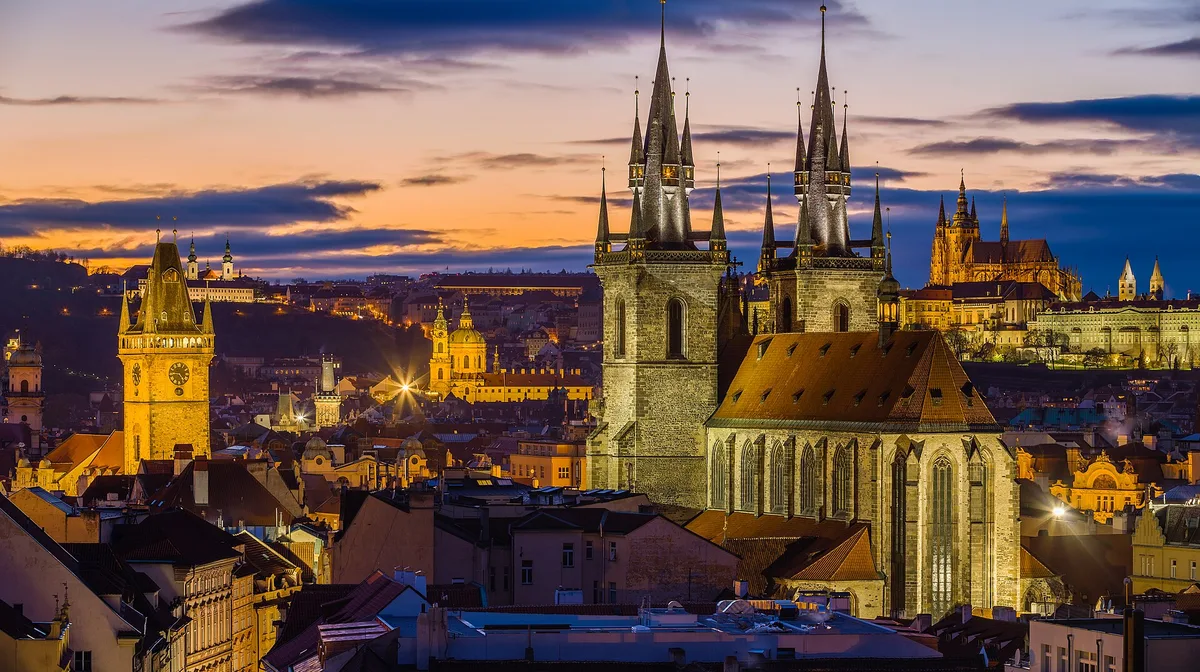
Prague is the largest and best-performing short-term rental market in Central Europe, and 2026 is the year it stopped being an informal one. Around 14,169 active listings earn at roughly 64% occupancy on an average rate near €125, and in the year to June 2026 revenue rose about 15% while listings grew under 5% — a market absorbing demand faster than supply, which is rare and will not last. What changed is the compliance layer. Regulation (EU) 2024/1028 has applied since 20 May 2026, but it harmonises the national registration schemes Member States choose to run rather than creating a European number — and in Czechia that scheme is e-Turista. Czechia's mechanism for that is e-Turista, the national register of accommodation establishments, accommodation units and accommodated persons, with reported fines up to CZK 100,000 for failing to register. Underneath both sits a point that catches foreign owners repeatedly: in Czech law short-term letting is an accommodation service, not residential letting, so it brings a trade licence, guest-reporting duties and local-fee collection with it. The stay fee itself is contested — the statutory ceiling is CZK 50 per person per night, Prague charges at that ceiling, and Prague 1 has proposed raising it to CZK 175, with any increase effective no earlier than 2027. This is now a market where being properly registered is a commercial asset, not just an obligation.

Prague's demand is deep enough that owners have been able to succeed here without trying, and that is precisely the habit that is about to stop working. The Historic Centre was UNESCO-inscribed in 1992, Prague Castle is the largest ancient castle complex in the world by area, the Astronomical Clock has been running since 1410, and Charles Bridge was begun in 1357 — none of which requires marketing. What does require marketing is everything outside Prague 1. The old town runs near 80% occupancy at around CZK 3,000 a night and is the most competitive square kilometre in Central Europe; Prague 3 and outward run around 65% at CZK 1,800 to 2,200, on far less competition, and the metro connects them in ten minutes. Vinohrady is the city's most liveable district and prices accordingly. Karlín rebuilt itself after the 2002 floods into the business and restaurant quarter. Žižkov and Holešovice trade on character and galleries. The guest mix runs from German and British short breaks and a substantial stag economy that many buildings actively resist, through American and Asian heritage and culture travel, to a growing corporate and conference base. Pensions and small hotels in converted burgher houses are a serious part of the supply and compete for the same guest.

Top Attractions & Landmarks

  • Prague Castle and St Vitus Cathedral
  • Charles Bridge, begun in 1357
  • The Old Town Square and the 1410 Astronomical Clock
  • The Jewish Quarter of Josefov and its synagogues
  • Vyšehrad, its ramparts and the view down the Vltava
  • Petřín hill, the funicular and the lookout tower
  • The Náplavka riverbank and its Saturday farmers' market

Nearby Markets: Bratislava  |  Budapest  |  Kraków

Airbnb marketing services in Prague, Czech Republic, Europe
Why Cavmir

The Cavmir Advantage
in Prague

Cavmir wins in Prague by moving owners out of the Prague 1 rate war and into districts where the same property specification faces a fraction of the competition. That work is specific: we write which metro line and how many stops, what the walk to the river is, whether a Vinohrady address means quiet and a park or a tram line under the window, and why Karlín is a better base for a business traveller than the old town is. We make compliance visible, because with e-Turista registration, a trade licence, guest reporting and local-fee collection all landing at once, an operator who can show they are fully registered has an argument that a large amount of informal Prague supply cannot make — and the platforms are now enforcing it. We price the calendar the city publishes rather than reacting to it: Prague Spring opening on 12 May, Signal in October filling the streets with light installations, the Christmas markets on the Old Town Square, and the shoulder weeks in March and November where a well-positioned property still fills. We photograph Prague in the hour that matters, on the river or above the roofs, rather than in the midday queue on Charles Bridge. And for the pensions and boutique hotels in the centre we build direct-booking websites and repeat-guest programmes, because at Prague's occupancy the commission line is the largest controllable cost in the business. We help position and market your property. We never manage it or touch your keys.

State of the Industry · History

The Prague STR Market — Past & Present

Prague spent six hundred years being more important than its size suggested, and the buildings are the evidence. Charles IV made it the capital of the Holy Roman Empire in the fourteenth century and built accordingly: the New Town laid out on a scale that took five centuries to fill, the university founded in 1348, the stone bridge begun in 1357 that still carries his name. The Astronomical Clock was installed on the Old Town Hall in 1410 and has been running, with interruptions, ever since — the oldest of its kind still in operation. The Habsburgs followed, and with them the baroque churches and palaces that give the Malá Strana its particular density. Rudolf II moved the imperial court here and filled it with astronomers and alchemists. Then the city spent the nineteenth century as a provincial Austrian capital and the twentieth being fought over — independence in 1918, occupation, the communist decades, the Prague Spring of 1968 and the tanks that ended it, and finally 1989.

What matters commercially is what did not happen: Prague was not flattened. Unlike Warsaw, Gdańsk or Wrocław, the historic core came through the twentieth century substantially intact, which is why the Historic Centre was UNESCO-inscribed in 1992 without any qualifying language about reconstruction. The consequence arrived immediately afterwards. Prague became the destination of the 1990s, then the destination of the budget airlines, and by the 2010s the old town had been converted to visitor accommodation at a scale that hollowed out the resident population of Prague 1. The 2002 floods reshaped part of the city — Karlín was badly hit and rebuilt into the business and restaurant district it is now, and Náplavka's riverbank was reworked into public space that Praguers actually use. The rental economy grew through all of it with very little regulation, and the reckoning has come not from City Hall but from Brussels: the EU regulation landing in May 2026, implemented through e-Turista, has done more to formalise this market in a year than two decades of local debate managed.

Pricing Strategy & Seasonality

Pricing, Seasonality & When to Capture ROI

Pricing Strategy

Prague's rate map is really a competition map, and the highest rates sit where the fight is hardest. Prague 1 — Staré Město, Malá Strana, Josefov — runs near 80% occupancy at around CZK 3,000 a night, and it is the most contested square kilometre in Central Europe; a distinctive property earns very well and a generic one competes purely on price. Vinohrady (Prague 2) is the quality alternative: leafy, residential, excellent restaurants, ten minutes on the metro, and a guest who is deliberately choosing to stay somewhere people live. Karlín (Prague 8) is the business tier, rebuilt after the 2002 floods into the city's restaurant and office quarter, and it is systematically underpriced Monday to Thursday because owners market it as a leisure product. Žižkov (Prague 3) runs around 65% occupancy at CZK 1,800 to 2,200 with a fraction of Prague 1's competition, and sells on character, bars and the walk over the hill. Holešovice (Prague 7) trades on galleries, the market halls and Letná park, with a younger, longer-staying guest. Blended, the city runs near €125 a night at 64% occupancy, with revenue up around 15% year on year against under 5% listing growth.

Seasonality & ROI Windows

Prague is one of the steadier European capitals because it has three distinct demand engines running on different calendars. Spring is the strongest leisure stretch, from Easter through Prague Spring in May and into a busy June. July and August are the volume peak, hot and crowded, with the old town at capacity and a large share of the stag and group traffic. September and October are the best-balanced months of the year: the weather holds, the conference calendar returns, and Signal fills the streets in October. November is the softest month. December is a genuine second peak, with the Christmas markets on the Old Town Square and Wenceslas Square drawing five or six weeks of dense demand. January and February are quiet on leisure but hold a corporate and conference floor that keeps them from collapsing.

Regulation & Licensing · 2026

What the Law Requires in Prague

Prague is the most heavily formalised market on this slate, and the change is recent enough that a lot of published guidance is out of date. Start with the structural point that catches foreign owners: in Czech law, letting a property for short stays is an accommodation service (ubytovací služba), not residential letting. That classification brings a trade licence — a živnost — with it, along with guest-reporting duties, local-fee collection, and the fire, sanitary and building expectations of an accommodation business. Owners who treat it as passive rental income discover this at the wrong moment.

On top of that sits the registration layer. Regulation (EU) 2024/1028 has applied since 20 May 2026 and is the most widely misdescribed rule in this industry. It works on an opt-in basis: it sets common standards for the registration procedures Member States choose to operate, and it creates no European registration number, obliges no Member State to introduce a scheme, and does not by itself require any host to register. Czechia does operate one, and it is e-Turista: mandatory registration of accommodation establishments, units and accommodated persons, with reported fines up to CZK 100,000 for failing to register. That is the registration that matters here, and it is Czech rather than European. Czechia's vehicle for this is e-Turista, the national register covering accommodation establishments, accommodation units and accommodated persons, with reported penalties up to CZK 100,000 for failure to register. Building consent is a separate and very real obstacle: a unit's use classification and the position of the building's owners' association both matter, and an apartment recorded as residential is not automatically usable for accommodation services.

The stay fee (poplatek z pobytu) is collected by the operator from the guest and remitted to the city. The Local Fees Act sets a ceiling of CZK 50 per person per night and Prague charges at that ceiling; published sources disagree about the exact current figure, so confirm it with the city rather than trusting a guide. Prague 1 has pushed to raise it to roughly CZK 175, with a national review expected in mid-2026 and any increase taking effect no earlier than 2027. Prague 1 has also pressed repeatedly for stronger local powers over short-term letting. None of that has produced a nights cap yet — but of every market on this slate, Prague is the one where the direction of travel is least ambiguous.

Market-Specific Tips & Challenges

Local Tips & Unique Market Challenges

Tips That Actually Move Revenue in Prague

Get out of Prague 1 in your positioning even if you own in it. The old town runs at 80% occupancy and the highest rates in the country, but it is also the most crowded square kilometre in Central Europe, and a listing there that says nothing specific competes only on price. Name the street, the courtyard, the view and the floor. If you own outside the centre, sell the metro: Prague 3 and outward run around 65% occupancy at nearly half the nightly rate, and a stated ten-minute ride is worth far more than an implied central address. Write for the business traveller in Karlín — it is the city's office and restaurant district and it is systematically underpriced Monday to Thursday. Keep the trade licence, the e-Turista registration, the guest reporting and the stay-fee collection current, because they are the baseline duties of running an accommodation service in Czech law. Price New Year in the summer, with a three or four-night minimum. And photograph the city from Letná or Vyšehrad at dusk rather than joining the midday queue on Charles Bridge, because everybody already has that photograph.

Unique Prague Challenges

Compliance is now the entry barrier and it is a real one: a trade licence, e-Turista registration, guest reporting, stay-fee collection, and — the one that stops purchases dead — a building use classification and an owners' association that will actually permit accommodation services. Prague 1 is saturated at a level where a generic listing has no defence but price. The stag and group economy is lucrative and expensive at once, generating the noise complaints and building conflicts that push associations toward restriction. Old buildings mean original risers, water-escape claims and no lifts, and riverside districts carry genuine flood exposure. Prague 1 has been lobbying for stronger local powers for years, and the registration infrastructure now being built is exactly what would make a cap enforceable. Anyone underwriting on today's absence of a nights cap should assume they are underwriting the last few years of it.

The Clock That Predates The Discovery Of America
The astronomical dial on the Old Town Hall was installed in 1410 and is the oldest astronomical clock still in operation anywhere. It does not tell you the time in any ordinary sense — it shows the position of the sun and moon in the zodiac, Old Bohemian time counted from sunset, Babylonian hours that change length with the season, and the current phase of the moon. The calendar dial below it was added later. It has been repaired, rebuilt and rewired for six centuries, and it was already a century old when Columbus sailed.
Finance Essentials — Prague
🛡️

Insurance

Standard Czech homeowner cover does not contemplate paying guests, and because short-term letting here is legally an accommodation service, an insurer treating your property as a private residence may decline a claim outright on that basis. Ask explicitly for accommodation-service cover, confirm public liability for guests on communal stairs, and check the position on the building's shared parts. The specific Prague risks are old buildings with original risers, where water escape into a neighbour's flat is the most common expensive claim, and — for anything near the Vltava — flood exposure, which the 2002 floods demonstrated is not theoretical in Karlín, Holešovice or the lower riverbank.

🧾

Property & Income Tax

Czech income from an accommodation service is business income rather than passive rental income, which changes the tax treatment, the social and health insurance position and the deductibility of costs — this is the point where owners who assumed they were landlords discover they are running a business. VAT registration becomes relevant above the statutory turnover threshold, and accommodation carries a reduced rate. Separately, the stay fee is not a tax on you but an obligation of yours: you collect CZK 50 per person per night from the guest, up to the statutory ceiling Prague charges at, and remit it to the city, with Prague 1 pressing for a substantial increase that would take effect no earlier than 2027. Ask a Czech accountant to confirm both your income treatment and your fee registration before you take a booking.

🏦

Mortgages & Financing

Czech lenders assess short-term rental income conservatively and generally underwrite against long-term market rent rather than platform revenue. Foreign buyers can purchase Czech property without the restrictions some neighbouring countries apply, which is one reason Prague drew so much international capital, but the practical constraints have shifted: entry prices in Prague 1 and Vinohrady are among the highest in Central Europe, and the binding question for a new buyer is no longer financing but whether the building's use classification and owners' association will permit accommodation services at all. Verify that before you verify the mortgage.

Future Outlook · 2027 & Beyond

Where Prague is Headed Next

Prague's next few years are about formalisation rather than restriction, at least at first. e-Turista will do something no Czech debate managed for two decades: make every unit in the market visible, attributable and countable. That alone removes a layer of informal supply competing on price without carrying cost, which is good for professional operators and bad for casual ones. The second-order effect is what to watch. Once a city can see exactly how many units are operating in each building and district, a nights cap or a zoning restriction becomes administratively possible in a way it never was before, and Prague 1 has been asking for precisely those powers for years. The stay-fee increase to something like CZK 175 is the near-term signal, and it will not take effect before 2027. Against that, demand looks robust: revenue grew about 15% in the year to June 2026 on under 5% listing growth, the congress calendar keeps expanding, and Prague's position as the most-visited city in Central Europe is not seriously contested. The most likely 2028 is a smaller, fully registered, more professional market in Prague 1, a materially larger one in Vinohrady, Karlín and Žižkov, and boutique hotels and pensions taking share from apartments that could not clear the compliance bar.

From the Desk of Sofie Sinag

Why We Love Marketing in Prague

We love Prague because it is the great European survivor. Warsaw was rebuilt from paintings, Gdańsk from photographs, Wrocław from other people's cities — Prague simply came through, which is why the UNESCO inscription in 1992 needed no asterisk. Six centuries stacked in one place: a Gothic bridge, a baroque hillside, an Art Nouveau boulevard, a functionalist quarter, and a clock from 1410 that still tells you where the moon is. What we like about working here is that the obvious version of the city has been photographed to death, which means the real advantage goes to whoever can show a guest something else. The view from Vyšehrad's ramparts down the river. Náplavka on a Saturday morning when the farmers' market is on and the old town is still asleep. Vinohrady's side streets, which are what Prague actually looks like when nobody is performing. Karlín, which drowned in 2002 and came back as the best place in the city to eat. Prague does not need help being beautiful. It needs someone willing to look past the first thing everybody sees, and that is a much more interesting job than it sounds.

Cavmir's Prague Cheat Sheet

The Picks We Recommend for Your Welcome Book

The picks we send Prague guests — the version of the city that is not on Charles Bridge at midday, checked for what is actually open rather than lifted from an older list.

Coffee & First Light

A specialty room in Vinohrady or Karlín, before nine

Prague's coffee scene left the old town years ago and settled in the districts where people live. Small rooms, serious roasting, and a local crowd on the way to work. Send guests out early and they will have seen the city before it fills up, which is the only way the centre is genuinely pleasant in summer.

The Splurge Table

A tasting menu in Karlín

The district that flooded in 2002 rebuilt into the best eating in the city, and the serious kitchens are here rather than around the square. Czech ingredients treated properly — river fish, game, root vegetables, and a wine list that takes Moravian bottles seriously. Book two or three weeks ahead.

Local Obsession

Beer, taken more seriously than anywhere

Czechia has the highest beer consumption per head in the world and has held that position for decades, and the local argument is about the pour rather than the brand — hladinka, šnyt and mlíko are three different servings of the same beer. Send guests somewhere that keeps its lines properly and tell them to ask.

Shoulder Season Secret

Vyšehrad at sunset in late September

The other castle, on the other hill, with ramparts looking down the Vltava at the whole city and almost nobody on them. Twenty minutes from the centre, free to walk, and the single best photograph available in Prague that has not already been taken ten million times.

Weekend Escape

Náplavka riverbank on a Saturday morning

The rebuilt embankment below Vyšehrad holds a farmers' market every Saturday morning, with the vaulted cellars in the wall converted into small bars and galleries. It is where Praguers actually spend a weekend, it is a fifteen-minute walk from the old town, and visitors almost never find it.

What Guests Ask For

Which metro, how many stairs, and is the street loud

Prague enquiries repeat these three. Answer them in the listing — the line, the stop count and the walk, an honest stair count in a building that probably has no lift, and what the street does after eleven at night — and most bookings arrive without a message. Noise is the review risk in this city.

Local Work · Composite Case Vignettes

What Cavmir Has Done for Prague Properties

A few composite engagements drawn from how Cavmir typically works in this market. The details are illustrative and consistent with Prague, not pulled from a single named client.

Two-bedroom apartment · Vinohrady
The Brief

A handsome flat ten minutes from the centre by metro described itself as "close to the Old Town", competed on that basis against Prague 1 listings it could not match on address, and discounted through every shoulder month rather than selling what the district actually offers.

What We Did

Cavmir repositioned it around Vinohrady itself — the park, the restaurants, the residential quiet, the metro line and stop count — reshot it in morning light, targeted longer-staying couples and returning visitors rather than first-timers, and priced against the district rather than against the square.

The Result

The property stopped losing a competition it had entered by mistake, average stay lengthened, and it began attracting the repeat visitor who had already done the old town and wanted to stay somewhere people live.

26-room pension · Malá Strana
The Brief

A converted baroque house below the castle took nearly all bookings through platforms at Prague's high occupancy, meaning the commission line was its single largest controllable cost, and its website had no direct rate, no packages and a booking flow that failed on a phone.

What We Did

Cavmir built a direct-booking website with proper photography and a published best-rate guarantee, packaged Christmas market and Prague Spring stays, put the building's history and its full registration status on the room pages, and set up a post-stay sequence inviting returning guests to book direct.

The Result

Repeat guests began arriving through the house's own site, the Christmas and New Year weeks filled earlier and at better rates than the previous year, and at Prague's occupancy levels the shift in commission was the largest single improvement to the year's margin.

One-bedroom · Karlín
The Brief

A modern flat in the city's business and restaurant district was marketed purely as a leisure city-break property, sat empty Monday to Thursday, and made no mention of its registration status at all.

What We Did

Cavmir rewrote it for the corporate midweek guest — the walk to the offices and the restaurants, a proper desk, stated connection speed, a washing machine — split the calendar into business midweek and leisure weekend pricing, and put the trade licence and e-Turista registration plainly in the listing.

The Result

Midweek filled with a guest the owner had never targeted, weekend rates rose without hurting occupancy, and the midweek corporate rate held through the months that had previously been dead.

Ready to Grow in Prague?

Let's Put Your Prague
Property on the Map

Talk to Cavmir today. We'll show you exactly what your Prague property is leaving on the table — and how fast we can change that.

Book a Free Strategy Call