



Let's start with the honest answer, because it'll save you money. Vacation rental paid ads — the sponsored spots on Google and the promoted posts on Facebook and Instagram — only start paying off once the rest of your marketing is already pulling its weight. If your photos are dim, your listing copy is thin, or the only place you can send a click is an Airbnb page you don't control, ads won't fix any of that. They'll just help you spend faster. Good advertising doesn't rescue a weak offer; it pours fuel on whatever's already burning.
When your foundation is strong — sharp photos, a clear listing, and a website or landing page you own — paid ads start doing something genuinely worth paying for. They buy you direct bookings, the kind that don't hand a chunk of every reservation to an online travel agency (OTA). They grow an email list you can market to later for close to nothing. And they build retargeting audiences — pools of people who already looked at your place — that you own and can reach again. That's the difference between renting attention for a night and building something that keeps working after the campaign ends.
So this guide is about doing paid ads in the right order. I'll walk you through when vacation rental Google Ads and Airbnb Facebook ads actually make sense, what you're really paying for, how search and social differ, the landing page that makes or breaks the whole thing, how to track results without being creepy about it, how to set a budget you won't regret, and the specific ways hosts light money on fire. At the end there's a step-by-step for launching your first campaign. I've spent years watching this play out for hosts and small properties, and the pattern never changes: foundation first, then ads.
When Paid Ads Actually Make Sense for a Vacation Rental
Here's the mental model I want you to keep: ads are an amplifier, not an instrument. They make whatever you already have louder. If your listing quietly converts the people who find it on their own, ads will bring more of those people and more bookings. If your listing is quietly failing to convert, ads will bring more people to not book — and you'll pay for every one of them. So before you put a dollar behind traffic, run through a short readiness check.
You're ready when five things are true. One, your photos are genuinely good — a scroll-stopping cover shot and a couple dozen bright, honest images that show the space, the light, and the neighborhood. Two, your listing or page copy is clear about who the place is for and what makes a stay there worth it. Three, your pricing is sane next to comparable rentals, so a shopper doesn't bounce on sticker shock. Four, you have some social proof — reviews, ratings, a few guest quotes. Five, and this is the one hosts skip, you have somewhere to send the click that you actually own. More on that later, because it's the whole game.
If you're missing two or three of those, spend your next month fixing them instead of buying ads. It's not glamorous work, but it's the highest-return work you can do. When you're ready to think about the bigger picture, our walkthrough on how to win more direct bookings for your rental lays out how ads fit alongside everything else. Ads are one chapter, not the book.
There's one narrow exception where you can start a little earlier: bidding on your own property name. If people are already typing your rental's name into Google, a small campaign that catches them is cheap insurance — but even that needs a page to land on. Everything comes back to the same thing.
What You're Really Buying With Vacation Rental Paid Ads
Most hosts think they're buying traffic. You're not, or at least you shouldn't be. Traffic is a means. What you're really buying with vacation rental paid ads is three durable things, and if a campaign isn't producing at least one of them, it's not working.
The first is direct bookings you own. When someone books through your own site instead of an OTA, you keep the commission that would otherwise disappear, and — just as valuable — you keep the guest relationship. You have their email, their stay history, and the ability to invite them back next year without paying a middle layer to reach them again. If you've never sat down and run those numbers, our breakdown of the economics of Airbnb versus direct bookings is worth twenty minutes; it changes how you feel about every ad dollar.
The second is email signups. Not everyone who clicks your ad is ready to book today. Some are dreaming about a trip six months out. If you can capture even a fraction of those people onto an email list, you've turned a cold click into a future guest you can reach for free. A visitor who joins your list is worth far more than a visitor who leaves and forgets you.
The third is retargeting audiences you own. Every person who visits your site while a tracking pixel is running becomes part of an audience you can advertise to again — cheaply, because they already know you. Over months, that audience becomes one of the most valuable assets in your whole marketing setup. You built it with ad spend, but it keeps paying you back long after.
So reframe the purchase. You're not buying clicks. You're buying bookings that skip the commission, contacts you can nurture, and an audience you can reach on demand. Judge every campaign against those three, not against how many people showed up.
Google Ads and Search Intent: Catch People Who Already Want to Book
Google's superpower is intent. Nobody searches "beachfront cabin for four near the state park in October" unless they're actively planning a trip. That's a person leaning toward a booking, and vacation rental Google Ads let you put your place in front of them at the exact moment they're deciding. That's why search is usually where I want a host to start.
Start with your own name
The cheapest, highest-intent term you can buy is your own property name. When someone searches for your rental by name, they're all the way down the funnel — they've heard of you and they're looking for the door. A small branded campaign catches them and, importantly, keeps an OTA from buying an ad on your name and skimming a booking you'd otherwise have gotten directly. This is the one campaign I'll let a host run before everything else is perfect, because it's so cheap and so high-intent.
Then bid on area terms
The next tier is location-plus-category searches: things in the shape of "[area] vacation rental," "[area] cabin rental," or "pet-friendly rental in [area]." Someone typing "Palm Springs vacation rental" is picking a place to stay right now, and if you host in a named destination like that — see our Palm Springs market guide for how this plays out — those searches can be gold. They cost more than branded terms because you're competing with OTAs and other hosts, so lean on tight match types and a running list of negative keywords (words like "jobs," "for sale," or "long term" that signal the wrong intent) to keep from paying for clicks that will never book.
Bid on your own property name even if you rank first organically. It costs pennies compared to area terms, it blocks OTAs from buying an ad on your brand, and it sends people straight to your direct-booking page instead of a listing where you pay commission. It's the closest thing to free money in this whole guide.
Be careful with the automated campaign types
Google will happily nudge you toward its broad, hands-off campaign types — the ones that spread your budget across search, display, video, and more with a promise to figure it out for you. For a small rental with a small budget, I'd hold off. These campaigns can spend fast across placements you'd never choose, and they make it hard to see where your money actually went. Start with a plain Search campaign, exact and phrase match, a tight geographic radius around who you're targeting, and clear negatives. Once you understand your own numbers, you can test the fancier stuff. Control first, automation later.
Meta and Instagram Ads: Interest, Retargeting, and Lookalikes
Google catches people who are already searching. Meta — that's Facebook and Instagram — does something different: it interrupts people who weren't looking for you at all and makes them want your place anyway. Nobody scrolling their feed on a Tuesday night is searching for a rental. But show them a gorgeous plunge pool at golden hour with the right caption, and suddenly they're planning a getaway they didn't know they wanted. That's why Airbnb Facebook ads and Instagram ads are demand generation, not demand capture.
Interest and demographic targeting
On Meta you build an audience by describing the people you want, not the words they type. You can target by location (feeder cities a short flight or drive from your rental), by age and life stage, and by interests — travel, hiking, wine, wellness, whatever fits your property and guest. The trick is not to go too narrow too soon. Give the platform enough of an audience to find your buyers, then let the results tell you who's actually responding.
Lookalike and retargeting audiences
Two audience types do the heavy lifting here. Lookalike audiences take a list you already have — past guests, email subscribers, or people who've booked — and find new people who resemble them. It's one of the most efficient ways to grow, because you're fishing where the fish are. Retargeting audiences reach people who already visited your site but didn't book; we'll spend a whole section on those because they punch far above their weight. Both depend on having a pixel installed and a decent-sized starter list, which is one more reason the foundation matters before you scale spend.
The channels each shine at something different, and the mistakes each one invites are different too. Here's how I'd summarize the landscape for a host deciding where to start.
| Channel | Best for | Watch-out |
|---|---|---|
| Google Search — branded terms | Catching people who search your property by name; blocking OTAs from your brand | Volume is small; it protects bookings but won't grow demand on its own |
| Google Search — area terms | Reaching people actively searching "[area] vacation rental" with high intent | Competitive and pricier; needs tight negatives or you pay for junk clicks |
| Google broad automated campaigns | Scaling once you already know your numbers and have proven creative | Spends fast across placements you can't see; risky for a first, small budget |
| Meta and Instagram feed | Creating demand with photo and video; interest and lookalike targeting | Lower intent; needs strong creative and a landing page or it just entertains |
| Meta and Instagram retargeting | Winning back site visitors and re-booking past guests cheaply | Small audiences fatigue fast; cap frequency and refresh the creative |
The Landing Page or Direct-Booking Site Is the Whole Game
I'll say it plainly: your ad is only as good as the page it sends people to. You can write the sharpest headline and shoot the most beautiful video, but if the click lands somewhere slow, confusing, or off-brand, you've paid for a visit and gotten nothing. This is the single most common reason vacation rental paid ads fail, and it's completely within your control.
The non-negotiable rule is this: send paid traffic to a page you own, built to convert. Not your general homepage, where the visitor has to hunt for the thing your ad promised. And definitely not your OTA listing — because when you pay Google or Meta to send someone to Airbnb, you pay twice (once for the ad, once for the commission) and you still don't own the guest. That's the worst of every world.
A page that converts paid clicks does a few things well. It loads fast and looks right on a phone, because most of your clicks are mobile. It leads with the hero photo that matches the ad, so the visitor feels like they arrived in the right place. It shows availability and price without making people dig or guess. It gives one clear reason to book direct — a better rate, a free perk, flexible terms — and it makes the booking button impossible to miss. And it carries trust signals: reviews, real photos, a face and a name. If you want the full architecture behind that, we cover it in our guide to building a direct-booking system that competes with Airbnb.
If you don't have a page like this yet, build it before you advertise, not after. This is exactly the problem a purpose-built direct-booking website is designed to solve — a page whose only job is turning a paid click into a reservation you keep. The ad is the invitation. The page is where the deal closes. Skimp on the page and everything upstream is wasted motion.
Tracking and Attribution Without Creeping People Out
You can't improve what you can't see, and paid ads without tracking are just donations to Google and Meta. But tracking has gotten more complicated and more sensitive, so let's be both practical and respectful about it. There are three pieces you want in place, and one attitude to hold about all of them.
The three pieces are a pixel, analytics, and UTM tags. The pixel — the Meta pixel or the Google tag — is a small snippet on your site that lets the platforms see which clicks turned into bookings and lets you build those retargeting audiences. Analytics, usually a tool like Google Analytics, shows you what people do once they land: which pages they see, where they drop off, how long they stay. UTM tags are short tracking codes you add to the end of an ad link (things like the source, the campaign, and the specific ad) so that when a visit shows up in analytics, you know exactly which ad sent it. Without UTMs, all your paid traffic blurs into one anonymous lump and you can't tell your winners from your losers.
Decide on a naming pattern for your UTM tags before you launch anything, and never break it. Same casing, same order, same words every time. Future-you, staring at an analytics report trying to figure out whether "fb-summer" and "facebook_summer" are the same campaign, will thank present-you for the discipline.
Now the attitude: hold your attribution loosely. No tracking setup is perfect. Last-click attribution gives all the credit to the final ad and ignores everything that warmed the guest up first. View-through attribution overcounts. Browser privacy changes and cookie loss mean some conversions simply won't be traced back. Use the data to see direction and relative performance — this campaign is clearly beating that one — not as gospel truth down to the dollar.
And be a good citizen about privacy. Show a proper cookie consent banner, honor it, and never stuff personal data into URLs or ad links. Rules like GDPR and CCPA carry real obligations, and how they apply to your setup is a question for your lawyer, not for me. The practical upshot is to lean on the data you own and collect with permission — your email list above all — because first-party data is both the most durable and the most respectful thing you can build a marketing program on.
Budget Discipline: Start Small and Stay Honest
The fastest way to hate paid advertising is to start big. The fastest way to make it work is to start small, learn cheaply, and scale only what's proven. So set a monthly number you could lose entirely without it hurting, and treat your first several weeks as tuition. You're not trying to strike gold on day one; you're buying data about what your market responds to.
Two rules keep early budgets honest. First, don't spread a small budget across five channels — you'll starve them all and learn nothing. Pick one, maybe two, and give them enough to produce a readable result. Second, resist the urge to react to a single day. Ad platforms need a little time and volume before their numbers mean anything. Check weekly, not hourly, and make changes based on patterns, not panic.
The common ways hosts burn money on ads
I've seen the same expensive mistakes over and over, so let me just hand you the list. Avoid these and you'll be ahead of most hosts running ads today.
- Boosting posts with no goal. The "Boost" button feels like advertising but usually just buys likes from people who'll never book.
- Sending paid clicks to an OTA listing. You pay for the ad and the commission, and you don't own the guest. This one hurts the most.
- Running broad automated campaigns with no guardrails. They'll spend your whole budget across placements you'd never pick, and hide where it went.
- Skipping negative keywords. Without them you pay for searches like "jobs," "for sale," and "long-term lease" that will never turn into a nightly booking.
- Flat spend all year. Running the same budget in your dead season as your peak season quietly drains money when nobody's booking.
- Judging by clicks instead of bookings. A cheap click that never converts is more expensive than a pricey click that books.
- Never turning off the losers. Every account has ads that don't work. The discipline is killing them, not hoping they turn around.
The habit that prevents all of this is simple and unglamorous: look at the account every week, cut what's clearly failing, and pour a little more into what's clearly working. Slow, steady, and honest beats big and hopeful every single time.
Seasonal Flighting: Spend When People Are Actually Booking
Demand for your rental is not flat, and your ad budget shouldn't be either. Flighting just means concentrating your spend in the windows when it matters and pulling back when it doesn't. Done well, it can make the same annual budget produce noticeably more bookings, because you're not wasting money shouting into an empty room during the off-season.
The key insight most hosts miss is that you flight to the booking window, not the travel dates. People book weeks or months before they travel, so your summer campaign should run in spring when people are planning summer, not in July when the calendar's already full. So the first thing to learn is your own booking lead time — how far ahead your guests tend to reserve. Once you know that, you can push budget hard right as searches for your season start climbing, and ease off once your peak dates are booked or once demand naturally dries up.
Market data helps you see the shape of a season before you're living it. Tools like AirDNA can show demand and pace patterns for your area, which is useful for deciding when to lean in and when to coast. Layer in the things you already know locally — a festival, a holiday weekend, a shoulder-season lull you could fill with a small deal — and build a rough calendar of when your ads should be loud and when they should be quiet.
The mistake to avoid is autopilot. Campaigns left running at a flat budget into a dead stretch will happily spend every dollar you give them and hand you very little back. Put reminders on your calendar to raise, lower, pause, and relaunch spend with the seasons. Your budget is a spotlight, not a floodlight — point it where the demand is.
Retargeting Past Visitors and Past Guests
If I could only run one type of campaign for a host, it'd be retargeting. The math is almost unfair: you're advertising to people who already visited your site or already stayed with you, so they know you, they've shown interest, and they cost a fraction of what it takes to win a cold stranger. In most accounts I've seen, retargeting is where the money works hardest.
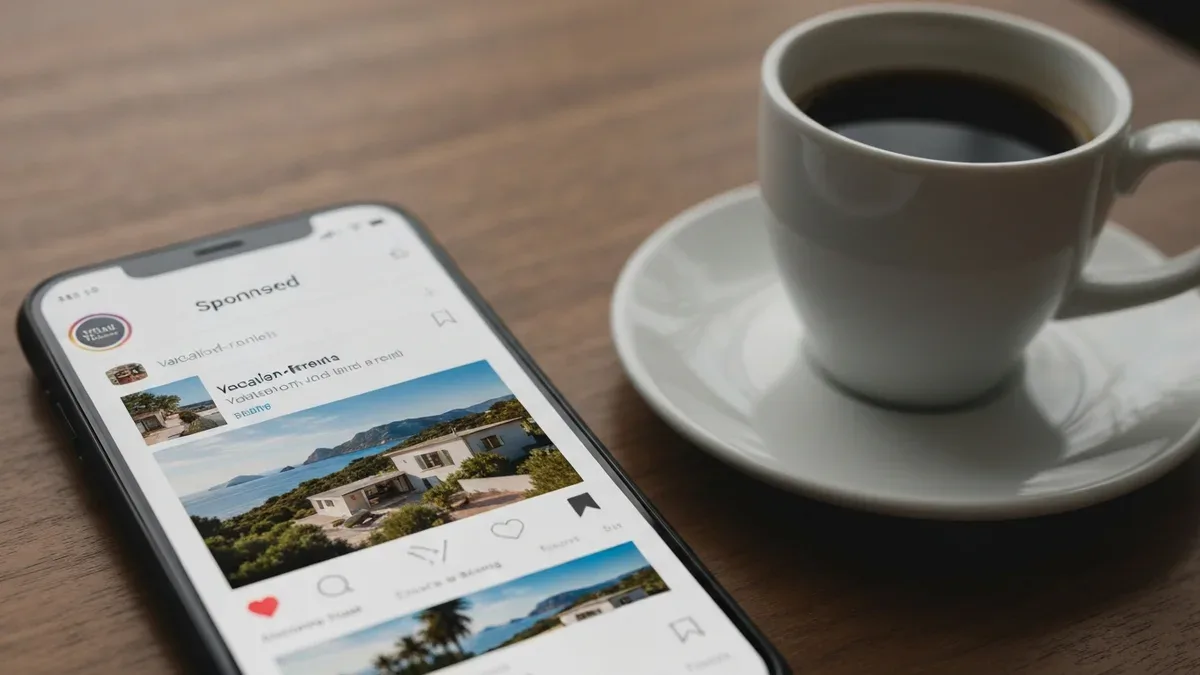
Retargeting is what puts your rental back in front of the person who visited your site, got interrupted by real life, and never finished booking — often while they're half-scrolling a feed with a coffee in hand. A familiar photo, a gentle nudge, and a link straight back to your booking page.
Site visitors who didn't book
Most people who land on your page won't book on the first visit. Life interrupts — a phone call, a kid, a work email — and they're gone. Retargeting catches them again a day or a week later with a reminder. Because your pixel has been quietly building this audience, you can show these near-miss visitors a fresh photo, a note about availability, or a small reason to come back and finish. Two cautions: cap how often any one person sees your ad so you don't become the property that annoyed them into never booking, and rotate the creative so it stays interesting.
Past guests you already delighted
Your best future guest is often a past one. Upload your guest and email list as a custom audience and you can put your rental back in front of people who already loved staying there — an invitation to book again, maybe for the same week next year. It's some of the most efficient spend you'll ever run. This is also where paid and email work as a team; if you're not already emailing past guests, our vacation rental email marketing guide pairs perfectly with retargeting, because the same list powers both. One last tip: exclude people who just booked, so you're not paying to advertise to guests who already said yes.
Creative That Earns the Click: Real Photos and Short Video
Targeting decides who sees your ad. Creative decides whether they care. And in the rental world, the single biggest creative lesson is this: real beats staged, every time. Guests can smell a stock photo from across the feed, and the moment they sense something generic, they assume the reality will disappoint. Your actual space, your actual view, your actual morning light will always outperform a polished image of a place that isn't yours.
So show the real thing. The plunge pool at dusk. The reading nook by the window. The coffee setup you're quietly proud of. The two-minute walk to the water. The first frame is everything — it has to stop the thumb mid-scroll — so lead with your strongest, most specific, most this-could-be-your-trip image. Then let the rest earn the click.
Short vertical video is doing more and more of the heavy lifting, because motion shows a space the way a still can't — the flow from kitchen to deck, the actual size of the room, the view swinging past the window. You don't need a film crew; an honest phone-shot walkthrough often beats something overproduced. If you want to get good at this format, our take on using short-form video and Reels for rental marketing goes deep, and the same clips that work organically often make excellent ads.
Test three or four different lead images or opening clips against the same audience, then put your budget behind the one that wins and quietly retire the rest. You'll be surprised how often the photo you almost didn't include is the one that books the most stays. Let the audience vote — they're better at this than any of us.
Two more things. Refresh your creative before it goes stale; even a great ad tires out when the same people see it too many times, and performance sags. And write copy like a person, not a brochure — one specific, honest promise, a real detail or two, and a clear call to action (CTA) telling people exactly what to do next. "Check summer dates" beats "Book your dream getaway" because it's concrete and it respects the reader's time.
Measuring Success: Cost Per Booking and Return on Ad Spend
Forget clicks and impressions for a minute. Two numbers tell you whether your ads are actually working, and both are about money, not vanity. The first is cost per booking — how much ad spend it took to produce one reservation. The second is return on ad spend (ROAS) — how much booking revenue you got back for every dollar you put in. Watch these two and you'll never again wonder whether a campaign is pulling its weight.
Cost per booking is simple to reason about: your ad spend divided by the bookings those ads produced. The reason it's so useful for a rental is that you already have a natural benchmark — the commission you'd have paid an OTA to get that same booking. If a direct booking from ads costs you less than what an OTA would have skimmed, you're winning on price and you own the guest on top of it. If it costs more, you've got tuning to do. That comparison is the honest yardstick, and it's why the direct versus OTA math underpins this whole conversation.
ROAS answers the bigger question of whether the whole effort is profitable. I'm not going to hand you a target ROAS number, because anyone quoting a universal figure as fact is guessing — it swings wildly by market, season, nightly rate, and property. What I'll tell you is how to think about it qualitatively: a campaign whose revenue clearly and repeatedly outruns its spend is one to feed; a campaign that's underwater after it's had enough time and volume to prove itself is one to fix or cut. Trust the direction and the consistency, not a magic ratio.
Two adjustments keep these numbers honest. Account for lifetime value — a guest who rebooks next year or refers a friend was worth more than that first booking suggested, which makes your true return better than the raw math shows. And account for lead time — because people book ahead, the bookings from this month's spend may not all land this month. Give campaigns a fair window before you judge them, and always optimize toward bookings and profit, never toward the cheap clicks that feel good and do nothing.
Balancing Paid Against Organic — and When to Hire Help
Paid ads are rented reach. The moment you stop paying, they stop. Organic marketing — your search rankings, your content, your social presence, your email list — is owned reach, and it compounds: the work you did last year keeps bringing guests this year at no extra cost. Neither one is better; they solve different problems. Paid gives you speed and control right now. Organic gives you durability and lower costs over time. The strongest rental marketing runs both, and lets each cover the other's weakness.
In practice, that means using paid to bring in bookings and data today while you invest in the slow-burn assets that reduce your dependence on paid tomorrow. A steady content and SEO engine is what eventually lets you dial ad spend down without watching your calendar go empty. When your ads are running efficiently, take some of that return and reinvest it in content, because that's how you stop renting every guest forever. If you want to stay current on where travel demand and marketing are heading, industry outlets like Skift are a solid, credible read.
So when should you bring in help? A few honest signals. When your monthly spend has grown past what you're comfortable losing while you learn by trial and error — the stakes now justify expertise. When the tracking, the audiences, and the campaign types have gotten complex enough that managing them is eating the time you should spend on your actual property and guests. And when a professional would simply get more bookings per dollar than you can, which past a certain budget is usually true. A good partner ties every campaign back to bookings and revenue, not to likes and clicks, and tells you plainly what to cut.
One boundary worth stating clearly, because it shapes how we work: Cavmir is a marketing agency for short-term rentals and boutique properties. We market your place — we don't manage it. If you get to the point where ads deserve a specialist's attention, our paid ads service exists to run this properly, measured against bookings you own rather than vanity metrics. You keep the keys and the calendar; we handle the advertising.
How to Launch Your First Campaign, Step by Step
Enough theory — here's how to actually get a first campaign live without wasting money. Follow these in order. The order matters as much as the steps, because half of what makes ads work is doing the boring setup before you spend a cent on reach.
- Confirm your foundation is ready. Sharp photos, clear copy, sane pricing, some reviews, and a page you own to send clicks to. If any of these is shaky, fix it first — ads can't paper over it.
- Pick one goal and one channel. Direct bookings via Google Search is the cleanest first campaign. Resist doing everything at once; you'll learn faster from one focused test than five scattered ones.
- Set up tracking before you launch. Install the pixel or Google tag, connect analytics, and decide your UTM naming pattern. If you launch without this, you're flying blind and can't tell winners from losers.
- Point the ads at a real landing page. A fast, mobile-friendly page you own with clear availability, price, and one obvious booking button — never your OTA listing, never a cluttered homepage.
- Start with branded and one area term. Bid on your property name plus one high-intent local term like "[area] vacation rental." On Meta instead, start with one retargeting audience or one lookalike from your guest list.
- Add negatives and exclusions. Block irrelevant searches (jobs, for-sale, long-term) on Google, and exclude recent bookers on Meta so you're not paying to reach people who already said yes.
- Set a small daily budget and a schedule. Choose an amount you could lose without flinching, and align it to your booking window so you're spending when people plan, not when the calendar's already full.
- Launch, wait, then read the data honestly. Give it enough time and volume to mean something. Then cut what's clearly failing, put more behind what's clearly working, and repeat. That loop is the entire job.
That's it. It isn't complicated, but it is disciplined, and the discipline is where the money is. Do these eight in order and your first campaign will teach you more than any guide — including this one — ever could.
Key Takeaways
- Foundation first. Vacation rental paid ads amplify what you already have. Fix photos, copy, pricing, and your booking page before you spend, or you'll just pay to fail faster.
- You're buying assets, not clicks. The real return is direct bookings you own, email signups, and retargeting audiences you build — not traffic for its own sake.
- Google is intent; Meta is demand. Start on Google Search with your own name plus area terms, and be cautious with broad automated campaign types until you know your numbers.
- The landing page decides everything. Send paid clicks to a fast page you own, never to an OTA listing where you pay twice and don't keep the guest.
- Track it, respect privacy, and start small. Use a pixel, analytics, and consistent UTM tags; honor consent; and treat your first weeks as cheap tuition.
- Retargeting and past guests are your best spend. People who already know you convert cheaply — lean into them and pair ads with email.
- Real photos and short video win. Show the actual space, refresh creative before it tires, and judge campaigns on cost per booking and return on ad spend, not clicks.
- Balance paid with organic. Paid buys speed today; content and SEO lower your costs tomorrow. Run both, and bring in help once the stakes and complexity justify it.
If there's one thing I hope sticks, it's the order of operations. Paid ads aren't a shortcut around good marketing — they're a multiplier for it. Get your photos, your listing, and your own booking page genuinely strong, then turn on a small, well-tracked campaign and let it teach you. Do that and advertising stops feeling like a gamble and starts feeling like a dial you can turn up when demand is there and down when it isn't.
And if you'd rather not learn the expensive lessons firsthand, that's exactly what we're here for. Whenever you want a second set of eyes on your setup — or someone to run the ads while you focus on your guests — come say hello through our contact page. No pressure and no jargon; just a straight conversation about whether paid ads are the right next move for your place, and what it'd take to do them well.