


Vacation rental content marketing is the practice of publishing genuinely useful, findable content — blog posts, local area guides, photos, and video — that earns your rental free traffic from search engines and builds an audience you actually own. Instead of paying an online travel agency (OTA) like Airbnb or Vrbo a cut of every booking to be shown to strangers, you create the thing those strangers are already searching for, and they find you first.
Here's the difference in one sentence: an OTA rents you attention, and content earns you an audience. When a guest books through a platform, that guest belongs to the platform — you get a payout and a cleaning date, and the relationship ends there. When a guest finds your local guide to the best coffee near your place, reads it, joins your email list, and books direct next spring, that guest belongs to you. The first model resets to zero after every stay. The second one compounds.
This guide is the long version of that idea. I'll walk you through the direct-booking flywheel, how a property blog and local area guides rank on Google (and get quoted by AI search assistants), how to pick topics and keywords that bring the right guests, the on-page basics that make a post findable, how to turn one article into a week of social content, and how to measure whether any of it is working. I've spent six-plus years doing this for short-term rental brands, and I'll be honest about what takes real effort and what's quietly overrated.
What Content Marketing Actually Means for a Rental
Most hosts hear "content marketing" and picture a company blog nobody reads. That's not this. For a vacation rental, content marketing is a narrow, practical thing: you answer the questions your future guests type into Google before they've decided where to stay, and you answer them so well that Google sends those people to you.
Think about the real path to a booking. Almost nobody wakes up and searches "book a three-bedroom house in my town." They start much earlier and much fuzzier: "things to do in Lisbon in October," "is Alfama or Bairro Alto better for first-timers," "best day trips from the coast." Those trip-planning searches happen weeks or months before anyone opens a booking site. If you're the one who answered the trip-planning question, you're already the trusted local by the time the person is ready to book a place to sleep.
That's the whole game. You're not trying to out-shout the OTAs on their turf. You're getting in front of the guest earlier, on the open web, where the content you publish is an asset you keep. A listing on a platform disappears the moment you stop paying fees or the algorithm changes. A local guide that ranks on Google keeps working at 2 a.m. on a Sunday, for years, for free.
Before you write a single post, spend twenty minutes reading your own guest messages and reviews. Every "what's the wifi password / where do we park / is there a good breakfast spot nearby" is a content topic in disguise. Your guests are telling you exactly what to write. The best local guide I ever helped produce was just a host's most-asked questions, cleaned up and expanded.
The Direct-Booking Flywheel
The reason content marketing is worth the effort isn't any single blog post. It's the flywheel — a loop where each piece makes the next one cheaper and more effective. Once it's spinning, it's hard for a competitor who only lives on the OTAs to catch you.
It works in three moves:
- Content brings visitors. Your local guides and blog posts rank on Google and get shared, pulling in people who are planning a trip to your area. This traffic is free and it's targeted — these are exactly the humans who might stay with you.
- Visitors join your list. A visitor who found your guide isn't ready to book yet, so you don't ask them to. You ask for their email in exchange for something useful — a printable itinerary, a restaurant map, a "when to visit" cheat sheet. Now you can reach them again for free.
- The list books direct. When those subscribers are finally ready to travel, you email them an offer to book straight through your own site — no platform fee, no competing listings one click away. Past guests on that list rebook and refer friends, which feeds more direct bookings.
Each direct booking you win is money you keep instead of handing to a platform, and each guest you capture by email is someone you can reach for the rest of their traveling life. That's the compounding part. The OTAs are still useful — they're a discovery channel and a trust signal, and I'd never tell a host to abandon them. But treating them as your only source of guests is renting your whole business from a landlord who can raise the rent, change the rules, or bury your listing whenever they like. The flywheel is how you build something next to that instead of on top of it. If you want the tactical version of converting this audience, our direct-booking playbook picks up where this section ends.
Your Property Blog and Local Area Guides
The engine of all of this is a simple blog attached to your rental's own website, plus a small library of local area guides. You don't need a fancy content management system or a design team. You need a handful of pages that answer real questions and are built to be found.
The two kinds of pages that pull their weight
There are two content types that earn their keep for rentals, and almost everything else is a variation on them:
- The local area guide. A thorough, honest page about your destination or neighborhood — what to do, where to eat, how to get around, when to come. This is your cornerstone. It ranks for trip-planning searches and it doubles as a resource you can hand to guests who've already booked.
- The focused blog post. A shorter piece answering one specific question: "Where to park in the old town," "Best beaches within 30 minutes," "Rainy day activities for families." Each one targets a single search and links back to your local guide and your booking page.
Together they cover the whole arc of a trip planner's research, from the wide-eyed "what's it even like there" stage down to the "okay, where exactly do I stay" stage. And because Google increasingly rewards sites that demonstrate real, first-hand knowledge of a place, a host who actually lives near the property has a genuine edge over a national booking site writing about a hundred cities it's never visited. Your local knowledge is the one thing the big platforms can't manufacture. For the mechanics of getting these pages found in search, the companion piece on how Airbnb's own search ranking works is worth reading alongside this — the two systems reward different things, and you want both.
One more reason local guides matter more every year: AI search assistants. When someone asks an assistant "what should I do for three days near [your town]," the assistant pulls from clear, factual, well-structured pages on the open web — exactly the kind of guide you're about to learn to write. A page built to be genuinely helpful to a human is also the page most likely to get quoted back to one. More on that below.
Choosing Topics and Keywords That Bring the Right Guests
Good content marketing lives or dies on topic selection. Write about what you find interesting and you'll get an audience of nobody. Write about what your future guests are searching for and you get bookings. The trick is matching the two.
Start with search intent, not clever ideas
A keyword is just the phrase a person types into a search box. Your job is to find the phrases that (a) your guests actually use, and (b) show they're planning the kind of trip your place is for. A luxury beach house and a budget city studio serve different searches even in the same town. Aim for the intent that matches your property.
The evergreen winners for almost every rental fall into a few reliable buckets:
- Things to do near you. "Things to do in [area]," "[area] with kids," "hidden gems in [area]." The widest top-of-funnel net, and the natural home for your cornerstone guide.
- Best restaurants and food. "Best restaurants in [neighborhood]," "where to eat near [landmark]," "[area] breakfast spots." Food searches are constant, high-intent, and perfect for AI citation because they're so concrete.
- Seasonal and event guides. "[City] in December," "[festival] guide," "best time to visit [area]." These ride a predictable yearly spike — publish before the spike, not during it.
- Where-to-stay comparisons. "Where to stay in [city] for first-timers," "[neighborhood A] vs [neighborhood B]." This is the closest topic to a booking — the reader is literally deciding where to sleep — so it's your highest-value target even though the search volume is smaller.
You don't need paid tools to start, though they help. AirDNA is useful for understanding demand patterns and what draws travelers to your market; you can browse AirDNA for market context without inventing numbers you can't back up. Google's own autocomplete and the "People also ask" boxes are a free, endless source of the exact phrasing real people use. Type the start of a question about your area and read what Google suggests — that's a keyword list, handed to you.
Evergreen versus seasonal — you want both
Evergreen content stays useful all year: "best neighborhoods to stay in," "how to get from the airport," "top ten things to do." It builds slow, steady, compounding traffic and it's the backbone of your library. Seasonal content — holiday events, summer festivals, "cherry blossom season" — spikes hard and then fades, but the spikes are big and they repeat every year if you keep the page updated. The healthy mix is roughly two-thirds evergreen for the foundation, one-third seasonal for the bursts. Write the evergreen pieces first so you always have something working; add seasonal pieces on a calendar timed to publish six to eight weeks ahead of each spike, so Google has time to rank them before the searches arrive.
Don't chase the biggest keywords. "Things to do in Lisbon" is fought over by every travel giant on earth, and a single rental will not beat them. "Things to do in Lisbon with a dog" or "quiet Lisbon neighborhoods to stay in" have far fewer searches — and far fewer competitors — so you can actually rank, and the person searching them is a much better match for a specific property. Narrow beats big almost every time when you're small.
The Local Guide as Both an SEO Asset and a Real Guest Resource
Here's the part that makes local guides such a good use of your time: the same page does two jobs at once. It's a search asset that earns strangers, and it's a hospitality resource that delights the guests who've already booked. You write it once and it works on both ends of the funnel.
A strong local guide has a predictable shape. Say your market is a walkable city like Lisbon: lead with a short, honest orientation to the area — who it's for, what it feels like, when to come. Then organized sections a planner actually wants: things to do, where to eat (broken out by meal or vibe), getting around, day trips, and a "know before you go" section for the practical stuff. Name real places. Give real opinions. "There's a bakery two streets over" is forgettable; "Skip the touristy waterfront cafes and walk five minutes uphill to the family-run place that sells out of custard tarts by 11 a.m." is the kind of specific, lived-in detail that both readers and search engines reward.
Because you're a marketer here and not a property manager, the guide should also do quiet commercial work without ever feeling like a sales pitch. A natural line like "our place sits a ten-minute walk from all of this" with a link to your booking page turns a helpful reader into a potential guest. Do that once or twice per guide, gently. The guide earns the right to that ask by being genuinely useful first.
And don't let the guide sit only on your website. Send it to confirmed guests before arrival as a pre-trip gift — it cuts down on repetitive questions, it makes you look like the thoughtful host you are, and it plants the idea that you're the local expert worth booking again. One page, three payoffs: it ranks, it converts, and it improves the stay. If you're building your rental's web presence from scratch, our walkthrough on getting your rental onto Google covers the Business Profile and mapping side that pairs with these guides.
On-Page SEO Basics, Without the Jargon
Search engine optimization (SEO) sounds like a dark art, but the on-page basics — the things you control on your own pages — are simple and mostly a matter of not skipping them. Get these right on every post and you've done 80 percent of what a small rental site needs.
The handful that actually matter
- One page, one main keyword. Each post should target one primary phrase. Trying to rank a single page for "things to do," "restaurants," and "where to stay" all at once means it ranks for none of them well. Split them into separate pages that link to each other.
- Title tag and H1. The title tag is the clickable blue headline in search results; the H1 is the big heading on the page. Put your keyword near the front of both, and write them for a human deciding whether to click, not just for a robot. "Where to Eat in Alfama: A Local's 12 Favorite Spots" beats "Alfama Restaurants."
- Headings that map the page. Break the article into clear H2 and H3 sections that mirror how someone would ask about the topic. This helps readers skim and helps search engines (and AI assistants) understand what each part answers.
- Internal links to your booking page. Every content page should link, in plain language, to the page where someone can actually book or inquire. This passes ranking strength to your money page and guides the reader toward the next step. Vary the wording so it reads naturally.
- Image alt text. Alt text is the written description attached to each image, read by screen readers and search engines. Describe the image plainly and, where it's honest, include the place: "sunset over the Alfama rooftops from our terrace" tells everyone — including a blind visitor and Google Images — what they're looking at.
- A clean URL and meta description. Keep URLs short and readable (/blog/alfama-restaurants/, not /blog/post?id=4471). Write a one-sentence meta description that makes the click worth it. Neither is a magic ranking lever, but both lift how often people choose your result.
Notice what's not on that list: keyword stuffing, hidden text, buying links, or any of the tricks that get sites penalized. Modern SEO for a rental is mostly "write the genuinely best answer to a real question, then make it easy for a machine to read." That's it. The travel industry press, including outlets like Skift, has covered for years how search keeps tilting toward first-hand expertise and away from thin, gamed content — which is very good news for a host who actually knows their town.
Writing for AI Search Assistants
A growing share of trip planning now starts with an AI assistant instead of a list of blue links. Someone asks "plan me a relaxed long weekend near [your area]" and gets a synthesized answer that pulls from web pages. You want yours to be one of those pages. The good news: writing for AI search and writing for humans have converged almost completely.
AI systems favor content that is clear, factual, and answer-first. That means a few concrete habits:
- Answer the question in the first sentence, then explain. Don't bury the payoff under three paragraphs of throat-clearing. If the heading asks "when is the best time to visit," the next sentence should say when, and then justify it.
- Be specific and verifiable. Name the neighborhood, the dish, the walk time, the month. Vague content gets skipped by both readers and machines; concrete facts get quoted.
- Structure it cleanly. Descriptive headings, short paragraphs, and the occasional list make it easy for a model to find and lift the exact answer. The same structure that helps a skimming human helps an assistant.
- Stay honest and current. Update pages when a restaurant closes or a festival moves. Accuracy is what earns repeat citations; a guide caught recommending a place that shut down two years ago loses trust fast.
You don't need a separate "AI strategy." You need to write the clearest, most useful, most current version of each answer — which is what you should have been doing for humans anyway. Getting cited by an assistant is the same reward as ranking on Google, earned the same way: be the best answer.
Add a short, plainly worded FAQ to the bottom of each local guide — three to five real questions with direct, one-paragraph answers. "Is [area] walkable? Yes — most of what's worth seeing sits within a fifteen-minute stroll of the old square." This block is catnip for AI assistants and for Google's own answer features, because it's already in question-and-answer form. It costs you ten minutes and it's some of the most-quoted content you'll ever write.
Use Your Own Photos and Video
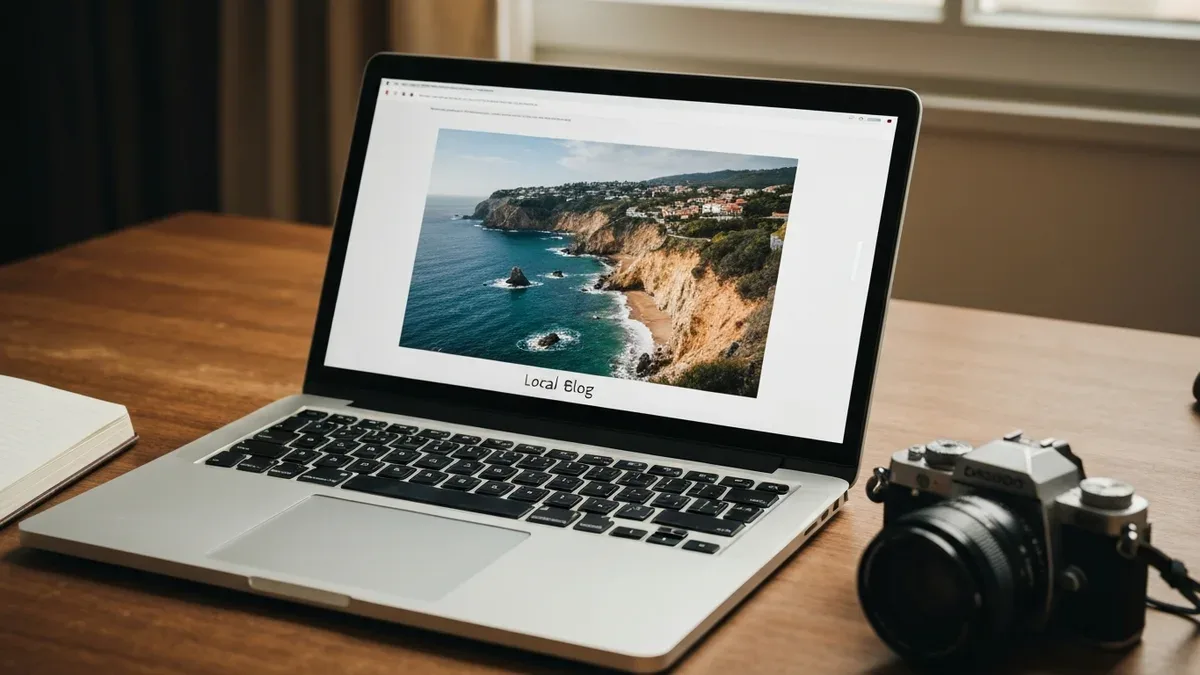
A local guide built on your own photos beats a page of stock imagery every time — it proves you're really there, and it gives you a bank of visuals to repurpose across every channel.
Stock photos are the tell of a lazy page. The moment a reader sees the same polished beach shot they've seen on ten other sites, your credibility drops. Your own imperfect photos — the actual view from your terrace, the actual bakery, the actual walk to the water — do the opposite. They prove first-hand knowledge, which is exactly the signal search engines and readers are hunting for, and they make the page feel like a person made it.
You don't need a professional kit. A recent phone shoots more than enough quality for web content. What matters is that the images are yours and specific: the dish you actually ordered, the street you actually walk, the light at the hour you actually recommend. Shoot wide and shoot often — every time you're out near the property, grab a few photos and a few short video clips. You're building a library you'll draw from for a year.
Video is where this pays off twice. A ten-second clip of the sunrise over your neighborhood is a header for your guide, a Reel, a Pinterest pin, and an email banner — one capture, four uses. That's the mindset shift: you're not "making a video," you're gathering raw material for a content system. For the property itself, well-made visuals do a lot of the selling, and our note on turning that footage into short-form content on short-form video on Reels gets into the editing side. The point for now: your camera roll is a content goldmine, and it's already in your pocket.
Turn One Article Into a Week of Content
The single biggest mistake I see hosts make is treating every piece of content as one-and-done. You spend three hours on a great restaurant guide, publish it, and move on. That's leaving most of the value on the table. One solid article is the raw material for a dozen smaller pieces across every channel you have — and repurposing is far faster than creating from scratch, because the thinking is already done.
Take that restaurant guide. From it you can pull: an Instagram carousel of your five favorite spots, a short Reel walking to the best one, three or four Pinterest pins (each dish or view as its own pin, all linking back to the guide), a "local's picks" email to past guests, a Facebook post asking your audience for their own favorites, and a set of story polls. Same core idea, reshaped for where each audience lives. The blog post is the hub; everything else is a spoke pointing back to it.
The reason this works is that different channels do different jobs. Search content earns strangers who don't know you exist. Social content nurtures the people who already follow you. Email converts the ones who are ready. You need all three, but you don't need three separate content efforts — you need one good piece, repurposed with intent. Here's how the common formats map to goals and channels:
| Content type | What it's for (goal) | Best channel |
|---|---|---|
| Cornerstone local area guide | Rank on Google for trip-planning searches and earn strangers | Your blog (SEO) + Pinterest |
| "Best restaurants near [area]" roundup | Capture hungry planners and earn AI-assistant citations | Blog + Google Business Profile |
| Seasonal event or festival guide | Ride a predictable yearly search spike | Blog + email to past guests |
| Where-to-stay / neighborhood comparison | Win bottom-of-funnel searchers deciding where to sleep | Blog + link to your booking page |
| Short walking or "day in the life" video | Build trust and personality with people who already follow you | Instagram Reels + Facebook |
| Guest photo repost (user-generated content) | Social proof that real people love the place | Instagram + your listing gallery |
| Answer-first FAQ post | Get quoted by AI search and Google answer features | Blog + email |
Notice that email shows up again and again. That's deliberate — it's the one channel you fully own, and repurposing content into a simple monthly email is how you keep the direct-booking flywheel turning. The full system is in our guide to email marketing for rentals, and it's the piece most hosts skip and later regret skipping.
A Realistic Calendar, and a Plan You Can Start This Week
Consistency beats volume, every time. A host who publishes one solid piece a month for a year ends up with twelve ranking assets and a real library. A host who publishes eight posts in one heroic January and then burns out has eight posts and no habit. Google rewards steady, ongoing publishing, and so does your own sanity. Pick a cadence you can actually sustain around cleanings and check-ins — for most solo hosts that's one to two pieces a month — and protect it like a booking.
Here's a concrete plan to go from zero to a working content engine. You don't have to do it all at once; you have to start.
- Pick one keyword theme. Choose the single biggest question travelers ask about your area — usually a version of "things to do in [your place]." This becomes the anchor for everything else.
- Build a 12-topic list. Brainstorm a year's worth of posts around that theme: roughly eight evergreen (restaurants, neighborhoods, getting around, day trips) and four seasonal (events, holidays, best-time-to-visit). Twelve topics is one a month.
- Write your cornerstone guide first. Before any small post, write the big, thorough local area guide. Everything else will link to it, so it needs to exist. Give it a full day; it's the most valuable page you'll make.
- Set a cadence and calendar it. Put your publish dates on an actual calendar, and slot seasonal pieces six to eight weeks ahead of their spike. A date on a calendar gets done; a vague intention doesn't.
- Optimize each post on-page. Before you hit publish, run the checklist: one keyword, strong title and H1, clean headings, a plain-language link to your booking page, and real alt text on every image.
- Repurpose every piece. The day a post goes live, carve it into three or four smaller pieces — a carousel, a Reel, a couple of pins, a Facebook post — and schedule them across the following two weeks.
- Capture the email. Add a simple sign-up offer to every post — a printable itinerary or map in exchange for an address — so the traffic you worked for turns into an audience you keep.
- Review quarterly and double down. Every three months, look at which posts brought traffic and inquiries, then write more on those winning themes and refresh the underperformers. Let the data pick your next topics.
Eight steps, and only the first three need to happen before you see anything live. The rest is rhythm. If paid promotion ever enters the mix to accelerate a strong post, treat it as fuel on a fire that's already lit — the mechanics are in our paid ads walkthrough — but earn the organic foundation first.
Guest-Generated Content and Reviews as Fuel
Some of your best content will be made by other people. Guests photograph your place constantly — the morning coffee on the balcony, the kids in the pool, the sunset they'll never forget. That user-generated content (UGC) is more persuasive than anything you can produce yourself, because it's obviously real and it's obviously from someone with nothing to sell.
Build a light habit around collecting it. Ask happy guests, at the right moment, if you can share a photo they posted. Most are flattered to say yes. A repost of a guest's genuine snapshot, credited to them, does double duty: it's fresh social content you didn't have to create, and it's social proof that quietly tells the next visitor "real people love it here." Over a season you'll accumulate a stream of authentic images that keep your channels alive between your own posts.
Reviews are the written version of the same fuel. A specific, glowing review isn't just a trust signal on your listing — it's a source of content ideas and language. When three guests mention the same nearby bakery, that's a sign to write the bakery post. When reviewers keep using a certain phrase to describe the vibe, borrow it for your headings, because that's the language your future guests will search with. Reviews are your audience telling you, in their own words, what to make more of. Mine them.
Create one simple, on-brand photo spot at your property — a hammock with a view, a cozy reading nook, a wall with the town name painted on it — and mention it in your welcome note. Guests will photograph it and post it without being asked, and every one of those posts is free, authentic content with your place at the center. Design for the photo, and the photo comes to you.
Measuring What Matters: Traffic to Inquiries to Direct Bookings
Content marketing has a reputation for being impossible to measure. It isn't — you just have to track the right chain, not vanity numbers. The chain that matters runs: traffic to your site, then inquiries or email sign-ups, then direct bookings. Follow that funnel and you'll know exactly what's working.
You need only a couple of free tools to see it. Google Analytics shows how many people reach your content and what they do next; Google Search Console shows which searches bring them and which of your pages rank for what. Between them, you can see that your "best restaurants" post pulled a few hundred visitors last month, that a slice of them clicked through to your booking page, and that a handful joined your email list. That's the funnel, made visible.
Then close the loop to money. Watch three numbers over quarters, not days:
- Traffic to your content — is the library growing its total organic visits over time? Content compounds slowly, so judge it in quarters.
- Inquiries and sign-ups — how many of those visitors take a next step, by messaging you or joining your list? This is the bridge between "read something" and "might book."
- Direct bookings — the number that pays for all of it. Bookings made through your own site, where you keep the platform's cut.
Don't expect a straight line, and don't panic in month two. Content marketing is slow to start and then compounds — you'll see very little for a few months while pages age and gain trust, and then a curve that keeps climbing while you sleep. The honest metric of success is a rising share of your bookings coming direct instead of through the OTAs, quarter over quarter. When that line moves, the strategy is working, whatever any single post did.
When to Write It Yourself, and When to Get Help
Here's the honest trade-off. Your local knowledge is the irreplaceable ingredient — no writer, however good, knows that the custard tarts sell out by 11 or that the north beach is calmer with toddlers. That's why the earliest, most important content, especially the cornerstone guide, is best drafted by you or from your detailed notes. The first-hand voice is the whole advantage; don't outsource it away before it exists.
But writing consistently is a real job, and it competes with running the property. Outsourcing makes sense when the strategy is proven and the bottleneck is production, not knowledge — when you know it works, you have the topic list, and you simply can't keep the cadence alone. The model that works best is a hybrid: you supply the local expertise, the photos, and the opinions; a writer shapes it into polished, optimized posts on schedule. You stay the source of truth; someone else handles the craft and the consistency.
That's exactly the line Cavmir works along. We're a marketing agency for short-term rentals and boutique hotels — we don't manage anyone's property, and we never will. What we do is turn a host's local knowledge into content that ranks and converts, run the search engine optimization that gets it found, and handle the social media repurposing so one good guide becomes a month of posts. Whether you do it yourself or bring in help, the strategy in this guide is the same. Help just means you keep the cadence without giving up your nights.
One boundary worth naming: anything touching the tax or legal side of your rental income — how to report earnings, what local licensing your content should or shouldn't promise — is a question for your accountant or lawyer, not your content plan. Keep your guides about the destination and the stay, and leave the regulatory specifics to the professionals who carry that responsibility.
Key Takeaways
- Vacation rental content marketing earns you free, targeted traffic and an audience you own, instead of renting attention from the OTAs one booking at a time.
- The direct-booking flywheel is the point: content brings visitors, visitors join your email list, and the list books direct — and every turn compounds.
- Your cornerstone is a thorough local area guide plus focused blog posts that rank on Google and get quoted by AI search assistants because they're clear, factual, and answer-first.
- Pick narrow, specific keywords you can actually rank for — "quiet neighborhoods to stay in [city]" beats "things to do in [city]" for a small property.
- Nail the on-page basics on every post: one keyword, a strong title and headings, plain-language links to your booking page, and real image alt text.
- Write one good piece, then repurpose it into carousels, Reels, Pinterest pins, and email — same idea, reshaped for where each audience lives.
- Use your own photos and video; first-hand imagery proves you know the place and builds a library you'll draw from all year.
- Consistency beats volume — one solid post a month for a year is twelve ranking assets. Measure traffic to inquiries to direct bookings over quarters, not days.
- Draft the local, first-hand content yourself; outsource production once the strategy is proven and the only bottleneck is keeping the cadence.
None of this is fast, and I won't pretend otherwise. Content marketing is the slow, compounding alternative to renting your visibility from a platform — quiet for the first few months, and then a set of assets that bring you guests for years without a per-booking fee. The host who starts a modest local guide today and adds to it steadily will, a year from now, own something no algorithm can take away: a stream of travelers who found them first, trust them already, and book direct.
If that's the business you want to build and you'd rather not build it alone, that's the whole reason Cavmir exists — to turn what you know about your place into content that gets found. Have a look at what we do, or just tell us about your property and your market on our contact page. No pressure and no long pitch — start with one guide, and let it compound from there.