



Morning
Coffee off Fifth, not on it
Send early risers a block or two off La Quinta to a real local café rather than the tourist front row — better coffee, half the price, and the photo the guest posts looks like the town, not the strip.

Expert short-term rental marketing to grow your bookings and nightly rate in Playa del Carmen — Playacar, Centro, Coco Beach, Colosio and the new Corasol and Mareazul developments.
Sixteen services, one team. Everything below is built in-house and scoped to your property and market. Most owners start with the 12-Step System.
Every engagement is quoted to your portfolio. These are the ready-made scopes owners pick most — the AI Efficiency Discount is already applied. A clear proposal within 48 hours.
The work is public. Selected engagements and what changed — and reviews from the owners and managers behind them.
* Market averages. Properties marketed by Cavmir typically exceed these figures by 25–45%. Data sourced from AirDNA, STR market reports, and Cavmir internal analytics.
Playa del Carmen is the beating heart of the Riviera Maya, and for a short-term rental owner it is one of the deepest, most liquid markets in the entire Caribbean basin. Where Cancún built itself around a wall of all-inclusive hotels and Tulum built itself around a boho-luxury brand, Playa grew up as a walkable town that happens to sit on a beautiful beach — and that single difference is why it holds more genuinely independent, individually-owned rental condos than almost anywhere else in Mexico. A guest who books Playa is choosing a neighborhood, a coffee shop they can walk to, a grocery store, a beach club and a ferry to Cozumel, not a gated resort compound. That is exactly the guest a well-marketed private rental is built to win.
The market is a set of very distinct addresses stacked along Fifth Avenue and the beach. Playacar is the gated, manicured, golf-and-beach enclave south of the ferry pier — villas and low-density condos, the highest rents, the calmest guest. Centro is the dense core around La Quinta (Fifth Avenue), where nightlife, restaurants and walkability drive strong occupancy on smaller condos. Coco Beach and the Colosio district north of Constituyentes are the fast-growing condo frontier — newer buildings, rooftop pools, better value, and the neighborhoods where most new investor stock is delivered. El Cielo and the area west of the highway offer quieter, family-friendly, better-priced product for the longer-stay and digital-nomad guest. Corasol and Mareazul anchor the luxury master-planned end. A listing that names its neighborhood and sells that specific rhythm outperforms a generic 'condo in Playa' every time.
The guest mix is what makes Playa so resilient. American and Canadian couples and families come for the winter sun and the ease — a nonstop flight into Cancún (CUN) and a 45-minute transfer south. A very large and growing remote-work and digital-nomad population comes for months at a time, drawn by fast internet, low cost of living and a real town to live in. Latin American travelers fill the summer and the Mexican holiday calendar. European long-stayers come for the deep winter. When one of those source markets softens, another is peaking — but only if your listing is built to be found by all of them, priced for both nightly and monthly stays, and present in more than one language.
What makes the investment math work is the combination of demand depth and comparatively low entry prices. A one- or two-bedroom condo in a good Playa building still costs a fraction of comparable Caribbean beachfront in the Cayman Islands, Turks and Caicos or the Bahamas, while renting into one of the busiest tourism corridors on earth — Cancún airport moves tens of millions of passengers a year, and the overwhelming majority pass within an hour of Playa. Strong yields on accessible entry prices are why the Riviera Maya condo market keeps expanding, and why the marketing gap between a professionally run listing and an amateur one shows up so clearly in cash-on-cash return.
Nearby Markets: Cozumel | Cancún | Isla Mujeres
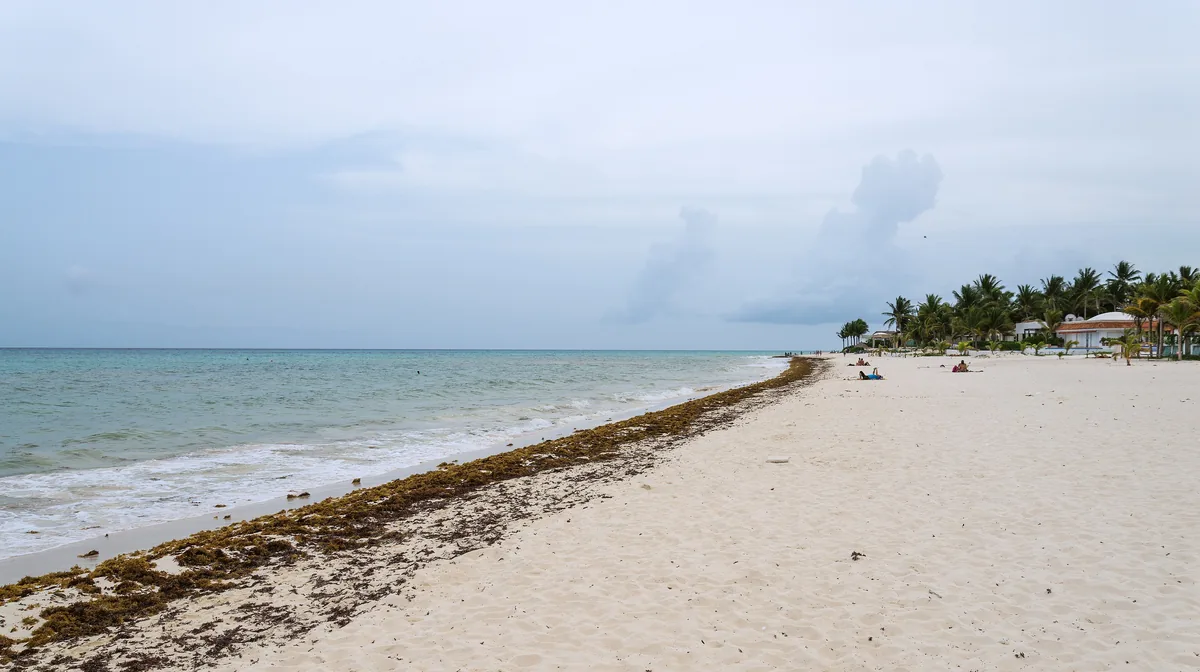
Photo: Giorgio Galeotti · CC BY 4.0 · via Wikimedia Commons (resized)
Cavmir markets Playa del Carmen condos and villas as the independent homes they are, not as budget stand-ins for a resort. We position your property in front of the exact traveler who chooses Playa — the walkable-town couple, the month-long remote worker, the family that wants a kitchen and a neighborhood — in the languages they search, across Google, Instagram and a direct-booking site that keeps you off the commission treadmill and away from the price war on the platforms.
Fifty years ago Playa del Carmen was a fishing village of a few hundred people whose main function was the boat launch to Cozumel. When Cancún was conjured out of the sand to the north in the 1970s as a government-planned resort city, Playa stayed small and slow — and that head start on smallness is precisely what shaped its character. Backpackers and Europeans discovered the beach and the laid-back main street in the 1980s and 90s; Fifth Avenue grew from a sand path into a pedestrian promenade of restaurants and shops; and the town urbanized at one of the fastest rates in Latin America without ever becoming a hotel wall. The result is a real town with a tourism economy layered on top, rather than a resort strip with a town bolted on.
The condo-rental market grew directly out of that town-first DNA. As Playa boomed through the 2000s and 2010s, developers built mid-rise condominium buildings — not thousand-room resorts — and sold the units to individual investors from the US, Canada, Mexico and Europe. Those owner-condos, placed on Airbnb, Vrbo and Booking.com or run by local property managers, became the backbone of the market. Playacar villas and the older Centro buildings came first; Coco Beach and Colosio filled in through the 2010s; and the current wave of construction has pushed the condo frontier north and west, delivering rooftop-pool buildings aimed squarely at the nightly-and-monthly rental investor.
Today Playa is one of the highest-volume independent-rental markets in the Caribbean, and its defining trait is depth. There is enormous demand and enormous supply, which means occupancy is achievable almost year-round for a competent operator, but rate is fiercely contested and visibility is the whole game. Unlike a scarcity market where a single beachfront villa can coast on its address, Playa punishes the passive owner: a condo that competes against two hundred near-identical units in the same three-block radius either markets itself into visibility or quietly sinks to the bottom of the search results and rents on price alone.
The present market is also defined by formalization and by the digital-nomad boom. Quintana Roo has tightened tourism-tax collection, the platforms now withhold Mexican taxes at source, and the state has leaned into the remote-work economy that exploded after 2020 — turning what used to be a winter-only beach town into a year-round place people actually live for months at a time. For owners the lesson is twofold: compliance is no longer optional, and the properties that win are the ones built for both the seven-night vacationer and the ninety-day remote worker, because Playa now runs on both.
Playa is a value-volume market, and pricing has to respect that reality rather than fight it. The bulk of the inventory — one- and two-bedroom condos in Centro, Coco Beach and Colosio — competes on strong occupancy at accessible nightly rates, so the winning strategy is usually a competitive headline rate paired with a real direct-and-repeat channel that strips out platform commission and a monthly rate that captures the remote-work stay. Playacar villas, beachfront Mareazul and Corasol units are the exception and the top of the market, where the play is premium positioning, private-pool photography and longer holiday minimum stays. Pricing the same two-bedroom the same way in Playacar and in inland El Cielo is the classic amateur error; they are different products for different guests.
The single most underused lever in Playa is the monthly rate. A very large share of demand now comes from remote workers, snowbirds and long-stay Europeans who book thirty to ninety days at a time, and an owner who only prices for nightly vacation stays is invisible to them. A well-structured monthly rate — discounted off the nightly but delivering a nearly-full calendar with almost no turnover cost — often out-earns chasing back-to-back weekend bookings, especially in the shoulder and low seasons. The listings that win the nomad economy publish a clear monthly price, show the desk and the fast Wi-Fi speed test in the photos, and describe the neighborhood as a place to live, not just to vacation.
The third lever is the Mexican and Latin American holiday calendar, which many foreign owners simply do not see. Semana Santa (Holy Week), the summer school holidays, the Día de Muertos long weekend, and the December Guadalupe-Reyes stretch are massive domestic demand surges. An owner priced and marketed only for the North American winter leaves those weeks underpriced or empty. Being visible and priced in Spanish for the domestic peaks is a second and third season hiding in plain sight — and it is exactly the kind of calendar management that separates a professionally run Playa condo from a passive one.
Medium seasonality with genuinely year-round demand. The North American winter escape runs roughly mid-December through April and is the rate high point; Christmas/New Year and US spring break (March) are the super-peaks. Semana Santa spikes hard. Summer (July–August) brings a strong Mexican and Latin American family wave to warm water, and the digital-nomad base fills months that used to be soft. The genuine low window is September and early October — the heart of Atlantic hurricane and rainy season — where flexible terms and monthly value pricing win the travelers still willing to come.
The revenue most Playa owners miss sits in the shoulders and the low season, because they treat the market as winter-only. The remote-work stay, the honest monthly rate and the Mexican-holiday surge together turn September-through-November and the summer into real income rather than a dead calendar. Being visible before those windows — not scrambling to discount once they arrive — is the difference, and it is a marketing problem, not a pricing one.
Mexico does not impose a single federal short-term-rental licence, but there is a real compliance stack in Quintana Roo that every owner must handle. You must register with the tax authority (the SAT) and obtain an RFC tax ID to earn rental income legally; rental income is subject to income tax (ISR) and, in most cases, value-added tax (IVA, 16%). Quintana Roo levies a lodging tax (Impuesto al Hospedaje) of around 3.5% collected from guests, and the state also charges tourists a Visitax environmental fee. The major booking platforms now withhold Mexican taxes at source, which simplifies collection but does not remove your own registration and filing obligations — this is a place to have a local accountant (contador) from day one.
The rule that surprises foreign buyers most is not about renting — it is about owning. Playa del Carmen sits inside Mexico's constitutional restricted zone (within 50 km of the coast), where foreigners cannot hold direct title to residential land. Instead you buy through a fideicomiso, a renewable bank trust in which a Mexican bank holds title for your benefit with full rights to use, rent, improve and sell, or through a Mexican corporation if you own multiple properties. The fideicomiso is completely standard, secure and routine here — but it carries setup and annual trustee fees you must budget for, and it is the single most important structural item to get right with a reputable notary (notario público) and real-estate attorney.
The practical rules that bite day-to-day are usually the condominium's, not the government's. Most Playa rental stock is inside condominium regimes whose reglamento (HOA rules) govern whether short-term letting is allowed, minimum stays, guest registration, pool and amenity use, and noise. Some buildings are rental-friendly and even run internal programs; others restrict or ban nightly rentals outright. Read the condominium regime documents and the administrator's rules before you buy, because they determine whether you have a rental business or a vacation home with restrictions. As always, treat this section as orientation, not legal or tax advice — enforcement and rates change, so confirm current requirements with a Quintana Roo notario, a contador and the municipality before you list.
The first Playa-specific tip is to build for two guests at once: the vacationer and the remote worker. The properties that win here publish both a nightly and a genuine monthly rate, photograph the workspace and the actual Wi-Fi speed, and describe the neighborhood the way a resident would — the coffee shop on the corner, the grocery store two blocks over, the beach club you can walk to. That dual positioning fills the calendar in both directions and pulls you out of the pure nightly price war that grinds down the passive condos around you.
Second, sell the neighborhood and the walkability, not 'the Riviera Maya.' Playa's whole advantage over Cancún and Tulum is that a guest can live here without a car — so a listing that maps the ten-minute walk to Fifth Avenue, the beach access, the ferry pier and the supermarket is selling the exact thing the guest is shopping for. A Playacar villa sells the gated calm and the golf; a Centro condo sells the walk-everywhere energy; a Coco Beach rooftop sells the pool and the value. Match the imagery and the copy to the specific address.
Third, market in more than one language and to more than one calendar. A meaningful share of Playa demand is Mexican, Latin American and European, and a listing written only in English for the North American winter is leaving whole seasons on the table. Being present, priced and described in Spanish for Semana Santa and the summer, and offering the monthly rate a European long-stayer expects, is how you turn the 'off-season' into a real season. This is exactly the multi-market, multi-language visibility work Cavmir is built to run.
Fourth, treat reviews and operations as your ranking engine, because in a market this deep they are the whole game. A wall of recent five-star reviews that specifically praise the fast pre-arrival communication, the accurate listing, the spotless turnover and the reliable air-conditioning and Wi-Fi is what lifts you above two hundred near-identical condos in the same search. That means a turnover team that actually delivers, a check-in flow that works when a flight lands late, and photos and copy that match the unit exactly so no guest arrives disappointed. The review flywheel is slow to build and nearly impossible for a competitor to copy — which is precisely why it is worth engineering on purpose.
Playa's defining challenge is saturation. There is a great deal of supply, much of it near-identical two-bedroom condos, and a passive listing simply disappears into the search results and ends up renting on price. That is not a reason to avoid the market — it is the reason marketing matters more here than almost anywhere. Differentiation through neighborhood-specific positioning, real photography, a direct-booking brand and a review flywheel is not a luxury in Playa; it is the core of surviving in a deep market.
The second challenge is a pair of environmental realities the honest listing addresses head-on. Sargassum — the seasonal seaweed that can wash onto Caribbean-facing beaches, typically heaviest roughly April through August — is real, varies year to year, and is best handled with transparency, a pool as a hero amenity, and neighborhood beach clubs that groom their sand. Hurricane season (June–November) rarely produces a direct hit but always shapes the calendar and demands proper insurance and a clear, guest-friendly cancellation posture. Owners who name these openly and show how they manage them convert anxious shoppers into bookers; owners who hide them collect bad reviews.
The third is the management-distance problem common to absentee-owner markets. Most Playa condos are owned by investors in the US, Canada and Europe and run remotely, and a property managed by whoever answers first tends to drift — inconsistent housekeeping, slow replies, a listing that quietly goes stale, air-conditioning that nobody services until a guest complains. In a market this competitive guests feel that gap immediately and punish it in reviews. The owners who win close the distance with a real local team and a marketing partner who keeps the brand, the photography and the direct channel current, so the unit presents the same way in September as it did the day the professional photos were shot.
Caribbean-coast hurricane cover is specialty and priced accordingly. You will want named-storm/wind and flood coverage; inside a condominium the building's master policy covers the structure while you insure your unit's interior, contents and liability. Confirm exactly what the master policy includes and where your responsibility begins, budget for meaningful per-event deductibles, and factor the premium into your yield — not as an afterthought.
Rental income is subject to Mexican income tax (ISR) and generally 16% IVA, with the platforms now withholding at source; the state lodging tax (~3.5%) is guest-collected. Annual property tax (predial) in Mexico is famously low, but budget for the fideicomiso's annual trustee fee, and plan for capital-gains tax (ISR) on eventual sale. US and Canadian owners still report worldwide income at home — coordinate credits and foreign-reporting with a cross-border accountant and a local contador.
Foreign buyers can obtain Mexican-peso mortgages through local banks, but typically at lower loan-to-value (around 50–65%) and higher rates than US or Canadian equivalents, so many buyers pay cash, use developer financing, or borrow against assets at home. Whatever the structure, model debt service against a realistic, seasonally-shaped occupancy that includes the monthly-stay income — not a flat nightly average.
The near-term outlook for Playa del Carmen is growth, and the forces behind it are structural. Cancún airport keeps expanding, the new Tulum airport (Felipe Carrillo Puerto International) has added a second gateway to the corridor, and the Tren Maya rail project is stitching the whole peninsula together — all of which widen the funnel of travelers who can reach Playa easily. The remote-work economy that turned the town into a year-round destination is not reversing. Demand depth, in short, is going up.
The variables to watch are supply, regulation and the environment. New condo construction keeps arriving in Coco Beach, Colosio, Corasol and west of the highway, which means the average unit faces more, better-marketed competition every year — the durable winners will be the properties that behave like brands with a direct channel and a repeat base, not like interchangeable inventory. Regulation and tax enforcement will keep tightening, rewarding clean, compliant operators. And sargassum and hurricane resilience will remain part of the product story that honest listings manage rather than hide.
The other force reshaping the next few years is how guests find a place to stay. More travelers now start with an AI assistant or a direct Google search than with an endless scroll through a booking platform, and Playa properties that publish clear, structured, genuinely useful information — real neighborhood detail, honest seasonality and sargassum notes, a fast website an assistant can actually read — are the ones that surface in those answers. In a market this saturated, the condos that treat their online presence as an afterthought will keep paying rising platform commissions for visibility they could own outright. Positioning for that shift now, while most of the corridor still markets the old way, is the most durable advantage a Playa owner can build.
Playa del Carmen is the Caribbean market I most enjoy working on precisely because it is a real town, and the thing most listings miss is how much that matters to the guest. People do not book Playa to be sealed inside a resort — they book it to walk to breakfast, to have a neighborhood, to take the ferry to Cozumel on a whim, to live somewhere for a week or a month. When a listing leans into that lived-in, walk-everywhere reality instead of recycling generic beach adjectives, it attracts the exact traveler who is shopping for Playa, and that traveler stays longer and complains less.
What I love about the market is that it rewards editorial care in a way scarcity markets do not force. In a place with two hundred near-identical condos, the owner who names the coffee shop on the corner, photographs the actual sunrise from the rooftop, and writes an honest, resident's welcome book simply wins — because everyone else is coasting on the same three tired photos and the building's name. The raw material is generous: the water is that impossible turquoise, the cenotes are genuinely otherworldly, the food scene is real. Our job is rarely to invent an angle. It is to notice the true one the owner has stopped seeing, frame it honestly, and put it in front of the guest already looking for exactly that.
The other reason Playa is a joy is the loyalty hiding underneath the churn. Snowbirds find the right condo and come back every winter; remote workers rebook the same desk-and-Wi-Fi apartment for another three months; families adopt a building and return for spring break for years. In a deep, noisy market, that repeat base is quiet gold — it is far cheaper to earn than a new stranger every night, and it is exactly what a direct-booking brand is built to capture. When a Playa listing finally sounds like the specific neighborhood it is instead of a generic Riviera Maya brochure, the bookings that follow feel less like marketing and more like introductions.
The picks Cavmir puts in a Playa del Carmen welcome book — the details that make a stay feel like resident knowledge instead of a printed concierge script, and that quietly earn the five-star reviews.
Send early risers a block or two off La Quinta to a real local café rather than the tourist front row — better coffee, half the price, and the photo the guest posts looks like the town, not the strip.
Playa's beach is a chain of clubs with different personalities — family-calm, party-loud, chic-quiet. A host who matches the guest to the right one (and warns which stretches catch sargassum first) looks like a local and saves the guest a wasted afternoon.
The ferry leaves right from the town pier. Tell guests to go early, dive or snorkel the Palancar and Colombia reefs, and be back for dinner — the single best day trip in the region and it needs no rental car.
The freshwater cenotes are the region's most otherworldly experience and most guests do not know where to start. Point them to a specific one for their crowd — snorkel-easy versus cavern-dive — and pre-arrange it if you can.
Playa's food scene is genuinely good and genuinely deep. Two reservations — one rooftop for sunset, one tucked-away courtyard for the last night — turn a good stay into the trip they tell friends about.
Half an hour south, Akumal bay is one of the few places guests can reliably snorkel with green sea turtles. Tell them to go with a licensed guide and reef-safe sunscreen — the responsible version reads as care, not just a tip.
The big eco-parks are a highlight or a tourist trap depending on the guest. A host who explains which park suits families versus adrenaline-seekers, and to buy ahead, is worth their weight.
Tell guests to do one big grocery run on arrival rather than daily convenience-store trips, and where the local produce market is. Small logistics that save real money read as genuine hospitality.
Centro is walk-everywhere; a colectivo van runs cheaply to Tulum and Puerto Morelos; a rental car pays off only for cenote-and-ruins days. A host who lays out the trade-off saves the guest money and earns the trust.
Fifth Avenue runs from mellow to very loud within a few blocks. Steer guests to the live-music and mezcal spots that fit them — and, if your condo is near the loud end, set the expectation honestly before they arrive.
Warm water, softened rates, thinner crowds and often lighter sargassum than midsummer. The windows that reward the guest willing to travel just off the calendar — and the marketer patient enough to fill them.
Representative Cavmir engagements in Playa del Carmen. Property identifiers redacted; figures composited from internal analytics and market benchmarks.
A newer rooftop-pool unit lost among dozens of near-identical two-bedrooms in the same three blocks, renting almost entirely on price with dated photos and a title that just named the building.
Rebuilt the listing around the specific unit — the rooftop sunset, the ten-minute walk to Fifth Avenue, a genuine remote-work setup — with new photography and a Wi-Fi speed test, added a real monthly rate, and launched a direct-booking page plus a repeat-guest offer.
Occupancy climbed into the mid-80s and the monthly-stay bookings filled the old dead shoulder months; within a year, direct and repeat guests covered the low-season weeks that used to sit empty.
A gated-community villa with a pool, beautiful in person but invisible online against the flood of cheaper Centro condos, with no positioning to justify its higher rate.
Repositioned it as a private, gated family compound rather than a generic villa — a cinematic property film, golf-and-beach itinerary, pre-arranged chef and transfers, and a media kit aimed at families and small groups booking the holidays.
Peak-season ADR rose sharply and Christmas and spring-break weeks began booking months in advance; the villa now earns a durable premium over the Centro condo market instead of competing with it.
A quiet inland one-bedroom struggling to compete on the nightly market against beachier condos, sitting empty far too often.
Pivoted the entire strategy to the long-stay and digital-nomad guest — monthly pricing, a photographed workspace and fast fiber, a residential-neighborhood story, and distribution tuned for month-plus bookings.
The unit shifted to a near-full calendar of thirty-to-ninety-day stays with almost no turnover cost, delivering steadier net income than the nightly grind ever had.
Yes. Cavmir works with condo and villa owners across Playa del Carmen — Playacar, Centro, Coco Beach, Colosio, El Cielo, Corasol and Mareazul — on branding, listing optimization, photography direction, direct-booking websites, SEO and paid campaigns. Whether you own a walk-to-Fifth-Avenue condo or a gated Playacar villa, we position it in front of the exact traveler who books Playa.
The snapshot on this page shows average nightly rates around $155 with occupancy near 68%, but Playa is really several markets — a garden-view inland one-bedroom and a beachfront Playacar villa are worlds apart, and the monthly-stay economy changes the math again. Treat these as directional averages, not guarantees; in a market this deep, the gap between a well-marketed unit and a passive one is wide.
Playa peaks from mid-December through April, with super-peaks at Christmas/New Year and US spring break, plus a hard Semana Santa spike. Summer brings a strong Mexican and Latin American family wave, and the year-round digital-nomad base fills months that used to be soft. The genuine low window is September–early October; owners who price a monthly rate and stay visible turn the shoulders into real income.
There is no single federal STR licence, but there is a real compliance stack: register with the SAT for an RFC, pay income tax (ISR) and generally 16% IVA, and the ~3.5% state lodging tax is guest-collected (platforms now withhold Mexican taxes at source). Foreign owners buy coastal property through a fideicomiso bank trust, and your condominium's rules may restrict rentals. Work with a local notario and contador — Cavmir handles the marketing side, not legal or tax advice.
Playa sits in Mexico's restricted zone (within 50 km of the coast), where foreigners can't hold direct title to residential land. Instead you buy through a fideicomiso — a renewable bank trust in which a Mexican bank holds title for your benefit, with full rights to use, rent, improve and sell. It's standard, secure and routine here, but it carries setup and annual fees. Confirm the specifics with a reputable notario and real-estate attorney before you buy.
In Playa, the best answer is usually both. A very large share of demand now comes from remote workers, snowbirds and long-stay Europeans booking thirty to ninety days, and an owner priced only for nightly vacations is invisible to them. Cavmir builds listings that win both — a competitive nightly rate for vacationers and a genuine, well-presented monthly rate that fills the shoulders and low season with almost no turnover cost.
By refusing to be interchangeable. In a market with hundreds of near-identical condos, the winners differentiate on neighborhood-specific positioning, real photography, a direct-booking brand and a wall of recent five-star reviews. Cavmir builds that stack — direct booking, vacation rental SEO and multi-language visibility — so your unit rises above the price war instead of drowning in it.
It depends on scope. Current plans and one-time project pricing are on the pricing page — most owners start with a listing overhaul or the 12-step system. A conversation about your property costs nothing: contact Cavmir.
Send us the listing and we'll tell you what we'd change. Not a pitch deck — a straight read on your photos, your title, your rates against the Playa del Carmen comp set, and whether a direct-booking site would pay for itself.
You'll hear back from a person, usually inside one business day. If we don't think we can move your numbers, we'll say so. Cavmir is a short-term rental marketing agency — we position and market properties, we don't manage them.
Demand in Playa del Carmen peaks around January, February and March and runs quietest around September through October. Here is how the year actually books — and what to do about each stretch of the calendar.
The dry winter is the engine, roughly mid-December through April, with the Christmas and New Year weeks and March spring break at the very top. Reliable sun, the beach and the Quinta Avenida scene pull the North American crowd straight through. Set the holiday and spring-break weeks high and early, hold minimum stays over the busiest dates, and have the listing fully dialed before the December rush.
April and May carry the tail of spring break, July brings a summer bump on family and European travel, and late November lifts on the Riviera Maya Jazz Festival right before the winter high. The weather stays warm and the beach delivers. Use midweek angles and repeat-guest offers to hold pace through the warmer and shoulder months.
September and October are the softest weeks, the heart of the wet, storm-prone season, and much of the fly-in crowd waits it out. Keep the rate reasonable rather than dark, and use the lull for maintenance and a photography refresh. Longer stays and remote workers who want warm, walkable weeks are the honest play for these two months.
Holiday and spring-break weeks book the furthest out, with winter travelers securing dates through the fall and summer families through the spring. Long-stay nomads and short couples trips move on shorter notice year-round. Lock the peak dates early, then keep the shoulder calendar responsive and open to monthly bookings.
Winter and summer run on week-long stays, while couples and celebration groups skew toward long weekends and the digital-nomad layer books by the month. Spring break stacks group bookings into March and April. It is a broad calendar that rewards hosts who market to several guest types and lean on long stays through the quiet weeks.
The home that wins is walkable to the beach or Quinta Avenida, with a pool, strong air conditioning and comfortable outdoor living. Sun travelers want water and the avenue at their door, nomads want fast wifi and a real desk, and celebration groups want several bedrooms and gathering space. A stylish, well-equipped condo or house near the center covers the widest demand.
Build the listing around how walkable you are to the beach and Quinta Avenida, with photography that sells the pool, the outdoor living and the walkable energy. Price the winter deliberately: the Christmas and New Year weeks and March spring break behave nothing like ordinary dates, so set them high and early. Add a Google Business Profile for map searches and a direct-booking site to capture the repeat sun travelers and long-stay nomads who return. That listing, imagery and local SEO work is the marketing layer Cavmir builds for Playa hosts.
The dry winter from mid-December through April is the high season, topped by the Christmas and New Year weeks and March spring break. July brings a summer bump on family and European travel and late November lifts on the jazz festival, while September and October are the quiet, wet low with hurricane season.
Holiday and spring-break weeks book the furthest ahead, often many months out, with winter travelers filling through the fall. Long-stay nomads and short couples trips move on shorter notice year-round. Lock the peak dates early, then stay responsive and open to monthly stays.
Guests fly into Cancun and drive down the highway, so Playa draws the same dense North American and European traffic as the wider Riviera Maya. New York, Chicago, Dallas and Toronto lead the volume, while European charters help fill the summer.
A walkable location near the beach or Quinta Avenida leads, followed by a pool and strong air conditioning. Fast, reliable wifi and a real work setup matter for the long-stay crowd, and comfortable outdoor living rounds out what guests reward most in Playa.
Talk to Cavmir today. We'll show you exactly what your Playa del Carmen property is leaving on the table — and how fast we can change that.
Book a Free Strategy CallPhotography via Wikimedia Commons (images resized and cropped): Beach - Playa del Carmen, Mexico - August 15, 2014 02 by Giorgio Galeotti (CC BY 4.0).
