


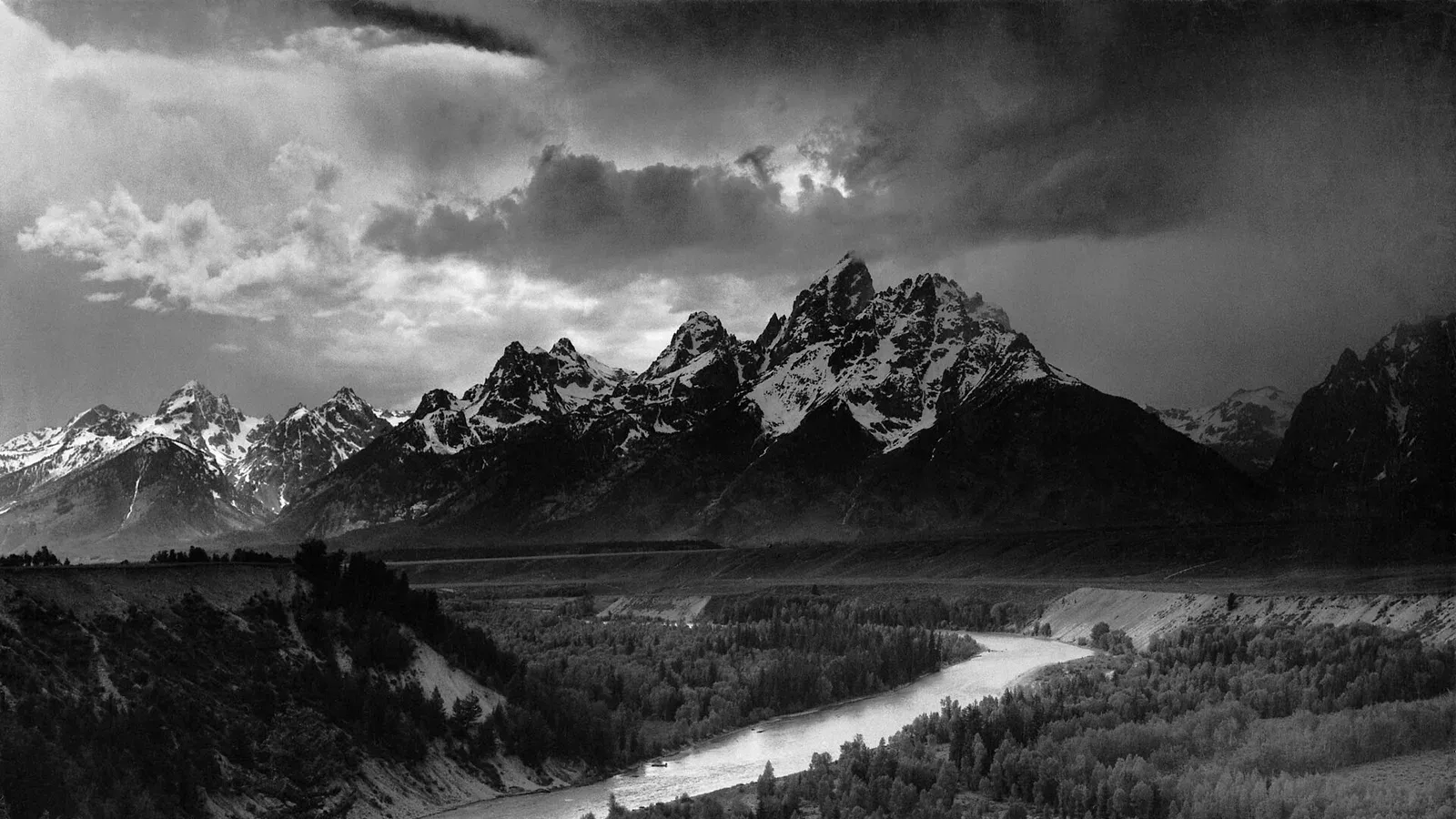
In 1942, Ansel Adams set up his tripod on a bluff above the Snake River and made a photograph of the Tetons that people have been trying to copy ever since. You have seen it even if you don't know you've seen it — the river curving like a silver ribbon toward mountains that look painted on, storm light doing things storm light only does once a decade. It was later chosen as one of the images sent into deep space aboard the Voyager spacecraft, which means that if anything out there ever finds us, one of the first things it will learn about Earth is that Wyoming is gorgeous.
Here is what the photograph doesn't show: a few miles behind Adams and his tripod, there were towns. There always are. Every national park in America has a front door, and at every front door there is a small town that grew up around the gate the way a general store grows up next to a railroad stop. Jackson outside Grand Teton. Springdale pressed against the red walls of Zion. Estes Park at the foot of the Rockies. Gatlinburg wedged into its Smoky Mountain valley like a carnival that wandered into a cathedral and decided to stay.
These gateway towns are some of the most interesting short-term rental markets in the country — and some of the most misunderstood. The demand is enormous, concentrated, and utterly indifferent to your pricing strategy, because it isn't really demand for your town at all. It's demand for the park. Your guests are borrowing your bed so they can stand somewhere else at sunrise.
That one fact changes everything: how people book, when they check in, what they search for, what makes them leave five stars, and what makes a market boom or bust. So let's walk through the gates — six of them — and figure out how the economics of a front door actually work, what the regulations look like town by town (spoiler: they could not vary more wildly), and how to run a park-adjacent listing that guests remember for the right reasons. There will be a bear. I promise there will be a bear.
A Front Door Economy
Most vacation rental markets sell a place. A beach town sells the beach, and the beach is everywhere — a hundred access points, ten miles of sand, no ticket booth. A gateway town sells a doorway. The park has an entrance, the entrance has a road, and the road runs through town. Demand doesn't spread across the market like water; it funnels through it like sand through the neck of an hourglass.
That funneling is the whole story. When millions of people a year want to see the same canyon, and the practical overnight options within thirty minutes of the gate amount to one small town's worth of hotels, cabins, and rentals, you get a market where occupancy in peak season is less a question of whether you'll fill nights and more a question of what you'll charge for them. The National Park Service publishes detailed visitation statistics for every park — annual and monthly, going back decades — and if you're serious about any gateway market, that public data should be your first stop. I won't quote the numbers here, because they shift every year and you should pull them fresh, but the shape of the curves will teach you more than any listing screenshot.
The second thing a front door does is cap supply in a way beach towns never experience. Gateway towns are small — often startlingly small — because they're hemmed in on every side by land nobody can build on. National park on one flank, national forest on another, sometimes a canyon wall doing the zoning for free. Springdale, Utah, can't sprawl. Tusayan, Arizona, occupies a pocket of private land inside a national forest roughly the size of a large ranch. When demand grows and supply physically can't, prices carry the adjustment. That's wonderful for owners who are in, and it's exactly why several of these towns have decided to control who gets in — more on that when we reach the regulation section, which is where this guide earns its keep.
The third thing: gateway demand is loyal to the park, not to you. If wildfire smoke closes the canyon, your bookings vanish no matter how nice your hot tub is. If the park adds a reservation system, your guests' entire day gets rescheduled, and their check-in with it. You are, in a very real sense, a downstream business of the federal government's most beloved agency. Most of the time that's a gift. Occasionally it's a flood, a fire, or a government shutdown, and your calendar finds out before you do.
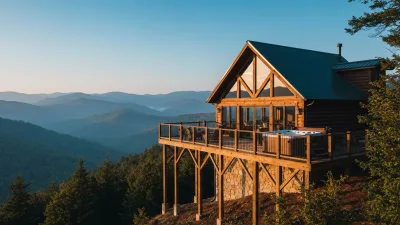
Let me introduce someone who learned all of this the fun way. Renee bought a two-bedroom cabin on the Fall River side of Estes Park, Colorado — knotty pine, a deck facing the water, elk in the yard so often she stopped photographing them by October. She priced it like the mountain lake houses she'd seen elsewhere, wrote a listing about the fireplace, and waited. What happened next is the rest of this article.
The Park Sets Your Guests' Alarm Clocks
Renee's first surprise wasn't the demand. It was the schedule. Her guests didn't behave like vacationers. They behaved like commuters with a very scenic office.
In a normal market, guests check in mid-afternoon, wander to dinner, sleep in, and drift toward the attraction whenever. In a gateway town, the park is the attraction, and the park has operational rhythms that override everything. Trailhead parking at the popular lots fills not long after sunrise in peak season. Shuttle lines build through the morning. Several parks — Rocky Mountain among them in recent summers — have used timed-entry reservation systems, which means a guest's whole day pivots on a slot they booked weeks ago at a specific hour. Check the park's current system before you write a single word of your guidebook, because these programs change year to year.
What that does to your operation is specific and predictable. Guests want early check-in or at least a place to stash bags, because they drove in at noon and their entry window is 2 p.m. They leave at dark-thirty, which means your coffee setup matters more than your streaming subscriptions. They come home at 8 p.m. sunburned, dusty, and starving, which means your kitchen gets used hard and your washing machine becomes a selling point. And they go to bed at nine, which means the hot-tub-party demographic largely isn't yours — a blessing your neighbors will appreciate.
Renee rebuilt her whole guest experience around the 5:40 a.m. departure. Programmable coffee maker set the night before. A grab-and-go shelf with granola bars and fruit. Headlamps in a basket by the door with a laminated card: "Take one, bring it back, the sunrise at Dream Lake forgives all alarm clocks." A boot tray and a mudroom bench where hiking boots could die with dignity. Her reviews changed almost immediately — not because the cabin changed, but because the cabin finally understood what job it was hired to do.
Write your house manual in park time, not hotel time. Lead with tomorrow morning: where to get an entry reservation if one's required, which trailhead lot fills first, where the closest early-opening coffee is, and how long the drive to the gate takes at 6 a.m. versus 10 a.m. A guest who nails their first morning forgives almost anything else about your property.
One more scheduling wrinkle: gate seasons. Some park entrances close entirely for months. The west entrance to Yellowstone shuts to regular vehicles in winter and the town it feeds transforms into a snowmobile and snowcoach economy. Higher-elevation roads — Trail Ridge in Rocky Mountain, sections of many mountain parks — close with the first serious snow and reopen when the plows win, on a date nobody can promise you. Your calendar isn't seasonal the way a ski town's is seasonal. It's seasonal the way a drawbridge is.
Seasonality Cliffs and Weather That Cancels Christmas
Every vacation market has seasons. Gateway markets have cliffs. The difference matters when you're underwriting a purchase or setting an annual budget, so let's be precise about it.
A beach market's demand curve looks like a hill: a long build through spring, a summer plateau, a gentle slide through fall. A gateway market's curve often looks like a mesa — flat and high through the core season, then a drop so steep you can date it to a specific week. The drivers are physical, not psychological. School calendars start the exodus, but what finishes it is the park itself: roads close, shuttles stop running, daylight shrinks, and the headline experiences simply become unavailable. Nobody shoulder-seasons their way up a road that's under six feet of snow.
Pull the monthly visitation tables from the Park Service for your target park and look at the ratio between the biggest month and the smallest. In some parks that ratio is merely dramatic. In others it's a different business entirely — a town that runs at full sprint for twenty weeks and then audibly exhales. West Yellowstone in late October, between the park's autumn road closures and the start of snow season, is a town of drawn shades. Springdale in January is quiet enough to hear the Virgin River from the middle of the main road. Whether that's a problem or a feature depends entirely on whether you modeled it.
Then there's weather as an event rather than a season. Desert parks flash flood; slot canyons close on beautiful sunny days because it rained forty miles upstream. Mountain parks close roads for late-June snow. Wildfire smoke can erase a shoulder month in either direction. And once in a while something biblical happens — the flooding that severed park roads near Yellowstone's northern gateways a few years back turned entire town economies off like a switch for weeks, then bent visitation toward the other entrances while repairs went on. Hosts near the closed gates lost a season. Hosts near the open ones had the strangest windfall of their lives.
The operational lesson isn't fear, it's structure. Gateway hosts need three things a beach host can skimp on: a genuinely flexible peak-season cancellation stance for park-closure situations (fighting a guest over a wildfire refund is a one-star factory), a cash buffer sized to the cliff rather than to the average month, and a shoulder-season plan that's an actual plan rather than a discount. That last one deserves its own section, and it gets one below.
Renee's version of this lesson arrived in year one, when an early-season snowstorm closed the high road and three separate guests asked her, politely and with total sincerity, what she intended to do about it. Her answer now lives in her welcome message: a list of what's gorgeous in Estes Park when the alpine is shut — and it's a long list — so the storm reads as a plot twist instead of a cancellation.
Six Front Doors, Six Completely Different Markets
Now the tour. These six towns all do the same job — bed, breakfast, and proximity — but as markets they have about as much in common as a lighthouse and a lava lamp. I'm deliberately not quoting rate or occupancy figures here; those move constantly, and the analytics platforms and the Park Service's own data will give you current numbers. What follows is the character of each place, which changes much more slowly.
Springdale, Utah — Zion's One-Street Kingdom
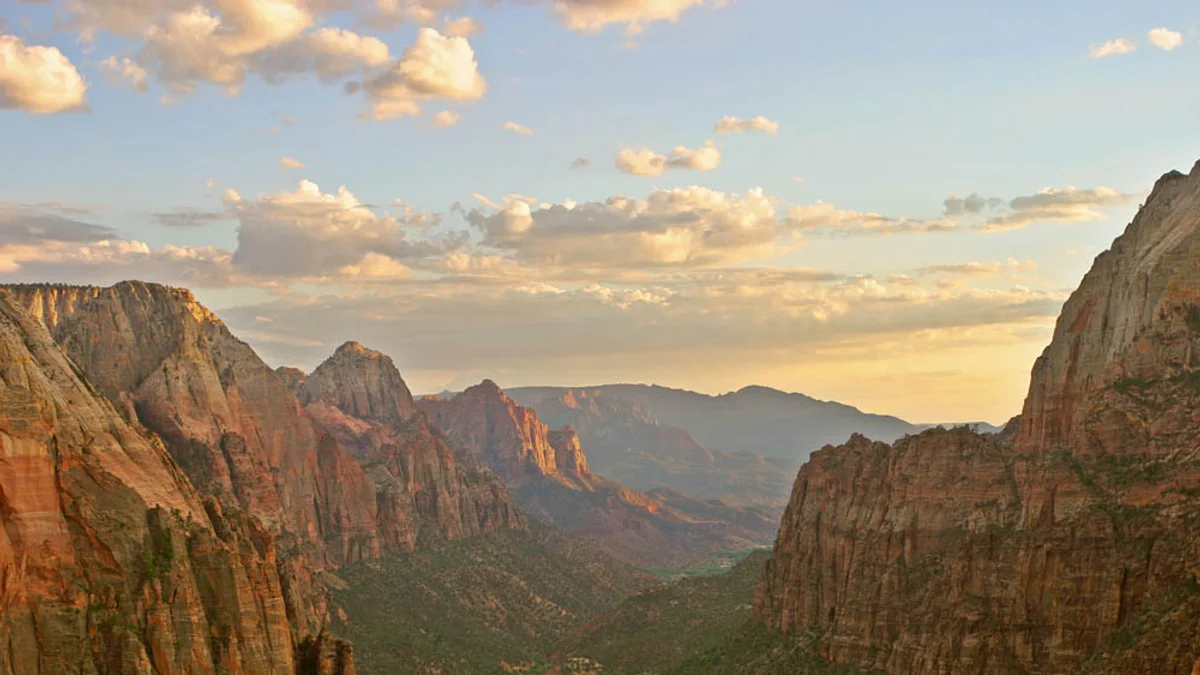
Springdale is a town of a few hundred residents holding the doorknob of one of the most visited parks in the country. There's essentially one road, and it runs straight into the canyon. For most of the year, private cars can't drive Zion Canyon's scenic road at all — you ride the park shuttle, and Springdale runs its own town shuttle that connects lodging to the entrance. That makes location within Springdale unusually literal: a listing's distance to a shuttle stop is a measurable, monetizable fact. The town knows exactly what it's sitting on and regulates lodging accordingly, with rules about where and how short-term rentals can operate that you must verify with the town before you believe a single listing headline. Supply is squeezed between canyon walls, and the neighboring communities down the road pick up the overflow — often with very different rules of their own.
Estes Park, Colorado — The Civilized Basecamp
Renee's town. Estes Park is bigger and rounder than Springdale — an actual town with a lake, a historic hotel that inspired a famous horror novel, an elk population that treats the golf course as a spa, and a genuine year-round community. It sits at Rocky Mountain National Park's east entrances, close enough to Front Range cities that it gets weekend demand no remote gateway can match. That drive-market cushion softens the seasonality cliff: when the alpine closes, Denver still comes up for anniversary weekends. The trade-off is regulatory maturity. Estes Park has run a vacation-rental registration system with caps on registrations in residential zones for years, complete with waitlists — the details evolve, so check the town's current ordinance before you underwrite anything. It's the clearest example on this list of a town that welcomed the industry and then installed a ceiling on it.
Gatlinburg, Tennessee — The Maximalist
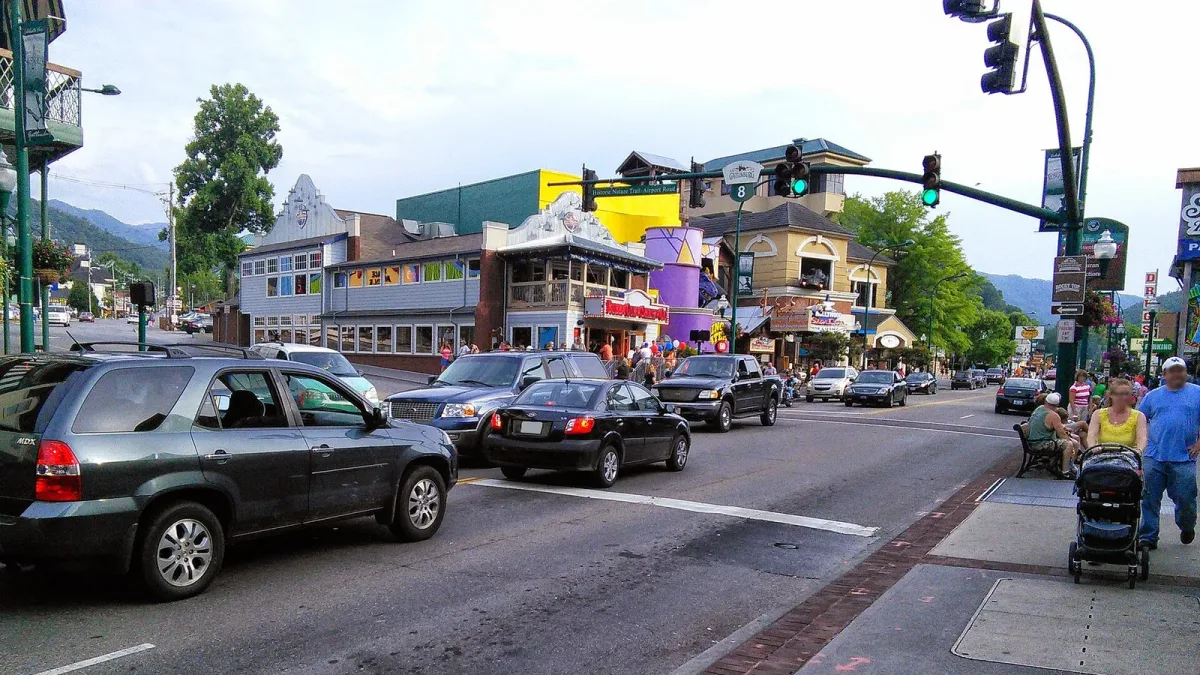
Everything Springdale restrains, Gatlinburg amplifies. The most visited national park in the country has no entrance fee, sits within a day's drive of a huge share of the U.S. population, and funnels a river of humanity through a mountain town that responded by building pancake houses, moonshine tasting rooms, a space needle, and one of the largest cabin-rental economies on Earth in the wooded hills around it. Overnight rentals are woven into the town's zoning DNA rather than fought — this is one of the friendliest regulatory environments any gateway offers, though friendly never means rule-free, and the county versus city distinction matters enormously. The market is deep, professionalized, and competitive in a way the western gateways aren't: you're not one of forty listings, you're one of thousands, and differentiation is the entire game. We wrote a full breakdown in our Gatlinburg and Smoky Mountains market guide, and if the maximalist model appeals to you, start there.
Moab, Utah — Two Parks and a Hard Ceiling
Moab is the only town on this list with two national parks in its lap — Arches a few minutes north, Canyonlands up the road — plus a state park, a famous river, and a mountain-biking culture that predates the crowds. Demand comes in overlapping waves: spring and fall are the desert's glory seasons, summer bakes, winter sleeps. And Moab is the cautionary tale on regulation: after years of explosive growth, the city and surrounding county moved to sharply restrict approvals of new overnight rentals in most zones. The practical effect is that existing, legally established units carry their permissions like a scarce asset, and buyers must verify — in writing, with the local government, not with a listing agent — exactly what a property is entitled to do. The gap between "currently operating" and "legally entitled to operate" has rarely been more expensive than it is in Moab.
West Yellowstone, Montana — The Drawbridge Town
West Yellowstone exists because the park's west entrance exists; the town line and the park boundary are neighbors. Summer is a torrent — it's the busiest of Yellowstone's gates in the warm months — and then the entrance closes to cars for the winter and the town reinvents itself around snowmobiles, snowcoach tours, cross-country ski trails, and a much smaller, hardier breed of visitor. Two seasons, two different businesses, one address. Montana's regulatory posture has generally been permissive compared to the resort towns of Colorado or Utah, but town-level licensing and state lodging tax registration still apply, and you should confirm both. The operational challenge here isn't rules; it's running a property profitably through a shoulder season that isn't a shoulder so much as a hibernation.
Tusayan, Arizona — The Town That Barely Exists
And then there's Tusayan, at the Grand Canyon's south entrance — one of the smallest incorporated towns in Arizona, a strip of hotels, restaurants, and an IMAX theater on a pocket of private land surrounded on all sides by national forest. There is almost no residential housing stock, which means there is almost no short-term rental market in the conventional sense, and that scarcity is the lesson. Gateway investing isn't about getting close to the park at any cost; it's about finding the nearest town where inventory can actually exist. For the Grand Canyon, that conversation happens in Williams and Flagstaff, each a highway drive from the rim, each with its own rules and its own character. Sometimes the best gateway play is one ring out from the gate — the same dynamic desert hosts discovered in the towns around Joshua Tree, which we mapped in our Joshua Tree market guide.
Shoulder-Season Engineering
Here's the mistake almost every new gateway host makes with the off months: they treat the shoulder season as peak season at a discount. Same listing, same photos, same pitch, lower price. Then they're confused when a thirty percent price cut doesn't conjure demand for a park experience that is, at that moment, partly closed.
Discounting doesn't create demand. It reallocates demand that already exists. In a gateway town in the off months, the summer demand doesn't exist to reallocate — those travelers aren't shopping for a cheaper October; they're not shopping at all. Shoulder-season revenue comes from finding the demand that does exist in October and building a product for it. That's engineering, not pricing, and it's the single highest-return skill a gateway host can develop. We go deep on the general playbook in our guide to turning shoulder months into real revenue; here's the gateway-specific version.
Start with what the park is actually good at in the off season, because it's usually something the summer crowds never see. Desert parks are at their best in the exact months the crowds are gone — Moab's sweet seasons are spring and fall, and even winter delivers snow-dusted red rock to photographers willing to wear gloves. Mountain parks trade hiking for elk bugling in the fall rut, golden aspen, and snowshoe routes. Yellowstone in winter, reached by snowcoach out of West Yellowstone, is by many accounts the best version of the park: steaming basins, bison in frost, and a fraction of the visitors. Every one of those is a bookable reason to travel — if your listing tells that story instead of running summer photos at a discount.
Then rebuild the listing itself, seasonally. Swap the photo order: fireplace, snowy deck, aspen gold, elk in the yard. Rewrite the headline for the season's audience. Retarget the guest: off-season gateway travelers skew toward photographers, retirees with flexible calendars, remote workers on week-long stays, and locals from the nearest metro on weekend resets. Those guests want different things — fast Wi-Fi, a desk, a long-stay discount, a kitchen worth cooking in — and they read reviews for different signals. A listing that changes clothes with the seasons consistently out-earns a static one in these markets, and hardly anyone bothers to do it.
Build two listings' worth of photography in one shoot per season — a bright summer set and a moody winter set — and actually swap them on a calendar reminder. While you're at it, rewrite your first three photo captions for the season. It's an afternoon of work twice a year, and it's the cheapest revenue project in this entire guide.
Renee's October used to be her worst month: the high road closes, summer families vanish. Now it's her favorite. She markets the cabin from September onward as an elk-season and aspen basecamp, added a long-stay discount that catches remote workers, and keeps a shelf of field guides and a spotting scope on the deck. The cabin didn't change. The story did.
The Regulation Lottery: Same Job, Wildly Different Rules
If the six-town tour left you with one impression, let it be this: there is no such thing as "national park gateway regulation." There is Gatlinburg, where overnight rentals are a founding industry. There is Estes Park, with its registration caps and waitlists. There is Moab, where new approvals have been sharply curtailed in most zones. Same national customer, same federal attraction, utterly different local law — sometimes different law on opposite sides of the same road, where town limits end and county land begins.
Why so different? Because gateway towns feel the pressure of tourism more intensely than almost anywhere else. They're tiny, their housing stock is finite, their workforce — the rangers, servers, guides, and cleaners who make the whole show run — has to live somewhere, and every home that converts to nightly rental tightens that squeeze in a town that physically cannot build outward. Some towns respond by leaning into lodging as their economic identity. Others respond by protecting residential neighborhoods with caps, zones, or moratoriums. Both responses are rational. Your job isn't to have an opinion about them; it's to know exactly which one your target town has chosen this year.
So here is the diligence sequence, in order, before any offer:
One: verify at the source. Call or visit the town's planning or licensing office and ask, about the specific parcel: is short-term rental permitted here, under what license, is there a cap, is there a waitlist, and does the license transfer on sale? Get the answer in writing. In capped markets, transferability is the entire ballgame — a property with a nontransferable license is, for your purposes, a property without one.
Two: check every layer. Town, county, and state can each have a say, plus lodging-tax registration at one or more levels, plus an HOA if there is one — and HOA prohibitions quietly kill more rental plans than any city council. A cabin outside town limits may face county rules that are looser or tighter than the town's. In Sevier County around Gatlinburg, the layers stack one way; around Moab, another entirely.
Three: assume change. Gateway regulation is a live wire. Councils in these towns revisit their ordinances constantly because the pressure never stops. Whatever you verify today, build your model to survive a plausible tightening — and if a market's entire appeal depends on rules staying exactly as loose as they are, price that fragility in. Our permits and licensing guide for new hosts walks the general process step by step, and our state permit data hub is a starting point for the state-level layer — with the standing caveat that local rules move fast and the town clerk always outranks the internet.
One more gateway-specific wrinkle: some of the land around these parks is federal in ways that surprise buyers. Cabins on national forest land sometimes sit on recreational leases with their own restrictions on commercial use. Inholdings inside park boundaries come with unique deed histories. If a property near a park seems like a bargain, the explanation is usually in the land status, and a good local title company will find it. This is a "confirm with your attorney" paragraph if there ever was one — treat it that way.
Marketing a Park-Adjacent Listing Without Fibbing
Gateway guests search differently. They don't start with "cabin in Tennessee." They start with the park — "airbnb near national parks," "cabin near Zion," "lodging by the Smokies entrance" — and work backward to a bed. Your listing wins or loses on how credibly it answers the only question that matters: how close am I to the thing I came for, and what do you know that will make my trip better?
Which brings us to the first commandment of gateway marketing: trailhead-distance honesty. Every gateway market is haunted by listings claiming to be "minutes from the park" when they're forty of them, or "at the entrance" when they're at an entrance — the one nobody uses. Guests find out. They find out at 6 a.m. on the first morning, in the car, doing arithmetic, and the arithmetic goes straight into your review. State the drive time to the specific gate, at the time of day your guests will actually drive it, and name the gate. "Twenty-five minutes to the Fall River entrance; add time in July midday" reads like a host who has made the drive. It converts better than vagueness, and it protects your ratings better than any amenity.
Second: sell the sky. A remarkable number of parkland regions hold official dark-sky designations — several Utah parks among them — and even the ones without certificates sit under skies most of your guests have never actually seen. Darkness is an amenity with zero acquisition cost. A deck facing away from town lights, a pair of binoculars, a red-light flashlight so nobody torches their night vision, a one-page star chart for the season, a note about the Milky Way season and meteor-shower dates: that package costs less than a throw pillow and shows up in reviews forever. If your area qualifies, say the words "dark sky" in your listing, because a real audience searches for exactly that.
Third: write the ranger-style guide. Not a list of restaurant links — a real local briefing in a confident, generous voice. Which entrance to use and when. What time the popular lot fills in June versus September. The hike that's just as good as the famous one with a third of the crowd. Where to see elk without becoming a headline. What the reservation system requires this year and the link to book it. This document does three jobs at once: it improves trips, it pre-answers the messages that would otherwise arrive at 9 p.m., and it signals expertise that guests reward with loyalty and direct rebooking. The same principle powers great water-market listings — our lake house marketing guide makes the case that hosts win by selling the experience around the property, and nowhere is that truer than at a park gate.
Fourth: build for gear. Park guests travel heavy — trekking poles, coolers, bikes worth more than your furniture, climbing racks, ski bags, muddy everything. A lockable gear room or garage space, a bike rack, a boot dryer in mountain towns, a hose bib and brush at the door in red-rock country, a big mudroom bench: these cost little and photograph well, and in listing search they separate you from every generic cabin whose owner has never carried a wet tent through a living room. Mention them by name in the listing; gear people scan for them.
Put your drive-to-gate time in your listing title or first line, stated precisely and honestly — the gate's name included. In gateway search results, that one specific number outperforms every adjective you could buy with the same characters. Vague listings get clicks; precise listings get bookings from guests whose expectations you've already set.
Renee's version of all this fits on one laminated page and a short section at the top of her listing. Drive times to both east entrances, morning and midday. A fall elk-viewing etiquette note. A star chart. The line in her reviews that appears most often, in various spellings, is some version of "she told us exactly what to expect." That sentence is the entire marketing strategy, achieved.
The Bear Is Not a Metaphor
Now, as promised: the bear.
There is a photograph on Wikimedia Commons — you'll find it below — of a black bear napping in a tree in downtown Estes Park. Not at a trailhead. Not in the backcountry. Downtown, above the shops, draped over a branch with the boneless confidence of an animal that has absolutely no plans and no predators. Somewhere below, presumably, tourists were buying taffy.

I love this photo because it captures the gateway host's situation exactly. The wildlife is the product — it's a huge part of why guests come — and the wildlife is also an operational stakeholder who did not read your house rules. If you host at a park gate, animals are part of your property management reality, and your obligations run in three directions at once: to your guests, to your neighbors, and to the animals themselves.
To your guests: education, delivered warmly and unmissably. Distance rules for elk and bison, which hurt more people in the parks than predators do. What to do (and not do) in a bear encounter. Why the elk in the yard during the fall rut is not a photo opportunity to walk toward — bull elk in September have the temperament of a bouncer at closing time. Put it in the welcome book, put the crucial bits on the fridge, and write it in the ranger voice: matter-of-fact, a little funny, zero panic.
To your neighbors and the town: trash discipline. This is the one that gets hosts in genuine trouble. A bear that finds food in your cans learns your address, then your street, then — in the phrase wildlife officers use with real grief — becomes a problem bear, and problem bears often end up dead over someone's pizza box. Many mountain and gateway communities require wildlife-resistant containers or enclosed storage by ordinance, and turnover-day trash from a rental is a known weak point. Check your town's current rules, buy the certified containers, and write the trash procedure into your cleaner's checklist and your checkout instructions. Nothing sours a neighborhood on short-term rentals faster than being the house that feeds the bears — and in capped-permit towns, neighborhood goodwill is not a soft asset.
To the animals: design choices. Bird-safe practices, no feeding, motion lights aimed low, secured grills and coolers, hummingbird feeders down in bear season if local guidance says so. None of this is expensive. All of it is the price of doing business inside someone else's habitat — and "inside someone else's habitat" is, when you strip away the spreadsheets, the actual product you're selling.
And yes: sell it. Renee's spotting scope, her field guides, her "elk are commuting, please yield" doormat — guests mention them constantly. Wildlife done responsibly isn't a liability line item. It's the most photogenic amenity you will ever not have to pay for.
Underwriting a Gateway: Questions Before Spreadsheets
I've kept this guide deliberately light on figures, because the honest ones are perishable and the invented ones are worse. But when you do sit down with real data — the Park Service's visitation tables, the analytics platforms' market pages, actual comp listings' calendars — bring these gateway-specific questions with you, because they're the ones a generic STR model misses.
How wide is the moat? A market's pricing power lives in its supply constraints. Is the town hemmed by federal land? Is there a permit cap, and are you buying an existing permission or hoping for a new one? Moab-style restriction makes existing licensed units more valuable and new entries nearly impossible; Gatlinburg-style openness means deep competition forever. Neither is wrong. They're different businesses.
How tall is the cliff? Take the park's monthly visitation curve and stress-test your budget against the worst three months, not the average. Can the property carry itself through the trough on realistic off-season revenue, or does the whole model depend on twenty perfect weeks? Then ask the darker question: what happens in a closure year — fire, flood, a shutdown? A gateway property should survive one bad season without forcing a panic sale, because over a long hold, one bad season is not a risk. It's a scheduled event with an unknown date.
Who shows up when the park is closed? The strongest gateway markets have a second demand engine — Estes Park's Front Range weekenders, Moab's bikers and off-roaders, West Yellowstone's snow economy, Gatlinburg's attraction ecosystem that functions rain or shine. A town that's only a park gate is a single-tenant building where the tenant is a mountain. Wonderful tenant. Read the lease.
What does the town want to become? Read the last two years of council minutes — they're public, they're searchable, and they are the cheapest market research in real estate. A town actively debating caps is telling you the future. A town investing in shuttles, trails, and shoulder-season events is telling you a different future. Believe them.
None of this is exotic analysis. It's the ordinary discipline of matching a property to a place, done in a category where the place has stronger opinions than usual.
The Long View From the Bluff
Back to that bluff above the Snake River. The thing about the Adams photograph is that it still works. Eighty-plus years on, the river has shifted its braids, the trees have grown into his composition's foreground, and photographers still line up at the same overlook because the mountains are still doing the thing. National parks are the rare travel product that does not go out of style — protected by law, marketed by every calendar and screensaver on Earth, and renewed every generation by families who first saw them from a back seat.
That permanence is the real case for gateway markets, and it's also the reason to approach them with more respect than opportunism. These are small towns doing a hard job: hosting the world at the door of something irreplaceable, with finite housing and a workforce that has to sleep somewhere. The hosts who thrive in them for decades are the ones who act like part of the town — licensed, bear-smart, honest about drive times, generous with local knowledge — rather than an extraction operation with a keypad. The market rewards that posture too, which is the pleasant kind of alignment.
Start with the park's own visitation data, verify the local rules at the source, engineer your shoulder season instead of discounting it, and write a listing that tells the truth precisely. Do those four things and you'll be ahead of most of the market at any gate in the country.
And if you'd like your park-adjacent listing to show up when travelers type that park's name into a search bar, that's the kind of work Cavmir does every day — our SEO team spends a suspicious amount of time thinking about how people search for the places they love.
Photography via Wikimedia Commons, resized and cropped: hero, Adams The Tetons and the Snake River, public domain; inline, Downtown Gatlinburg, Tennessee - panoramio by Evan Nichols (Virtua… (CC BY 3.0).




.jpg)

