The Market
Why Gdańsk is One of the World's Premier STR Markets
Gdańsk is the most seasonal major rental market in Poland, and that single fact should drive every decision an owner makes here. Summer months run somewhere between 140% and 200% of the average monthly revenue, October is the strongest month outside the peak, and January is the softest — a swing wide enough that a flat annual rate is not a pricing strategy, it is a donation. The city has a genuine reason for that shape: it is a Baltic port with a beach, a rebuilt Hanseatic centre on the Motława, and one enormous event. St Dominic's Fair runs from 25 July to 16 August 2026 in its 766th edition, three full weeks of stalls and performances through the Main Town, and it lands squarely in the middle of the summer peak. What Gdańsk does not have is a licence to apply for. There is no city register, no nights cap, and — unusually — no tourist tax at all, the climate fee having been abolished here as in Kraków. What did not change this year, despite a great deal of noise suggesting otherwise: Poland still has no national short-term rental register, and Regulation (EU) 2024/1028, applying since 20 May 2026, harmonises national schemes rather than creating one. Poland's own act, with its national register and municipal restriction zones, was still in the legislature. For now, Gdańsk is a market where the rules are light and the calendar is everything.
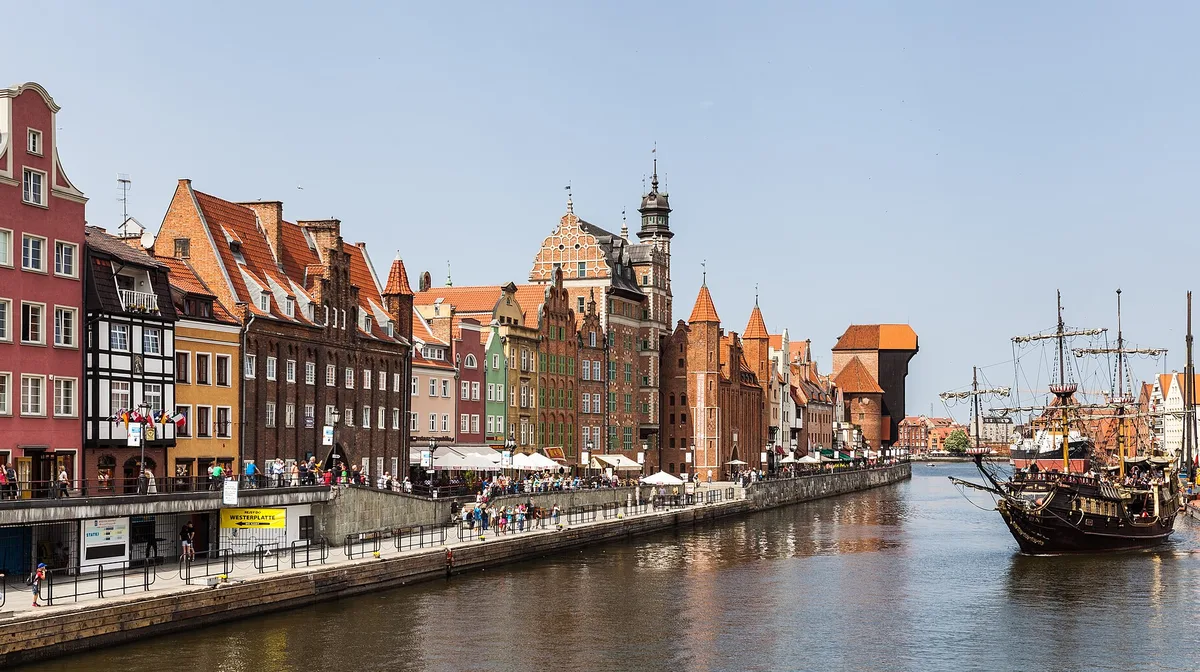
Gdańsk sells three products that happen to share a postcode, and most listings only describe one. The first is the Main Town — Długi Targ, the Neptune Fountain, Mariacka Street with its amber shops and the Motława waterfront with the medieval crane — a rebuilt Hanseatic core that draws city-break travellers year-round and fills completely for the three weeks of St Dominic's Fair. The second is the Baltic coast: Brzeźno and Jelitkowo have real beaches within the city limits, and the tram runs to them, which turns a July booking into a beach holiday with a medieval centre attached. The third is the Tricity, because Sopot and Gdynia are separate towns fifteen and thirty minutes up the SKM commuter line, and a guest choosing Gdańsk is often really choosing the whole conurbation. Rates blend near €85 at occupancy around 55%, but published figures vary widely between sources because they count different listing universes; what nobody disputes is the seasonal amplitude. Guest mix is Scandinavian and German at the top of the summer, British and Irish on weekend flights into Gdańsk Lech Wałęsa, a large domestic contingent driving up from Warsaw and central Poland in July and August, and a steady year-round stream for the European Solidarity Centre and the amber trade. Small hotels and guest houses in the Main Town compete for exactly the same guest.
Top Attractions & Landmarks
- Długi Targ, the Neptune Fountain and Artus Court
- The Motława waterfront and the medieval Żuraw crane
- St Mary's Church, one of the largest brick churches in the world
- Mariacka Street and the Amber Museum in the Great Mill
- The European Solidarity Centre at the historic shipyard
- Brzeźno and Jelitkowo beaches on the Baltic
- Oliwa Cathedral and its baroque organ
Nearby Markets: Warsaw | Kraków | Wrocław