The Market
Why Wrocław is One of the World's Premier STR Markets
Wrocław is the Polish market where supply is growing faster than anywhere else on this list, and that is the single most important thing an owner here needs to understand. Active listings sit around 3,212 and grew roughly 30.5% in a year — while rates and revenue still trended upward, which is the good news and also the trap. Demand has absorbed the new supply so far. It will not do so indefinitely, and the properties that get positioned now are the ones that keep their occupancy when it stops. Blended rates run near €72 a night at about 60% occupancy, which makes Wrocław cheaper than Kraków and steadier than Gdańsk. The regulatory picture is the same one facing every Polish city, and it is lighter than most guides claim: there is no national short-term rental register in force, and Regulation (EU) 2024/1028, applying since 20 May 2026, harmonises national schemes rather than creating one. Poland's own act — a national register with a per-offer ID and municipal power to designate restriction zones — was still in the legislature in August 2026, and Wrocław has not signalled the appetite for restriction that Kraków has. What Wrocław does have, and what almost no listing here mentions, is one of Poland's largest business-services and technology employment bases. That produces a genuine corporate midweek floor in a city everybody markets as a weekend break.
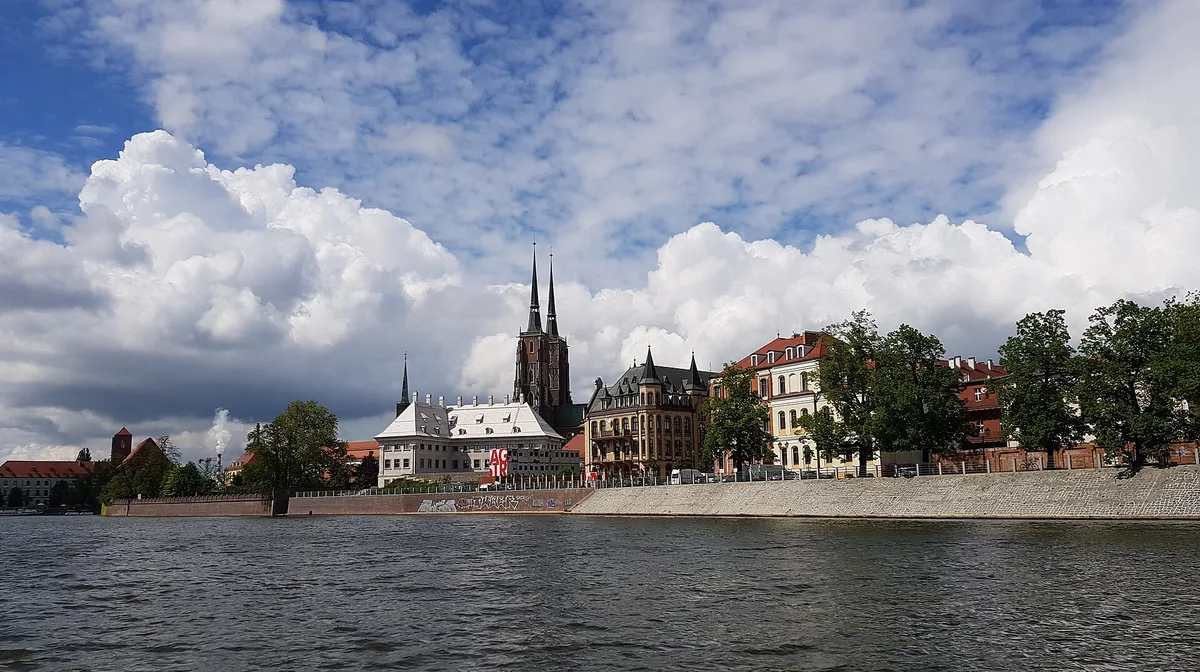
Wrocław is built on twelve islands and something over a hundred bridges, and the geography does real commercial work. The Rynek is one of the largest market squares in Europe with a Gothic town hall in the middle of it and the whole restaurant economy around the edges. Ostrów Tumski, the cathedral island, is the oldest part of the city and still has gas lamps that a lamplighter lights by hand every evening — the last such round in Poland, and a five-minute walk from the square. Centennial Hall, Max Berg's 1913 reinforced-concrete dome, was UNESCO-inscribed in 2006 and sits out east by the Japanese Garden and the fountain. The dwarfs, several hundred small bronze figures scattered across the pavements, began as a nod to the Orange Alternative's absurdist protests against the communist government and are now the thing every family with children comes to hunt. Against that, the guest mix is broader than the tourism suggests: German and Czech weekend travellers on a short drive or flight, British and Irish city breaks, a substantial domestic market, a large student population that drives parents' visits and graduation weekends, and — the part most owners miss — Monday-to-Thursday corporate demand from the technology, finance and shared-services employers that made Wrocław one of Poland's biggest business-services cities. Small hotels and guest houses around the Rynek compete for all of it.
Top Attractions & Landmarks
- The Rynek, one of Europe's largest market squares, and its Gothic Old Town Hall
- Ostrów Tumski, the cathedral island, and its hand-lit gas lamps
- Centennial Hall (Hala Stulecia), UNESCO-inscribed in 2006
- The Panorama Racławicka in its purpose-built rotunda
- The Wrocław dwarfs scattered across the pavements
- The Multimedia Fountain and the Japanese Garden in Szczytnicki Park
- Aula Leopoldina at the University of Wrocław
Nearby Markets: Kraków | Warsaw | Gdańsk