



Plenty of hosts have heard that the website is finished as an idea. Guests book on Airbnb, the story goes, and the rest of the planning happens inside ChatGPT or on Instagram, so why pay for pages nobody visits? It sounds reasonable until you watch what an AI assistant does when someone asks it about a place to stay. It goes looking for the business itself. When the business runs its own website, the assistant has a page that speaks for the business and can check the rest of the web against it. When there is no site, the assistant has to assemble the story from scraps, and the scraps rarely agree.
This guide makes the case for the website in 2027 from that angle. A site you own has become the reference copy of your business: the record that answer engines, search engines and careful guests hold everything else up to. I'll show you how that works, why a listing can't do the same job, why the advice to keep your site small and simple costs you visibility, and when a large site helps or hurts. The examples come from real rental websites built by Cavmir™ for owners in the Caribbean, Florida, Arizona, upstate New York, Hawaii and Brazil, with screenshots taken in October 2026.
The Case Against Websites, and Where It Goes Wrong
The argument against a website usually comes in four parts, and each one starts from something true. For many owners, most bookings do come through the big platforms. More and more trip planning starts in a chat window. Social video is where plenty of younger travelers first see a place. And a website that nobody updates is a cost with no return. Put those together and a site looks like a brochure from 2012.
Where the argument goes wrong is in what it assumes the website is for. It treats the site as a destination, a place a guest has to type in and visit before anything good happens. In 2027 that's the smallest part of the job. The bigger part happens when nobody from your future guest list is looking at your site at all: a crawler from Google, Microsoft, OpenAI or Perplexity is reading it, storing what it says and deciding whether your business is a safe thing to mention when someone asks.
Think about the questions travelers now type into an assistant. They're long and specific: a quiet place in Santo Domingo facing the sea, with a bathtub by the window; a cabin near a ski hill with its own hot tub; a house in Orlando close to a hospital, for a nurse on a thirteen-week contract. A listing can answer some of that, but its title is rarely the business name, its location is blurred and parts of it are closed to AI crawlers. An assistant needs written facts it can trust, and it needs to know which business those facts belong to.
That's also why the "nobody visits websites anymore" point misses. In a February 2026 Phocuswright survey, 56% of American leisure travelers had turned to AI while planning a trip in the twelve months before. Fewer of them click through than used to: Pew Research Center found in 2025 that Google users clicked a regular result in 8% of visits that showed an AI summary, against 15% without one. Yet visits that AI tools sent to U.S. travel sites in May 2026 were up 194% on the same month a year before, according to Adobe figures reported by Skift. Every AI answer is built from somebody's pages, and a business whose pages weren't among them wasn't in it. Visits are a bonus; being a source is what gets you named.
Potenza Rentals is a good example of a business the old argument would have talked out of a site. It rents out apartments facing the sea along the Malecón, Santo Domingo's waterfront boulevard, and it already had years of Airbnb reviews. Its website now describes each kind of apartment on its own page, from studios with a freestanding tub at the glass to a villa with a pool in Boca Canasta, so an assistant asked about any one of them has something exact to read.
How an Answer Engine Builds a Picture of a Business
It helps to know, in plain terms, what happens between a traveler's question and the answer on the screen. The details differ from one company to the next, but the main steps hold for Google's AI features, ChatGPT search, Perplexity and Microsoft Copilot alike.
First, the assistant breaks the question apart. Google has described this for AI Mode as a "query fan-out": one question becomes many smaller searches, each on a subtopic, run at the same time. A question about a family villa on St. Croix might fan out into searches about beaches safe for children, the drive from the airport, villas with a pool, how many bedrooms, and recent reviews. Google's head of Search wrote in 2025 that its deeper research mode can run hundreds of these searches for a single question.
To see what that means for one property, take a question a couple might ask in December: a cabin for two near a ski hill in the Adirondacks, with a private hot tub, for a long weekend in February. Broken apart, that's a search for cabins near ski areas in the region, one for cabins with private hot tubs, one for February snow and conditions, one for what's open in winter, one for how far the drive is from the couple's city and one for recent reviews. Adirondack Mountain Bungalows has a page for nearly every one of those: the cabins and their hot tubs, the distance to Titus Mountain, a winter page that runs month by month, drive pages for nearby cities and a reviews page. A listing covers a few of them.
Second, the assistant pulls candidate pages from a search index. That's the same kind of index regular search uses, which is why Google tells site owners that AI Overviews and AI Mode need nothing beyond normal search eligibility, no extra markup and no special optimization. A page has to be indexed and allowed to show a snippet, and the usual search basics apply. ChatGPT search, Perplexity and Copilot work from their own crawlers and partner indexes, and each publishes the name of the crawler it uses so site owners can let it in. OpenAI's crawler for ChatGPT search is OAI-SearchBot, and Perplexity says its PerplexityBot exists to surface and link websites in its answers.
Third, the assistant reads the pages it found and writes an answer, usually with links to the sources it leaned on. This is the step where your site pays off, or doesn't. A page that states facts plainly, in sentences, near the top, is easy to quote. A page that hides its facts in images, sliders and booking widgets gives the assistant nothing to work with.
OASENA, a two-bedroom home twelve floors up in one of the towers of the Amrit resort on Florida's Singer Island, has a page written for this step. Its summary page for AI tools says what the residence is, where it sits, how many guests it takes and how booking works, in short numbered sections, and none of it contradicts any other page on the site. Any guest can read it, and Google needs nothing special to use it. Its value is that each fact is stated once, plainly, and the same way as everywhere else on the site.
The scale of this matters. Google said in May 2026 that AI Overviews has more than 2.5 billion monthly users and AI Mode more than a billion, and OpenAI said in September 2026 that ChatGPT has about 1.2 billion weekly users. Only some of them are asking where to stay, but the answers they get draw on websites.
The Website as the Reference Copy
This is the core of the argument. When an assistant researches your business, it needs a starting point it can treat as your own account of yourself. Your website is the one spot on the internet that fills that role, because it's the only place you control completely and that speaks for the business by definition.
Picture how a careful journalist checks a story about a company. They don't start with a stranger's forum post. They start with what the company publishes about itself, then call around to see whether outside sources confirm it. If the company says it has thirteen homes and three outside sources say thirteen, the number stands. If one source says nine, the journalist trusts the number with support behind it and notes the outlier. The company's own record is where the checking begins, even when it isn't where it ends.
Assistants are meant to work the same way. Microsoft's Bing team, for one, writes that conflicting sources have to be caught rather than quietly picked between, because that risks a confident wrong answer. The safest facts are the ones that appear on the business's own site and are repeated elsewhere. Your website gives them the first half of that pair. Reviews, press, directories and links give them the second half.
SP Vacations, which handles holiday rentals for the St. Croix brokerage Sterling Point Real Estate, has thirteen villas and condos on the island, and its site shows what a reference copy looks like in practice. Each collection page, such as Beachfront, lists the homes in it with bedrooms, bathrooms and how many they sleep, and says plainly which beaches are good for swimming and which are better for walking. The same numbers appear on each villa's own page, so an assistant gets one answer wherever it reads on the site.
There's a second reason the site works as the anchor. Search engines and assistants keep track of businesses as things, often called entities: a name tied to a place, a type of business, an owner and a set of profiles. Google's documentation says Organization markup can help it understand a business's administrative details and tell it apart from others in search results, and it includes a property called sameAs for listing the business's other official profiles. In other words, the website is where you tell the machines which Instagram account, which Airbnb listing and which Facebook page belong to you.
Without that anchor, every profile is a separate claim. With it, they become one business seen from several angles.
How Outside Sources Confirm the Story
The reference copy is only half of what an assistant weighs. The other half is what the rest of the web says about you. The way we put it at Cavmir: the website states the facts, and backlinks, reviews and mentions are how a machine decides whether to believe them.
Google has been nudging people to think this way for years. Its guidance on helpful content asks owners a pointed question: if someone researched the site behind a page, would they come away thinking it was well trusted or widely recognized on its topic? The handbook Google gives its human search raters makes the same point at length, sending them to independent reviews, references and news coverage instead of a site's own claims. Raters have no control over rankings, but the handbook describes what Google's systems are built to reward.
Outside research on AI answers points the same way. When Ahrefs looked at 75,000 brands in 2025, the measure most closely tied to showing up in Google's AI Overviews was the number of places on the web that mention the brand. That link was about three times as strong as the one for backlinks, 0.664 against 0.218 on the study's scale, and Ahrefs warns that it shows correlation, not cause. That doesn't mean links stopped mattering. It means a business that people write about, review and refer to is easier for a machine to recommend than one that only talks about itself.
For a rental, the outside sources that carry the most weight are the ones a traveler would also trust:
- Guest reviews on Airbnb, Vrbo, Google and booking sites, ideally shown on your own site as well, each with a first name and the month of the stay. Show only real ones: under the FTC's fake-review rule, in force since October 2024, a business that posts testimonials on its own site is responsible for them.
- Local press and travel writing that names the property and links to it.
- Tourism boards, chambers of commerce and event organizers that list you as a place to stay.
- Partner businesses such as charter captains, chefs, golf courses and wedding planners that mention you on their own pages.
- Consistent profiles on Instagram, Facebook, Pinterest and YouTube that use the same name and point back to the same website.
Adirondack Mountain Bungalows, a group of four cabins in Malone, New York, close to Titus Mountain and every one with a private hot tub, collects its outside proof on one page. Its reviews page gathers what guests wrote on each cabin's Airbnb listing, word for word, most recent at the top, sorted by cabin. Airbnb keeps each listing's separate reviews page closed to crawlers, so a page like this one is where search engines and AI tools can read what guests said in full.
Cavmir's practice calls this corroboration, one of the four jobs in the generative engine optimization guide. The website can't corroborate itself. But it gives every outside mention something to agree with.
A Business With No Website, Seen by an AI
Now run the same research on a rental that has no site. The assistant still fans the question out and still searches its index. It still finds things. What it can't find is the one page that ties those things together and says, in the owner's words, what is true today.
Here is what usually turns up instead, and why each piece falls short on its own:
| Where the assistant looks | What it tends to find | What goes wrong |
|---|---|---|
| Airbnb or Vrbo listing | A marketing title, photos, a rating, how many it sleeps, a rough area on a map | The title is rarely the business name, the exact location is hidden, and parts of the page may be closed to AI crawlers |
| Google Business Profile | Usually nothing for a vacation home | Google doesn't allow profiles for rental properties such as vacation homes |
| Old directory or tourism listing | A name, a phone number, sometimes an address | Often years out of date, sometimes still carrying a previous owner's details |
| Instagram or Facebook | Photos, short captions, a link in the bio | Very little text, and the facts are spread across hundreds of posts that contradict each other over time |
| Reviews on other sites | Opinions, dates, a first name | Properties with similar names get mixed up, and nothing says which business replies |
| A news story or blog post | One description at one moment | No way to tell whether it's still true |
Two of those rows deserve a note. Google's rules for Business Profiles name vacation homes, along with other properties offered for rent or sale, as ineligible, so a vacation home with no website often has no page on Google that speaks for it at all. And platform listings aren't always open to the machines doing the research. On October 29, 2026, Airbnb's robots file kept Perplexity's crawler out of every listing page and closed each listing's reviews, description, amenities and location pages to all crawlers.
When those fragments disagree, the assistant has three choices, and none of them help you. It can describe you with the wrong facts, such as an old bedroom count or a nightly price from two summers ago. It can merge you with a property that has a similar name in the same town, which is easy to do in places full of "Ocean View Villa" and "Mountain Retreat." Or it can play safe and leave you out, recommending a business whose story it can confirm.
That last outcome is the quiet one, and the hardest to spot. Nobody tells you that you were left out of an answer. You just get fewer inquiries from the people who asked.
A website fixes this with a page most owners never think to write: who you are. Potenza Rentals' About page says it's a Santo Domingo hosting team, how long it has hosted, how many homes it looks after and where they are. Those sentences are plain to write and very useful to a machine, because they turn a scattered set of listings into one named business with a history.
If you only build one page this year, build that one, on a domain you own, and spell the business name exactly as it appears everywhere else.
Why a Listing Can't Stand In for a Site
A common reply is that the Airbnb listing already does all this. It has the photos, the reviews, the amenities and the calendar. Why repeat it on a site?
Because the listing isn't yours, and that shows up in several ways an assistant can notice.
The platform writes the rules. Airbnb decides what a listing can say and link to. Its policy on payments and transparency bars links in listing pages or messages that take people off Airbnb, and requires every conversation before a reservation to happen on Airbnb. So the listing can't even point to the rest of your business. It's a room with no doors.
The platform decides who can read it. A platform's robots file tells crawlers what they may fetch, and those choices are made for the platform's business, not yours. Airbnb's file also bars OpenAI's and Anthropic's training crawlers from the whole site, while Vrbo's invites the main AI search crawlers in. Either way, the decision isn't yours, and it can change without notice. On your own site, you make it.
A listing describes one unit, not a company. An owner with three cabins has three listings, each with its own title and its own reviews. Nothing on the platform says they belong to one business with one owner and one standard of care. The website is where that connection gets written down.
The listing can vanish. A suspension, a policy change or a dispute can take a listing offline, and its page, reviews and search history go with it. A domain you own and renew stays yours.
Every booking through the platform carries a fee. The money chapter below has the current rates. A guest who finds you through an assistant and books on your own site keeps that money between the two of you.
There's evidence that assistants already lean toward operators' own sites. Cavmir tested this in July 2026, putting 550 pre-booking questions to Google's AI in fifteen U.S. rental markets and logging every source it cited. Of those citations, 82% pointed to independent or regional rental operators rather than the big platforms, and under a fifth of the answers mentioned Airbnb or Vrbo. It's one study, and it's ours; our July 2026 research on AI visibility sets out the method.
None of this means leaving Airbnb. The platforms bring guests you'd never reach alone, and their reviews are some of the strongest outside proof you have. The point is order: the listing supports the website, not the other way around. The Cerulean, a five-bedroom villa on the water at St. Croix's East End that sleeps twelve, keeps its Airbnb listing but leads with its own site. The bedrooms, the steps down to the beach and reef, and the pool over the water are all in the first screen, beside the booking button.
Our guide to Airbnb fees against your own website runs the money side in detail. Here the point is simpler: the platform owns the listing, so the platform's copy can't be the master copy of your business.
Who Owns Your Website
A website is only your reference copy if it's yours. That sounds obvious, but a surprising number of owners find out during a dispute or a software switch that the address, the words or the photos belong to someone else.
The common traps look like this. A designer registered the domain in their own name years ago and has since stopped answering email. The booking software hosts the site on its own address, a subdomain of the vendor's, so leaving the vendor means leaving the address and everything search engines learned about it. The site's text lives inside a template system with no export. The photographer licensed the pictures for the listing but not for the website or for ads. A reviews widget pulls from a service that, once cancelled, takes every review off the page.
Each of those turns your reference copy into a rented one. Here's what to hold in your own name:
- The domain. You're the registrant, the renewal goes on your card and the registrar account opens with your own login.
- The words. Your contract says the content written for your site is yours to keep and reuse.
- The photos. The licence covers your website, social media and ads, and you have the full-size files.
- The keys. You, not only your agency, have access to the domain's settings, the hosting, Google Search Console and your analytics.
- A copy. You can get an export of the site's pages and media if you ever move.
The booking engine can belong to a vendor. Most do, and that's fine, because the price and the calendar come from your booking or property management software anyway, or from your Airbnb calendar if that's all you use. What matters is that the address guests and machines know you by, and the pages that describe your business, stay with you whatever software you use.
OASENA gets this right. The residence has its own short domain, and the site carries its own name, guides, arrival details and photo credits. Bookings still go through Airbnb for now, so the fee savings start whenever it takes bookings itself, but the address and the pages are already its own. If OASENA changes how it takes bookings, every page an assistant has read stays put.
Relevance Decides Who Gets Named
Underneath all of this is one idea: relevance. Each time an assistant replies to a traveler, it's picking a handful of businesses out of hundreds that could fit. It can't describe all of them, and it has every reason to avoid recommending one it knows little about. So it leans toward the ones it can describe in detail and confirm from more than one place.
A business with no website starts that contest behind. It may be excellent. The assistant just has less to go on, and when two options look equal on price and rating, the one with a clear, consistent record of itself is the lower-risk recommendation. Over thousands of questions, that small preference adds up to a large difference in who gets named.
Relevance also works one question at a time. A site doesn't become relevant in general; it becomes relevant to the specific things it covers. That's why the depth of a site matters so much, which we'll come to in a moment.
Libema Properties, which rents furnished Orlando houses for stays from one night to several months, shows what topic-by-topic relevance looks like. Its Who We Host page lists fourteen types of guest stay, from travel nurses and relocating employees to government staff on orders and families out of their homes after a fire or flood, and each one links to a page of its own showing the homes that fit and the questions that come up. A traveler in any of those situations who asks an assistant for a furnished house in Orlando points it to the Libema page written for exactly that situation.
Signals that tell an assistant a business is established and relevant include:
- A domain of its own, in use for a while, with the business name on it.
- Pages that answer the questions its guests ask, each on its own page.
- Facts that stay the same everywhere they appear.
- Reviews, press and partner mentions that point back to the site.
- Fresh dates on pages that change, such as rates, seasons and events.
Every one of those signals needs a website to exist, or to point to.
Where "Keep It Simple" Came From
Plenty of owners have been told the opposite of everything above: keep the site small, five pages at most, a big photo and a booking button, because visitors don't read. It's worth understanding where that advice came from, because part of it is right.
It came from three places. Design trends of the last decade prized white space and short copy. Template website builders made one-page sites easy and cheap, and sold that ease as a virtue. And conversion advice, much of it from online retail, said that every extra choice on a page loses buyers. All three were built for a world where the person reading the site was a shopper deciding in seconds.
The part that's right is about layout. A rental site should load fast, look calm, put the booking button where a thumb can reach it and never bury the price. Nobody wants clutter.
The part that's wrong is about content. A clean layout and a thin site are different things, and the advice blurs them. A five-page site can answer maybe fifteen of the questions a guest has before booking. The real list runs to hundreds: where everyone sleeps, whether the pool is warm enough in winter, how long the airport drive takes at night, whether the beach is good for small children, where to buy groceries, what's open on a holiday. An assistant fanning one question into many smaller searches is looking for a page on each of those topics. A minimal site doesn't have them.
Sedona Pickler, a West Sedona home that sleeps eight and has a private indoor pickleball court, has a page most small sites would never have: a long explanation of why pickleball noise causes complaints in neighborhoods across the country and how an indoor private court solves it. It doesn't sell a bedroom. It answers a question that players search for and that no five-page site would ever cover, and it ties the answer to the house.
So keep the design simple. Make the site deep.
Depth Is What Gets Quoted
If relevance is earned one question at a time, the way to earn more of it is to answer more questions well. That's what depth means on a rental site: many pages, each about one real thing, each written for the person who'd ask about it.
The questions people bring to assistants keep getting longer. Google told investors in October 2026 that queries in AI Mode run, on average, three times longer than traditional searches. A long question carries several conditions at once, and the answer goes to the business with a page that meets them.
Here's what depth looks like on the client sites in this guide:
- A page per departure city. The Cerulean has a page for travelers flying in from each major gateway, from Boston and New York to Chicago and Minneapolis, with the flights, schedules and travel times from that city. Adirondack Mountain Bungalows does the same by road, with drive pages for cities such as Montreal and Ottawa.
- A page per reason for the trip. Libema Properties has a page for each major employer near its Orlando homes. The AdventHealth page describes the health system, where its hospitals are and how many minutes the homes are from them, for nurses and staff arriving on assignment.
- A page per comparison. SP Vacations has pages that set St. Croix beside St. Thomas, Puerto Rico, the Florida Keys, Hawaii and other places, the kind of side-by-side a traveler asks for before choosing where to go at all.
- A page per place nearby. Maui Beachside Bungalows covers beaches, restaurants, parks and trails across Maui, each list on its own page.
- A page per season. Adirondack Mountain Bungalows has a page for each season at the cabins, with the weather, the hours of light, which places close for the season and the dates worth knowing.
Each of those pages exists because a real guest would ask the question it answers. None of them repeats another. And every one of them gives an assistant grounds to name the property in an answer that a five-page site could never appear in.
Depth also helps the guests who never ask an assistant anything. A nurse who lands on the AdventHealth page sees in one screen that the house is a short drive from work and can be booked by the month. That page does the selling a listing can't, because a listing has no room for it.
If you want to plan this kind of content for your own property, our content marketing guide walks through how to build the list of questions and turn them into pages.
Page Count and Google's Spam Rules
Another worry we hear often, especially from owners who follow search news: won't a big site get penalized? The fear is understandable. People have heard about sites wiped out of Google after publishing thousands of pages, and they assume the number of pages was the crime.
It wasn't. Google's spam policies name the problem scaled content abuse and describe it as churning out large numbers of pages chiefly to push rankings, pages that give readers little or nothing. The policy adds that it applies however the pages were made. The target is pages with nothing in them, made in bulk, not a large number of pages as such.
Google has been enforcing that line hard. After its March 2024 core update finished rolling out, it reported 45% less low-quality, unoriginal content in its results. The sites that lost were full of near-copies: the same article with the city name swapped, thin pages built around a keyword, text spun from other sites. Sites with large numbers of distinct, useful pages weren't the target.
Two findings put page count in perspective:
- Crawling isn't a worry at rental scale. Google's crawl budget guide is written for sites with more than a million unique pages that change weekly, or more than ten thousand that change daily, and tells everyone else they don't need to read it.
- Page count alone barely moves AI visibility. In Ahrefs' study of 75,000 brands, the number of pages on a site had one of the weakest links to appearing in AI Overviews, far behind being mentioned around the web. Its score for page count was 0.17, against 0.664 for web mentions. Pages help when they give the web something to cite and talk about.
The same goes for how a page was written. Google's guidance has said since 2023 that appropriate use of AI or automation isn't against its rules, and its current guidance tells publishers to fact-check and review AI-assisted content before it goes live. Cavmir uses AI in its writing, and cavmir.com is itself a large site: the Learn library behind this guide, original research and calculators. Every page is fact-checked and reviewed for sources and repetition before it publishes. The question Google asks is the one that matters: does this page help the person who reads it?
Telling a Useful Page From a Garbage Page
So the line isn't between small sites and big sites. It's between pages that help and pages that don't. Here's how to tell them apart before you publish, using the signs a guest, a search engine and an assistant all pick up on.
| Sign | A useful page | A garbage page |
|---|---|---|
| Purpose | Answers one question a guest would ask | Exists to catch a search phrase |
| Facts | Names, distances, dates and prices, with a source where it matters | Statements that would fit any town on earth |
| Originality | Says something no other page on the site says | Shares paragraphs with ten sister pages, the town name swapped |
| Pictures | The real home and the real place, credited | Stock or generated images of nowhere in particular |
| Links | Points to the next page a reader needs | Links only to the booking page, or to nothing |
| Upkeep | Dated and reviewed each season | Untouched since launch |
| Reader test | You'd send it to a guest who asked | You'd wince if a guest read it |
Maui Beachside Bungalows' beaches page passes every line. It's the list of beaches the hosts hand to arriving guests, about a dozen of them, ranging from Sugar Beach, a short walk away, down to Makena's Big Beach, with the tip that the south shore is calmest early in the day and the old island warning to keep your eyes on the waves. Nobody else could have written it, because it comes from hosts who know that shore well.
Score any page on your site, or any page you're about to publish, with the card below.
Is This Page Worth Publishing
Ten lines for one page. It takes two minutes, and nothing leaves your device.
Keep Every Fact the Same Everywhere
The reference copy only works if it agrees with everything else. This is where many owners with good sites still lose ground: the website says the house sleeps ten, the Airbnb listing says twelve, a directory from 2021 says eight, and the Instagram bio still lists last year's phone number.
To a person, those are small slips. To a machine, they're a conflict it has to resolve. Microsoft's Bing team, writing in 2026 about how its index supports AI answers, warns that a stale fact produces a misleading response, and that sources in conflict have to be flagged, not settled in silence. An assistant that can't tell which number is right will either hedge, pick one, or move on to a business whose numbers agree.
The facts worth keeping identical across your website, every listing and every profile:
- The business name, spelled and styled the same way, and each property's name.
- The town or neighborhood, and the address wherever you publish it.
- Bedrooms, beds, bathrooms and the number of guests each home sleeps.
- Arrival and departure times, the shortest stay you accept and whether pets can come.
- The phone number, the email address and who answers them.
- Any permit or registration number your city makes you display.
- The way you describe prices and what they include.
Make one rule and keep it: the website changes first. When a fact changes, update the site, then every listing and profile the same day. Twice a year, search your own business name and look through the first couple of results pages, and ask two or three assistants to describe you. Anything wrong in their answers points to a source you need to correct.
The footer of SP Vacations' site shows the habit in one place: the business name, phone number and email, worded the same on every page, links to every collection and guide, and a row of buttons that open an AI assistant with a question about the business already typed in, each one pointing back at the site itself. The site also publishes a plain-text summary for AI tools. For the technical side of making a site readable by assistants, see our guide to getting a vacation rental recommended by AI.
Languages, Seasons and Guests You Haven't Met
Depth has three more directions owners rarely plan for, and all three matter more now that assistants do the first round of research for so many travelers.
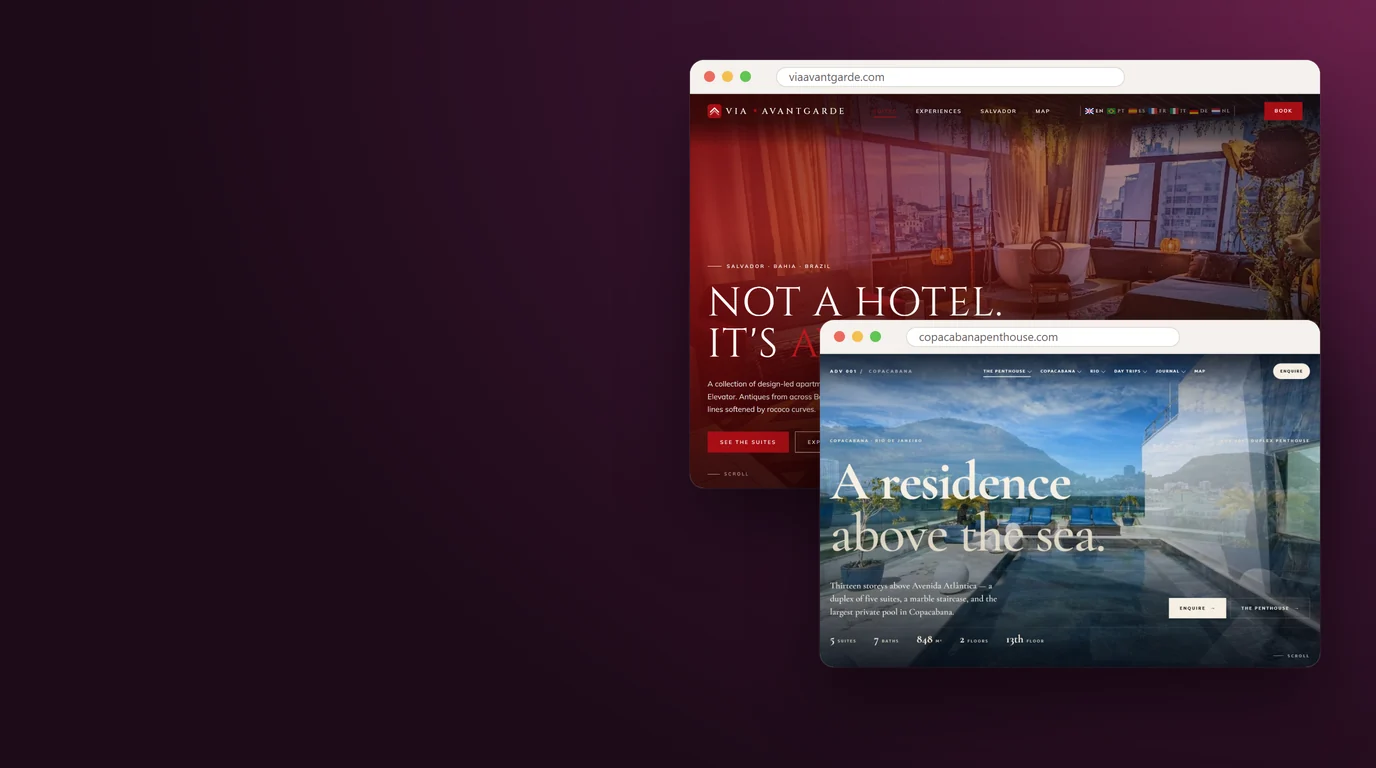
Language. An assistant replies in whatever language the traveler used, and it prefers sources in that language when good ones exist. A traveler in Tokyo planning a week in Rio will usually ask in Japanese. Lux Vidigal, an apartment with an ocean view in the Vidigal neighborhood of Rio de Janeiro, publishes its site in ten languages, Japanese and Chinese among them, so that question has a page written for the person asking it. Via Avantgarde, four apartments with a strong design style beside the Lacerda Elevator in Salvador's old town, does the same in eight languages. A listing translated by a platform's software is a poor substitute: the owner usually didn't write it, few owners check it, and a listing has little room for the local detail a traveler from another country needs.
Season. The same home is a different trip in January than in July, and travelers ask about the version they want. Adirondack Mountain Bungalows' winter page walks through December to March at the cabins: how much snow falls, how short the days get, when the lakes ice over, which places shut for the season, and the winter dates worth planning around. It also says winter stays account for over a third of the cabins' reviews, which tells a reader something no photo can. Sedona Pickler goes the other way with a set of pages on beating the summer heat, written for people in Phoenix wondering whether Sedona is cooler.
Guests you haven't met yet. Every rental has a few groups of travelers it suits perfectly and rarely hears from. The Cerulean has pages for family offices and for guests arriving by private plane. Libema has pages for patients' families staying near the hospitals, contractor crews, and students and interns. Those pages bring in people who'd never have searched for a vacation rental at all, and they let an assistant suggest the home to them.
Each of these is a page an assistant can match to a question that would otherwise go to someone else. None of them is possible on a listing, and none of them fits on a five-page site.
What the Website Earns on Its Own
So far this guide has been about visibility. The money side is more familiar, but it's worth stating plainly, because it's what pays for the work.
The platforms' cut has grown. On Airbnb's single service fee, which its help center says most hosts now pay, about 15.5% of each booking goes to Airbnb; hosts who remain on the older split fee pay about 3%, and their guests add a fee of 14.1% to 16.5%. Vrbo's flat 12% commission, which starts on October 29, 2026, replaced rates of 5% for managers connected through software and 8% for other hosts. When a guest reserves on your site instead, you keep that share, minus card processing and your booking software's cost. Guests whose first stay was booked direct, and the friends they send, are the most likely to book this way, and the website is where they find you again.
Direct guests also bring something the platforms keep to themselves: the relationship. You know who they are, you can thank them properly and you can invite them back. The São Conrado villa's site in Rio puts the headline facts in one row under the title: five suites, six bathrooms, room for up to twelve guests and a one-night minimum. Its inquiry button goes straight to the villa's own team.
One rule to keep in mind: the platforms' terms limit what you can do with guests who booked through them, so build your direct business from people who discover your website, your social profiles or your brand independently. Our plan for direct bookings in 2027 shows how to grow that list without breaking platform terms.
The calculator below shows what a share of direct bookings is worth after the cost of the site. Swap in your own numbers.
What Your Own Site Keeps
Rough math for one home. Nothing you type leaves this page.
Example inputs. The two fee rates were read on the Airbnb and Vrbo help centers in late October 2026, and your own account shows your exact rate. Booking software fees and taxes aren't included.
For the full model, with booking software and marketing costs, use our direct booking calculator.
Your Website Plan for 2027
If your site is thin, out of date or missing, this is the sequence I'd follow. Most owners can get through the first five steps in a month and keep the rest going with a couple of hours each week.
- Own the address. Put the domain in your name, set it to renew automatically and keep the login somewhere you'll find it in three years.
- Write the reference pages. Who runs the business, each home with its true facts, the house rules, the policies, how to reach you, and your reviews. These are the pages every other source gets checked against.
- Make the facts match. Go through every listing and profile and bring them in line with the site. From now on, the site changes first.
- Let the right crawlers in. Check your robots file and your host's bot settings so Googlebot, Bingbot, OAI-SearchBot and PerplexityBot can read the site. OpenAI says a site that shuts out its search crawler is left out of ChatGPT's search answers.
- Tie the profiles together. Link to your listings and social profiles from the site, link back to the site from each one where the platform allows it, and list them in your Organization markup.
- Add depth, one question at a time. Start with the questions guests already send you, then the travelers you'd like to host more often, then the seasons. Write each page to pass the scorecard above.
- Earn mentions. Local press, the tourism board, event organizers and partner businesses. Each one that names you and links to you is a vote for your version of the facts.
- Measure. Watch Google's Search Console and Bing's Webmaster Tools; Bing added a report in 2026 on how often your pages are cited in AI answers. In your analytics, look for visitors arriving from chatgpt.com, perplexity.ai and copilot.microsoft.com.
- Review each season. Rates, events, opening hours and rules change. A page with a fresh date and correct facts keeps its place; a stale one loses it.
The Cerulean's guide library shows where steady work leads. It now holds 44 field guides to St. Croix's beaches, forts, food and trip logistics, each one on a single subject and checked against original sources.
Website Plan for 2027
Tick off each step as you finish it. Your progress is saved on this device only.
- The reference copy
- Consistency
- Depth and proof
- Upkeep
Does a website still matter in 2027? More than it did five years ago, for a reason that has little to do with visits. It's the one record of your business that you control, and the machines that now do so much of the research start there. Build it as the reference copy, make it deep, keep it accurate, and give the rest of the web something to agree with.
If you'd like help, Cavmir builds and maintains websites like the ones in this guide. See the case studies for the full stories behind them, or our website design service for what a build includes.
Sources
The figures, rules and policies quoted above trace to the documents below, each opened on October 29, 2026. Client sites are described as they appeared live that day, and the calculator numbers are examples.
- Google's guidance for site owners on AI Overviews and AI Mode, revised December 10, 2025
- Google's May 20, 2025 announcement of AI Mode's wider rollout, by Elizabeth Reid
- Sundar Pichai's I/O keynote remarks, May 19, 2026, with AI Overviews and AI Mode user counts
- Alphabet's third-quarter 2026 earnings remarks, October 28, 2026, on the length of AI Mode queries
- TechCrunch's DevDay 2026 report of September 29, 2026, with OpenAI's weekly ChatGPT user figure
- Phocuswright's March 26, 2026 release on U.S. travelers using AI, as reprinted by Travel Professional News
- Pew Research Center's July 22, 2025 analysis of clicks on Google pages with and without AI summaries
- Skift's June 17, 2026 report on Adobe's figures for AI-referred traffic to U.S. travel sites
- OpenAI's documentation of its crawlers, including OAI-SearchBot and GPTBot
- Perplexity's documentation of PerplexityBot and its other agents
- Google's reference for Organization structured data and the sameAs property, revised September 8, 2026
- Google's self-assessment questions for people-first content, revised October 5, 2026
- Google's Search Quality Rater Guidelines (PDF), the handbook for its human search raters, including the section on researching a site's reputation
- Ahrefs' May 26, 2025 correlation study of brand visibility in AI Overviews across 75,000 brands
- Google's web search spam policies, including scaled content abuse, revised August 28, 2026
- Google's March 5, 2024 post on its core update, with the April 26, 2024 result note
- Google's crawl budget guide for very large sites, revised July 22, 2026
- Google's February 8, 2023 statement on AI-assisted content in Search
- Google's guidance on publishing generative AI content, revised October 1, 2026
- Microsoft Bing's May 6, 2026 post on how its index grounds AI answers and handles conflicting sources
- Microsoft Bing's February 10, 2026 launch note for the citation report in its webmaster tools
- Google's eligibility rules for Business Profiles, listing vacation homes as ineligible
- Airbnb's robots file as served on October 29, 2026
- Vrbo's robots file as served on October 29, 2026
- Airbnb's help article 2799 on keeping links, messages and payments on the platform
- Airbnb's help article 1857 on host and guest service fees
- Vrbo's help article on its pay-per-booking commission
- Skift's September 29, 2026 report on Vrbo's move to a flat 12% commission
- The FTC's November 2024 questions and answers on its rule against fake reviews and testimonials