


.jpg)


Two states
Missouri and Kansas
Kansas City, Missouri and Kansas City, Kansas are different cities with different rules. Say which one you are in, in the first line, every time.

Expert short-term rental marketing to grow your bookings and nightly rate in Kansas City, Missouri, USA.
* Market averages. Properties marketed by Cavmir typically exceed these figures by 25–45%. Data sourced from AirDNA, STR market reports, and Cavmir internal analytics.
Kansas City is two states, one name and a great deal of confusion for anyone booking from out of town. The Missouri side is the older and larger one, and it is the city people mean when they say Kansas City without qualifying it. It grew on the bend where the Kansas River meets the Missouri, made its money in stockyards and railroads, and then spent the twentieth century producing an amount of culture wildly out of proportion to its size. Kansas City jazz came out of the clubs around 18th and Vine under a city administration that simply declined to enforce Prohibition, and Charlie Parker grew up in it. The barbecue tradition here is its own argument, conducted daily and in public. The Country Club Plaza opened in 1922 as one of the first shopping districts in the world designed around the car, and its Spanish towers still light up the week of Thanksgiving. For an owner, Kansas City offers something rare: a genuine big-city calendar, two major league teams, a purpose-built women's football stadium, a convention trade and a World Cup on its recent record, attached to Midwestern property prices. The catch is that the city has thought carefully about who is allowed to run a short-term rental, and the answer depends heavily on whether you live here.
Registration is required for any rental period of fewer than 30 consecutive days, and it applies to resident and non-resident owners alike. The standard annual fee is $200, it expires after twelve months, and applications go through CompassKC. Then the structural rule that decides most investment questions in this city: non-resident short-term rentals are prohibited in residentially zoned areas and may operate only in commercially zoned areas, and there may not be another non-resident short-term rental within 1,000 feet of a single-family home or duplex. If you do live here, you register as a resident and must occupy the home as your primary residence at least 270 days a year. Unregistered operation draws fines reported at $200 to $1,000, with each day treated as a separate violation. There is precedent worth knowing about: for the 2026 FIFA World Cup the city opened a $50 limited-term permit covering 3 May to 31 July 2026, the maximum ninety-day period the code allows. The tournament itself ran from 11 June to 19 July 2026, so that window has closed, but it tells you how the city responds to a genuine surge. On tax, the city applies a 7.5% transient boarding and accommodation tax to short-term rentals plus an occupancy fee of $3.00 per night per unit.
Nearby Markets: Branson | Lake of the Ozarks | Omaha
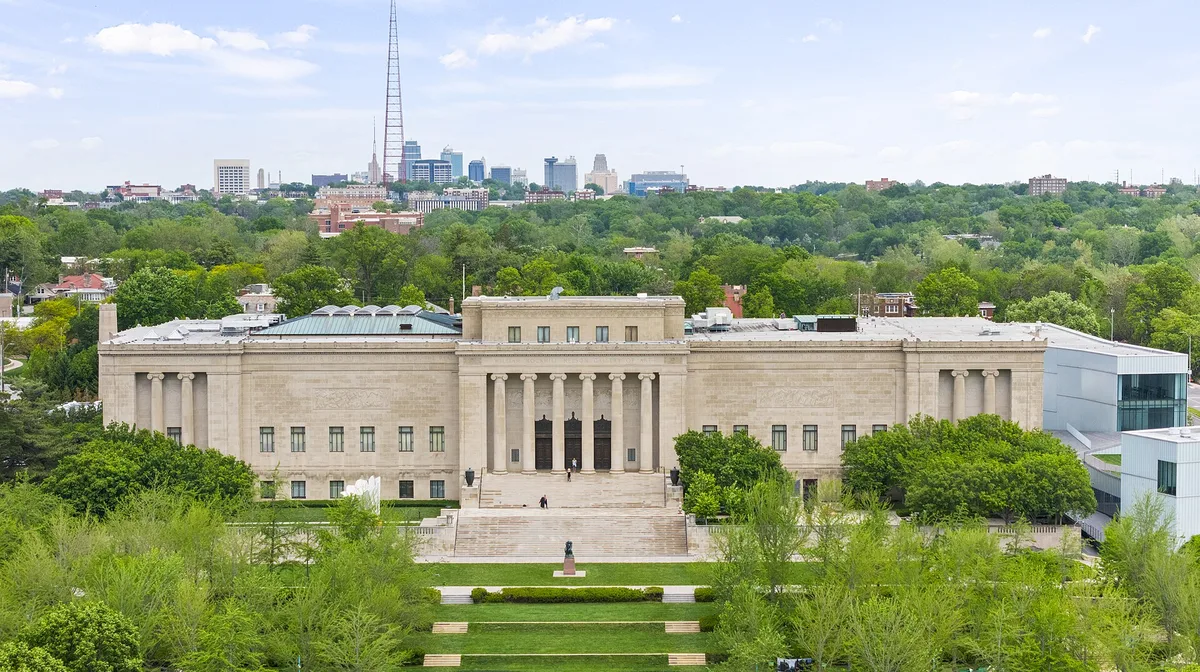
A few of the visual fingerprints we lean into when we shoot, brand and market a Kansas City Missouri skyline property — courtesy of the open Wikimedia Commons archive.
Cavmir markets Kansas City properties around the fact that this city's demand arrives in identifiable, plannable waves, and almost nobody prices or writes for them. A Chiefs Sunday, a Royals homestand, a Current match at CPKC Stadium, a Big 12 tournament week, a First Friday in the Crossroads and a convention at Bartle Hall are six different guests with six different lead times, and a listing written for all of them speaks clearly to none. We start by working out which of those your property is actually well placed for, because a two-bedroom in the Crossroads and a house in Brookside are not competing for the same booking. We photograph in a way that answers the practical questions a visitor to this city has, which are parking, the streetcar, and how far you really are from the thing you came for. We write the listing so your zoning status and registration are stated plainly rather than buried, because in a market where the rules turn on residency, a guest and a future buyer both benefit from clarity. Then we build the direct booking site, run local SEO against neighbourhood and event searches, place ads against the sports and convention calendars, and keep an email list segmented by the reason someone came the first time. We help position and market your property. We never manage it or touch your keys.
Kansas City grew where the Kansas River runs into the Missouri, at a landing that served wagon trains heading west on the Santa Fe, Oregon and California trails. The railroads arrived after the Civil War, the stockyards followed, and by the turn of the century this was one of the great livestock and grain markets of the continent. The money that came out of that built a city with unusual ambitions. J.C. Nichols laid out the Country Club Plaza in 1922 as one of the first shopping districts in the world designed for people arriving by car, with Spanish towers and fountains, and the surrounding residential districts were planned with the same deliberateness. The city acquired so many fountains along the way that it now claims second place worldwide behind Rome, a claim it makes cheerfully and without much interest in verification. The most consequential chapter came in the 1920s and 1930s. Under a political machine that simply declined to enforce Prohibition, the clubs around 18th and Vine ran all night, and out of that came Kansas City jazz: Count Basie's band, Mary Lou Williams, Lester Young, and a teenager named Charlie Parker who reworked what a saxophone could do. The same district housed the Negro Leagues, and the Kansas City Monarchs sent more players to the major leagues than any other team in that history. Both stories are now told in museums on the same corner. Meanwhile the barbecue tradition, brought together in the early twentieth century and argued over ever since, became the city's other export. Modern Kansas City is a metropolitan area of roughly two and a half million across two states, with a downtown that has genuinely come back, a free streetcar, a purpose-built stadium for the Current, and a run of major events on its record that includes a World Cup. For an owner the relevant history is simple: this city has been in the business of hosting people arriving from somewhere else since it was a river landing.
Kansas City rewards event-aware pricing more than almost anything else, because the events are large, dated well in advance, and visible to anyone who looks. Build a calendar at the start of the year with the Chiefs home schedule, the Royals homestand pattern, the Current's home matches, the Big 12 tournament, the largest conventions at Bartle Hall and the college graduations, then set your rates against it before the season opens rather than reacting when the searches arrive. Those dates carry a genuine premium and guests book them early, so a property still sitting at its base rate in March for an October weekend is giving money away. Between the peaks, this is a steady midweek business market with a solid weekend leisure layer, and the right approach there is length rather than discount: a three-night midweek rate that is genuinely worth taking will beat the same nights individually discounted. Remember that the guest here is paying more than the headline rate, because the city applies a 7.5% transient boarding and accommodation tax plus $3.00 per night per unit, and the fixed nightly fee bites hardest at the bottom of the market. If you are running a lower-priced unit, that $3 is a larger share of the total than it looks, and it is worth being straightforward about the all-in number rather than surprising people at checkout. Neighbourhood matters enormously to what you can charge: the Crossroads, the Plaza, Westport and River Market command different rates from Brookside or Waldo, and they attract different stays.
The calendar here is driven by sport, conventions and the school year far more than by weather. Autumn is the strongest run, with football, the convention season and pleasant conditions arriving together. Spring is close behind on the back of baseball opening, graduations and tournament weeks. Summer is warm and humid, the business travel thins, and family and road-trip visits take over, so the total holds up but the mix changes. Winter is the quiet stretch except for the Plaza Lights, which switch on at Thanksgiving and pull a genuine holiday trade through December, and any January football that goes deep into the postseason, which in this city is not a remote possibility.
Kansas City regulates short-term rentals through registration, and the rule that decides most investment questions is about where you live. Registration is required for any rental of fewer than 30 consecutive days, and it applies to resident and non-resident owners alike. The standard annual fee is $200, the registration expires after twelve months, and applications are made through CompassKC. From there the two tracks diverge sharply. If you are a resident registrant, you must occupy the home as your primary residence at least 270 days a year. If you are a non-resident owner, short-term rentals are prohibited in residentially zoned areas altogether and may operate only in commercially zoned areas, and there may not be another non-resident short-term rental within 1,000 feet of a single-family home or duplex. In practice that means the non-resident investment map in this city is a zoning map, and it is much smaller than the city. Anyone buying here as an out-of-town investor needs to confirm the zoning classification of the specific parcel and the 1,000-foot separation position before committing, not afterwards, because the difference between a commercially zoned block and the residential street behind it is the difference between a business and a violation. Enforcement is real: unregistered operation draws fines reported at $200 to $1,000, with each day of operation treated as a separate violation, which compounds quickly. There is one piece of useful precedent on the record. For the 2026 FIFA World Cup the city created a limited-term permit at $50 covering 3 May to 31 July 2026, the maximum ninety-day term the code allows, to accommodate the surge around matches at Arrowhead. The tournament ran from 11 June to 19 July 2026 and that window has closed, but it demonstrates that the city will open a temporary class for a genuine event of scale rather than simply absorbing the pressure. Confirm the current registration requirements, fees and zoning position with the City of Kansas City before you apply or advertise, since this framework has been amended more than once since it was adopted.
Work out which Kansas City you are selling before you write a word, because there are several and they do not overlap. A property downtown or in the Crossroads is selling walkability, the streetcar and being able to get to a game or a show without driving. A property near the Plaza is selling the Plaza, the museums and a different kind of weekend entirely. A house in Brookside or Waldo is selling a neighbourhood and space, usually to families and to people visiting relatives. Each of those needs its own photographs, its own first paragraph and its own set of search terms. The streetcar is worth naming explicitly if you are anywhere near it, because it is free, it runs the spine of downtown, and out-of-town guests do not know it exists unless you tell them. Second, treat barbecue as a service rather than a joke. Every visitor to this city has a barbecue plan and most of them are working from a list somebody gave them. A short, genuinely opinionated guide in the welcome material, with an honest note about which places close early and which have queues, produces more goodwill per sentence than anything else you can write. Third, be precise about parking and about which stadium is which, since Arrowhead and Kauffman sit side by side in the same complex and CPKC Stadium is somewhere else entirely. Fourth, if you are in a commercially zoned non-resident property, photograph it so it reads as a considered space rather than as a converted office, because that is the honest risk with the inventory the zoning rules push investors toward. Finally, build the email list around events. A guest who came for a Chiefs game will come again for a Chiefs game, and reaching them before the schedule is announced is worth more than any discount.
The regulatory position is the main one: if you do not live here, the residential city is closed to you, and the commercial zones where you may operate are a genuinely different property market with different buildings and different guests. The 270-day primary residence rule for resident registrants is strict and it is a real constraint on owners who travel. Enforcement with per-day fines means the cost of getting it wrong escalates fast. Beyond the rules, the market is competitive around the event calendar and thin between peaks, so an owner who only shows up for football weekends will find the rest of the year hard work. Winter is genuinely quiet outside the holiday stretch, and weather-driven cancellations around January football are a recurring operational annoyance.
Cover a Kansas City short-term rental with a purpose-written short-term rental policy or a landlord policy carrying an explicit short-term rental endorsement. A standard homeowner's policy will generally not respond to a claim arising from paid guest occupancy, and finding that out at claim time is expensive. Ask about liability limits, loss of income cover and whether guest belongings are included. If you are operating in a commercially zoned property as a non-resident, tell the insurer that plainly, because the classification of the building affects both the rating and what the policy will respond to. Missouri weather is a real underwriting factor: this is a hail and severe storm state, so check the wind and hail deductible and whether it is expressed as a flat amount or as a percentage of the insured value. Also confirm how the policy treats freeze and burst pipe damage, which is the most common winter claim here. Platform host protection is a supplement, not a substitute. If there is a mortgage on the property, tell the lender how it is being used.
Kansas City applies a transient boarding and accommodation tax to short-term rentals at 7.5% of gross receipts, together with an occupancy fee of $3.00 per night per rented room or unit. Both were approved by voters and took effect in 2023, and they are administered by the City's Finance Department, which publishes a tax guide specifically for short-term rentals. Missouri state and local sales taxes also apply to accommodation, and there may be additional local charges depending on the address, so confirm the full stack with the City and with the Missouri Department of Revenue before you publish a total. Registration for tax is separate from your short-term rental registration, and holding one does not create the other. Platforms may collect and remit part of what is due, and the $3 per night fee in particular is the sort of charge that is easy to assume somebody else is handling, so ask your platform explicitly which lines it files and file the remainder yourself. Because the fee is fixed per night rather than proportional, it weighs more heavily on lower-priced units. Ask your accountant how the income should be treated federally and for Missouri purposes.
Financing here is more conventional than in most short-term rental markets because the underlying property market is a normal metropolitan one rather than a resort. Conventional investment mortgages, portfolio loans and DSCR products are all available, and the price points mean the deposit required is manageable. The complication is regulatory rather than financial. A lender assessing a short-term rental in Kansas City will want to know whether the address may lawfully be operated as one, and for a non-resident buyer that means demonstrating commercial zoning and the 1,000-foot separation position rather than simply pointing at rental history. Have the zoning confirmation in the file before you go to underwriting. For resident buyers, the 270-day primary residence requirement generally aligns well with owner-occupier mortgage products, which can mean better terms than an investment loan, but read the occupancy covenant carefully to be sure that short-term letting of the home you live in is permitted by the loan as well as by the city. If you are buying an operating property, present the income history as evidence of demand rather than as a transferable asset.
The registration framework is the thing to watch. Kansas City has amended its short-term rental rules more than once, the World Cup permit class showed the city is willing to create temporary categories when the demand case is strong enough, and the pressure from both the housing side and the tourism side is constant. Any movement on the non-resident zoning prohibition or on the 270-day residency threshold would materially change what this market is, so track the council agenda rather than waiting for coverage. On the demand side, the direction of travel is good. Downtown has kept redeveloping, the streetcar has been extending, CPKC Stadium has given the city a genuinely distinctive draw as the first stadium purpose-built for a women's professional team, and the run of major events the city has now hosted has done a great deal for its reputation with travellers who had never considered it. That reputational shift is the opportunity: visitors who came once for an event and were surprised by the city are exactly the audience a direct booking site and an email list are built to capture, and most owners here are still handing that relationship to a platform.
Kansas City is a city that argues with itself in public about barbecue and is entirely right to. It has jazz that came out of clubs at 18th and Vine under a city government that could not be bothered to enforce Prohibition, and it has a museum on that corner sitting next to another one about the Negro Leagues, which between them tell more American history in two rooms than most cities manage in a decade. It has the Nelson-Atkins, which is free, and a lawn in front of it with four enormous shuttlecocks on it, which is the sort of decision a confident city makes. It has the Plaza, built in 1922 for people arriving by car, with Spanish towers that light up the week of Thanksgiving and stay lit through the winter. It has fountains everywhere, which it will tell you about. It has a stadium built specifically for a women's football team, the first of its kind, and it filled it. It has a free streetcar. And it has a genuine, unforced friendliness that visitors comment on constantly and residents do not seem to notice. What we like most, though, is that Kansas City consistently surprises people. Nobody arrives expecting much and almost everybody leaves planning to come back, which is the single best condition a short-term rental market can have, and almost nobody here is marketing to it deliberately.
A great property in Kansas City Missouri skyline doesn't just want a listing — it wants a point of view, an audience, and a brand the city itself would recognise.
Eight things to understand about Kansas City before you write listing copy, starting with the fact that half of it is in a different state and your guests do not know that.
Kansas City, Missouri and Kansas City, Kansas are different cities with different rules. Say which one you are in, in the first line, every time.
Galleries, restaurants and First Fridays. Walkable, on the streetcar, and the right base for guests who want to be out on foot.
The 1922 district with the Spanish towers, close to the Nelson-Atkins. A different weekend entirely from downtown and worth selling as one.
The American Jazz Museum and the Negro Leagues Baseball Museum on the same corner. Essential context for any guest asking what to do.
The City Market, the Arabia Steamboat Museum and the north end of the streetcar line. Good for morning walks and weekend markets.
Residential, leafy, family-friendly. This is where visiting relatives and longer family stays are comfortable.
Arrowhead and Kauffman share the Truman Sports Complex east of the city. CPKC Stadium is downtown by the river. Never conflate them.
It runs the downtown spine at no charge. Out-of-town guests will not discover it unless your welcome material tells them.
The three examples below are composite and illustrative. They reflect patterns we see repeatedly in event-driven metropolitan markets, and they are not descriptions of particular businesses or particular clients.
A well-located apartment was priced flat all year and filling reliably on ordinary weekends while selling out months early, at the same rate, for football Sundays and major conventions. The owner was fully booked and quietly underpaid.
We built an annual calendar from the published sports, convention and university schedules, set tiered event pricing and minimum stays against it before the season opened, and rewrote the listing to speak to the event guest specifically, including honest walking times and streetcar directions.
Event dates sold at a substantial premium rather than at the base rate, overall occupancy held, and the owner stopped discovering after the fact that a sold-out weekend had been the city's busiest of the year.
An out-of-state owner operating lawfully in a commercial zone had a property that photographed as an office conversion, attracted price-led bookings, and generated recurring guest questions about whether the building was residential at all.
We restyled and reshot the interior so it read as a considered place to stay rather than as leftover commercial space, wrote copy that made a virtue of the location's proximity to the arena and convention centre, stated the compliance position plainly, and built a direct booking site around event traffic.
The property moved out of the price-led tier, guest questions about the building largely disappeared, and event-driven direct bookings became a consistent share of the calendar.
A comfortable four-bedroom in a residential neighbourhood was being marketed on interiors and competing against downtown apartments it had no business competing with. Bookings were sporadic and the owner assumed the location was the problem.
We repositioned it entirely around the guests it was actually suited to, visiting families, graduation weekends and multi-generational trips, photographed the yard and the street as features, wrote the copy around space and quiet rather than nightlife, and targeted the university and family-visit calendars.
The property stopped losing comparisons it was never going to win, average party size and stay length both rose, and graduation and holiday weekends began booking well in advance at strong rates.
Demand in Kansas City peaks around September through October and runs quietest around January through February. Here is how the year actually books — and what to do about each stretch of the calendar.
Autumn is the strongest stretch of the year, with football, the convention season and good weather arriving together. Set rates against the published home schedule before the season opens rather than reacting to search demand in September. Minimum stays on football weekends are accepted here and worth applying.
Spring is a genuine second season on the back of baseball opening, graduations and tournament weeks, and it is consistently priced too low. Summer holds up on family travel and road trips even as business travel thins, so the mix changes rather than the volume. Both respond well to a three-night midweek offer rather than to nightly discounting.
Winter is the quiet stretch apart from two things: the Plaza Lights, which run from Thanksgiving through the holidays and pull a real December trade, and any January football that goes deep into the postseason. Use the rest of the winter for maintenance and for building the email list ahead of spring.
Football weekends and major conventions book months ahead, and the best dates are gone by the time most owners think about pricing them. General weekends fill a few weeks out. Winter outside the holiday period is close to last-minute.
Weekend-weighted, with two and three night stays dominating around the sports and event calendar. Midweek is softer and business-driven, and responds to length rather than to rate. Holiday weekends behave like peak regardless of season.
The right property depends entirely on which Kansas City you are selling. Downtown and Crossroads units win on walkability and the streetcar, Plaza-adjacent properties win on the museums and the shopping, and houses in Brookside or Waldo win on space for families. Trying to be all three produces a listing that persuades nobody.
Start with photography that shows what a guest actually gets here, then write the listing around a real itinerary rather than a feature list. Build a direct-booking site so returning guests can come back without going through a platform, and keep an email list segmented by season so you can reach last year's visitors before the calendar opens. Local search matters more than people expect in a market this size, because guests search the destination and the attraction rather than the word rental. A marketing agency layer handles the photography, the listing copy, the direct-booking site and the local SEO as one system instead of four disconnected jobs.
Autumn is the peak, with football, conventions and the best weather landing together, and spring runs a close second on baseball and graduations. Summer stays busy but the guest mix shifts from business to family travel. Winter is quiet apart from the Plaza Lights through December and any deep postseason football run.
The dates that matter most, football weekends and large conventions, book months in advance and are usually gone before owners get around to pricing them. Ordinary weekends fill a few weeks out, and winter is close to last-minute outside the holidays.
Largely a regional drive market from St Louis, Omaha, Wichita and Des Moines, with a flown-in layer arriving for football, conventions and the museums. Geo-targeting those drive corridors against specific event dates works far better than broad advertising.
Parking is the first thing most guests ask about, so off-street parking is worth more than almost any interior upgrade. Beyond that, fast wifi and a workspace serve the midweek business trade, and a full kitchen with laundry serves the families and groups who come for events.
Run your Airbnb, Vrbo, or website through Cavmir's free grader. It checks the things that decide whether guests book in Kansas City — photos, listing copy, page speed, local search — and shows you where bookings leak. Takes about a minute, and there's no sales call attached.
If the report says your booking engine is the weak link, that's fixable: a direct-booking website of your own means repeat guests stop paying platform fees to come back to you. That's the work Cavmir does — see Airbnb website design in Kansas City.
Send us the listing and we'll tell you what we'd change. Not a pitch deck — a straight read on your photos, your title, your rates against the Kansas City comp set, and whether a direct-booking site would pay for itself.
You'll hear back from a person, usually inside one business day. If we don't think we can move your numbers, we'll say so. Cavmir is a short-term rental marketing agency — we position and market properties, we don't manage them.
Talk to Cavmir today. We'll show you exactly what your Kansas City property is leaving on the table — and how fast we can change that.
Book a Free Strategy CallPhotography via Wikimedia Commons (images resized and cropped): Nelson-Atkins Museum of Art 2024 by Peterspexarth (CC BY 4.0) · Kauffman Center for Performing Arts 2 by Rex Hughes (CC BY-SA 4.0) · Kansas city (16778782291) by Dean Hochman (CC BY 2.0) · Netherlands vs Tunisia - 2026 FIFA World Cup, Kansas City by CNC33 (CC BY 4.0).
