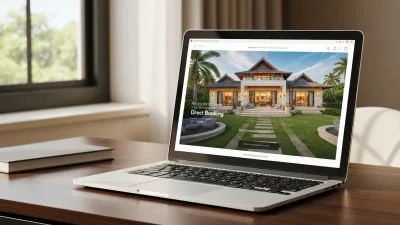
Elena restored a 1908 farmhouse outside Fredericksburg, Texas. Longleaf pine floors, a wraparound porch, a stock tank pool that photographs like a magazine spread. She spent nine months and real money on that restoration, and then she put it on a template site that cost her $23 a month and looked, in her own words, "like a nice dentist's office."
I want to be careful here, because Squarespace and Wix are good products. They are genuinely well-made software, and the people who built them are better at their craft than most of the internet gives them credit for. I've recommended them. I'll recommend them again in this article. This is not a hit piece.
But they were built to solve a specific problem — get a small business a decent-looking presence without a developer — and a vacation rental is a particular kind of business that runs into the edges of that problem faster than a bakery or a yoga studio does. Elena hit four of those edges in her first year. Knowing where the ceiling is before you build under it saves you the rebuild.
So: what these platforms do well, the six specific places lodging businesses hit the ceiling, and how to tell which side of it you're on.
What template platforms genuinely do well
Real credit first, because it matters for the decision.
The design floor is high. You cannot easily make something ugly on a modern template platform, and that is a genuine achievement. Type scales are sane, spacing is consistent, the mobile breakpoints work. Compare that to what a non-designer produced fifteen years ago and the gap is enormous.
They handle hosting, SSL, backups, and uptime so you never think about any of it. That's real value, and a category of problem most owners have no interest in owning.
The editing experience is good. Once the site exists, changing a photo or fixing a typo is genuinely easy, which matters because a site nobody can update goes stale.
And they're honest about what they are. Neither company markets itself as a lodging platform. The mismatch, when it happens, comes from us using a general tool for a specialized job — not from anyone overselling.
Ceiling one: the booking engine
This is the big one and it's structural, not a settings problem.
A vacation rental booking is not a product purchase. It's a date-range reservation against a shared calendar that also lives on Airbnb, Vrbo, Booking.com, and your property management system, all of which need to agree in something close to real time. Sell one week twice and you don't have a support ticket, you have a family in a rental car in your driveway.
Template platforms are built around product commerce and appointment scheduling. Those are different data models. Appointment scheduling handles a slot; lodging handles a range with minimum stays, changeover-day rules, seasonal pricing, gap-fill logic, and cancellation windows. You can approximate it — most owners end up embedding a third-party booking widget in an iframe — and that approximation carries three costs.
The embed usually looks nothing like the site around it, so the moment a guest reaches the most important step, the design credibility you paid for evaporates. Embedded widgets are frequently the slowest thing on the page, so your booking step is also your worst performance moment. And embedded content is generally invisible to search engines, which means your availability, your rates, and your unit detail contribute nothing to how you rank.
None of that means don't do it. It means know that you've bolted a critical system onto the side of a platform that wasn't designed to hold it, and budget for the friction.
Ceiling two: multi-property architecture
One property on a template platform is fine. Three is awkward. Eight is a maintenance problem that will eventually make you rebuild.
The reason is that template platforms don't really do structured content. A property in your business is a record with fields — bedrooms, sleeps, amenities, minimum stay, location, rate band, unit code — and what you want is one design that renders every property from its record, so updating your cancellation policy or adding an amenity happens once and appears everywhere correctly.
What template platforms give you is pages. Each property is a hand-built page, and every change is manual work multiplied by your unit count. Owners solve this the way people always solve it: they duplicate a page and edit it. Eighteen months later there are four different cancellation policies live on the site, two properties still list a hot tub that was removed, and nobody knows which page is canonical.
The SEO consequence is worse than the admin one. Duplicated pages produce near-identical content, which search engines are specifically built to filter out. Eight properties described in eight versions of the same paragraph is eight pages competing with each other, and the usual outcome is that none of them wins.
Ceiling three: the SEO controls you don't get
Template platforms give you the visible layer of SEO — a title, a description, a URL slug, an alt text field. Those matter. They're also about a quarter of what makes a lodging site rank.
What tends to be locked, awkward, or absent: control over the structured data the page emits, so search engines can't reliably tell they're looking at a lodging business in a specific place with specific amenities. Fine-grained canonical control when you do have similar pages. Control over how the platform generates and paginates archive or category pages, which is where duplicate-content problems usually originate. Server-level redirect management when you restructure. And control over what scripts load and in what order, which is where speed goes to die.
There's also a subtler limit: page architecture. Ranking in a lodging market means building pages that answer the queries people type — the market plus property type, the market plus amenity, the neighborhood, the drive time from the nearest city, the seasonal question. That's a content structure with dozens of interlinked pages and a deliberate internal linking pattern. It is technically possible to build that on a template platform. It's just that the tooling fights you at every step, and almost nobody finishes.
If your site isn't ranking today, the diagnosis walk-through is in why your vacation rental website doesn't show up on Google.
Open your site's homepage, view the page source, and search it for the word "LodgingBusiness" or "VacationRental." If it isn't there, search engines are guessing what kind of business you are from your prose. On a competitive market page, guessing is not good enough.
Ceiling four: performance
Template platforms carry weight. They ship a general-purpose framework that has to support every feature any customer might use, plus the builder's own runtime, plus whatever third-party embeds you've added. On a lodging site that usually means a booking widget, a review widget, a map, a photo gallery, and analytics — five separate scripts from five separate origins.
The result, consistently, is a site that's serviceable on a desktop with good wifi and slow on a phone with two bars. That's exactly backwards for this business, because a meaningful share of vacation rental traffic is someone on a phone, sometimes in a place with mediocre signal, deciding in a few seconds whether to keep going.
You can improve it — compress your images properly, cut widgets, use the platform's own gallery instead of an embed. You can't get past the framework itself, and the framework is usually the floor. The full argument for why this is a revenue issue rather than a technical vanity metric is in what a slow website costs you in bookings.
Ceiling five: the template tell
This is Elena's "nice dentist's office" problem, and it's the one owners feel first and articulate last.
Templates are designed to look good on average across thousands of businesses, which necessarily means they express nothing specific about any of them. Guests can't name what they're seeing, but they read it accurately: the site says this is a competent, ordinary business. For a dentist, ordinary is reassuring. For a restored 1908 farmhouse trying to hold a rate 40 percent above the market median, ordinary is the entire problem — because the rate is a claim about specialness, and the site is quietly contradicting it.
The gap between what Elena's property is and what her site said it was is the most expensive thing on this list, and it never shows up on an invoice. It shows up as a rate she couldn't defend and a booking window she couldn't extend.
Ceiling six: you're renting, not owning
The monthly fee feels like the affordable option, and for a while it is. Two structural facts are worth naming.
First, it doesn't stop. A subscription is a permanent operating expense that rises over time, and the total across five or seven years is usually well past what a one-time build costs — with the difference that at the end of the subscription you own nothing, and at the end of the build you own an asset. We ran the arithmetic properly in what a direct booking website actually costs.
Second, portability is limited. Your content is in a proprietary editor and your design is a proprietary template. You can export text and download images; you cannot take the site. When you outgrow the platform, you rebuild — which means the subscription years bought you time, not equity.
Add the ecosystem creep: the base plan, the commerce upgrade, the booking widget subscription, the review widget, the form tool, the email add-on. Owners routinely tell me they're on "the $23 plan" and then total up $90 to $150 a month once everything's counted. Total yours before you compare it to anything.
Example math only: $90 a month across all plan and add-on subscriptions is $1,080 a year, $5,400 across five years — and at the end you still don't own the site. Add up your own line items, including every widget, before deciding which option is the cheap one.

The fit test
Here's the honest sorting, which is what you actually came for.
| Your situation | Template platform | Professional build |
|---|---|---|
| One property, already booked solid, want a findable page | Right choice | Overkill |
| Testing a property or a concept you might exit | Right choice | Premature |
| One property, competitive market, chasing direct bookings | Workable with real effort | Usually pays back faster |
| Two to five units | Straining; duplication starts | Right choice |
| Six or more units | Maintenance problem | Right choice, clearly |
| Premium rate you need the brand to justify | Actively working against you | The reason to build |
| Real-time availability and PMS sync required | Embed with friction | Native integration |
| Ranking for market terms is the growth plan | Ceiling hits early | What the architecture is for |
| You are a designer or developer | Fine — you'll route around the limits | Your call |
The pattern: template platforms are excellent when the site's job is to exist and be pleasant. They strain when the site's job is to rank, convert, integrate, and carry a premium brand. Most owners start in the first category and quietly move to the second without noticing the platform didn't come with them.
You don't need a rebuild to test whether the site is the constraint. For one month, drive the same traffic to your site and to a competitor's you consider comparable, and compare what happens after arrival — time on page, whether people reach the booking step. If they leave your site faster, the problem isn't traffic, and more traffic won't fix it.
If you're staying put, do these five things
Plenty of owners on template platforms should stay there for now. Get the most out of it:
Compress every image before upload. Not after — before. Most owners upload straight from the camera roll, and that single habit is usually the largest share of a slow site. Aim for well under 300KB per photo at full width.
Give every property a genuinely distinct page. Not a duplicate with the bedroom count changed. Different opening paragraph, different specifics, different reason to choose it. If two of your properties can't be described differently, merge the pages.
Add real local content. Not "explore our charming town" — the actual wineries, the actual drive times, the actual month the wildflowers peak. This is what earns rankings and what AI assistants cite when someone asks where to stay in your market.
Fill in every SEO field the platform gives you, on every page. Titles and descriptions written for humans and containing the terms guests type. It's the quarter of SEO you do control.
Put the privacy policy, the cookie consent banner, and an accessible contact form in place. Compliance isn't optional because your platform didn't prompt you. Ask your attorney what applies to you — but do ask.
What we build instead
Cavmir builds property sites the way the business actually works, which is the short version of everything above.
Our direct booking website service is a one-time build you own outright. No monthly platform fee for the website itself — the difference between buying a building and renting a storefront, and worth understanding before you commit to a recurring charge attached to your own brand.
Every build is brand-matched rather than templated, so a restored 1908 farmhouse looks like a restored 1908 farmhouse and not like the demo it inherited. Booking is integrated with your property management system, so availability is real and double-booking isn't possible. SEO structure is architectural — market pages, property pages, and the internal linking between them, with lodging structured data emitted correctly. Speed and mobile performance are build requirements, not a later project. Privacy policy, cookie consent, and accessible markup come standard.
Multi-property is where the difference gets loudest: properties are records rendered by one design, so a policy change happens once and is correct everywhere, and every unit gets a genuinely distinct page instead of a duplicate.
Scopes run from a clean single-property launch through full portfolio builds with PMS-synced direct booking. Current pricing is published on our pricing page, and every engagement is quoted to your actual portfolio and market, with a written proposal back inside 48 hours.
Common questions
Can you take vacation rental bookings on Squarespace or Wix?
Not natively in the way lodging needs. Both platforms are built around product commerce and appointment scheduling, which are different data models from a date-range reservation with minimum stays, changeover rules, and seasonal pricing synced across multiple channels. The usual workaround is embedding a third-party booking widget, which works but carries three costs: it rarely matches your design, it is often the slowest element on the page, and its content is generally invisible to search engines.
Is Squarespace or Wix better for a vacation rental?
The differences matter less than most comparison articles suggest, because both hit the same lodging-specific ceilings. Squarespace tends to produce a more restrained default aesthetic; Wix offers more layout freedom and a larger app marketplace. For a single property that mainly needs to be findable, pick whichever editor you find less annoying. For anything more, the choice between them is not the decision that matters.
How many properties can I reasonably put on a template site?
One is comfortable. Two or three is workable. Beyond that it becomes a maintenance problem, because each property is a hand-built page rather than a record rendered by a shared design. Owners solve it by duplicating pages, and eighteen months later there are conflicting cancellation policies live on the site and near-identical pages competing with each other in search.
Is Squarespace good for SEO?
It handles the visible layer competently — titles, descriptions, URL slugs, alt text fields, an automatic sitemap. That is roughly a quarter of what makes a lodging site rank. What tends to be locked or awkward is the structured data your pages emit, fine-grained canonical control, script loading order, and the ability to build a deliberate multi-page architecture around the queries guests actually type. You can rank on a template platform. It is harder, and the ceiling arrives sooner.
Can I move my Squarespace or Wix site somewhere else later?
You can export your text content and download your images. You cannot take the site — the design is a proprietary template and the structure is proprietary to the editor. In practice, outgrowing the platform means rebuilding. That is worth knowing at the start, because it means the subscription years bought you time rather than equity.
What does a template site really cost per year?
Add every line, not just the plan. The base subscription, the commerce tier if you need it, the booking widget subscription, the review widget, the form tool, the email add-on. Owners who describe themselves as being on a low-cost plan frequently total ninety to a hundred and fifty dollars a month once everything is counted, and none of it accrues to an asset you own.
Should I start on a template platform and upgrade later?
For a single property you are still proving out, yes — that is a sensible, cheap way to begin. For a property or portfolio you already know you are keeping, starting on a platform you will predictably outgrow means paying twice: once for the subscription years and once for the eventual rebuild, plus the ranking migration in between.
The verdict
Squarespace and Wix are good software being asked, in this industry, to do a job slightly outside their design. For a single property that mostly needs to be findable by name, that's a fine ask and you should take the $23 plan and spend your money on photography instead.
For a property or portfolio that needs to rank in a competitive market, sync real availability, hold a premium rate, and stop paying commission on bookings it already earned — the platform will get you a decent-looking site and then stop, and the stopping point arrives sooner than most owners expect.
Elena's farmhouse is on a real site now. The stock tank pool is the first thing you see, each of the three sleeping arrangements has its own page, the booking calendar is live against her property management system, and she ranks on the first page for her market plus "historic farmhouse." Her rate went up in the spring and the booking window got longer, which is the outcome the restoration was supposed to buy her and the site had been quietly undercutting.
If you're wondering whether you've hit the ceiling, the fastest way to find out is to ask. Tell us the property, the market, and where your bookings come from now, and we'll send a scope and a number within 48 hours — start at the direct booking website service or tell us about the property.
Photography via Wikimedia Commons (hero, inline, in-article); licences as noted on each file page.