





Keeneland
Versailles Road, west of town
Spring meet in April, fall meet in October, plus the sales. Give the distance in minutes and warn guests about meet-day parking.

Expert short-term rental marketing to grow your bookings and nightly rate in Lexington, Kentucky, USA.
* Market averages. Properties marketed by Cavmir typically exceed these figures by 25–45%. Data sourced from AirDNA, STR market reports, and Cavmir internal analytics.
Lexington calls itself the Horse Capital of the World and, unusually for a civic slogan, the claim survives inspection. The city sits on the Inner Bluegrass, a shallow plateau underlain by limestone, and the standard local explanation is that the calcium working its way up through the soil into the pasture is what builds the bone that made this the place to breed a thoroughbred. Whether or not the geology deserves all the credit, the landscape it produced is genuinely singular: black plank fences running over low hills, avenues of trees leading to barns better built than most houses, and a working agricultural economy that happens to be beautiful. Keeneland, which opened in 1936, runs short meets in April and October and holds the sales that set world prices. Around all of that sits a real city of roughly three hundred thousand people, with the University of Kentucky, Rupp Arena and a basketball culture that is not a hobby. Bourbon has come back hard, and Lexington is now a base for touring distilleries in every direction. For an owner, the appeal is a market with two enormous demand peaks, a solid year-round university and business floor underneath them, and a rulebook that has recently become considerably more demanding.
Lexington-Fayette operates a Special Fees License through the Division of Revenue, renewed annually, reported at $200 for the first unit and $100 per additional unit, with renewals running through str.lexingtonky.gov. The general short-term rental regulations sit in the Zoning Ordinance at Section 3-13. The change that matters most is recent: on 5 December 2024 the Urban County Council approved density limits, effective 12 December 2024. Under them the city may deny a conditional use permit for an unhosted short-term rental in a residential neighbourhood if 2% of the homes within 1,000 feet are already short-term rentals, or if there is an existing short-term rental within 600 feet. Short-term rentals inside owner-occupied homes, and those in specified business zones, are exempt from the conditional use permit requirement. And the provision that catches buyers: short-term rental conditional use permits are not transferable. A buyer applies for their own, in a market where the density formula may have filled up since the seller was approved. That single sentence should be the first thing checked in any purchase here, before the inspection and before the appraisal, because it determines whether the property you are buying is the business you think you are buying.
Nearby Markets: Louisville | Red River Gorge | Lake Cumberland
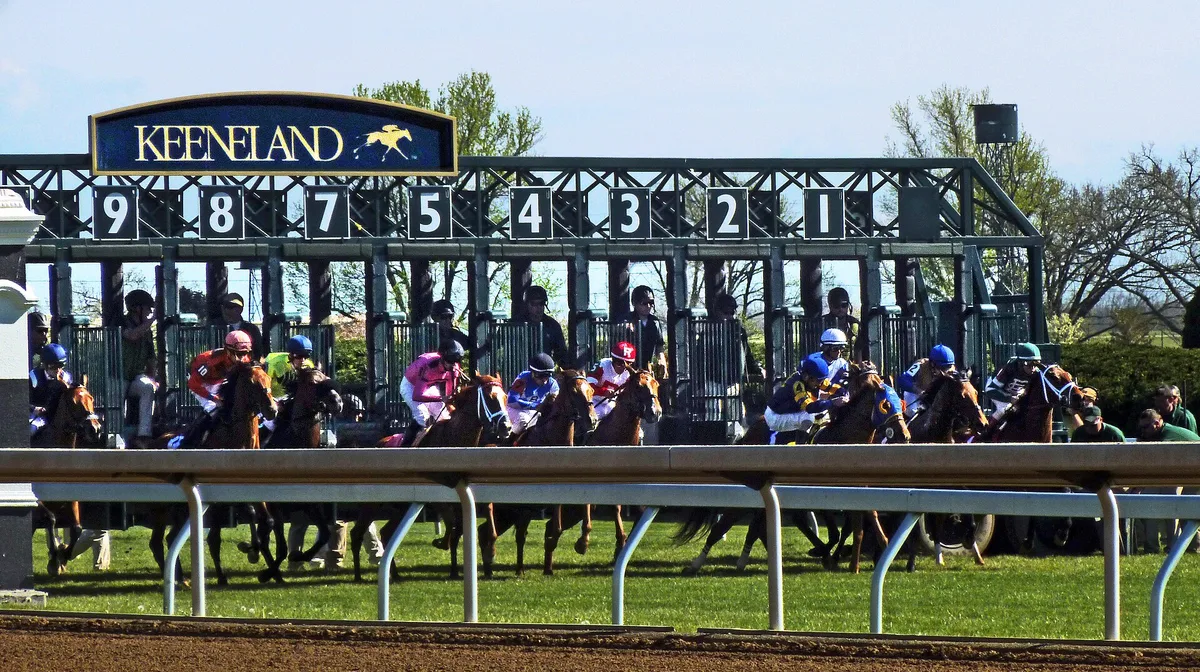
A few of the visual fingerprints we lean into when we shoot, brand and market a Keeneland Lexington property — courtesy of the open Wikimedia Commons archive.
Cavmir markets Lexington properties on the calendar, because this is a market with two weeks that matter enormously and a great many weeks that are quietly profitable if anyone bothers to sell them. Keeneland's spring and fall meets pull national and international visitors who book early and pay properly, and most owners here do a reasonable job of capturing that. Far fewer do anything at all with the sales weeks, the bourbon touring season, graduation, football Saturdays, the horse farm tour trade or the steady stream of visitors coming through the equine veterinary and bloodstock businesses that operate here all year. We photograph the property in a way that suits the guest who is actually coming, which for a farm-adjacent house means showing the setting and the drive, and for a downtown property means showing the walk to the restaurants and to Rupp. We write listings that answer the questions a first-time visitor to horse country genuinely has about tours, distances and what is bookable in advance. Then we build a direct booking site that states your permit position plainly, run local SEO against the meet and bourbon searches, place ads against the calendar, and keep an email list of repeat visitors, who in this market are unusually loyal. We help position and market your property. We never manage it or touch your keys.
Lexington was named in 1775 by a party of frontiersmen who heard about the battle at Lexington, Massachusetts, and decided the site should carry the name. It grew quickly, and for a while in the early republic it was the largest and wealthiest town west of the Allegheny Mountains, known as the Athens of the West. Transylvania University, founded in 1780, is still here and still claims the title of the oldest university west of the Alleghenies. Henry Clay lived and farmed here at Ashland, and his estate is open on Richmond Road. But the thing that made Lexington permanently distinctive was underneath it. The Inner Bluegrass sits on limestone, and the soil that limestone produces grows pasture unusually rich in calcium and phosphorus. Local tradition holds that this is why horses raised here develop the bone they do, and whether or not the geology deserves the full credit, the thoroughbred industry organised itself around this landscape and never left. The farms that resulted are among the most deliberately beautiful working agricultural properties anywhere: plank fences, mature trees, stone walls built by nineteenth-century masons, and barns constructed with more care than most houses. Keeneland opened in 1936, designed from the start as a place that would look and feel like a country meeting rather than a stadium, and it still runs short meets in April and October alongside sales that set international bloodstock prices. Meanwhile the University of Kentucky grew into the city's largest employer, and its basketball programme became a civic institution in its own right. Bourbon, which had been quietly declining for decades, came back with force in the 2000s, and Lexington positioned itself as the base for touring the distilleries scattered through the surrounding counties, while reviving its own distillery district along Manchester Street. What an owner inherits is a small city with two international-grade demand peaks, a durable university and medical floor beneath them, and a rulebook that changed significantly at the end of 2024.
Lexington is a two-peak market and the peaks are worth an enormous amount if you price them properly and almost nothing if you do not. Keeneland's spring meet in April and fall meet in October are the obvious ones, and they carry national and international visitors who book months ahead and expect to pay a meeting rate. Set those dates high, set them early, and set minimum stays, because they will fill regardless and a property still at its base rate in January for an October Saturday has simply given the money away. The under-exploited peaks are the ones most owners miss: the Keeneland sales weeks, which bring in a bloodstock trade that is if anything less price-sensitive than the racegoers; University of Kentucky graduation and move-in; home football Saturdays; and the bourbon touring season, which now runs a long shoulder from spring through late autumn. Between those, this is a steady university, medical and business town, and the right play midweek is length rather than discount. The tax position affects your headline number: Kentucky applies a 1% statewide transient room tax and the 6% state sales tax to short-term rental income, and a local transient room tax applies in Fayette County on top, so the guest's total is meaningfully above your nightly rate. Present the all-in figure honestly. On the horse-farm side, if your property has any genuine equestrian connection, that is a premium position and should be priced as one rather than treated as decoration.
Two months carry this market and everything else fills in around them. April is the spring meet and the beginning of the touring season, and October is the fall meet plus foliage plus football, which together make it the strongest stretch of the year. Late spring and early autumn shoulder well on the back of graduations, sales weeks and bourbon travel. Summer is warm and quieter on the racing side but holds up through family travel, the Horse Park and the distillery trade. Winter is the genuine off-season, softened by university basketball, which fills weekends from November through March and is the main reason the calendar does not collapse entirely between the meets.
Lexington's short-term rental rules changed materially at the end of 2024 and the change is about density. The licensing layer is straightforward enough: operators hold a Special Fees License through the Division of Revenue, renewed annually, reported at $200 for the first unit and $100 for each additional unit, with renewals handled through str.lexingtonky.gov. General short-term rental regulation sits in the Zoning Ordinance at Section 3-13. The substantive change came on 5 December 2024, when the Urban County Council approved density limits with effect from 12 December 2024. Under those limits the city may deny a conditional use permit for an unhosted short-term rental in a residential neighbourhood on either of two grounds: if 2% of the homes within 1,000 feet of the property are already short-term rentals, or if there is an existing short-term rental within 600 feet. In other words the cap here is not a citywide number that you can look up. It is a geometric test applied to your specific address, and the answer depends on what your neighbours are doing. Two categories sit outside the conditional use permit requirement: short-term rentals inside owner-occupied homes, and short-term rentals in specified business zones. If you live in the property, or if the property sits in the right commercial zoning, the density test does not gate you in the same way. Then the provision that catches buyers hardest: short-term rental conditional use permits are not transferable. A purchaser does not inherit the seller's permit. They apply for their own, under the rules as they stand on the day they apply, in a neighbourhood where the 2% and 600-foot tests may well have been satisfied by other properties since the seller was approved. That means an operating short-term rental in a residential Lexington neighbourhood is not straightforwardly a business you can buy. Verify the current density position for the specific parcel with the Division of Planning before you make an offer, and confirm the licensing requirements and fees with the Division of Revenue before you apply or advertise.
Sell the meet, but do not only sell the meet. The owners who do well here are the ones who have worked out what to say in June and January, and the answer is almost always horses in some other form. The Kentucky Horse Park runs an event calendar most of the year, the farms run tours, the equine veterinary and bloodstock businesses bring professional visitors continuously, and the bourbon trail is a full season in its own right that has nothing to do with racing. Write those into the listing and the welcome material as first-class reasons to come, not as filler. Second, be specific and accurate about what a visitor can actually do at a horse farm, because this is the single biggest expectation gap in the market. Working farms are not open to the public on a whim; tours must be booked, and a guest who assumes they can drive up a private lane and look at a stallion will have a bad afternoon. A short, honest paragraph about which tours to book and how far ahead is worth more than any amount of scenery in the photographs. Third, if you are anywhere near Keeneland, say the distance in minutes and mention the parking situation on meet days, because that is the practical question every racegoer has. Fourth, treat bourbon guests as a distinct segment with distinct needs: they are driving between distilleries, they need a designated-driver plan, and a genuinely useful route suggestion in the welcome book gets remembered. Fifth, and most importantly for anyone buying, put the permit position in writing early. In a market where permits do not transfer and the density test is live, an owner who can show a clean, current licensing position has an asset that is easier to sell and easier to finance than one who cannot.
The permit regime is the hard part. The density test means your ability to operate depends on decisions your neighbours made, the non-transferability means a purchase carries genuine regulatory risk, and both together make residential investment here considerably less predictable than it was before December 2024. The calendar is the other challenge: two enormous peaks and a long quiet winter mean cash flow is uneven, and an owner who budgets from April revenue will have a difficult February. Competition around the meets is intense and rates get tested. And the horse-country expectation gap generates disappointed reviews for owners who oversell access to a landscape that is mostly private working farmland.
Insure a Lexington short-term rental on a policy written for paid occupancy, either a dedicated short-term rental product or a landlord policy with a short-term rental endorsement, and get the confirmation in writing. Standard homeowner's cover will generally decline a claim arising from a paying guest. Ask about liability limits, loss of income cover and guest property. Two local points are worth raising with the underwriter. If the property is on or adjacent to a farm, or if guests will have any contact at all with horses, fencing or agricultural equipment, say so explicitly, because equine liability is a distinct exposure and Kentucky has specific statutory provisions about assumption of risk in equine activities that your insurer will want to consider. Second, this is a region with real severe weather, including damaging wind and hail and occasional tornadoes, so check the wind and hail deductible and whether it is a flat sum or a percentage of insured value. Confirm the position on freeze and burst pipe damage as well. Platform host protection supplements a policy rather than replacing it. Tell your lender how the property is used.
Kentucky applies a statewide transient room tax of 1% of rent on every occupancy, and the 6% state sales tax applies to short-term rental income in addition to it. Under House Bill 8, effective from 1 January 2023, accommodation intermediaries and platforms are required to collect the room tax on the total charges for the rental, which shifted a good deal of the collection burden onto Airbnb and similar services; stays of thirty or more consecutive days fall outside the tax. On top of the state layer, a local transient room tax applies in Lexington-Fayette and is collected for the benefit of the local tourism and convention effort. Published figures for that local rate vary between sources, so confirm the current rate directly with the Lexington-Fayette Urban County Government Division of Revenue and with VisitLEX rather than relying on a guide, and do not print a combined percentage until you have. Where a hosting platform charges and collects the rent, the platform is generally responsible for collecting and remitting the local tax; where it does not, the licensee is. Registration for tax is separate from your Special Fees License. Ask your accountant how the income is treated federally and for Kentucky purposes.
Financing in Lexington is complicated less by the property market, which is a normal and reasonably priced one, than by the permit regime. A lender assessing an unhosted short-term rental in a residential neighbourhood is being asked to underwrite income that depends on a conditional use permit which does not transfer with the sale and which may be refused under the density tests. Experienced local lenders understand this; national DSCR desks working from a spreadsheet often do not, and the deal falls over late. Deal with it at the front: obtain the density position for the parcel from the Division of Planning, and be clear with the lender about whether the income case rests on an unhosted permit you must obtain, on an owner-occupied arrangement that is exempt, or on a business-zoned address. Properties in the exempt categories are materially easier to finance for exactly that reason. Conventional investment mortgages are available at ordinary terms for buyers whose position is clean, and owner-occupier products may suit a hosted arrangement, though the loan's occupancy covenant needs reading alongside the city's rules. Where the property has a genuine equestrian or agricultural component, expect the appraisal to take longer and to require a valuer who understands farm property.
The density limits adopted in December 2024 are the thing to watch, for the simple reason that they are self-tightening. Every new unhosted permit granted in a residential neighbourhood makes the 2% and 600-foot tests harder to satisfy for the next applicant in that area, so the practical availability of new permits contracts over time without the council needing to do anything further. Anyone modelling a purchase should assume the residential door narrows rather than widens. Watch the Urban County Council for amendments, and watch how the Division of Planning applies the tests in practice, because early decisions will set the pattern. On the demand side the outlook is strong. Bourbon tourism has been growing for two decades and shows no obvious ceiling, the equine industry remains an internationally significant business rather than a heritage attraction, Keeneland's meets and sales continue to draw a global audience, and the university anchors the rest of the calendar. The strategic implication is clear enough: in a market where the right to operate is becoming scarcer, the value of owning the guest relationship directly, through your own booking site and your own email list, rises considerably. The owners who build that now will be the ones with a defensible business when new permits are genuinely hard to come by.
There is a stretch of road north of Lexington, out toward Paris and Georgetown, where the plank fences run over the hills for miles and the barns are better built than most people's houses, and it is one of the genuinely great landscapes in the country. It is also a working agricultural district, which is what makes it interesting rather than merely pretty. Keeneland is the other thing. It opened in 1936 with the deliberate intention of not becoming a stadium, and it still runs two short meets a year in April and October where the paddock is under trees and the whole thing feels like a country meeting that happens to set world bloodstock prices. Beyond the horses there is a real city: Transylvania University, founded in 1780 and still going, Henry Clay's estate on Richmond Road, a basketball culture that is closer to a civic religion than a pastime, and a distillery district along Manchester Street in buildings that used to be something else. The bourbon is everywhere now and it has been very good for the town. What we like most about Lexington is the limestone underneath all of it, quietly putting calcium into the grass, which is the local explanation for why the horses turn out the way they do. Whether or not the geology deserves the credit, it is a lovely thing for a city to believe about itself.
A great property in Keeneland Lexington doesn't just want a listing — it wants a point of view, an audience, and a brand the city itself would recognise.
Eight things worth knowing about Lexington before you write listing copy, starting with the fact that horse country is private working farmland and your guests will assume otherwise.
Spring meet in April, fall meet in October, plus the sales. Give the distance in minutes and warn guests about meet-day parking.
Open most of the year with its own event calendar, and where Man o' War is buried. The reliable horse answer outside meet weeks.
Bars, restaurants and distilleries in reused industrial buildings, walkable from downtown. The evening answer for bourbon guests.
Restaurants, the arena and the university within walking distance. Basketball weekends fill this from November to March.
Tours must be booked in advance and lanes are not public. Say this plainly and you will prevent your most common bad review.
Distilleries are scattered across surrounding counties. Guests are driving between them and need a designated-driver plan.
Graduation, move-in and football Saturdays are real peaks that most owners underprice compared with the meets.
Conditional use permits for unhosted rentals do not pass to a buyer, and density tests apply. Verify before making an offer.
The three examples below are composite and illustrative. They are drawn from patterns common to two-peak destination markets, and they are not accounts of any specific business or client.
A handsome property with genuine horse-country views was priced high for the two Keeneland meets and then sat largely empty for the rest of the year, while its reviews included repeated disappointment from guests who had expected to be able to visit the farms nearby.
We rebuilt the year around the demand that exists outside the meets: the Horse Park calendar, bourbon touring, sales weeks and the equine professional trade. We wrote an honest, specific section about what visitors can and cannot do on working farms and which tours to book ahead, and set shoulder-season rates that were attractive without undercutting the meets.
The quiet months began producing real bookings rather than occasional ones, the expectation-gap reviews stopped, and the property's annual revenue became far less dependent on two short weeks.
A well-placed apartment was marketed almost entirely on Keeneland and left money on the table for the entire basketball season, which fills the same blocks from November through March.
We built pricing and copy for the basketball calendar as a first-class season rather than an afterthought, reshot to show the walk to the arena and the restaurants, and set event rates against the published home schedule months in advance rather than reacting to search demand.
Winter, previously the weakest stretch, became a reliable second season, and the property stopped depending on two April and October weeks to make its year.
A purchaser was under contract on a residential property that had been operating successfully as an unhosted short-term rental, on the assumption that the permitted use came with the house.
We flagged that conditional use permits in this market are not transferable and that the density tests are applied to the address at the time of application, set out what needed to be confirmed with the Division of Planning before closing, and rebuilt the marketing plan around the two positions that are exempt from the conditional use requirement.
The buyer went into the decision knowing exactly what they were and were not acquiring, and the eventual marketing was built on a permitting position that had been verified rather than assumed.
Demand in Lexington peaks around April and October and runs quietest around January, February and December. Here is how the year actually books — and what to do about each stretch of the calendar.
Two short meets carry this market and they are worth an enormous amount. The Keeneland spring meet in April and the fall meet in October bring national and international visitors who book months ahead and expect to pay a meeting rate. Set those dates high and early, apply minimum stays, and do not discount into them under any circumstances.
The sales weeks, the bourbon touring season and the university calendar are the shoulders, and they are badly under-exploited. Bloodstock buyers are if anything less price-sensitive than racegoers, and the distillery trade now runs a long season from spring into late autumn. Sell those as their own seasons rather than as gaps between meets.
Winter is the genuine off-season, softened considerably by university basketball, which fills weekends from late autumn through March. Use the quiet weeks for maintenance and for building the direct booking channel, because repeat business in this market is unusually strong and worth owning outright.
Meet weekends book furthest out, frequently several months, because groups have to coordinate. Sales weeks fill as soon as catalogues are published. General weekends run a few weeks ahead and the winter is close to last-minute outside game days.
Two and three night stays around the meets, with longer stays from the bloodstock and equine professional trade. Bourbon travellers often stay three or four nights and use the city as a base. Winter basketball weekends are short.
Properties with any genuine equestrian or farm connection command a premium and should be marketed on it rather than treating it as decoration. In the city, walkability to downtown and Rupp is the deciding factor. Everywhere else, the drive time to Keeneland in minutes is the number that closes the booking.
Start with photography that shows what a guest actually gets here, then write the listing around a real itinerary rather than a feature list. Build a direct-booking site so returning guests can come back without going through a platform, and keep an email list segmented by season so you can reach last year's visitors before the calendar opens. Local search matters more than people expect in a market this size, because guests search the destination and the attraction rather than the word rental. A marketing agency layer handles the photography, the listing copy, the direct-booking site and the local SEO as one system instead of four disconnected jobs.
Two short Keeneland meets, in April and October, are the peak and they book months ahead at rates unrelated to the rest of the year. October is the strongest month overall because racing, foliage and football land together. Winter is the off-season, held up mainly by university basketball weekends.
Meet weekends book furthest ahead, often several months, because groups coordinate diaries. Sales weeks fill as soon as catalogues appear. General weekends are a few weeks out and winter is largely last-minute outside game days.
A wide regional drive catchment from Louisville, Cincinnati, Nashville, Indianapolis and Columbus, plus an international audience flying in for the meets and the bloodstock sales. That international layer is small but extremely valuable and is reached through the industry rather than through travel advertising.
Parking and a clear drive time to Keeneland matter most to racegoers. For the longer bloodstock and bourbon stays, a full kitchen, laundry, fast wifi and somewhere for a group to sit outside are what get chosen, along with flexible check-in for people arriving late from sales.
Run your Airbnb, Vrbo, or website through Cavmir's free grader. It checks the things that decide whether guests book in Lexington — photos, listing copy, page speed, local search — and shows you where bookings leak. Takes about a minute, and there's no sales call attached.
If the report says your booking engine is the weak link, that's fixable: a direct-booking website of your own means repeat guests stop paying platform fees to come back to you. That's the work Cavmir does — see Airbnb website design in Lexington.
Send us the listing and we'll tell you what we'd change. Not a pitch deck — a straight read on your photos, your title, your rates against the Lexington comp set, and whether a direct-booking site would pay for itself.
You'll hear back from a person, usually inside one business day. If we don't think we can move your numbers, we'll say so. Cavmir is a short-term rental marketing agency — we position and market properties, we don't manage them.
Talk to Cavmir today. We'll show you exactly what your Lexington property is leaving on the table — and how fast we can change that.
Book a Free Strategy CallPhotography via Wikimedia Commons (images resized and cropped): Keeneland gate by Calstanhope (CC BY-SA 4.0) · Lexington Kentucky - Kentucky Horse Park "Man 'O' War" by David Ohmer (CC BY 2.0) · Lexington Downtown Area Panorama by Fredgar (CC BY-SA 3.0) · Rupp Arena view from Triangle Park by Ezugger (CC BY-SA 4.0) · Lexington Dirt Bowl 2023 by TheLexingtonTimes (CC BY-SA 4.0).
