



If you run your rentals on Hostaway, Guesty or OwnerRez and want a direct booking site built on top of it, these website designers publish a connection to at least one of the three, on their own pages or on the PMS's partner pages: Crafted With Code, CraftedStays, BuffStays, Fullstay, Hudson Creative Studio, Host Camp, RealTech, Magnetic Strategy, STYLABS, ICND, Boostly, Webready, Creative Edge Media Group and STR Assistance. Each PMS also keeps its own list. Hostaway's marketplace has a Direct Booking category, Guesty's marketplace files designers under Brand & Marketing, and OwnerRez publishes a page of certified WordPress designers plus a list of website partners.
This guide is for the technical buyer. It explains how each of the three systems hooks into a website, what every designer above says about its method and price, what to test before you pay a deposit, and how to switch from an old site without dropping bookings or search traffic.
Website Designers Who Build Direct Booking Sites for Hostaway, Guesty and OwnerRez
The short answer to "which website designers build direct booking sites that connect to Hostaway, Guesty or OwnerRez" is a list of about fifteen firms that fall into four groups. They differ less in which PMS they support than in how much of the site they build by hand, whether they also market it, and where the guest pays.
- Custom studios. Crafted With Code, Fullstay, STYLABS and BuffStays design and code a site around your brand and wire it to the PMS. Creative Edge Media Group does the same on OwnerRez, according to OwnerRez's designer page.
- Agencies that build and market. RealTech, Magnetic Strategy, ICND, Hudson Creative Studio and Boostly pair the website with marketing work such as SEO, email or paid search. We sit in this group too, and our own section is near the end.
- Self-serve builders. CraftedStays and Webready let you set up a site yourself from synced PMS listings, for a monthly fee.
- Packaged and done-for-you services. Host Camp sells three fixed-price packages that embed your PMS's booking widget, and STR Assistance, a virtual assistant company, offers to build a direct booking site as one of its services.
Every one of these firms describes its own work. None of the three PMS companies ranks designers. A marketplace listing tells you an integration exists, and in Hostaway's case that it passed a review; it isn't a rating of the design. Use it as a first cut, then run the checks later in this guide to compare two or three firms on your own account.
Without a PMS at all, say for a single cabin you run by hand, the system-specific chapters matter less; the questions about payments, fees and ownership still apply. Managers with a larger portfolio will find more on the full site in our guide to websites for property management companies.
Three Ways a Website Connects to Your PMS
Before you compare designers, it helps to know what they're plugging into. A property management system holds your listings, calendar, rates, fees, taxes, reservations and guest records. Any site that takes bookings must read part of that record and, when a guest books, write a reservation back. There are three ways to do it.
The PMS's Own Website Builder
All three systems sell or include a website builder. Hostaway's Booking Website comes with the subscription, Guesty Websites is free to build and charged once it goes live, and OwnerRez Hosted Websites is a premium feature priced per property. You pick a theme, add your domain, and the listings come across from the PMS. It's the quickest and cheapest route, and the booking flow is the PMS's own, so there's little to break. The trade-off is design: you work inside the builder's themes and settings.
The PMS's Booking Engine Inside a Designed Site
A designer builds the site on WordPress, Webflow or custom code, then places the PMS's booking engine or widgets on it: a search bar, an availability calendar, a quote box, a Book Now button. Hostaway offers widgets for search forms, featured properties and category filters. Guesty lets you connect an existing site to its booking engine by widget or through its Booking Engine API. OwnerRez's widget set covers inquiry and quote forms, a Book Now button, calendars, a property search that filters by open dates, rate tables and reviews. You get a fully designed site, and the step where money changes hands is still the PMS's.
A Custom Site Built on the PMS's API
Here the designer's code calls the PMS's API for listings, availability and prices, renders its own property pages, and creates the reservation through the API. Developers call this headless. It gives the most control over design, speed and search pages, and it's the most work to build and to keep running, because someone has to update the code when the PMS changes its API.
Many studios mix the second and third routes: they build property pages from API data, show a live quote, and then pass the guest to the PMS's checkout with the dates already entered. Our own Hostaway builds work that way, and Crafted With Code, CraftedStays and Fullstay describe similar options. The table shows what each PMS offers on each route.
| Route | Hostaway | Guesty | OwnerRez |
|---|---|---|---|
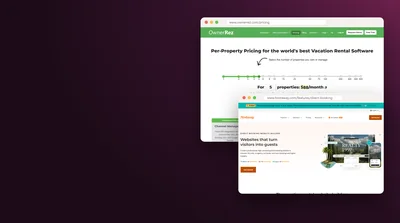
| PMS's own website | Booking Website, included; Booking Website Pro, an extra $49 monthly with Hostaway keeping 0.5% per booking | Guesty Websites, free to build and charged when the site goes live; prices not published on the feature page | Hosted Websites, $15 a month on a single property, cheaper per home on larger accounts |
| Booking engine or widgets in a designed site | Embedded booking engine and widgets for search, featured properties and category filters | Booking engine connected by widget | Inquiry, quote, Book Now, calendar, search, rates and review widgets |
| Custom site on the API | Public API with OAuth 2.0 client credentials, a reservation price calculator and webhooks | Booking Engine API, which Guesty recommends for direct booking sites | API v2; partners use OAuth apps, and the WordPress Plugin and Integrated Websites premium opens the listings and reviews data |
Prices in the table are as listed on each company's pages in November 2026. For a longer look at booking engines as a product category, see our vacation rental booking engines guide.
How a Website Connects to Hostaway
Hostaway's direct booking page lays out the basics. The standard Booking Website costs nothing beyond your Hostaway plan. Booking Website Pro is an add-on priced at $49 monthly, and Hostaway takes 0.5% of each reservation that comes through it. Hostaway also says US guests pay a 1.8% charge it adds on top. The same page says sites built elsewhere can connect through its Open API, and that its embedded booking engine lets guests check availability, book instantly and pay securely (Hostaway direct booking).
The Public API
Hostaway's API documentation says it uses the client credentials grant of OAuth 2.0. The client ID is your Hostaway account ID, and the client secret comes from your Hostaway dashboard. An access token lives for 24 months. The API lets Hostaway users create, update and delete listings and reservations, read listing calendars and block or unblock days, and its changelog lists a price details calculator for working out a reservation's price. Hostaway also supports webhooks, so another system can be told when something changes, and it returns an HTTP 429 code when an application goes over its rate limits (Hostaway API documentation).
Three things follow for a buyer. First, you create the key in your own dashboard and hand the designer the pair of values; you never share your Hostaway login. Second, a token that lives two years should be revoked the day you part ways with a designer. Third, ask how the site gets its prices. A site that asks Hostaway's price calculator for each stay shows the number Hostaway will charge. A site that rebuilds the total from nightly rates in its own code can drift from Hostaway when you add a fee or change a rule.
Checkout on a Hostaway Site
There are two common patterns. In the first, the designer's site shows dates, guests and a quote, then sends the guest to Hostaway's checkout to pay. On the SP Vacations site we built in St. Croix, the quote comes live from Hostaway, the card goes in at Hostaway's checkout and isn't charged until the guest confirms, and that checkout runs on book.spvacationsvi.com, a subdomain the owner controls (our Hostaway page). In the second pattern, the designer runs payment on its own page. CraftedStays says Hostaway operators can stay on the bundled Hostaway checkout or run a custom Stripe integration through CraftedStays for a flow on their own domain (CraftedStays partners).
Neither pattern is wrong. They put the payment, the refund process and the card-security paperwork in different places, which the payments chapter below covers.
What Designers Say They Read From Hostaway
Crafted With Code lists the Hostaway Public API with OAuth2 for listings, calendars, price details and reservations, plus webhooks for new and updated bookings. Fullstay describes Hostaway as an open API with a reservation widget. STYLABS builds custom Hostaway booking sites with a branded guest site and its own operator dashboard, and leaves calendars, channels and reservations in Hostaway. On our SP Vacations build, home names, descriptions, amenity lists, bedroom counts and photos come from Hostaway, listing order follows Hostaway, and a review hidden in Hostaway comes off the site. Ask any designer for the same list in writing for your account.
How a Website Connects to Guesty
Guesty's website feature page says its users can build with the website tool at no charge and start paying once the site is live, with plans that move from themes and booking engine integration up to professional design services on its top tier. For an existing site, it says to connect Guesty's booking engine through the Booking Engine API or a widget (Guesty Websites). Guesty's developer documentation is plainer still: for anyone who wants to build their own website, it recommends the Booking Engine API, which can check real-time availability, return a current price quote and create reservations (Guesty developer docs).
The Booking Engine API Instance
You, the account owner, create a Booking Engine API instance in Guesty. Guesty's getting-started page says the instance is where you choose which properties appear, coupon codes, a payment processing model and reservation settings, and that your booking option has to match the flow the site uses (Guesty Booking Engine API). The options are inquiries only, instant booking only, or both. An inquiry creates a reservation with the status Reserved; an instant booking is Confirmed once the card is validated.
Two setup steps catch people out. Guesty asks you to activate the booking engine by creating a reservation in its interface first, and then a first reservation through the API. And the access token is a JSON Web Token that expires after 24 hours, each application needs its own, and an account can have up to five. Guesty also warns never to send tokens or the client secret by email. So when a designer asks for credentials, share them through a password manager or let them watch you paste them in on a call.
Quotes, Fees and Taxes
Guesty's quote flow returns a price breakdown with fields for the accommodation fare, the cleaning fare, total fees, subtotal and total taxes. Guesty holds a quoted price for 24 hours from the moment the quote is created, a quote can't be reused for a second booking, and the docs say adding extra fees or taxes on top of the rate plan isn't supported through the API (Guesty quote flow). In practice that means fees and taxes belong in Guesty's setup, not in the designer's code, which is what you want: one place to change them.
Payments and Known Limits
For instant bookings, the site collects card details through a payment form and passes Guesty a GuestyPay or Stripe token. Guesty's booking flow page says it accepts only payment tokens through its API, not card details. The same page lists limits a designer should plan for: the Booking Engine API doesn't support changes or cancellations by guests after booking, so those are handled in Guesty by your team, and reservations are created even if the payment method later turns out to be invalid (Guesty booking flow). Guesty's developer page also warns that sending reservation and payment requests for the same booking at the same time can cause race conditions and lost data. Ask the designer how the site handles a declined card and a double click on the Book button.
Designers describe their Guesty work in similar terms. Hudson Creative Studio's Guesty marketplace listing says the Booking Engine API is at the core of its integration. Magnetic Strategy's listing says it supports Guesty Pay or Stripe payments. STYLABS lists custom booking sites on Guesty's Booking Engine API, and Fullstay says headless builds on Guesty are welcome. On the Guesty sites we build, each home's pictures, text, free dates and price come from Guesty, edits made there flow through to the site, and no guest money ever passes through us (our Guesty page).
How a Website Connects to OwnerRez
OwnerRez documents more routes than the other two. Its websites page describes Hosted Websites as its own vacation rental website builder, a native WordPress plugin that links a WordPress site to your OwnerRez data, and widgets for inquiries, quotes, booking, calendars, date-based search, rate tables and reviews (OwnerRez websites). It also has an API that designers use for fully custom sites.
The Premium Feature Designers Depend On
OwnerRez's partner articles for RealTech, Boostly, CraftedStays, ICND, Magnetic Strategy and Webready all say the same thing: turn on the Integrated Sites premium feature, or the designer can't sync listing data from OwnerRez to your site. The costs page prices the WordPress Plugin and Integrated Websites feature at $10 for one property and $5 more for a second, then $3 a home for properties 3 to 9, $2 for 10 to 19, $1 for 20 to 199 and 50 cents beyond that. Hosted Websites follows the same steps from a $15 start. The same page says the premium opens the API's reviews and listings endpoints to third-party integrations (OwnerRez costs and fees).
The API, Tokens and OAuth
OwnerRez's API overview says token-based authentication is intended for private use and isn't designed for partners, and that a partner offering services to OwnerRez clients in general has to use its OAuth API authentication (OwnerRez API overview). For you, that means a designer working across many OwnerRez clients should connect through an OAuth app that you approve inside OwnerRez, not ask you for a personal token. Crafted With Code's services page lists both options for OwnerRez's API v2, personal access tokens or OAuth apps, with webhooks available to OAuth apps.
Quotes, Bookings and Payment
OwnerRez's article on creating bookings and quotes is direct about money: the API doesn't record payments, so a site either collects payment itself or creates a quote so the guest pays through OwnerRez. A quote applies your own rates, stay rules, payment schedule, rental agreement and guest messages, and the reply carries a payment form link where the guest reviews the quote and books. The API can't cancel or delete a booking or block, and dates must be free. For sites that don't want custom checkout, the article's own suggestion is to embed your booking widget, which needs no development (OwnerRez quotes and bookings).
That quote route matters. It keeps your rental agreement, payment schedule and card processor in OwnerRez, so the site never touches card data. If a designer proposes collecting payment on its own page instead, ask how the booking, the agreement and the payment get back into OwnerRez, and who reconciles them.
One more OwnerRez detail for anyone switching from a hosted site: OwnerRez's widgets overview says to disable the old hosted site when you move to an external site with widgets, because keeping both live can cause multiple URL issues (OwnerRez widgets overview). As for us, our OwnerRez page says we have no OwnerRez client yet, lists the questions we would settle in writing on your account before quoting a booking line, and says the quote drops that line if the answers fall short (our OwnerRez page).
The Designer and Partner Lists Each PMS Publishes
The fastest way to build a shortlist is to start where the PMS points you. Each of the three publishes a list, and each list means something slightly different.
Hostaway Marketplace
Hostaway's marketplace claims more than 200 partner-built integrations and has a Direct Booking category for booking engines, website builders and direct reservations. Its FAQ says each listing completes a review that weighs customer value, technical implementation, documentation, security and support readiness (Hostaway marketplace). ICND appears there as a web design provider, and CraftedStays has a listing filed under Website Builder. Design quality and marketing results aren't on Hostaway's review list, so judge those yourself.
Guesty Marketplace
Guesty's marketplace pages for website designers sit in its Brand & Marketing category. Among the listings read for this guide: Hudson Creative Studio, Magnetic Strategy, Customyze, a digital production agency that focuses on custom Guesty API integrations, and RealTech Webmasters, whose listing promises website and marketing work for rental managers large and small and a checkout built for phones first (RealTech on Guesty).
OwnerRez Designer Pages
OwnerRez's WordPress designers page opens with a list of OwnerRez-certified WordPress designers and developers and adds that it also works with designers who use its API for other kinds of integrated sites (OwnerRez WordPress designers). The certified names on the page in November 2026 were Creative Edge Media Group, BuildUp Bookings, Hudson Creative Studio, RezReach, Vacation Rentals Agency and One Roof Designs. The support section's website partner list adds Book With Haven, Boostly, CraftedStays, Flow Web Designs, hostAI, InkSTR, ICND, Knokx, Magnetic Strategy, RealTech and Webready, along with the domain registrar Name.com.
| PMS | Where the list lives | What a listing tells you | Website names seen on it |
|---|---|---|---|
| Hostaway | Marketplace, Direct Booking category | The integration passed Hostaway's review of value, technical build, documentation, security and support | ICND, CraftedStays |
| Guesty | Marketplace, Brand & Marketing category | The partner has a published Guesty integration, often on the Booking Engine API | Hudson Creative Studio, Magnetic Strategy, Customyze, RealTech Webmasters |
| OwnerRez | WordPress designers page and website partner articles | Certified WordPress designers, plus partners whose sync depends on the Integrated Sites premium | Creative Edge Media Group, BuildUp Bookings, Hudson Creative Studio, RezReach, Vacation Rentals Agency, One Roof Designs, Boostly, CraftedStays, ICND, Magnetic Strategy, RealTech, Webready and others |
A designer missing from a PMS list can still build a sound site on that PMS's public API; Crafted With Code, Fullstay, STYLABS and BuffStays all describe direct API work. The list is a filter, not a verdict.
Studios That Build Custom PMS-Connected Sites
These firms design and code a site for you and connect it to the PMS by API or embedded engine. Each profile uses only what the company publishes. Where a firm doesn't publish something, such as a price or a location, the profile says so.
Crafted With Code
Crafted With Code calls itself a vacation rental web design agency building custom direct booking sites for owners and property managers. Its services page names the connection for each PMS: the Hostaway Public API with OAuth2, Guesty's Booking Engine API with full quotes and instant or inquiry bookings with tokenized payment, and OwnerRez's API v2 with personal access tokens or OAuth apps. It also lists Lodgify and Hostfully. For payment it names Stripe and other gateways with tokenized card entry, so card data never touches your web server. Standard projects take about 4 to 5 weeks after it receives content and PMS access, optional hosting and care is $50 a month, and you own your domain, content and the approved design deliverables, with source-code ownership available as a separate $2,000 option. It doesn't publish build prices; it says it replies within 48 hours with a written proposal (Crafted With Code services).
Fullstay
Fullstay is a UK design and development studio for self-catering and hospitality brands, and says most of its work is in the UK and Ireland. It lists more than 20 booking platforms, including Guesty, which it describes as having a proper Booking Engine API with headless builds welcome, Hostaway, with an open API and a reservation widget, and OwnerRez, with widgets, APIs and hosted checkout. It aims for a checkout that stays on your domain wherever the API allows it, and where a platform only offers an embedded engine, it designs around that engine. It quotes a focused build at six to ten weeks, and larger custom work across many properties at twelve to twenty. It publishes no prices and says it replies in writing within one working day (Fullstay).
STYLABS
STYLABS describes itself as an AI-native venture studio for custom software, website and product design, based in Dubai and Mumbai. For Hostaway it builds a branded guest site with search, location pages, property pages and checkout on the operator's own domain, plus a custom operator dashboard for listings, media, amenity groups, display order and reviews, while calendars, channels and reservations stay in Hostaway. For Guesty it lists custom booking sites on the Booking Engine API at USD 12,000 to 45,000. It doesn't list a Hostaway price or an OwnerRez service (STYLABS).
BuffStays
BuffStays says it designs and builds custom direct booking websites that connect to the PMS you use, naming Hostaway, Guesty, OwnerRez, Hospitable, Lodgify, Smoobu and Zeevou. Payments go through Stripe and sync back to your PMS, and the price is listed from €499 one-time. Its home page doesn't state a timeline, monthly costs, site ownership terms or a location, so ask for those in writing (BuffStays).
Creative Edge Media Group
OwnerRez's designer page describes Creative Edge Media Group as building WordPress sites with the OwnerRez plugin and custom Next.js sites connected to the OwnerRez API, with SEO and content included. It's the clearest example on the OwnerRez list of a designer offering both the plugin route and a headless build.
Agencies, Builders and Done-for-You Services
The next group either sells the site as part of a marketing service, sells software you set up yourself, or packages the build at a fixed price. If you want traffic as well as a site, start with the agencies; if you want the lowest monthly cost and are happy to do the setup, start with the builders.
Hudson Creative Studio and HomeRunner
Hudson Creative Studio publishes its prices: templates from $2,000, a Pro template at $4,500 for 11 pages, custom builds from $8,000, hosting and technical maintenance at $100 a month, and its HomeRunner booking engine from $45 a website, priced by the number of listings. It says its sites connect to Guesty, Hostaway, Hospitable, Hostfully, Lodgify, OwnerRez, Streamline VRS, Boom and Track, and that it never takes a commission on direct bookings (Hudson Creative Studio). HomeRunner's own site calls itself a Hudson Creative Studio product, says the whole booking happens on your site, and lists plans from $45 a month for up to 5 listings up to $885 a month for 300 (HomeRunner). OwnerRez's certified list describes Hudson as a New Orleans agency with a custom booking engine on the OwnerRez API.
RealTech
RealTech's own site pitches websites built around direct booking, plus the marketing to fill them, for rental managers large and small, from offices in Lakewood Ranch, Florida and Asheville, North Carolina. Besides custom builds it sells two named products, RealTech Connect and RealTech Direct, assigns each client a dedicated account manager, and shows no prices (RealTech). OwnerRez's RealTech article adds that RealTech Direct is for managers with fewer than 30 properties and starts at $195 a month, while RealTech Connect is a fully custom site. RealTech also has a Guesty marketplace listing.
Magnetic Strategy
Phoenix-based Magnetic Strategy designs booking sites for vacation rental property managers and handles their SEO, email, copywriting and paid search; its site asks you to book a call rather than listing prices. Its Guesty listing describes API-connected sites with real-time sync of availability, pricing and property details and support for Guesty Pay or Stripe, and OwnerRez's Magnetic Strategy article says its sites start at $1,500.
ICND
InterCoastal Net Designs lists its office in Ocean Isle Beach, N.C., and says it has worked for rental and property sales firms since 1999. Its project pages tag integrations with Escapia, Streamline, VRM, Guesty and Track on its Axis platform, it's listed in Hostaway's marketplace for web design, and OwnerRez's ICND article describes Axis as including website tools, a CRM and an OwnerRez integration, with digital marketing on top. It doesn't publish prices (ICND).
Boostly
Boostly's own site refused our request, so the details here are OwnerRez's, from its Boostly article: custom WordPress websites for scaling a rental business, a monthly fee of $97, £97 or €97 covering hosting, plugins, the Boostly CRM, a booking engine and API connections to property management systems, and a monthly fee that begins 30 days after you sign the proposal, whether or not the site is live yet (Boostly on OwnerRez). Ask Boostly for its build fee and timeline directly.
CraftedStays
CraftedStays sells software that operators use to run their own direct booking site. It lists native integrations with OwnerRez, Hostfully, Hostaway, Hospitable and Guesty over OAuth, with no credentials shared: listings flow from the PMS to the site, and bookings flow back. Pricing starts at two homes for $89.99 a month, adds $8 a month for each further home and carries no setup fee. It says it takes no cut of bookings and adds no markup on guest payments (CraftedStays). On OwnerRez, its partner article says properties, rates and availability sync automatically once you authorize the connection and map your listings.
Webready and Customyze
Webready describes a builder for a rental website in minutes, with a free booking engine and custom domains; OwnerRez lists it as a partner and mentions a free 30-day trial of its Starter plan (Webready). Customyze, powered by SocialLift.io, lists custom Guesty API integrations in Guesty's marketplace and doesn't publish prices there.
Host Camp and STR Assistance
Host Camp, the short-term rental education site whose pages carry the Robuilt name, sells a Direct Booking Site Design service. It names Hostaway, Guesty, OwnerRez, Hostfully, Lodgify and Hospitable (on Hospitable's Professional plan or above) as systems it works with, and says every booking and payment runs through your PMS's direct booking widget embedded on the site. Its three packages are DIY at $1,000 (a template and video course), Lite at $2,000 and done-for-you at $3,000, plus monthly hosting fees, with turnarounds from under three days to two weeks (Host Camp). STR Assistance, a virtual assistant company for rentals, lists building a direct booking site through PMS integration, WordPress or custom development among its services, without published prices (STR Assistance).
Designers Compared Side by Side
The table lines up what each firm publishes. Cells that read "not listed" are there on purpose: a missing price is a question for your first call, not a mark against the firm.
| Company | Type | Hostaway, Guesty, OwnerRez | How it says it connects | Published price |
|---|---|---|---|---|
| Crafted With Code | Custom studio | All three | Each PMS's official API; Stripe or other gateways with tokenized cards | Proposal per project; hosting $50 a month; source code option $2,000 |
| Fullstay | Custom studio, UK | All three, among 20+ platforms | API or embedded engine, checkout on your domain where allowed | Not listed |
| STYLABS | Custom studio, Dubai and Mumbai | Hostaway, Guesty | Hostaway API with own dashboard; Guesty Booking Engine API | Guesty sites USD 12,000 to 45,000 |
| BuffStays | Custom builds | All three, plus others | Stripe payments synced back to the PMS | From €499 one-time |
| Creative Edge Media Group | OwnerRez certified designer | OwnerRez | WordPress plugin or Next.js on the OwnerRez API | Not listed |
| Hudson Creative Studio | Agency with own booking engine | All three, plus others | API-connected templates or custom sites; HomeRunner engine | Custom work from $8,000 or a $2,000 template; $100 a month to host; HomeRunner from $45 a month |
| RealTech | Website and marketing agency | Guesty and OwnerRez per their pages | Syncs listing data from the PMS | RealTech Direct from $195 a month, per OwnerRez |
| Magnetic Strategy | Website and marketing agency | Guesty and OwnerRez per their pages | Booking Engine API on Guesty; Guesty Pay or Stripe | From $1,500, per OwnerRez |
| ICND | Website and marketing agency | All three per partner pages | Axis platform | Not listed |
| Boostly | WordPress sites and coaching | OwnerRez per its page | Booking engine and API connections | $97 a month, per OwnerRez |
| CraftedStays | Self-serve builder | All three, plus Hospitable and Hostfully | OAuth, two-way sync | Two homes $89.99 monthly; $8 per added home |
| Webready | Self-serve builder | OwnerRez per its page | Synced listings, free booking engine | Free trial; plans on its pricing page |
| Host Camp | Fixed-price packages | All three, plus others | Your PMS's booking widget embedded | $1,000, $2,000 or $3,000, plus hosting |
| Cavmir | Agency; builds the site, then markets it | Hostaway and Guesty live; OwnerRez reviewed, no client yet | Official API; live quote, PMS checkout | Direct booking package $8,293 one-time ($3,732 with the Fall Special running in November 2026) |
Matching a Designer to Your Portfolio
- One to five homes, small budget. Look first at the builder inside your PMS, a self-serve builder such as CraftedStays, or a fixed package such as Host Camp's. Your money goes further on photos and marketing than on custom code.
- A brand with a few homes that wants a distinct look. A custom studio or a template-plus-engine agency such as Hudson Creative Studio. Ask for live sites on your PMS you can book through.
- Twenty or more homes, a management company. Agencies that build for managers (RealTech, Magnetic Strategy, ICND) or a custom studio with a written support plan. Area pages, owner pages and reporting start to matter as much as the booking box.
- A complex inventory, such as a resort with rooms and villas. A studio that has built for that model before. Fullstay mentions custom work across many properties, and STYLABS builds its own operator dashboard.
What to Check Before You Hire a Designer
Every designer will tell you its sites have live rates. These are the checks that show what that means on your account. Ask for them in writing, then test them yourself on a site the designer has already built on your PMS.
Live Rates and the Full Total
Pick three stays: a weekend, a full week and a stay that crosses a minimum-night rule or a seasonal price change. Price each one in the PMS and on the site with the same guest count. The totals should match, including cleaning, pet or extra-guest fees and taxes. If they don't, the site is rebuilding prices in its own code instead of asking the PMS, and it'll drift every time you change a rule.
Sync Method and Speed
Ask whether availability comes by API or by iCal feed. Calendar feeds are slow by design: Airbnb's help center says its calendar updates imported calendars every 3 hours (Airbnb calendar sync). An API connection can check the PMS at the moment a guest searches. Ask how often content such as photos and descriptions refreshes, too; our integrations page, for example, gives ten minutes as the resync time for homes, text and photos on our Hostaway sites (our integrations page).
Booking Write-Back
When a guest books on the site, the reservation should appear in the PMS immediately and block those nights on every connected channel, Airbnb and Vrbo included. Ask what happens if the PMS is down at that moment, and whether the site retries or tells the guest.
Pages Google Can Read
Property pages should exist as real pages with their own addresses and text, not only inside a booking widget. Google's JavaScript guide says it can only index content that appears in the rendered HTML, and that server-side rendering or pre-rendering is still a good idea because not all bots run JavaScript (Google JavaScript SEO). Ask the designer to show you the HTML of a property page with JavaScript turned off.
Photos, Order and Reviews
Change a photo and the listing order in the PMS, then check how long the site takes to follow. Ask whether reviews come from the PMS and whether a review you hide there comes off the site.
Questions to send each designer
PMS connection
1. Which route will you use on my account: the PMS's own site, its booking engine or widgets, or a custom build on its API?
2. Which key or app connection do you need, and will I create it in my own PMS account?
3. How do you get prices: the PMS's own quote for each stay, or your own calculation from nightly rates?
4. Do availability and prices come by API or by calendar feed, and how often does content refresh?
5. When a guest books, how fast does the reservation appear in the PMS, and what happens if the PMS is down?

Payments, fees and taxes
6. Where does the guest pay: the PMS checkout, the PMS's payment form, or a payment page you run?
7. Whose merchant account takes the money, and who handles refunds and declined cards?
8. Do cleaning and other required fees show in the first total price the guest sees?

Search, content and ownership
9. Will each home have its own indexable page with text in the HTML?
10. Who will own the web address, the source code, the written copy and the design files?
11. What does hosting and support cost each month, and what is the response time when the PMS changes its API?

Proof
12. Can I book a test stay on two live sites you built on my PMS?
Score the Proposals
Run the scorecard once per designer, working from the written proposal and a test booking you made yourself. Four items carry triple weight because they're the hardest to change once the site is live: quotes that match the PMS, where payment happens, keys in your name and bookings that write back.
PMS-Connected Website Designer Scorecard
Grade one designer at a time against its proposal and a test booking; nothing is sent anywhere.
Payments, Fees and Taxes on a PMS-Connected Site
Where the guest pays decides who holds the money, who answers a chargeback, and how much card-security work lands on you. There are three patterns, and the designers above use all of them.
Payment in the PMS's Checkout
The site gives the price, and the PMS takes the money. Host Camp's packages, our own Hostaway builds and OwnerRez's quote-and-payment-form route all work this way. Payments, rental agreements, deposits and refunds stay inside the PMS with your existing processor, and the site never handles card numbers. The guest does see a second page, often on a booking subdomain, so ask the designer to match its look to the site.
Card Tokens Passed to the PMS
The site shows a payment form from GuestyPay or Stripe, turns the card into a token and passes it to the PMS, which charges it. Guesty's Booking Engine API works this way, and Magnetic Strategy, Crafted With Code and CraftedStays describe it for Guesty. The guest stays on your domain, and the charge still lands in your Guesty-connected account.
A Payment Page the Designer Runs
The site takes payment through Stripe or another gateway and then writes the booking to the PMS. BuffStays says its payments go through Stripe and sync back to the PMS; CraftedStays offers a custom Stripe setup for Hostaway operators. This gives the most control over the checkout. Make sure the Stripe account is yours, not the designer's, and ask how refunds, partial payments and security deposits get back into the PMS ledger.
The Total Price Rule
Whatever the pattern, the price display has rules. Since May 2025 the FTC's junk-fee rule has applied to every business that sells or promotes short stays, and the agency's FAQ lists vacation rentals by name. The headline price has to include every fee that can be known and worked out in advance, and the FAQ spells out that this means the cleaning fee. Taxes may sit outside it if the guest sees them before paying, and the all-in figure has to be the most prominent price on the page (FTC fee rule FAQ). A site that shows a nightly rate in large type and the cleaning fee on the last screen is a problem. Treat this as general information and get a lawyer's view before relying on any reading of the rule.
Card Security Paperwork
If you accept cards online, your processor will ask you to complete a PCI self-assessment. Sending guests to a payment page run by a PCI-validated provider shrinks that job but doesn't remove it. The PCI Security Standards Council says SAQ A for PCI DSS v4.x includes external vulnerability scanning by an approved scanning vendor for merchant e-commerce pages, even where payment processing is fully outsourced (PCI SSC FAQ 1604). Ask the designer which SAQ your setup falls under and who arranges the scans.
Lodging Taxes
Our direct booking page counts lodging tax filing among the costs that carry on no matter which build you choose. Set your tax rates in the PMS before launch so the site's quotes include them, and ask your accountant which state and local taxes your direct stays owe and who files them.
What a PMS-Connected Site Costs
Compare routes on what they cost over the years you'll keep the site, not on the build fee alone. A cheap build with a per-booking fee can end up costing more than a pricier build with a flat monthly fee once bookings grow, and the reverse is true for a small portfolio.
| Item | Price as published, November 2026 | Source |
|---|---|---|
| Hostaway Booking Website | Included with the subscription | Hostaway direct booking page |
| Hostaway Booking Website Pro | $49 monthly, and Hostaway keeps 0.5% of each booking it takes | Hostaway direct booking page |
| Guesty Websites | Free to build, charged once live; price not on the feature page | Guesty website page |
| OwnerRez WordPress Plugin and Integrated Websites | $10 for one property, $5 for a second, less per home beyond that | OwnerRez costs and fees |
| OwnerRez Hosted Websites | $15 for one property, $5 for a second, less per home beyond that | OwnerRez costs and fees |
| CraftedStays | $89.99 a month covering two homes, then $8 per extra home | CraftedStays home page |
| Host Camp packages | $1,000, $2,000 or $3,000, plus monthly hosting | Host Camp service page |
| BuffStays | From €499 one-time | BuffStays home page |
| Hudson Creative Studio | $2,000 and up for a template, $8,000 and up for custom work, then $100 monthly hosting and HomeRunner at $45 or more | Hudson Creative Studio home page |
| STYLABS Guesty sites | USD 12,000 to 45,000 | STYLABS home page |
| Crafted With Code | Build by proposal; hosting and care $50 a month; source code option $2,000 | Crafted With Code services page |
| Cavmir, Full w/ Direct Booking | One-time, $8,293 ($3,732 with the Fall Special running in November 2026) | Our pricing page |
None of these prices covers the PMS subscription, card fees or the marketing that sends guests to the site. For a wider look at what drives a build's price, see our guide to pricing a direct booking site.
What a PMS-Connected Site Costs Over Time
Type in a designer's quote and the stays you expect the site to book. The figures stay in your browser.
Sample figures, not market averages and not anyone's quote. Replace them with what your proposals and booking history say.
Worked example, with made-up numbers: a $3,000 build plus $100 a month to keep the site hosted and the engine running, kept for three years, comes to $6,600. At 20 stays a year worth $1,500 each, that's $110 a stay, a little over 7% of the typical stay. Now run a route with no build fee, $49 a month and a 0.5% fee per booking, the figures Hostaway lists for Booking Website Pro. Over the same three years it comes to about $2,214, or roughly $37 a stay. The cheaper route isn't automatically the right one, since it's a template and the first is a designed site, but the math shows what the design costs you per stay, and how many more stays it would have to win to pay for itself.
Moving to a New Site Without Losing Bookings or Rankings
Replacing an existing site is where bookings and search traffic most often go missing. The trouble usually sits in three places: old addresses that stop working, two booking flows running at once, and keys or feeds nobody turned off.
Map and Redirect Every Old Address
Google's guide to moving a site says to pair each old URL with its new one, use permanent redirects such as 301 or 308, leave them in place as long as you can, a year at the least in most cases, and refresh your sitemaps with the new addresses. If the domain or subdomain changes, it says to file a Change of Address in Search Console, and it warns that rankings can swing for a while during the move (Google site moves). Ask the designer for the redirect map as a spreadsheet before launch, with one row per old page, including old blog posts and property pages for homes you no longer rent.
One Booking Flow at a Time
Run the new site on a staging address and make test bookings on each booking option you use, inquiries and instant, then cancel them in the PMS. On launch day, switch the domain, confirm a real search returns live prices, and turn off the old booking flow. On OwnerRez that includes disabling the old hosted site if you move to an external one, as its widgets overview advises. On Guesty, make sure the booking option in your Booking Engine API instance matches how the new site books.
Clean Up Keys, Feeds and Tracking
Revoke the old designer's API key or app connection in your PMS, remove any calendar feeds the old site used, and move your analytics and Search Console to the new site under your own accounts. Keep the old site's files and a list of its addresses for at least a year, in case a redirect needs fixing.
- Weeks beforeExport every old URL, build the redirect map, and set fees and taxes in the PMS.
- StagingPrice three test stays against the PMS and make a test booking on each option.
- Launch dayPoint the domain, turn on the 301s, submit the new sitemap and turn off the old booking flow.
- Week oneCheck that bookings land in the PMS, revoke old keys, and fix any redirect that returns an error.
- Month one to twelveWatch Search Console for errors and keep every redirect in place for at least a year.
Contract Terms for a PMS-Connected Build
A PMS-connected site depends on a connection someone has to maintain, so the contract needs a few clauses a brochure site doesn't. Have a lawyer review it; what follows is a buyer's checklist, not legal advice.
- Accounts and keys. The domain, the PMS API key or app connection, any Stripe account, analytics and Search Console are in your name. The designer gets access you can revoke.
- Code ownership. Some designers transfer the code; others license it. Crafted With Code, for example, lists source-code ownership as a separate $2,000 option, while on our builds the client owns the web address, code, copy and photos from launch. Know which one you're buying.
- Integration upkeep. The monthly fee should name who repairs bookings when Hostaway, Guesty or OwnerRez changes its API, and the response time when bookings stop.
- Acceptance tests. Final payment depends on the checks in this guide passing: matching quotes, write-back to the PMS, working redirects.
- Payments. No guest money passes through the designer's accounts, and any processor is set up in your name.
- Exit. On cancellation, the designer hands over files, code or an export, removes its access and leaves the redirects in place.
Contract clauses for your lawyer to review
Accounts. The web address, the property management system API key or app connection, any payment processor account, Google Analytics and Google Search Console used for the website are registered to Owner. Designer receives access that Owner may change or revoke at any time.

Payments. Guest payments are processed by Owner's property management system or by a processor account registered to Owner. No guest funds pass through accounts held by Designer.

Integration upkeep. During the support term, Designer restores the booking flow within the response time stated in this agreement after any change to the property management system's API or booking engine.

Acceptance. The website is accepted when quotes for three agreed test stays equal the property management system's own quotes, each test booking shows up there with its dates blocked on connected channels, and every URL in the redirect map returns a permanent redirect to its new page.

Code and content. On final payment, Designer assigns to Owner, or grants Owner a perpetual license to, the website code, content and design files, as stated in this agreement. Third-party software and fonts are listed with their license terms.

Exit. Within the number of days stated in this agreement after it ends, Designer delivers all files and exports, removes its own access and leaves redirects in place.
Where Cavmir Fits Among These Designers
Our job is marketing for rental homes. We set up the booking site, then do the work that sends travelers to it: search pages, answers in AI tools, Google and Meta campaigns, press and links, area guides, a monthly newsletter to subscribers from your own site, plus social media. Running homes, answering guests and booking cleaners isn't our work (our agency page).
How We Connect to Each PMS
Our direct booking service page names Hostaway, Hospitable and Guesty as the systems behind the client sites we run now, and says that on Lodgify, Hostfully, OwnerRez and others we connect whichever booking engine the PMS provides. Each home shows its open dates and the price of the chosen stay straight from the PMS; the guest then lands on the PMS's checkout with the stay already set, and the PMS keeps the payment, the guest's details and the confirmation (direct booking websites). The SP Vacations case study sums up that St. Croix site in three phrases: a single brand, live prices and direct bookings (SP Vacations case study). On Guesty, our Art de Vivre site in Rio de Janeiro works by request: the owner approves a request and then sends the guest a secure payment link. On OwnerRez, we've reviewed the API and have no live site to show.
Price and Terms
Our pricing page lists the PMS-synced package, called Full w/ Direct Booking, a 125-page site with direct booking synced through the PMS for up to five properties, at $8,293 one-time ($3,732 with the Fall Special running in November 2026), with six to eight weeks to launch depending on the PMS integration. We take 50% of a website fee up front and the other 50% when the site goes live, commit to a delivery date on paper ahead of kickoff, and the web address, code, copy and photos belong to you (pricing). Ongoing marketing runs on monthly plans, and direct booking from your PMS is part of every plan from Destination up, $800 a month ($590 under the Holiday Discount, which ends January 1, 2027). Plans carry a six-month minimum you can't end early; after it, 30 days' notice ends them. We don't include ad spend in plan prices, and press coverage and AI answers aren't promised (monthly plans).
When Cavmir Isn't the Right Fit
- You run OwnerRez and want a proven OwnerRez booking flow today. We have none to show, so a designer from OwnerRez's certified list is the safer pick.
- You only want the website, with no marketing after launch. A custom studio or a self-serve builder will cost less.
- You want guests to pay on a page you run through your own Stripe account. We send guests to the PMS's checkout.
- You need guest messages, turnovers and cleaning crews handled. A manager or co-host does that work, and we don't.
- You'd rather pay a share of each booking than a flat fee. Our plans are flat monthly prices.
Whoever you hire, the test is the same: price three stays on their site and in your PMS, book one, and watch it land in the PMS and close the dates everywhere. A designer who'll let you do that before you sign is a designer worth talking to.
Sources
Each company fact in this guide was taken from the firm's own site or from a PMS partner page, and the pages behind it were opened on November 13, 2026. Prices and partner lists move, so open the page itself before you budget around a number.
- Hostaway, direct booking website builder: hostaway.com
- Hostaway, Public API documentation: api.hostaway.com
- Hostaway, integration marketplace: hostaway.com/marketplace
- Guesty, website builder and booking engine: guesty.com
- Guesty, its developer guide to booking sites on the Booking Engine API: open-api-docs.guesty.com
- Guesty, Booking Engine API getting started, booking flow, quote flow and API introduction: getting started, booking flow, quote flow, API introduction
- Guesty marketplace listings: Hudson Creative Studio, Magnetic Strategy, Customyze, RealTech Webmasters
- OwnerRez, websites, WordPress designers, costs and fees, API overview, quotes and bookings, widgets overview: websites, WordPress designers, costs and fees, API overview, quotes and bookings, widgets overview
- OwnerRez partner articles: RealTech, Boostly, CraftedStays, ICND, Magnetic Strategy, Webready
- Designer sites: Crafted With Code, CraftedStays, BuffStays, Fullstay, Host Camp, Hudson Creative Studio, HomeRunner, RealTech, STR Assistance, STYLABS, Magnetic Strategy, ICND, Webready
- FTC fee rule FAQ for businesses, published May 2025: ftc.gov
- PCI Security Standards Council, FAQ 1604 on SAQ A scanning: pcisecuritystandards.org
- Google Search Central, site moves with URL changes, and JavaScript SEO basics: site moves, JavaScript SEO
- Airbnb Help Center, syncing calendars: airbnb.com
- Our own pages, read the same day: Hostaway, Guesty, OwnerRez, direct booking websites, integrations, pricing, monthly plans