





National park
Since 2019
It was redesignated from National Lakeshore to Indiana Dunes National Park. Use the current name; it is the strongest search term here.

Expert short-term rental marketing to grow your bookings and nightly rate in Indiana Dunes, Indiana, USA.
* Market averages. Properties marketed by Cavmir typically exceed these figures by 25–45%. Data sourced from AirDNA, STR market reports, and Cavmir internal analytics.
Indiana Dunes is fifteen miles of Lake Michigan shoreline about an hour from downtown Chicago, and it is one of the strangest and best pieces of protected landscape in the country. The dunes themselves are large, genuinely mobile in places, and covered in an unusual concentration of plant species that made this a landmark site in the history of American ecology. It became a National Lakeshore in 1966 and was redesignated as Indiana Dunes National Park in 2019, making it the sixty-first national park. What makes it unusual is the company it keeps: the park is not a single block but a series of pieces threaded between working steel mills, a power station, small lakeside towns and a commuter railway. You can stand on a beach with two-hundred-foot dunes behind you and blast furnaces visible down the shore, and the honest thing to do is say so, because visitors find it remarkable rather than off-putting. The South Shore Line runs electric trains from Chicago straight through, so a substantial part of the visitor base arrives without a car. Beverly Shores, Porter, Chesterton, Michigan City and Ogden Dunes are the communities around the park, and every one of them writes its own short-term rental rules.
The frame here is state law. Indiana's House Enrolled Act 1035, passed in 2018, provides that municipalities may not prohibit the short-term rental of a residence. What they may do is require special exceptions, special uses, zoning variances or permits before a non-occupant owner rents, and they may revoke a permit for up to one year after three ordinance-violation citations in a calendar year. So the door cannot be closed, but it can be narrowed, and the narrowing happens locally. That local layer is the entire practical question in this market, because Indiana Dunes is not one jurisdiction. The national park spans Porter, Lake and LaPorte counties, and the communities around it, Beverly Shores, Porter, Chesterton, Michigan City and Ogden Dunes among them, each have their own ordinance. They differ, sometimes substantially, on whether a non-occupant owner needs a special exception, on occupancy, on parking and on inspection. There is no single Indiana Dunes rulebook and any guide that presents one is wrong. Verify the rules for the specific municipality your address sits in, directly with that municipality, before you buy or advertise. On tax, Indiana applies its 7% state gross retail tax to short-term rentals, and county innkeeper's tax applies on top; Porter County's innkeeper's tax is 5%, and the LaPorte County rate should be confirmed with the county.
Nearby Markets: Chicago | Saugatuck | South Haven
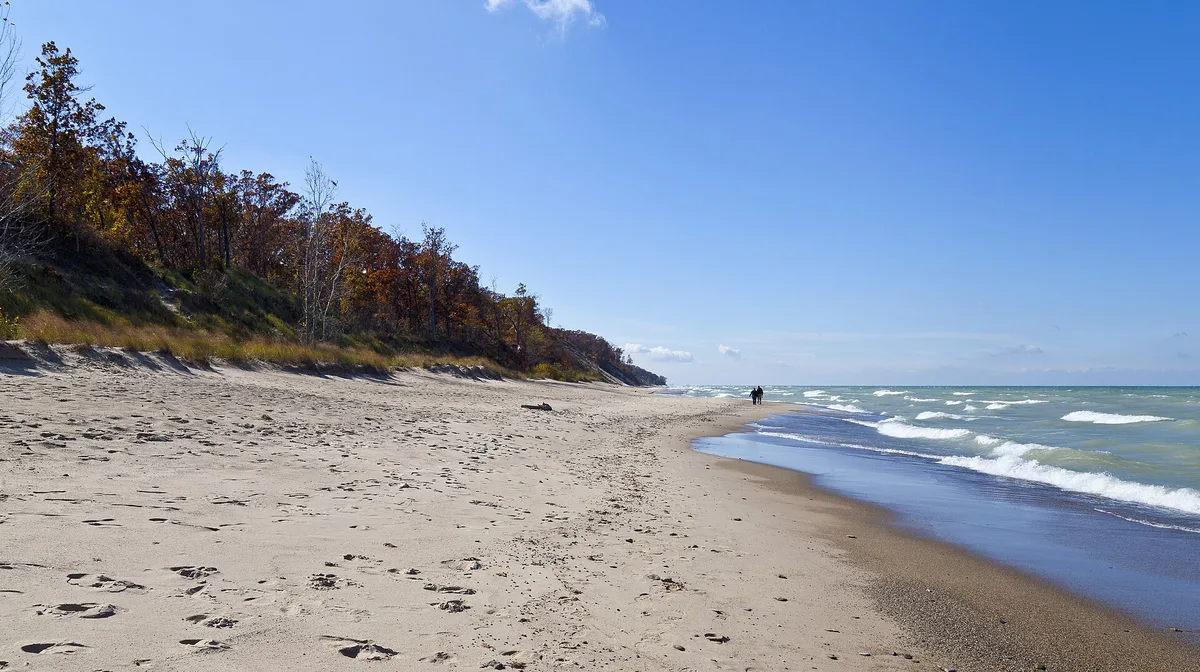
A few of the visual fingerprints we lean into when we shoot, brand and market a Indiana Dunes National Park property — courtesy of the open Wikimedia Commons archive.
Cavmir markets Indiana Dunes properties on the two things this shoreline has that its competitors on the Michigan side do not: a national park and a train. The park designation in 2019 changed how people search, and a great many listings here still describe the area as a lakeshore or simply as a beach, which leaves the strongest search term in the market unused. We use it, accurately, and we explain what the park actually contains, because Mount Baldy, the Three Dune Challenge, the West Beach loop and the Great Marsh are different experiences and a guest planning a weekend wants to know which is worth their morning. The South Shore Line is the other under-sold asset. A property within walking distance of a station can be marketed to Chicagoans who do not want to drive, and that is a large, close, wealthy audience that almost nobody addresses directly. We photograph the dunes and the water in the light that makes them look like themselves, which is early or late, and we are honest about the industrial view where there is one, because guests who are told find it interesting and guests who are surprised leave a comment about it. Then we build a direct booking site, run local SEO against park and train searches, place ads against the summer season, and hold the guest relationship. We help position and market your property. We never manage it or touch your keys.
The dunes at the southern tip of Lake Michigan were formed as the glacial lake retreated, and they have been moving ever since; some of them still are. What made them nationally significant was not their size but their botany. In the 1890s Henry Chandler Cowles, a University of Chicago ecologist, studied the plant communities running back from the shoreline and worked out that the sequence of vegetation from the open beach through grass, shrub and eventually oak forest represented a sequence in time as well as in space. The concept of ecological succession came substantially out of this shoreline, and the dunes became one of the founding sites of American ecology. That gave the conservation campaign an intellectual foundation it would not otherwise have had, which mattered enormously, because the same shoreline was extremely attractive to heavy industry. Steel mills were built along it from the early twentieth century, and the fight over what should happen to the remaining dunes ran for over sixty years. Indiana Dunes State Park was established in 1925 as a partial victory. The federal designation took until 1966, when Congress created Indiana Dunes National Lakeshore, and the resulting boundary was a compromise: a series of separate pieces threaded between the mills, the power station, the towns and the railway rather than a single continuous block. In 2019 it was redesignated Indiana Dunes National Park, the sixty-first in the system. Around it sit the communities that grew up as lakeside resorts for Chicago: Beverly Shores, Ogden Dunes, Porter, Chesterton and Michigan City, several of which were developed in the 1920s and 1930s explicitly as summer places reachable by the South Shore Line, the electric interurban railway that still runs from Chicago through the dunes to South Bend. That railway is the reason this stretch of shoreline developed as a weekend destination rather than as suburbia, and it remains the most under-used asset in the market.
This is a summer market with a sharp peak and a long tail, and the pricing has to reflect how concentrated the demand actually is. Late June through the end of August is the season, weekends are far stronger than midweek, and holiday weekends behave in a category of their own. Set summer weekend rates early and hold them; the inventory here is limited enough that discounting is rarely necessary and usually just transfers money to the guest. Midweek in summer is the genuine opportunity, because the beach is empty, the weather is identical, and Chicago families with flexible schedules will take a Monday to Thursday at a sensible rate. Build a real midweek offer rather than a token discount. September and early October are excellent and under-sold: the water is at its warmest of the year in early September, the crowds have gone, and autumn colour in the oak savannas is genuinely good. Winter is quiet, though the dunes in snow are striking and there is a small but real market for it. Two things should shape your rate card. First, the national park designation in 2019 substantially raised the profile of this shoreline, and pricing that still reflects its identity as a regional beach is leaving money behind. Second, remember the tax: 7% Indiana gross retail tax plus county innkeeper's tax, which is 5% in Porter County, sits on top of your rate.
Summer is the market. Late June through August is the peak, driven almost entirely by Chicago, with weekends far outperforming midweek and holiday weekends at the top. September is the quiet secret: the lake is at its warmest, the beaches are empty and the weather often holds into early October. Autumn colour in the oak savannas gives a short secondary draw. Winter is genuinely quiet, cold and windy off the lake, though the dunes under snow photograph beautifully and there is a small winter hiking and birding audience. Spring is unpredictable and cool, since the lake keeps the shoreline cold well into May.
The starting point is state law, and it is favourable. Indiana's House Enrolled Act 1035, enacted in 2018, provides that a municipality may not prohibit the short-term rental of a residence. That is a meaningful protection and it means no town along this shoreline can simply ban the activity. What municipalities retain is significant discretion over the conditions: they may require a special exception, a special use, a zoning variance or a permit before a non-occupant owner rents a property, and they may revoke such a permit for up to one year following three ordinance-violation citations in a single calendar year. So the shape of the framework is that the door must remain open, but the local authority decides how narrow the doorway is and can close it temporarily for repeated violations. Everything practical then depends on which local authority you are dealing with, and this is where owners get into difficulty. Indiana Dunes is not a jurisdiction. The national park spans Porter, Lake and LaPorte counties, and the communities in and around it, including Beverly Shores, Porter, Chesterton, Michigan City and Ogden Dunes, each maintain their own ordinances. Those ordinances differ, in some cases substantially, on whether a non-occupant owner requires a special exception, on maximum occupancy, on parking requirements, on inspection and on registration. Some of these are small towns with a few hundred residents and a strong view about weekend rentals; others are more permissive. There is no single Indiana Dunes rulebook, and any guide or listing service that presents one is misleading you. Establish precisely which municipality your address sits within, obtain that municipality's current ordinance, and confirm the requirements with its clerk or building department directly before you buy, apply or advertise. Where a property sits in unincorporated county area rather than within a town, the county's zoning applies instead, and that is a separate enquiry again.
Use the words national park, because they are accurate and because a great many listings here still describe this shoreline as a lakeshore, which stopped being its name in 2019. That designation changed how people search and it is the single most valuable term in the market. Then explain what the park actually is, because it is not a single place: Mount Baldy is a moving dune with restricted access, the Three Dune Challenge is at the state park rather than the national park and is genuinely strenuous, West Beach has the best succession loop, and the Great Marsh is a completely different landscape behind the shoreline. A guest planning two days wants to be told which of those to do. Second, sell the train. The South Shore Line runs from Millennium Station in Chicago through the dunes, and a property within walking distance of a stop can be marketed to a large, wealthy, close audience that would rather not drive. Almost nobody does this. Name the station, give the walk in minutes, and explain the journey time. Third, be honest about the mills. Steel plants are visible from parts of this shoreline, and guests who are told in advance find it genuinely interesting, an unusual collision of industry and wilderness. Guests who are not told mention it in reviews. Fourth, handle the water seriously: Lake Michigan has dangerous rip currents and structural currents near piers, and a clear safety note is both responsible and reassuring. Fifth, since every town here writes its own rules, state your compliance position plainly, because guests and neighbours in these small communities notice.
The fragmented regulatory map is the biggest practical problem: five or more separate municipalities with different ordinances, and no single source that gets them all right. The season is short and heavily weekend-weighted, which concentrates revenue into a small number of nights. Lake-effect weather makes spring cold and late. The proximity of heavy industry is a genuine consideration for some guests and must be handled honestly. And several of the communities here are very small, with strong local feeling about weekend rentals, which means an owner's relationship with the neighbours matters more than it would in a city.
Insure a dunes property on a policy written for paid guest occupancy, either a dedicated short-term rental product or a landlord policy with an explicit short-term rental endorsement, confirmed in writing. Standard homeowner's cover will generally decline a guest-related claim. Ask about liability limits, loss of income and guest belongings. Several exposures are specific to this shoreline. Liability around the water is the first: Lake Michigan rip currents are a genuine hazard, guests routinely swim unsupervised, and you should confirm how your policy treats claims arising from beach access and whether any exclusions apply. If the property has a pool or hot tub, that is a separate conversation again. The second is wind: this shoreline gets serious lake-effect weather and winter storms coming across open water, and roof and tree damage are routine claims, so check the wind deductible. The third is flood, which is excluded from standard property policies and can be relevant close to the shore and near the Great Marsh. The fourth is sand and moisture, which are hard on buildings here in ways underwriters understand better than owners do. Platform host protection supplements a policy rather than replacing it. Tell your lender how the property is used.
Indiana applies its state gross retail tax, which is set at 7%, to short-term rental accommodation charges, and county innkeeper's tax applies on top of that. The county rate depends on where the property sits, which matters here because the dunes shoreline spans more than one county. Porter County imposes an innkeeper's tax of 5% on net taxable receipts from accommodation rentals. LaPorte County also has innkeeper's tax authority, and its current rate should be confirmed directly with the LaPorte County Treasurer or from the Indiana Department of Revenue's published county innkeeper's tax table rather than from a guide. Innkeeper's tax generally applies to rentals of fewer than thirty days and covers personal residences including houses, apartments and condominiums, not merely hotels. Registration for both the state gross retail tax and the applicable county innkeeper's tax is the owner's responsibility and is separate from any municipal permit. Platforms may collect and remit some elements and not others, and the position varies, so ask explicitly which taxes yours files and file the remainder yourself. Confirm all current rates before publishing a combined figure, and ask your accountant how the income should be treated federally and for Indiana purposes.
Financing is generally straightforward here compared with capped coastal markets, because Indiana state law prevents municipalities from prohibiting short-term rental outright, which removes the worst regulatory scenario a lender might worry about. Conventional investment mortgages, portfolio loans and DSCR products are all available and property prices are moderate by the standards of a national park gateway. Two things complicate underwriting. The first is seasonality: revenue is concentrated into roughly ten summer weekends plus a shoulder, and a DSCR calculation on that pattern is less forgiving than one on a year-round market, so model conservatively and expect to bring more equity than a flat-income property would require. The second is the local permitting layer. If the municipality your address sits in requires a special exception or variance for a non-occupant owner, a lender may reasonably ask whether that has been obtained and whether it survives the sale, so establish the position in writing before you go to underwriting. Older lakeside houses in these communities can also raise appraisal issues around foundations, moisture and non-conforming lot sizes, so budget for a thorough inspection and expect the appraiser to take an interest.
Two forces are shaping this market. The first is the national park designation, which since 2019 has steadily raised the profile of this shoreline nationally and has brought visitors who previously had no idea it existed. Visitation to a park an hour from Chicago with a rail connection is not going to fall, and the practical implication for owners is that demand will keep broadening beyond the traditional regional weekend crowd. The second is the local regulatory response. Small shoreline communities across the country have tightened short-term rental rules as visitor numbers have risen, and there is no reason to expect the towns here to be different; Indiana's House Enrolled Act 1035 protects against outright prohibition but leaves ample room for special exceptions, occupancy limits, parking requirements and permit conditions to be made more demanding. Watch your own municipality's council and plan commission specifically, because the changes here will happen town by town rather than regionally. The third thing worth tracking is the South Shore Line, which has been the subject of substantial capital investment aimed at cutting journey times to Chicago. Faster trains would make this shoreline meaningfully more accessible to a car-free audience, and owners positioned near a station stand to benefit most.
Indiana Dunes is a national park an hour from downtown Chicago that you can reach on an electric train, and almost nobody outside the region knows it exists. The dunes are big, some of them still move, and the plant communities running back from the water are so distinctive that the concept of ecological succession was substantially worked out here in the 1890s. It became the sixty-first national park in 2019 after a fight that lasted more than sixty years. What makes it genuinely strange, and better for it, is that the park is not one block but a series of pieces threaded between working steel mills, a power station and a handful of small lakeside towns. You can stand on an empty beach with two hundred feet of sand dune behind you and see blast furnaces down the shoreline, and it is one of the more honest landscapes in the country. At Beverly Shores there is a row of houses from the 1933 Chicago World's Fair that a developer barged across Lake Michigan in 1935 to sell lots, still standing, still being restored. The South Shore Line runs through the middle of it all. And in early September the lake is at its warmest and the beaches are empty. We like the dunes because they are proof that a place does not have to be pristine to be worth protecting.
A great property in Indiana Dunes National Park doesn't just want a listing — it wants a point of view, an audience, and a brand the city itself would recognise.
Eight things to know about this shoreline before writing listing copy, starting with the fact that there is no single Indiana Dunes rulebook.
It was redesignated from National Lakeshore to Indiana Dunes National Park. Use the current name; it is the strongest search term here.
Runs from Millennium Station through the dunes. A property near a stop can be sold to a car-free Chicago audience.
Indiana Dunes State Park sits inside the national park boundary and has its own entrance fee. The Three Dune Challenge is at the state park.
It migrates inland and access is restricted at times. Check current conditions before recommending it to guests.
Five 1933 Century of Progress homes barged across the lake in 1935, now leased from the Park Service. Visible from the road.
Steel plants are visible from parts of the shore. Tell guests in advance and they find it fascinating rather than jarring.
Lake Michigan currents are dangerous, especially near piers. A clear safety note is both responsible and reassuring.
Beverly Shores, Porter, Chesterton, Michigan City and Ogden Dunes each write their own rules. Verify yours specifically.
The three examples below are composite and illustrative. They reflect patterns common in short-season shoreline markets with fragmented local regulation, and they are not accounts of specific clients.
A well-located beach house described the area as the Indiana Dunes National Lakeshore, a name that stopped being current in 2019, and was not appearing in searches for the national park at all.
We corrected the naming throughout, built the listing around what the national park designation actually means, explained the difference between the national and state parks, and wrote specific guidance on Mount Baldy, West Beach and the Three Dune Challenge.
The property began appearing in the searches that matter most in this market, and guests arrived with a clearer plan and a better sense of what they had booked.
A house a short walk from a South Shore Line stop was marketed entirely to drivers, competing on parking and beach distance against properties with better road access.
We built the positioning around car-free travel from Chicago, named the station, measured the walk, gave the journey time from Millennium Station, and targeted the copy and the local search work at Chicagoans who would rather not drive.
The property opened up a demand segment it had never addressed, attracted longer midweek stays from city visitors without cars, and stopped competing solely on parking.
A buyer looking at properties in three different communities along the shoreline was working from a single online guide describing Indiana Dunes short-term rental rules as though they were uniform.
We set out the state law frame under House Enrolled Act 1035, explained that municipalities may not prohibit short-term rental but may require special exceptions, variances and permits for non-occupant owners, and identified that each community along this shoreline maintains its own ordinance requiring separate verification.
The buyer evaluated each property against the ordinance that actually governed it, and avoided committing to an address whose local requirements did not suit the intended non-occupant model.
Demand in Indiana Dunes peaks around June through August and runs quietest around January, February and December. Here is how the year actually books — and what to do about each stretch of the calendar.
Late June through August is the season and it is heavily weekend-weighted, driven almost entirely by Chicago. Holiday weekends sit in a category of their own. Set summer weekend rates early and hold them, because inventory here is limited enough that discounting mostly just transfers money to the guest.
Early September is the quiet secret of this shoreline: the lake is at its warmest of the year, the beaches are empty and the weather often holds into October. Autumn colour in the oak savannas gives a further short draw. Summer midweek is the other genuine opportunity, because the beach is empty and the weather is identical.
Winter is cold and windy off the lake and the market goes very quiet, though the dunes under snow photograph beautifully and there is a small winter hiking and birding audience. Spring stays cool late because the lake holds its temperature. Use the off-season for maintenance and for building the direct channel ahead of summer.
Summer weekends and holiday weekends book well ahead and the best houses go by spring. Midweek fills close in. The autumn shoulder is largely last-minute, which is why it stays cheap.
Summer is weekend-weighted with two and three night stays, though full weeks are common for family houses. Shoulder-season birding and hiking stays are shorter. Midweek in summer is soft and rewards a genuine multi-night offer.
Houses with space, a yard and easy beach access outperform smaller stylish units, because the guest is usually a family staying several nights. Proximity to a South Shore Line station is a genuine and almost entirely unmarketed asset. Being honest about the industrial views where they exist prevents the most common surprise.
Start with photography that shows what a guest actually gets here, then write the listing around a real itinerary rather than a feature list. Build a direct-booking site so returning guests can come back without going through a platform, and keep an email list segmented by season so you can reach last year's visitors before the calendar opens. Local search matters more than people expect in a market this size, because guests search the destination and the attraction rather than the word rental. A marketing agency layer handles the photography, the listing copy, the direct-booking site and the local SEO as one system instead of four disconnected jobs.
Late June through August is the season and it is heavily weekend-weighted, driven by Chicago an hour up the shoreline. Early September is the best-kept secret, with the warmest water of the year and empty beaches. Winter is cold and very quiet.
Summer weekends and holiday weekends book well ahead, and the best houses are gone by spring. Summer midweek fills close in and is the biggest untapped opportunity. The autumn shoulder is largely last-minute.
Overwhelmingly a Chicago drive and rail market, with Indianapolis, South Bend and Milwaukee behind it. The South Shore Line runs electric trains from downtown Chicago straight through the dunes, which makes car-free Chicagoans a large and almost completely unaddressed audience.
Beach gear, an outdoor shower and parking do the most work for the summer family trade. Air conditioning matters in July and August, and a full kitchen with outdoor seating suits the multi-night family stays that carry this market.
Run your Airbnb, Vrbo, or website through Cavmir's free grader. It checks the things that decide whether guests book at Indiana Dunes — photos, listing copy, page speed, local search — and shows you where bookings leak. Takes about a minute, and there's no sales call attached.
If the report says your booking engine is the weak link, that's fixable: a direct-booking website of your own means repeat guests stop paying platform fees to come back to you. That's the work Cavmir does — see Airbnb website design at Indiana Dunes.
Send us the listing and we'll tell you what we'd change. Not a pitch deck — a straight read on your photos, your title, your rates against the Indiana Dunes comp set, and whether a direct-booking site would pay for itself.
You'll hear back from a person, usually inside one business day. If we don't think we can move your numbers, we'll say so. Cavmir is a short-term rental marketing agency — we position and market properties, we don't manage them.
Talk to Cavmir today. We'll show you exactly what your Indiana Dunes property is leaving on the table — and how fast we can change that.
Book a Free Strategy CallPhotography via Wikimedia Commons (images resized and cropped): Indiana Dunes National Lakeshore, Michigan City, Indiana, Estados Unidos, 2012-10-20, DD 03 by Diego Delso (CC BY-SA 3.0) · 2010-11-26 3060x2040 portage indiana dunes by J. Crocker (CC BY 3.0) · Florida Tropical House back elevation by Dima Sergiyenko; Please attribute this image as the work of "DiscoverW (CC BY-SA 4.0) · Indiana Dunes National Lakeshore-1 by Witoki (CC BY-SA 3.0) · INDunesFlower by Oydman (talk) (CC BY-SA 3.0).
