Start here Work with Cavmir in Oceanside
Get a Proposal (786) 751-3426
$413
Avg. Nightly Rate
49.5%
Avg. Occupancy Rate
$5,260
Avg. Monthly Revenue
4–7%
Est. Cash-on-Cash ROI
MODERATE
Seasonality
HIGH
Regulatory Burden

* Market averages from AirROI data for Oceanside, California, twelve months to September 2026 (updated October 1, 2026; 1,252 active listings). ROI is Cavmir's estimate. A single home's numbers depend on its size, its location and how it is marketed.

The Market

Why Oceanside Is North San Diego County's Beach Rental Market

Cavmir is an Airbnb marketing agency. We build the brand, the direct-booking website and the marketing for short-term rentals in Oceanside.

Oceanside is a coastal city on Interstate 5 in North San Diego County, about 100 miles south of Los Angeles by Visit Oceanside's count. Marine Corps Base Camp Pendleton runs along its northern side, the harbor sits at the city's north end, the pier stands off downtown, and the city reaches east up the San Luis Rey valley, past the old mission, to the farms of the South Morro Hills. Guests arrive from three directions with little effort. Los Angeles International is 88 to 100 miles away, an hour and a half or more by car, and Los Angeles is about two hours away on Amtrak's Pacific Surfliner, which ran 13 round trips a day between Los Angeles and San Diego in 2026. The Oceanside Transit Center downtown is also the last stop on two Metrolink lines from Orange County and the Inland Empire, and the northern end of the COASTER from San Diego. San Diego International is 38 to 40 miles south, John Wayne Airport about 50 miles north, and McClellan-Palomar in Carlsbad, 8 to 10 miles away, has flights to cities including Phoenix, Denver, San Francisco and Las Vegas, with routes that change by season. In AirROI's Oceanside data, 92 percent of listings are entire homes, split almost evenly between houses, at 46.8 percent, and apartments and condos, at 45.4 percent.

The market splits into products that earn very differently, and the dividing line mostly runs east from the sand. Beach houses and condos on the Strand, the street along the beach at the pier, and along the shore of South Oceanside sell what most guests come for. Condos by the harbor sell the boats and Harbor Beach, and the homes east of the beach, in Loma Alta, Fire Mountain and up the San Luis Rey valley, sell space and value. AirROI doesn't publish Oceanside figures by neighborhood, but its amenity data points the same way: listings tagged as waterfront earned about $86,100 a year against $48,900 for the rest, and listings with an ocean view about $93,700 against $56,100, with only 18 percent of listings able to claim that view. Size moves revenue as much as the water does. The median two-bedroom listing earned about $40,800 a year, the median three-bedroom $74,500 and the median home with five or more bedrooms $179,000. The city's rules divide the map as well. Since February 10, 2024, no new non-hosted rental can open outside the coastal zone, and a cap of 480 non-hosted permits west of Coast Highway is waiting on the California Coastal Commission. A listing titled 'Oceanside beach house' is up against all of these at once.

The calendar peaks in summer and stays busy the rest of the year. In AirROI's monthly figures for September 2025 to August 2026, July earned the most per listing, about $13,550 at 66.9 percent occupancy and $519 a night, and January the least, about $4,930 at 41.7 percent. June, July and August each ran between 64 and 67 percent occupancy, March reached 57.6 percent, and even the slowest month kept about four nights in ten booked, with the Marine base next door and the race calendar bringing people in every season. Guests are overwhelmingly American, 94 percent by AirROI's count, and they arrive from two directions: Los Angeles is the top origin city, followed by Phoenix, San Diego, Las Vegas and Tucson. Three of those five are desert cities, and Spanish is the second most common guest language in AirROI's data, at 16.2 percent.

Oceanside's numbers sit well above the state's. In AirROI's figures the average listing here took in about $63,100 over the year, earned at $413 a night with 49.5 percent of nights booked, up 11.2 percent on the year before. Statewide, AirROI's California average is about $43,100 a year at $355 a night and 43 percent occupancy, and AirROI ranks Oceanside 16th among the 643 California markets it follows. The distance between the middle and the top is large. Half of all listings charge less than about $305 a night and half fill fewer than 56 percent of their nights, while getting into the top quarter takes $480 or more and 75 percent or better, and the top tenth $755 and 87 percent. Monthly, the median listing brings in about $5,610 and the top quarter $9,410 or more. The habits that move a house toward that top quarter are ones marketing can build: aiming it at a particular guest, leading with its water or its space, pricing summer weeks and winter months differently, and staying in touch with the guests who stayed before.

Top Attractions & Landmarks

  • The Oceanside Pier and the Strand
  • Mission San Luis Rey de Francia, founded in 1798
  • Oceanside Harbor and Harbor Beach
  • The California Surf Museum on Pier View Way
  • Buena Vista Lagoon and the Audubon nature center
  • The Thursday Sunset Market downtown
  • IRONMAN 70.3 Oceanside (April 3, 2027)
  • Arrowood Golf Course in the San Luis Rey valley

Nearby Markets: San Diego  |  Newport Beach  |  Idyllwild

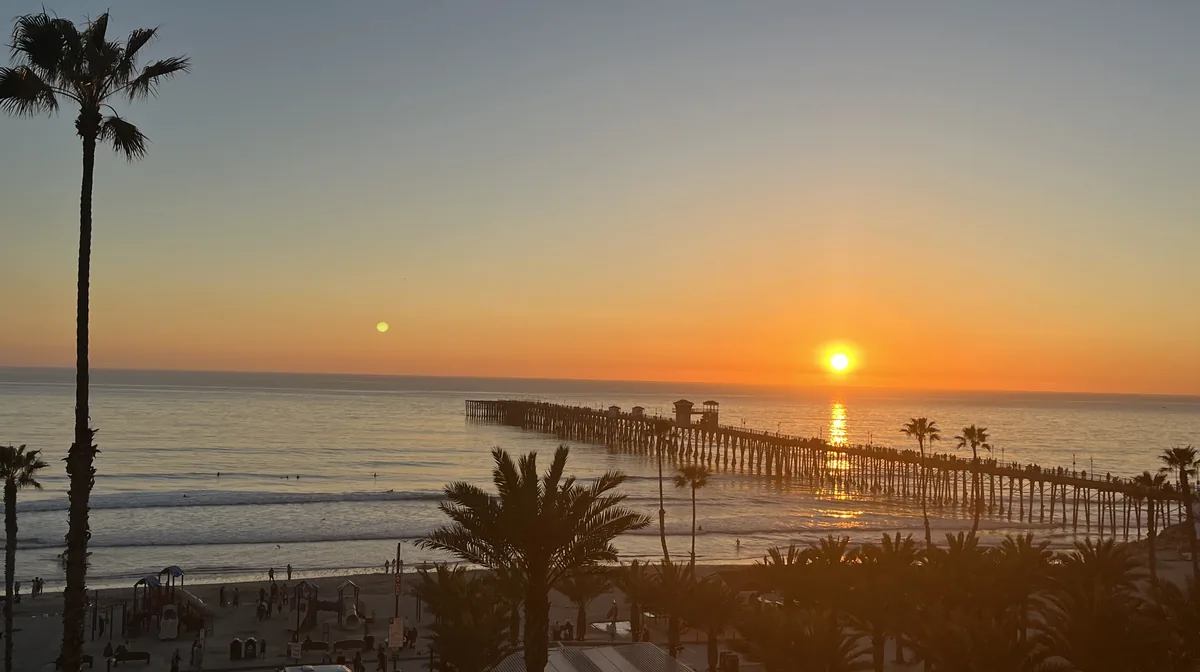
The sun setting beyond Oceanside Pier, with palms along the beach below, Oceanside, California
Why Cavmir

The Cavmir Advantage
in Oceanside

Cavmir treats each Oceanside rental as a small hospitality business with a guest of its own: the Strand house a Phoenix family rebooks for the same July week, the South Oceanside cottage where couples walk to coffee and Buccaneer Beach, the harbor condo that suits a race weekend or a day of fishing, the house up the valley with room for a Marine's family on a visit. Our work is reaching the travelers who already want Oceanside, the Los Angeles family riding the Surfliner down for a long weekend, the triathlete who needs a safe place for a bike, the couple planning a winter month near the water, in every place they look: a Google search, an AI assistant's answer, or an email from you about next summer's dates.

State of the Industry · History

The Oceanside STR Market — Past & Present

Long before Oceanside had a name, the San Luis Rey valley was home to the ataaxam, the name the San Luis Rey Band of Mission Indians uses for its people. The Band says its people have always occupied the valley, from the coastline and the lagoons to the oak woods, meadows and springs inland, and that the name San Luiseño was imposed on them by the missionaries. Father Fermín Lasuén founded Mission San Luis Rey de Francia in 1798, the 18th of California's 21 missions, and the Band's own history records that many ataaxam people suffered and died from European diseases and forced labor in the mission era. The mission's property was secularized in 1834. Today the Band, based in Oceanside and part of a coalition with six other Luiseño and Cupeño tribes, works to preserve its culture and share it with the generations to come, and the mission is an active parish of the Franciscan Friars of the Province of Saint Barbara and a National Historic Landmark, with a museum open every day.

The town grew up with the railroad. Construction on a line from Riverside to San Diego began in 1882, Andrew Jackson Myers applied for a homestead grant on the land that is now downtown in 1883, and Oceanside incorporated on July 3, 1888, the year its first train depot and its first pier were built. The city has built its pier six times. The first stood at the end of Couts Street until a storm destroyed it; a second followed at the end of Third Street in 1894, a third in 1903 with railroad steel for pilings, a fourth in 1927 and a fifth in 1947, and the sixth, today's, was dedicated on September 9, 1987. Visit Oceanside puts its length at 1,954 feet. The Strand along the beach was paved in 1928, and the amphitheater at the foot of the pier, first built in 1919, was dedicated in 2012 to the memory of Junior Seau, the Oceanside local who played for the San Diego Chargers.

Two projects in the middle of the century shaped the modern city. In 1942 the Marine Corps bought Rancho Santa Margarita y Las Flores, the ranch on the city's northern side, for $4,239,062, and President Franklin D. Roosevelt dedicated Camp Pendleton on September 25 that year. The base is named for Major General Joseph H. Pendleton, a World War I officer who had long argued for a West Coast training base. It covers more than 125,000 acres and holds the largest undeveloped stretch of Southern California's coast; more than 42,000 active-duty personnel are assigned there, more than 38,000 family members live in base housing, and the base counts Oceanside among the eight neighboring cities its families rely on for goods and services they can't find on base. Oceanside counted 21,000 residents in 1960 and 38,000 by 1969. Ground was broken for the harbor on February 6, 1961, and the small-craft harbor opened in June 1963, with an all-caps OCEANSIDE sign greeting the boats since the 1960s. Later milestones include the SPRINTER line to Escondido in 2008, the California Surf Museum's move to Pier View Way in 2009 and the state's designation of a cultural district in Oceanside in 2018.

Today the rental market is large, coastal and still growing. AirROI tracks 1,252 active listings, 9 percent more than a year earlier, 99 of them private rooms, and the average one took in about $63,100. A city staff report described by North County Pipeline in January 2024 put 749 short-term rentals in the coastal zone and 283 outside it, and since 2024 the rules have treated the two areas differently. In the coastal zone a new non-hosted rental can still apply for a permit, which comes with an inspection and a tax certificate, and no permit anywhere in the city passes to a buyer. The gaps we look for first in an Oceanside listing are the expensive ones: a beach listing that never says how many steps it is to the sand or which side of the street the house is on, a condo that calls a partial view oceanfront, more guests advertised than the city's formula of two adults per bedroom plus two allows, an inland house whose permit won't survive a sale, nothing priced for the long winter stays, and no way for last summer's families to rebook without a platform in between.

Pricing Strategy & Seasonality

Pricing, Seasonality & When to Capture ROI

Pricing Strategy

Oceanside rates climb with every bedroom, and revenue takes its biggest step at three. By size, AirROI's average nightly rates run $216 for a studio, $255 for one bedroom, $366 for two, $528 for three, $659 for four and about $1,152 for five or more. Annual revenue shows where the jump comes: median one- and two-bedroom listings earned about $37,300 and $40,800, almost the same, while the median three-bedroom earned $74,500, four bedrooms $104,000 and five or more $179,000. Market-wide, $305 a night sits at the middle, $480 marks the entry to the top quarter, $755 the top tenth, and $210 or less the bottom quarter; the single top earner in AirROI's data, a nine-bedroom house, took in about $507,000 at about $2,170 a night and 60.5 percent occupancy. The amenity data follows the coast and the climate. Listings with a fire pit earned about $92,200 a year against $49,300 for those without, listings with beach access $74,700 against $44,700, and listings with air conditioning $73,700 against $43,500. These are averages for the listings that have each feature, and those listings differ in other ways too, so read them as a guide to what guests value rather than a price list for upgrades: the water, a fire outside after dark and a cool bedroom in August.

The calendar does most of the pricing work. In AirROI's seasons, June through August brings about $10,700 a month per listing at 64 percent occupancy and $468 a night; March and May, the shoulder, about $6,560 at 52 percent and $379; and the other seven months about $5,260 at 48 percent and $350. Summer lifts both numbers at once: July 2026 averaged $519 a night at 66.9 percent occupancy, while February averaged $356 a night and January filled only 41.7 percent of its nights. The average booking arrives 58 days before check-in, about 90 days for July 2026 stays and only about 41 for February. Stays are long, 6.7 nights on average across AirROI's bookings, ranging from about 4.7 nights in August and October to 7.3 in January; most listings that name a check-in time pick 4 p.m., and checkout is usually 10 a.m.

Two pricing habits work against Oceanside owners: pricing a summer week like a weekend, and fees that make the total look padded. If your summer guests come from Phoenix, Las Vegas and Los Angeles, as AirROI's origin data suggests many do, sell them a week: set summer minimums that match the trip, price the week as one product and show the full total early. Nine in ten listings, 90.3 percent, add a cleaning fee; the median fee is $276 and the average $703, and spread across the average stay that comes to about $40 a night, or 11.8 percent of gross revenue. Of AirROI's review categories here, value scores lowest, 4.74 against 4.84 overall, so a total that feels padded costs stars. Minimum stays cluster at two nights, 43 percent of listings, and three nights, 23 percent. Nine percent still accept one night, which sits badly with the two-night minimum in the city's Good Neighbor Policy, and 10 percent ask for 30 nights or more, a separate product with its own guests.

Seasonality & ROI Windows

Seasonality here is moderate, with summer on top. In AirROI's two-year average, July brings in about 2.7 times January's revenue, and the three strongest months, June through August, account for 39 percent of the year. Summer belongs to families, driving in from Los Angeles and the desert cities or riding the train, and the Fourth of July is the peak inside the peak; in 2026 MainStreet Oceanside's Independence Parade celebrated the country's 250th birthday. The pier keeps its own traditions through the year, from the World Bodysurfing Championships, held for the 49th time in 2026, to the Labor Day Pier Swim, a one-mile swim around the pier whose 97th edition in 2026 was called off because of a forecast of large surf. September and October 2025 both ran above 51 percent occupancy at $368 to $378 a night. Winter is the low stretch, with January the weakest month, but January's guests also stay the longest.

Three parts of the calendar are easy to underprice. The first is winter. January stays averaged 7.3 nights and booked about 46 days ahead, and guests settling in for a week or a month want a weekly and monthly rate, a real workspace, a heater that works and a kitchen set up for cooking; a stay longer than 30 consecutive days also falls outside the city's definition of a short-term rental. The second is the event calendar. IRONMAN 70.3 Oceanside swims in the harbor, rides through Camp Pendleton and finishes on the Strand, and its April 3, 2027 race had sold out general registration by October 2026; the O'side Turkey Trot is based at the Civic Center on Thanksgiving morning, November 26, 2026. Athletes and their families book around those dates and want parking, a safe place for a bike and a flexible checkout. The third is Camp Pendleton next door. Visits from family follow the Marines' schedules rather than the beach season, so a house that states its drive time to the base and has room for parents, siblings and children can win those stays from the hotels.

Regulation & Licensing · 2026

What the Law Requires in Oceanside

Oceanside writes its own rules, and where a house sits on the city's map decides which of them apply. A short-term rental is a legally permitted dwelling, or part of one, rented for no more than 30 consecutive days; bed and breakfasts, hotels, motels and timeshares are excluded. The rules sit in Chapter 24 of the City Code, with the occupancy tax in Chapter 34, Article III. The City Council first adopted short-term rental rules on June 19, 2019, with Ordinance 19-OR0408-1, and amended them twice in 2024. A hosted rental is one where the owner lives in the house as a principal residence and stays on site while renting part of it; anything else is non-hosted. Hosted rentals are allowed in every zoning district, and the map matters for the rest. Ordinance 24-OR0844-1, adopted on January 10, 2024, and in force since February 10, 2024, bars new non-hosted rentals outside the coastal zone; a permit issued there before that date can be renewed while it stays in good standing but not after the property sells. Inside the coastal zone, short-term rentals remain allowed throughout for now, because the city's changes there take effect only once the California Coastal Commission certifies them as an amendment to its Local Coastal Program. The city's zoning map viewer shows which side of that line a parcel is on.

That certification is still pending. On May 8, 2024, the council adopted Ordinance 24-OR0207-1, whose coastal provisions would cap non-hosted permits at 480 in residential zones west of Coast Highway, not counting hosted and permit-exempt units, and allow no new non-hosted permits in the R-1 zone. Existing permits could keep renewing unless the owner adds habitable square footage or the property changes hands, and the city's FAQ says the amendment would also require a permit for every coastal rental, hosted ones included. The city sent the amendment to the Commission in late summer 2024; it was filed in the Commission's San Diego district office on October 9, 2025, as LCP-6-OCN-25-0019-1, and in a memo dated November 20, 2025, for the Commission's December 10 meeting, staff recommended extending the 60-day deadline to act by one year, citing insufficient staff time to review it. The city's FAQ, updated June 30, 2026, still describes the cap as awaiting certification. Other parts of the same ordinance took effect on June 7, 2024: a clearer annual renewal, a permit for hosted and non-hosted owners alike outside the exemptions below, a ban on tenants offering their homes and higher fines.

Every short-term rental now needs a city permit, with two exceptions: a unit in a gated homeowners association of at least 50 units that meets the parking requirements and has 24-hour security or on-site management, and, until the coastal amendment is certified, a hosted unit in the coastal zone. Even an exempt rental has to register for the transient occupancy tax. The process starts with a TOT certificate through MUNIRevs, the city's online portal; Planning staff then review the zoning and eligibility, hosted owners sign a primary-residence affidavit, and property managers file their management agreement. The permit costs $250 a year, and a property inspection costs $220 at the first application and at least every three years after; none of the fees are refundable. Permits don't transfer, so a new owner starts a new account, and a city business license is required only for residential rental properties of five units or more. Some properties can't be rentals at all: homes in mobile home parks, homes on non-conforming panhandle lots, and any property with an accessory or junior accessory dwelling unit permitted on or after September 9, 2017, in which case neither the unit nor the main house may be rented short term. Tenants can't offer a rental, and the city doesn't enforce private CC&Rs, so your homeowners association's rules apply on top of the city's.

The operating rules are specific. Occupancy is capped at two adults per bedroom plus two more people per unit, children included, so a three-bedroom house sleeps eight; up to ten daytime visitors may come between 7 a.m. and 10 p.m. Section 24.7(n) of the City Code sets quiet hours from 10 at night to 10 in the morning, when no amplified sound or other disturbing noise may be heard from the property line. The city's Good Neighbor Policy asks owners to use the garage and driveway for guests' cars first, keep trash out of sight except on collection day, post the permit and TOT registration numbers outside the unit with an emergency contact number, set a two-night minimum, have guests sign a written acknowledgment of the rules, stay reachable around the clock and respond to complaints from the city or neighbors within 60 minutes. A rental with three verified complaints is referred automatically to the City Attorney's Office, and violations can bring administrative fines, misdemeanor prosecution, civil nuisance abatement and the suspension or revocation of the permit; the city also runs a 24-hour complaint hotline. On top of the rent, guests pay the city's 10 percent transient occupancy tax under Section 34.15 and the Oceanside Tourism Marketing District assessment, 1.5 percent of room revenue for short-term rentals and 2.5 percent for hotels, stated separately on the bill. Returns are due monthly or quarterly by the last day of the following month, every period needs a return even when it's $0, and late payments can draw a 10 percent penalty plus interest. The city has voluntary collection agreements with Airbnb and Vrbo, and Airbnb's California tax page lists Oceanside's 10 percent tax and the assessment among the charges it adds to stays there of 30 nights or fewer, with the cleaning fee taxed along with the rent; owners who rent only through those platforms still register, file a zero return for each period and ask the platform for proof that it paid, and direct bookings are yours to collect and report. This is orientation, not legal advice: confirm the current rules with the city's Planning and Business License staff and your homeowners association before you list. Cavmir's part is the marketing; the permit, the inspections and the tax filings remain with you and your local professionals.

Market-Specific Tips & Challenges

Local Tips & Unique Market Challenges

Tips That Actually Move Revenue in Oceanside

First, describe the sand exactly. In Oceanside, beach access is common, listed by 61 percent of AirROI's listings, so it can't carry the pitch. Precision does: whether the house is on the Strand itself or a block or three back, how many steps it is to the sand and whether there are stairs, which rooms see the water, and whether the view is the open Pacific or a slice between buildings. Waterfront and ocean-view listings out-earn the rest by wide margins in AirROI's data, which is exactly why guests check the claim, and accuracy scores 4.85 across the market. Lead with the view from inside the house, show the walk to the beach next and the pier or the harbor you can actually see after that, and spell out parking, since the city's policy wants guests' cars in the garage and driveway first. The same plain facts feed vacation rental SEO and the AI assistants guests now ask.

Second, build the summer week for the desert drive market. Phoenix, Las Vegas and Tucson are three of AirROI's top five origin cities, and families coming from that heat want what a beach house can give them: air conditioning, which 65 percent of listings have, a shaded patio and a fire pit for the evening, chairs, an umbrella and boogie boards by the door, an outdoor shower, parking for the car they drove in and a washer for a week of sandy towels. Sell the week as a single product with a weekend changeover, a total that includes every fee and a first-refusal offer on the same week next year. Pets count here too: 38 percent of listings allow them and earn about 63 percent more on average, and a family making a long drive may well bring the dog. Check the guest count against the city's formula before you promise room for the grandparents.

Third, build the off-season before it arrives. From November through February, AirROI's nightly rates ran about $356 to $380 and occupancy about 42 to 50 percent, but stays were long, and winter guests are easy to please when the house is ready: a weekly rate and a monthly rate, a desk and fast wifi, heat that takes the chill off a gray morning, and a kitchen that works for cooking every night. A stay of more than 30 consecutive days falls outside the city's short-term rental definition, and the city's tax portal treats night 31 onward of one uninterrupted stay as exempt from the occupancy tax, with the first 30 nights exempt only under a written agreement for the longer stay that is in place from the first day. That makes a month-long product worth a look for houses the rules otherwise squeeze, including inland homes that can't get a new non-hosted permit; ask the city how it treats your case before you rely on it. Fill in the year with the event weekends too: IRONMAN 70.3 in the spring, the Turkey Trot on Thanksgiving, the Sunset Market every Thursday evening and the mission museum for a rainy afternoon.

Fourth, make the second booking easier than the first. In Oceanside the guest worth the most is the Phoenix or Los Angeles family that wants its same July week back every year, and each rebooking made on a platform hands that platform another fee. Bring those returns home instead: a fast direct-booking website and a note each fall offering last summer's families their week before the calendar opens to everyone. The competition sets a high bar: AirROI's Oceanside listings average 4.84 stars, 46 percent carry Airbnb's Guest Favorite badge, 77.2 percent belong to Superhosts and about 46 percent take Instant Book. The details that protect those stars are operational: the permit and emergency number on the outside of the house, a house manual that covers the 10 p.m. quiet hours up front, a phone answered within the hour, as the city requires, and door codes that work the first time for a family arriving late on a Friday from Los Angeles.

Unique Oceanside Challenges

Regulation is the first constraint, and it decides what a buyer is really buying. Outside the coastal zone, no new non-hosted permit is available and an existing one ends at sale, so an inland house marketed as a turnkey rental can't carry its non-hosted permit to a new owner. Inside the coastal zone a buyer can still apply for a new permit today, but the pending amendment would cap non-hosted permits west of Coast Highway at 480, allow no new ones in the R-1 zone and end permits when the property sells or the owner adds habitable space, and the city's mid-2026 FAQ still lists it as awaiting certification. Before you buy, check the parcel on the city's zoning map, ask Planning whether it sits west of Coast Highway and in which zone, read the homeowners association's rules, look the address up in the city's STR directory, which updates in real time, and its short-term rental and TOT map, updated monthly by the 20th, and run the numbers twice: with a permit, and as a rental of more than 30 nights.

The coast asks for care. Salt air, sand and summer crowds wear a beach house quickly, and a home that sleeps eight under the city's formula, with up to ten more visitors by day, sees a lot of traffic; budget for it. Carry insurance written for short-term rental use, look up the parcel's flood zone, and put the stairs, the parking and the quiet hours in plain words in the listing. Distance is the other risk. An owner in Los Angeles, Orange County or Arizona may see the house a few times a year, and that's how listings go stale: photos from three summers ago, replies that wait until morning, a January calendar still priced like July. With complaints to answer within 60 minutes at any hour, a reliable operations partner and current marketing are part of the cost of owning here.

The competition is large and professional. AirROI counts 1,252 Oceanside listings, up 9 percent in a year; 28.8 percent are professionally managed, 12 management companies with five or more listings run 36 percent of the market, and the top ten hosts alone run a quarter of it. In AirROI's monthly figures the top quarter of listings earns $9,410 or more while the bottom quarter earns $3,250 or less, so standing still costs money. The beach hotels want the same guest, among them the Mission Pacific Hotel overlooking the pier, and Carlsbad next door adds 651 more listings in AirROI's count. A house wins that comparison with what no hotel room has: a kitchen, a deck or a yard, a bedroom for each part of the family and its own front door near the sand, as long as the first lines of the listing say so.

A Curious Oceanside Fact
A house the Oceanside Historical Society calls a favorite landmark of residents and visitors began as a summer getaway for an inland family. The society says the Victorian cottage on North Pacific Street was built in 1888, the year the city incorporated, as a summer home for Dr. Henry Graves of Riverside. In 1985 Paramount Pictures rented it for two weeks, and it appeared in Top Gun as the home of Charlotte 'Charlie' Blackwood, played by Kelly McGillis. The society calls it the last oceanfront Folk Victorian cottage in San Diego County, and the Inland Empire is still a Metrolink ride away: the Inland Empire–Orange County line ends at the Oceanside Transit Center.
Finance Essentials — Oceanside
🛡️

Insurance

Insurance for an Oceanside rental starts with telling the carrier exactly how the house is used. The policy should be written for short-term rental use, either a rental policy or a homeowner policy with a rental endorsement, carry liability limits that match the full overnight occupancy plus up to ten daytime visitors, and cover water damage and wind for a house this close to the ocean; add flood coverage if the parcel is in a mapped flood zone, and make a clear choice about earthquake coverage. Keep the permit and inspection paperwork ready for the carrier, and get quotes from a San Diego County broker who insures beach homes before you make an offer.

🧾

Property & Income Tax

Rent is taxable income at both the federal and the state level, so keep a clean ledger from the first booking. Guests pay Oceanside's 10 percent transient occupancy tax and the 1.5 percent Tourism Marketing District assessment for short-term rentals; Airbnb collects both on its Oceanside reservations of 30 nights or fewer, and the city has a collection agreement with Vrbo as well. You still register with the city, file a return every period, a zero return when the platforms paid everything, and keep proof of what they remitted, and on direct bookings the collecting and filing are yours. Ask the San Diego County assessor's office how a rental is treated for property tax before you set a budget, and use an accountant who works with California short-term rentals.

🏦

Mortgages & Financing

Lenders will price the loan by how you use the house, second home or investment property, and beachfront or larger homes often need jumbo financing. Bring them a revenue model with a summer peak and long winter stays rather than a flat monthly average. Zillow put Oceanside's typical home value at about $865,000 at the end of September 2026, up 1.6 percent on the year, with a median sale price of about $880,000 in August and a median of 23 days to pending; by neighborhood, its typical values included about $720,000 in San Luis Rey, $897,000 in Loma Alta, $1.15 million in Townsite and $1.34 million in Morro Hills. Underwrite the permit as well: no Oceanside permit passes to a buyer, inland a non-hosted rental can't restart after a sale, and the pending coastal cap could close the door west of Coast Highway, so model the purchase with a permit and without one.

Future Outlook · 2027 & Beyond

Where Oceanside is Headed Next

The long-run case for Oceanside rests on things that don't move. Camp Pendleton has a daytime population of about 70,000 military and civilian personnel, the Transit Center links the city by rail to Los Angeles, Orange County, the Inland Empire and San Diego, and the beach, the pier and the harbor don't depend on any platform's search ranking. The biggest opportunity ahead is the 2028 Olympics. Visit Oceanside lists Trestles Beach among the LA28 venues and is already pitching the city as a base for it, describing Oceanside as home to USA Surfing's training grounds. It hasn't posted event dates yet, so treat 2028 as something to plan for, not revenue to count on.

What could squeeze returns is mostly local. Once certified, the coastal amendment would cap non-hosted permits west of Coast Highway at 480 and close the R-1 zone to new ones, and inland, the non-hosted supply already shrinks with each sale of a permitted house. The city runs a 24-hour complaint line and sends any rental with three verified complaints to the City Attorney, so enforcement has teeth. Review insurance, cleaning contracts and carrying costs every year. A well-run house can live with all of it, as long as the permit renewals, the inspections and the tax returns are done on time.

Search is changing too. Some Oceanside trips now begin as a question to an AI assistant, and the questions are specific: which houses sit on the Strand, which sleep ten under the city's limit, where a family parks two cars, how long the drive is to the harbor or the Camp Pendleton gate, and what a January month costs. The rentals that get named tend to be the ones whose own sites answer in plain words, on pages quick enough for an assistant to read; the steps are in our generative engine optimization guide for rental owners. Families, race travelers and military visitors all plan this way, so one set of clear answers serves all three.

From the Desk of Sofie Sinag

Why We Love Marketing in Oceanside

Oceanside sells best when the listing sticks to facts. The city has built its pier six times, its harbor sign has greeted boats since the 1960s, a mission founded in 1798 stands up the river valley, and downtown's Pier View Way holds both the surf museum and, since 2007, the Thursday market. A listing that names those things, and the minutes on foot to each, draws the traveler who wants Oceanside in particular, and that traveler is the likeliest to return.

What I love about Oceanside work is that one city sells five different trips. July belongs to the families on the Strand, early spring to the triathletes at the harbor, Thanksgiving to the runners at the Civic Center, January to the couple who wants a month of quiet beach walks, and every month to the families visiting a Marine at Camp Pendleton. Sell each of those trips by name and each one gets its own price, instead of the whole year being priced as one season.

And the material is generous. A Victorian cottage built in 1888 for a Riverside doctor that became Charlie's house in Top Gun, an amphitheater from 1919 dedicated to an Oceanside local who played for the Chargers, a lagoon that a weir turned into a freshwater lake where more than 200 bird species have been recorded, and the first California pepper tree on the mission grounds: that's more story than any welcome book has room for. None of it needs embellishing. My part is finding the true story an owner walks past every day, saying it in plain words and showing it to the people already searching for it.

Cavmir's Oceanside Cheat Sheet

The Picks We Recommend for Your Welcome Book

What goes in an Oceanside welcome book we'd write: places a local would send a friend, with the hours, addresses and small details that save guests a search and come back later as five-star reviews.

Morning

The pier at first light

The pier runs 1,954 feet out from downtown, and today's, the sixth, was dedicated in 1987. A bait shop halfway out rents rods and sells tackle and bait, and whales and dolphins are sometimes spotted from the end. On the way back, the amphitheater at its foot dates to 1919 and was dedicated to Junior Seau in 2012.

Dinner

Valle

Chef Roberto Alcocer's modern Mexican tasting menu at the Mission Pacific Hotel, 222 North Pacific Street, overlooking the pier. The name nods to the Valle de Guadalupe in Baja California, and the MICHELIN Guide calls the tasting menu imaginative. The guide lists dinner from Tuesday to Saturday, booked through Tock; reserve early for anniversaries and birthdays.

Second Night

Dija Mara

Indonesian, Thai and Vietnamese cooking at a moderate price at 232 South Coast Highway, one of the Oceanside restaurants listed in the MICHELIN Guide, which singles out the nasi goreng and a charred eggplant with smoked tomato sambal. It makes an easy second-night dinner after a tasting menu; check current hours before you send guests.

Surf History

California Surf Museum

At 312 Pier View Way, with the store and exhibit hall open every day, 10 a.m. to 4 p.m. Founded in 1986, it moved to this downtown location in 2009, and its current exhibit, Surfriding: Hawaiian Royalty's Gift to the World, follows the Hawaiian royals who took surfing around the globe. An easy hour before or after the beach.

History

Mission San Luis Rey

Founded in 1798 as the 18th of California's 21 missions and still an active parish run by the Franciscan friars. The museum opens every day from 10 a.m. until 4 p.m.; admission is $8 for adults, and active military and their dependents get in free, a detail worth passing on to families visiting Camp Pendleton. A free app guides an eight-stop self-guided tour, and the first California pepper tree grows on the grounds.

Thursday

The Sunset Market

Every Thursday from 5 to 9 p.m., all year, on Pier View Way west of Freeman Street and across Coast Highway downtown, with up to 240 food and retail booths and live entertainment. It has been in this spot since 2007. Guests who drive can park free in the Civic Center structure at 300 North Coast Highway; anyone staying downtown can simply walk.

Birding

Buena Vista Audubon Nature Center

On the Buena Vista Lagoon in South Oceanside, a state ecological reserve since 1968 where more than 200 bird species have been recorded. A weir at the mouth turned the lagoon into a calm freshwater lake, and the center's upstairs viewing deck and shoreline trail make an easy morning with binoculars.

On the Water

Helgren's Sportfishing

Half-day and full-day fishing trips from Oceanside Harbor, 1395 North Harbor Drive, from $75, plus private charters that can be set up for anything from a private fishing trip to a bachelor party. The company cites more than 40 years of experience and runs two boats; book before the guests arrive.

Golf

Arrowood Golf Course

A public 18-hole, par-71 course of 6,721 yards by Ted Robinson Jr., on a hilltop by the San Luis Rey valley about ten miles from the coast and next to Camp Pendleton. The Flight Deck adds Toptracer range technology and virtual courses for a gray day, and Fairways Kitchen & Bar is on site.

Inland Day

South Morro Hills and Guajome Regional Park

Visit Oceanside counts about 3,800 acres of family farms, wineries and stables in the South Morro Hills, cooled by breezes off the ocean, and Guajome Regional Park, in the same inland valley, has trails and picnic spots under the trees. A good half day for guests staying a week.

Harbor Afternoon

Harbor Beach and Harbor Village

The harbor at the city's northern edge opened in 1963. Harbor Beach has fire rings, volleyball courts, a playground and lifeguard towers; Harbor Village's shops and restaurants are built to recall a New England seaside town; and the OCEANSIDE sign has greeted boats since the 1960s. Seals and sea lions can often be seen resting on the docks.

Website Design · Oceanside

A Website for an Oceanside Vacation Rental

Guests who find an Oceanside rental on Airbnb search its name afterwards, and the page they should land on is the owner’s own site. Cavmir builds vacation rental websites of 40 to 125 pages in the owner’s brand. For a home that only lists on Airbnb, that is a website for your Airbnb: your name and domain, your photos, your area guides and your reviews, with a button that sends guests to the listing. For homes on Hostaway, Guesty or Hospitable it is a direct booking website: live availability and prices from the PMS, the whole stay priced before checkout, and the booking completed in the PMS. Both start from the same vacation rental website design, run the TrollBuster™ compliance scan before launch, and are yours at launch: domain, code, content and photos.

The guide pages of an Oceanside site can start with the picks on this page: the pier at first light, the California Surf Museum and Mission San Luis Rey. Each one is a search a guest makes before choosing a home, and each becomes a page that leads to the booking button.

Packages start at $1,475 for the Starter Website (40 pages, two to three weeks) and run to $3,732 for Full with Direct Booking (125 pages, booking synced with your PMS); the current prices are on the pricing page.

Local Playbook · Three Property Types

How Cavmir Markets Oceanside Properties

Three property types that do well in Oceanside, a common starting point for each, and the plan Cavmir builds for it.

5BR Beach House · the Strand
The Situation

A house on the sand near the pier that lists as a generic 'Oceanside beach house,' opens with a photo of the kitchen instead of the view, advertises beds for fourteen against the twelve the city's formula allows for five bedrooms, keeps the same two-night minimum all summer and sits half empty from November to February.

The Plan

Start with the paperwork, so the permit's five bedrooms and the listing's guest count of twelve agree, then rebuild the listing around the sand: the deck's ocean view as the first photo, the number of steps to the beach written out, where the cars go, and the pier and the Strand in the guidebook. Sell July and August as full weeks for families from Los Angeles and the desert cities, with a same-week-next-year offer, and build a winter weekly and monthly rate with a desk and fast wifi in the photos. Then give returning families a direct-booking site and an email before next summer's dates open.

What It Targets

Aimed at a higher summer weekly rate, a guest count inside the permit and longer winter stays. Track July and August weekly revenue, November to February occupancy and stay length, accuracy and value scores, and the share of repeat and direct bookings.

2BR Cottage · South Oceanside
The Situation

A small house a few blocks back from the beach that competes on price with beachfront condos it can't match on view, never mentions Buccaneer Beach, the lagoon or the coffee and vintage shops nearby, and empties out after Labor Day.

The Plan

Recast it as a South Oceanside base for couples and small families: walking times to Buccaneer Beach and the Buena Vista Lagoon, a short neighborhood guide to the coffee, vintage shops and restaurants, a Sunset Market evening, offers built around the IRONMAN weekend and Thanksgiving's Turkey Trot, a midweek rate from September to May, and search content for South Oceanside queries that leads to a direct-booking page.

What It Targets

Meant to fill the shoulder months and event weekends at a steady rate rather than fight beachfront homes for July. Watch September to May occupancy, midweek nights booked, event-weekend rates, search visits for South Oceanside terms and the number of direct bookings.

3BR House · the San Luis Rey valley
The Situation

A family house outside the coastal zone with a non-hosted permit issued before February 2024, which can be renewed while it stays in good standing but not after a sale; its listing calls it a beach house, shows no air conditioning, takes one-night bookings and has no plan for the day the owner sells.

The Plan

Keep the permit in good standing and plan around its limits. Market the house as what it is, with space, a yard, air conditioning and parking in the first photos, accurate drive times to the beach, the harbor, the mission and the base, a two-night minimum in line with the city's policy and a week-long family product for summer. Build a second product for stays of more than 30 nights for families moving to or visiting Camp Pendleton, and set a plan for the house after a sale, when the permit can't follow it.

What It Targets

Aimed at steadier occupancy with fewer one-night turnovers and a business that still works without the short-term permit. Track occupancy, average stay length, the share of bookings over 30 nights, review mentions of space and comfort, and complaint calls.

FAQ

Oceanside Airbnb Marketing:
Questions, Answered

Does Cavmir offer Airbnb marketing services in Oceanside?

Yes. Cavmir markets rentals across Oceanside, from the Strand and South Oceanside to the harbor and the San Luis Rey valley. In practice that means the brand and the words on the listing, photo direction, search and paid campaigns, and a direct-booking website of the owner's own, for beach houses, condos near the pier and the harbor, and larger family homes inland alike. We don't manage properties, so cleaning, upkeep and day-to-day guest care stay with you or your property manager.

What do short-term rentals earn in Oceanside?

Over the year to September 2026, AirROI's figures show the average Oceanside listing taking in about $63,100 at $413 a night with 49.5 percent of nights booked, 11.2 percent more than the year before. Results spread widely: in a typical month half the listings earn under about $5,610 and the top quarter $9,410 or more, while homes with five or more bedrooms reach a median of $179,000 a year. Use these as a benchmark rather than a projection; what a specific house earns depends on its product, its photos and its pricing.

When is demand highest for Oceanside rentals?

In summer. July earns the most, and occupancy in June, July and August ran between 64 and 67 percent in 2026. Outside summer, March was the strongest month, the IRONMAN 70.3 race brings triathletes to the harbor on April 3, 2027, September and October stayed above half full in 2025, and Thanksgiving brings the Turkey Trot. January is the slowest month, but its guests stay longest, about 7.3 nights on average.

Are short-term rentals regulated in Oceanside?

Yes, closely. Every rental of 30 consecutive days or fewer needs a TOT certificate, and most need a city permit, $250 a year plus a $220 inspection at least every three years. Outside the coastal zone no new non-hosted rental can open, and existing non-hosted permits there end when the house sells; inside it, a cap of 480 non-hosted permits west of Coast Highway is waiting on the California Coastal Commission. Occupancy is two adults per bedroom plus two, quiet hours run from 10 p.m. to 10 a.m., and complaints must be answered within 60 minutes. Confirm the details with the city before listing; Cavmir's role is marketing, and it doesn't give legal or permit advice.

Does Airbnb collect the occupancy taxes on Oceanside rentals?

Yes. The city has voluntary collection agreements with Airbnb and Vrbo, and Airbnb lists Oceanside's 10 percent transient occupancy tax and the Tourism Marketing District assessment, 1.5 percent for short-term rentals, among the charges it collects on reservations of 30 nights or fewer. You still register with the city, file a return for every period, a zero return when the platforms paid it all, and keep proof of what they remitted. On direct bookings you collect and report both yourself.

Can I start a new non-hosted rental in Oceanside?

It depends on where the house is. Outside the coastal zone, the city has barred new non-hosted rentals since February 10, 2024, though a hosted rental, where you live in the house and stay on site, is allowed in every zone. Inside the coastal zone you can still apply today, but the amendment the city adopted in May 2024 would cap non-hosted permits west of Coast Highway at 480 and allow no new ones in the R-1 zone once the Coastal Commission certifies it. Check the parcel on the city's zoning map and talk to Planning before you buy.

If I buy an Oceanside house with a short-term rental permit, does the permit come with it?

No. Oceanside's permits are non-transferable, so a new owner opens a new account. Outside the coastal zone, a non-hosted permit issued before February 10, 2024 isn't renewed after a sale, which means the buyer can't keep running the house as a non-hosted rental. Inside the coastal zone the buyer applies again, and once the pending amendment is certified, that application would fall under the 480-permit cap west of Coast Highway, with no new non-hosted permits in R-1. Price the house both with a permit and without one.

How much does Airbnb marketing cost for an Oceanside property?

It comes down to what the house needs. The monthly plans and the one-time projects are set out on our pricing page, and the usual first step for an Oceanside house is a full listing rebuild or the 12-step system. A first conversation about your property is free: get in touch with Cavmir.

Free Property Review

What is your Oceanside property actually worth per night?

Send us the listing and we'll tell you what we'd change. Not a pitch deck — a straight read on your photos, your title, your rates against the Oceanside comp set, and whether a direct-booking site would pay for itself.

You'll hear back from a person, usually inside one business day. If we don't think we can move your numbers, we'll say so. Cavmir is a short-term rental marketing agency — we position and market properties, we don't manage them.

  • No obligation, and no automated call sequence
  • We market and position — we never manage your property or hold keys
  • Works whether you're on Airbnb, Vrbo, or direct

Market Intelligence · Seasonality

Airbnb seasonality in Oceanside, month by month

Demand in Oceanside peaks around July and runs quietest around January, February and November. Here is how the year actually books — and what to do about each stretch of the calendar.

Peak demandSteadyQuiet

Peak season

Oceanside's high season is June through August, and July earns the most of any month. Families plan those weeks early, with July stays booked about three months out, so open next summer's calendar in the fall, hold weekly rates firm and set minimums that fit a family vacation. Finish the beach photos, the parking details and the listing copy before spring break.

The shoulders

March, May, September and October keep the calendar moving between the busy and quiet stretches. March is the strongest month outside summer, the IRONMAN 70.3 race brings triathletes to the harbor in the spring, and fall stays busier than winter. Offer midweek rates to couples, price race and holiday weekends as their own products, and aim weekend offers at Los Angeles and Orange County travelers who can come on short notice.

The quiet stretch

November through February is the quiet stretch, with January the slowest month, but stays get longer instead of disappearing. Build weekly and monthly rates, show a desk, fast wifi and a warm house in the photos, and keep pricing open late, since winter guests book closer to arrival. Thanksgiving week and the holidays add a lift, and January is the time to refresh photos and send last summer's families next year's dates.

Dates that fill first

IRONMAN 70.3 OceansideApril
The race swims in the harbor, rides through Camp Pendleton and finishes on the Strand; the 2027 race is set for April 3 and its general registration sold out months ahead, so open race weekend early and sell parking and bike storage.
Oceanside Independence ParadeJuly
MainStreet Oceanside's Independence Parade celebrated the country's 250th birthday in 2026; the Fourth of July is the top of the summer, so price that week as its own product.
Labor Day Pier SwimSeptember
A one-mile swim around the Oceanside Pier with traditional and wetsuit divisions, now close to a century old; the 2026 swim was cancelled for big surf, but the holiday weekend still closes the summer and deserves summer rates.
O'side Turkey TrotNovember
A Thanksgiving morning run from the Oceanside Civic Center with 5K, double 5K and kids' races, set for November 26 in 2026; it gives the holiday week a reason to book, so market it to families who make the race a tradition.
Market Intelligence · Guests

Who books Oceanside Airbnbs — and how far ahead

Desert-city summer families
Families from Phoenix, Las Vegas and Tucson who drive to the coast for a summer week. They want air conditioning, parking, beach gear and room for everyone, and they come back to a house that worked for them.
Los Angeles and Orange County weekenders
Couples and families who come down by car or on the train for a long weekend. They book closer in, care about walking to the beach, the pier and downtown, and fill shoulder-season Fridays and Saturdays.
Camp Pendleton families and visitors
Relatives visiting a Marine on the base next door, and military families between homes. They come in every season, value space, a kitchen and parking, and some need a furnished place for weeks rather than nights.
Race and event travelers
Triathletes and their families for IRONMAN 70.3 in the spring, runners for the Thanksgiving Turkey Trot and swimmers and bodysurfers for the pier's own contests. They book around the event date and want parking, gear storage and a flexible checkout.
Winter long-stay guests
Couples and remote workers who settle in for a week or a month between November and February. They pay for a desk, fast wifi, a warm house and a kitchen for cooking, and they book on shorter notice than summer guests.

The booking window

Guests book about two months ahead on average. Summer books furthest out, with July stays arriving about three months early, while February bookings come in only about six weeks ahead. Have summer ready by early spring, open race and holiday weekends as soon as the dates are set, and keep winter pricing flexible for late planners.

Typical stays

Most stays run from a long weekend to a week. They're longest in January, when winter guests settle in for a week or more, and shortest in late summer and early fall, when weekend trips and event visits fill more of the calendar.

Where guests drive from

Los AngelesOrange CountyRiversideSan DiegoPhoenixTucson

Where guests fly from

Las VegasDenverSan FranciscoOaklandReno
Los Angeles is the top origin city, followed by Phoenix, San Diego, Las Vegas and Tucson, so Southern California and the desert Southwest carry most of the year. Fly-in guests can land at McClellan-Palomar in Carlsbad, a short drive south, with seasonal flights to cities including Denver, San Francisco and Las Vegas, or at San Diego International about 45 minutes away. Geo-target Southern California for weekends and the desert cities for summer weeks.
Market Intelligence · What Wins

The Airbnb that wins in Oceanside

Two kinds of house win here. One is a beach house or condo on the Strand or in South Oceanside whose first photo is the water and whose listing says exactly how far the sand is; the other is a family home with three or more bedrooms, air conditioning and parking for the summer crowd from the desert. Inland, the houses that do best sell space, comfort and drive times instead of posing as beach houses, and every strong performer keeps its guest count inside the city's limits and says so.

Amenities that move bookings here

ocean viewsteps to the sandair conditioningfire pitoff-street parkingbeach gearpet friendlyfast wifi
The highest-leverage move is precision about the water: which side of the street, how many steps, which rooms see the ocean. A vague beach-house listing competes with every condo in town, while an exact one wins the guest who is paying for the sand.
FAQ

Oceanside Airbnb marketing questions, answered

How do I market my Airbnb in Oceanside?

Decide which Oceanside trip your house sells, a summer week on the Strand, a South Oceanside cottage for couples, a harbor condo for race and fishing weekends or an inland family home, and put that in the title and the first three photos. Price to the real calendar: firm summer weeks, event weekends as their own products, and weekly and monthly rates for winter. Give returning families a way to book you directly with your own site. Cavmir builds that marketing layer for owners here, from photo direction and listing copy to direct-booking websites and local search.

When is peak season for Oceanside Airbnbs?

June through August is the peak, with July the strongest month for revenue. March is the best month outside summer, September and October stay busier than winter, and Thanksgiving week gets a lift from the Turkey Trot. January is the slowest month, though its guests stay the longest.

How far in advance do guests book Oceanside Airbnbs?

About two months ahead on average. July stays book about three months out, while February stays come in about six weeks ahead. Have summer ready by early spring, open event weekends as soon as dates are set, and keep winter pricing flexible for late planners.

Where do most Oceanside Airbnb guests come from?

Los Angeles is the top origin city, followed by Phoenix, San Diego, Las Vegas and Tucson, and nearly all guests are American. Southern California guests drive or take the train, desert families drive in for summer weeks, and fly-in guests use McClellan-Palomar in Carlsbad or San Diego International.

What amenities matter most for an Oceanside Airbnb?

An ocean view and real closeness to the sand lead; waterfront and ocean-view listings earn far more than the rest in the market data. Air conditioning matters for summer guests from the desert, and a fire pit, a grill and outdoor space help a house stand out. Parking, beach gear, pet-friendly terms and fast wifi round out the list, the last one especially for winter long stays.

Free Tools · Websites That Book

See what your listing in Oceanside is leaving on the table

Run your Airbnb, Vrbo, or website through Cavmir's free grader. It checks the things that decide whether guests book in Oceanside — photos, listing copy, page speed, local search — and shows you where bookings leak. Takes about a minute, and there's no sales call attached.

If the report says your booking engine is the weak link, that's fixable: a direct-booking website of your own means repeat guests stop paying platform fees to come back to you. That's the work Cavmir does — see Airbnb website design in Oceanside.

What the grader measures

  • ✓Photos and the first-impression frame
  • ✓Listing title and copy
  • ✓Your direct-booking website (or the lack of one)
  • ✓Page speed and mobile experience
  • ✓Local search and Google visibility
Grade My Listing — Free
Ready to Grow in Oceanside?

Let's Put Your Oceanside
Property on the Map

Talk to Cavmir today. We'll show you exactly what your Oceanside property is leaving on the table — and how fast we can change that.

Book a Free Strategy Call