€72
Avg. Nightly Rate
45%
Avg. Occupancy Rate
€985
Avg. Monthly Revenue
6-9%
Est. Cash-on-Cash ROI
MEDIUM
Seasonality
LOW
Regulatory Burden

* Market averages. Properties marketed by Cavmir typically exceed these figures by 25–45%. Data sourced from AirDNA, STR market reports, and Cavmir internal analytics.

The Market

Why Belgrade is One of the World's Premier STR Markets

Belgrade is one of only two markets on this list outside the European Union, and that shapes the whole compliance picture. Regulation (EU) 2024/1028, which has applied across the Union since 20 May 2026, does not apply here. It is worth knowing what it does and does not do in any case: it harmonises the registration schemes Member States choose to operate and creates no European registration number of its own. Serbia is not in the eurozone either; the currency is the dinar. What does apply is domestic and it catches foreign owners: every foreign guest must be registered through eTurista within 24 hours of arrival, and that duty sits with the accommodation provider rather than the guest. Sojourn tax is set by local government inside national bands and collected by the host, reported at around €1.30 per person per night in Belgrade — confirm the current city decision rather than trusting a secondary source. There is no nights cap and no licence regime of the kind Slovenia or Hungary now operate. The market numbers diverge sharply depending on who is counting: somewhere between 3,716 listings at 36% occupancy and around €78 a night, and 7,617 listings at 55% and €65. Either way, occupancy is the problem to solve here, not price.

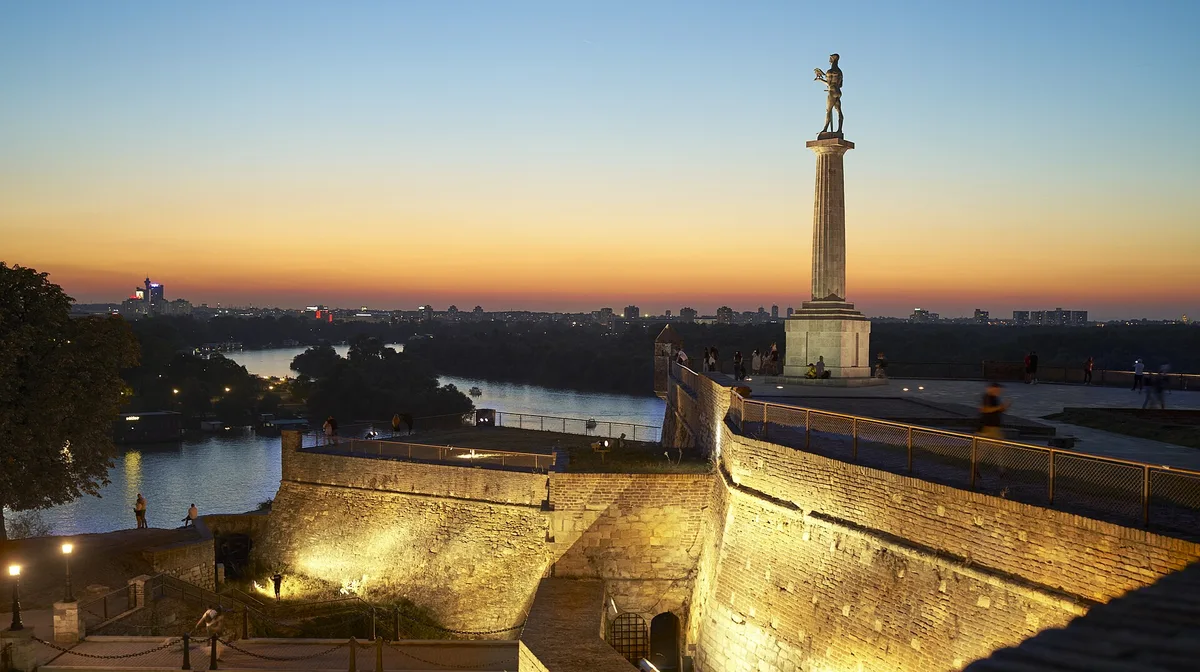
Belgrade sits where the Sava meets the Danube, and the city has spent two thousand years being fought over for exactly that reason — Kalemegdan fortress occupies the ridge above the confluence and has been rebuilt by almost everybody. What that geography produces commercially is a city with a genuinely distinctive river economy: the splavovi, floating clubs and restaurants moored along both banks, are unlike anything else in Europe, and Ada Ciganlija turns a former Sava island into a city beach with something close to a Mediterranean atmosphere in July. Demand is broad rather than deep. There is regional weekend traffic from across the former Yugoslavia and from Bulgaria, Romania and Greece; a substantial and growing base of relocated remote and technology workers who arrived from 2022 onward and stay for months rather than nights; a business and conference layer; and a European city-break market drawn by prices well below the EU capitals. Rates run near €72 at around 45% occupancy. Zemun, a separate Austro-Hungarian town until the twentieth century and now a Belgrade district, has a completely different character from the centre and prices accordingly. Small hotels and guest houses in the older districts compete for the same guest.

Top Attractions & Landmarks

  • Kalemegdan fortress above the Sava and Danube confluence
  • The Temple of Saint Sava, among the largest Orthodox churches in the world
  • Skadarlija, the old bohemian quarter
  • Knez Mihailova, the pedestrian spine of the centre
  • The splavovi, the floating clubs and restaurants on both rivers
  • Zemun's riverfront and the Gardoš tower
  • Ada Ciganlija, the island lake and city beach

Nearby Markets: Sofia  |  Zagreb  |  Bucharest

Airbnb marketing services in Belgrade, Serbia, Europe
Why Cavmir

The Cavmir Advantage
in Belgrade

Cavmir wins in Belgrade by chasing length rather than rate. At around 45% occupancy and €72 a night, the numbers say the same thing they say in Riga: discounting further is a race to the bottom, and the recoverable value is in guests who stay weeks rather than nights. Belgrade has an unusually strong version of that segment — a substantial community of relocated remote and technology workers who arrived from 2022 onward and who book monthly, need a desk, fast internet, a washing machine and a district rather than a landmark. Almost nothing in this market is written for them. We build that product and price it properly. We also write the geography, because Belgrade is a city of very distinct neighbourhoods and "city centre" tells a guest nothing: Dorćol and Savamala are not Vračar, Zemun is a different town, and riverside means splavovi, which means noise in summer that a listing must state honestly. We handle the compliance that trips foreigners, particularly the 24-hour eTurista registration duty that sits with the host. And for the city's guest houses and boutique hotels we build direct-booking websites and repeat-guest programmes — worth more here than almost anywhere, because outside the EU framework the platforms are the only visibility most operators have. We help position and market your property. We never manage it or touch your keys.

State of the Industry · History

The Belgrade STR Market — Past & Present

Belgrade has been destroyed and rebuilt more times than almost any city in Europe, and the reason is a piece of geography you can see from the fortress walls: the Sava runs into the Danube directly below, and whoever held that ridge controlled the river route between central Europe and the Black Sea. Celts, Romans, Byzantines, Bulgarians, Hungarians, Serbs, Ottomans and Habsburgs all held it in turn, and Kalemegdan is a palimpsest of their fortifications built on top of one another. The Ottomans ruled for centuries, the Habsburgs took and lost the city repeatedly, and the border between two empires ran through what is now a tram ride — which is why Zemun, on the far bank, was an Austro-Hungarian town with a completely different architecture and remained legally separate until the twentieth century.

Modern Belgrade is largely a twentieth-century construction, because very little survived the two world wars. Socialist Yugoslavia built New Belgrade across the Sava on what had been marshland, and the city became the capital of a country that no longer exists, then of a much smaller one after the 1990s. What has happened since is faster than most visitors expect: Belgrade developed a serious restaurant and nightlife economy, the splavovi turned the rivers into the city's social centre, Savamala went from derelict warehouses to galleries and bars, and the Belgrade Waterfront development reshaped the Sava bank entirely. From 2022 the city absorbed a large influx of relocated remote and technology workers, which changed the rental market's shape rather than just its size — long-stay demand became a permanent feature rather than an occasional one. Serbia remains outside the European Union, which means the registration framework that arrived across the EU in May 2026 does not reach here, and the rules that govern this market are entirely domestic.

Pricing Strategy & Seasonality

Pricing, Seasonality & When to Capture ROI

Pricing Strategy

Belgrade's rate map is a map of very distinct neighbourhoods, and using the phrase "city centre" throws away most of the available advantage. Stari Grad and Dorćol are the core — Knez Mihailova, Kalemegdan, Skadarlija — and take the top rates with the strongest weekend demand. Vračar, around the Temple of Saint Sava, is the quality residential tier: leafy, calm, excellent cafés, and the district long-stay guests actually want. Savamala and the Sava bank sell nightlife and river views, and the splavovi make summer nights genuinely loud, which a listing must state. Zemun is effectively a different town — Austro-Hungarian frontages, a riverside promenade, the Gardoš tower — and it sells calm and character at a discount that narrows every year. New Belgrade is the business and long-stay tier: modern blocks, lifts, parking, and proximity to the office districts, which makes it the natural base for the relocated remote-work segment. Blended, the city sits near €72 a night at around 45% occupancy — with published figures diverging enough that your own building's history is a better planning number than any city average.

Seasonality & ROI Windows

Belgrade's year is moderate with a distinctive summer inversion. Spring is strong from April, and May and June are the best months — terraces open, the rivers come into use and the weather is at its most comfortable. July and August are hot, genuinely so, and a meaningful share of residents leave for the coast, which softens the leisure market even as the splavovi and Ada Ciganlija run at full capacity. September is the best-balanced month of the year: the heat breaks, the business and conference calendar returns and the river season is still going. October and November hold on business travel. December brings a festive and New Year block that is a serious domestic and regional draw. January and February are the quiet months, carried by business travel and by the long-stay segment that does not care what the weather is doing.

Regulation & Licensing · 2026

What the Law Requires in Belgrade

Belgrade's regulatory position is the lightest on this slate and it is light for a structural reason: Serbia is not in the European Union, so Regulation (EU) 2024/1028 does not apply here. The regulation harmonises whatever registration scheme a Member State chooses to run rather than creating a European number, and none of its platform-reporting machinery reaches Serbia. Serbia is also outside the eurozone, so pricing and accounting run in dinars even where a listing quotes euros.

What applies is domestic, and the item that catches foreign owners hardest is guest registration. Every foreign guest must be registered through the eTurista system within 24 hours of arrival, and the duty sits with the accommodation provider rather than with the guest. It is not optional, it is time-bound, and an owner running a property remotely without a reliable person or process to do it is exposed. Set it up before your first booking.

Sojourn tax — boravišna taksa — is set by local government inside bands fixed nationally and is collected by the host from the guest and remitted. It has been reported at roughly €1.30 per person per night in Belgrade, but the rate is a city decision and should be confirmed directly rather than taken from a secondary source.

Beyond that, the ordinary obligations of operating a business in Serbia apply: registration, income and VAT treatment, and the fire and sanitary expectations of providing accommodation as a service. There is no nights cap, no licence regime of the kind Slovenia or Hungary operate, and no moratorium. Building-level rules are the layer most likely to affect you in practice, particularly in riverside buildings where the splavovi make summer nights loud and neighbours have opinions. The reasonable planning assumption is that Serbia's EU candidacy would eventually bring the European framework with it, so compliant habits built now cost nothing and save a scramble later.

Market-Specific Tips & Challenges

Local Tips & Unique Market Challenges

Tips That Actually Move Revenue in Belgrade

Chase length, not rate. At around 45% occupancy and €72 a night, cutting your price is a race you cannot win — the recoverable value in Belgrade is in the monthly booker, and this city has an unusually strong version of that segment thanks to the relocated remote and technology-work community that has grown since 2022. Build the product: a real desk, a stated internet speed, a washing machine, a kitchen, and a listing that sells a district rather than a landmark. Name the neighbourhood, because Belgrade's are genuinely distinct and "city centre" tells a guest nothing — Dorćol, Vračar, Savamala, Zemun and New Belgrade are five different propositions. Be honest about the splavovi if you are on the river: they are one of the best things about this city and they are loud until four in the morning in summer, and a listing that hides that buys a bad review. Set up your eTurista process before your first booking, because the 24-hour foreign-guest registration duty sits with you. And price September properly — it is the best-balanced month of the year here and almost everyone treats it as the end of summer.

Unique Belgrade Challenges

Occupancy is the structural problem: at around 45% with rates near €72, this is a market where a property can be busy and still not be profitable, and the answer has to come from stay length rather than from price. Published data diverges more here than almost anywhere on this slate, which makes planning from city averages genuinely unsafe. The 24-hour eTurista foreign-guest registration duty is a real operational burden for a remotely managed property and is easy to underestimate. Being outside the EU cuts both ways — lighter rules today, but no EU registration framework means the platforms remain the only visibility most operators have, which makes direct booking harder to build and more valuable once built. Summer heat and the resident exodus soften July and August. The splavovi are a genuine noise issue for riverside stock. And Serbian lending to non-residents is limited, so financing is frequently a problem to solve before the property is.

The Clubs That Float
Belgrade's splavovi are floating structures — clubs, restaurants and bars — moored in rows along the Sava and Danube banks, and they exist at a scale found nowhere else in Europe. They range from quiet fish restaurants to enormous nightclubs, and in summer a large part of the city's social life simply moves onto the water. Many are seasonal, some are towed to different moorings, and the arrangement has produced a genuine architectural category that Belgrade invented largely by accident and has never bothered to standardise.
Finance Essentials — Belgrade
🛡️

Insurance

Standard Serbian homeowner cover does not contemplate paying guests. In Belgrade the specific exposures are the age and variety of the stock — older central buildings with shared stairwells and original risers, where water escape into a neighbouring flat is the standard expensive claim — and, for riverside properties, the rivers themselves, which have produced serious flood events in the wider region within living memory. Ask for accommodation cover rather than residential cover, confirm public liability for guests on communal stairs, and check the position on shared parts. Given the long-stay segment that matters most here, also check that cover is not affected by tenancies running beyond a stated number of consecutive nights.

🧾

Property & Income Tax

Serbia is outside the eurozone and the currency is the dinar, so a listing quoting euros is quoting a convenience rather than the accounting currency — worth understanding before you model returns. Income from providing accommodation is taxed according to how the activity is structured, and the difference between operating as a private individual and through a registered entity is material at any scale. VAT treatment depends on turnover and structure. The sojourn tax is a separate collection duty rather than a cost: reported at around €1.30 per person per night in Belgrade, set by the city inside national bands, charged to the guest and remitted by you. Ask a Serbian accountant to confirm both your structure and the current sojourn rate before you take a booking, because neither is safely inferred from a guide.

🏦

Mortgages & Financing

Serbian lending to non-residents is more limited than in the EU markets on this slate, and a significant share of foreign purchases here are cash or financed from outside the country — plan for that early. Serbia is outside the European Union, so EU-buyer conveniences do not apply, though foreign ownership of apartments is generally workable subject to reciprocity. Entry prices in Belgrade are among the lowest of any European capital of its size, which is a large part of the appeal, and the arithmetic works best where a property is bought for the long-stay market — New Belgrade, Vračar, Zemun — rather than for a two-night weekend segment that already competes at 45% occupancy.

Future Outlook · 2027 & Beyond

Where Belgrade is Headed Next

Two forces will shape Belgrade to 2028. The first is European accession, which is a candidacy rather than a date, but which would eventually bring Regulation (EU) 2024/1028 and the wider framework with it — registration numbers, platform verification, data reporting. Operators who build compliant habits now will treat that as paperwork rather than as a shock. The second is the long-stay economy. The influx of relocated remote and technology workers from 2022 changed the shape of this market permanently: a substantial monthly-booking segment now exists that did not before, it is largely indifferent to season, and almost nobody markets to it deliberately. Whether it grows or plateaus is the biggest single variable in Belgrade's rental economics, and it is more consequential than any regulatory change on the horizon. On the demand side, the city keeps improving — the waterfront development, the restaurant scene, better air connections and a cost base far below the EU capitals. The most likely 2028 is a larger market with the same occupancy problem, in which the operators who built a genuine long-stay product are earning across twelve months while the two-night weekend segment continues to fight on price.

From the Desk of Sofie Sinag

Why We Love Marketing in Belgrade

We love Belgrade because it is completely uninterested in being charming at you. Most European capitals have worked out what visitors want and arranged themselves accordingly; Belgrade has a fortress on a ridge above two rivers, a restaurant scene that is genuinely excellent, nightclubs that float on the water, and absolutely no intention of explaining any of it. That makes it one of the more honest cities to work in. There is no preserved core to sell and no postcard to lean on — what there is instead is a set of very distinct neighbourhoods, a river that is the actual centre of social life from May to September, and prices that make a European capital affordable in a way that has largely stopped being true elsewhere. The other thing that makes it interesting right now is that the market has quietly changed shape. Since 2022 a substantial community of people who work remotely has settled here and books by the month rather than the night, and almost nobody has noticed commercially. In a city with 45% occupancy, that is not a niche. That is the answer.

Cavmir's Belgrade Cheat Sheet

The Picks We Recommend for Your Welcome Book

The picks we send Belgrade guests — the rivers, the neighbourhoods and the parts of the city that reward staying longer than a weekend.

Coffee & First Light

A Vračar or Dorćol café, mid-morning

Belgrade takes coffee slowly and seriously, and the good rooms are in the residential districts rather than on the pedestrian spine. Vračar around the Temple of Saint Sava and Dorćol toward the Danube are where the city actually sits down. Send guests there rather than to Knez Mihailova.

The Splurge Table

A serious Serbian kitchen away from Skadarlija

Skadarlija is atmospheric and largely for visitors; the cooking that justifies a special evening is elsewhere, working with river fish, slow-cooked meat, ajvar, kajmak and wines from Fruška Gora and the south that almost never leave the country. Book a week ahead and expect a long evening.

Local Obsession

The splavovi, on the water

Floating clubs and restaurants moored in rows along both rivers, from quiet fish places to enormous nightclubs, and in summer a large share of Belgrade's social life simply moves onto the water. Send guests to a restaurant splav first so they understand the form before they attempt a club one.

Shoulder Season Secret

Kalemegdan at sunset in late September

The fortress terrace looks straight down at the point where the Sava runs into the Danube, and in late September the light comes in low across both rivers with the heat gone. Free, ten minutes from the centre, and the single best photograph in the city.

Weekend Escape

Zemun, on foot along the Danube

A separate Austro-Hungarian town until the twentieth century and now a Belgrade district, with a riverside promenade, a fish-restaurant strip and the Gardoš tower on the hill above. Walk or take a bus, eat by the water, climb the tower. It feels like a different country and it is twenty minutes away.

What Guests Ask For

Which neighbourhood, and how loud the river is

Belgrade enquiries repeat these two. Name the district rather than saying central — they are genuinely different places — and state plainly what the splavovi do on a summer night if you are anywhere near the water. Both answers prevent the reviews that damage listings here.

Local Work · Composite Case Vignettes

What Cavmir Has Done for Belgrade Properties

A few composite engagements drawn from how Cavmir typically works in this market. The details are illustrative and consistent with Belgrade, not pulled from a single named client.

One-bedroom apartment · Vračar
The Brief

A well-kept flat in a quiet residential district competed for two-night weekend bookings against several thousand central listings, sat at occupancy in the low forties, and had no product at all for the long-stay market growing around it.

What We Did

Cavmir rebuilt it as a monthly product — a proper desk, a stated internet speed, a washing machine, a kitchen and a listing that sold Vračar as a neighbourhood to live in for a month rather than a location to sleep in for two nights — and priced weekly and monthly rates deliberately rather than as an afterthought.

The Result

Occupancy rose substantially because the property stopped depending on weekend turnover, revenue became far more predictable across the year, and the owner exited the most crowded and most price-driven segment in the city.

22-room boutique hotel · Dorćol
The Brief

An independent hotel took nearly all bookings through platforms, which outside the EU framework were also its only real visibility, and had no direct route, no corporate page and nothing for the autumn conference calendar.

What We Did

Cavmir built a direct-booking website with a published best-rate guarantee and a corporate page, packaged the New Year block and the river season, wrote the neighbourhood properly into the site, and set up a post-stay sequence to convert returning business guests to direct.

The Result

Direct bookings gave the hotel visibility it did not previously control, autumn midweek occupancy improved, and the New Year weeks filled earlier and at better rates than the previous year.

Two-bedroom apartment · Savamala riverside
The Brief

A flat overlooking the Sava marketed itself on the view, said nothing about the floating clubs moored below it, and collected summer reviews complaining about noise from guests who had expected a quiet river outlook.

What We Did

Cavmir rewrote the listing to state the splavovi honestly and sell them as the reason to be there, targeted guests who wanted the nightlife rather than those who would be ambushed by it, and built a separate autumn and winter positioning around the quiet months and long stays.

The Result

The summer noise complaints stopped because the guest mix matched the property, review scores recovered, and the autumn and winter months found a completely different and quieter audience that the listing had never previously addressed.

Ready to Grow in Belgrade?

Let's Put Your Belgrade
Property on the Map

Talk to Cavmir today. We'll show you exactly what your Belgrade property is leaving on the table — and how fast we can change that.

Book a Free Strategy Call