€68
Avg. Nightly Rate
45%
Avg. Occupancy Rate
€930
Avg. Monthly Revenue
7-10%
Est. Cash-on-Cash ROI
MEDIUM
Seasonality
MEDIUM
Regulatory Burden

* Market averages. Properties marketed by Cavmir typically exceed these figures by 25–45%. Data sourced from AirDNA, STR market reports, and Cavmir internal analytics.

The Market

Why Sofia is One of the World's Premier STR Markets

Sofia repriced itself on 1 January 2026. Bulgaria adopted the euro as the twenty-first member of the euro area, at the fixed and irrevocable rate of one euro to 1.95583 lev, following the Council's formal approval on 8 July 2025 — and for every operator in the country that was a genuine commercial event rather than an administrative one. Prices that had sat at psychologically comfortable lev numbers for a generation had to be restated, guests could suddenly compare Sofia against Prague and Warsaw without a mental conversion, and the friction that had quietly discounted Bulgaria against its neighbours disappeared. The second fact worth knowing is structural: short-term rentals here are regulated as tourist accommodation under the Tourism Act, not as ordinary property letting, so every property needs a categorisation certificate or registration — a simplified route exists for guest rooms and guest apartments, with a reported fee of BGN 50 to 250 and issuance taking up to sixty days. Regulation (EU) 2024/1028 has applied since 20 May 2026. And the third fact is the opportunity: with around 1,548 active listings, Sofia has the smallest supply of any capital on this list, at roughly 41% occupancy and €68 a night.

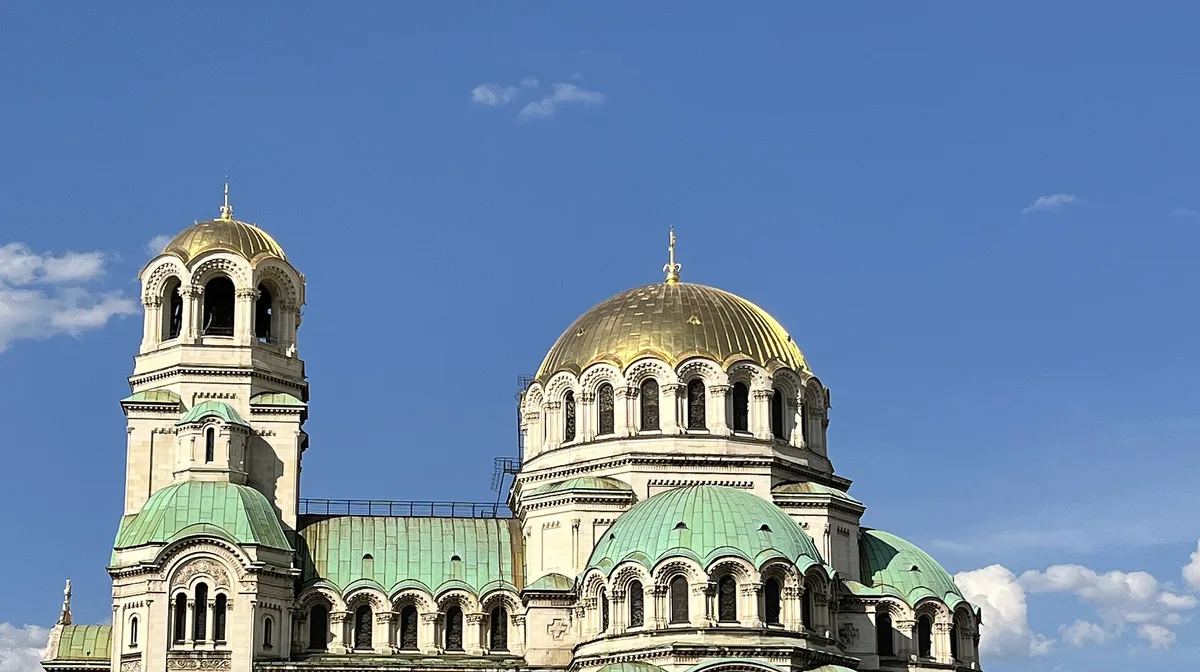
Sofia is the cheapest capital in the European Union to enter and it has an asset no other EU capital can claim: a mountain with a ski area inside the municipal boundary. Vitosha rises directly behind the city, about half an hour from the centre, and it is genuinely skiable in winter and genuinely walkable the rest of the year — and almost no listing in this market mentions it. The rest of the city is layered in an unusual way. The Rotunda of St George is a fourth-century building standing in a courtyard behind the presidency; the ruins of Roman Serdica sit under the Largo and are open to walk through; Alexander Nevsky's gold domes are the postcard; Boyana Church on the mountain's skirt has been UNESCO-inscribed since 1979, and Rila Monastery, inscribed in 1983, is about two hours south. Demand comes from European city breaks, a very substantial business and outsourcing sector, ski traffic heading to Bansko and Borovets, and a long-stay remote-working community drawn by cost. Around 1,548 listings run at roughly 41% occupancy and €68 a night — the smallest supply and the softest occupancy on this slate, which is a market with room rather than a market in trouble.

Top Attractions & Landmarks

  • Alexander Nevsky Cathedral and its gold domes
  • The fourth-century Rotunda of St George
  • The Roman ruins of Serdica beneath the Largo
  • Vitosha mountain and its ski area, inside the city boundary
  • Boyana Church, UNESCO-inscribed in 1979
  • Vitosha Boulevard and the City Garden
  • Rila Monastery, UNESCO-inscribed in 1983, two hours south

Nearby Markets: Belgrade  |  Bucharest  |  Zagreb

Airbnb marketing services in Sofia, Bulgaria, Europe
Why Cavmir

The Cavmir Advantage
in Sofia

Cavmir wins in Sofia by using the two things this market has and does not sell. The first is the euro. After 1 January 2026 a guest comparing Sofia against Prague, Budapest or Warsaw sees the numbers directly, without a conversion, and Sofia wins that comparison on almost every line — so we make the comparison explicitly rather than leaving guests to make it by accident. The second is Vitosha. No other European Union capital has a ski area inside its municipal boundary, half an hour from the centre, and the fact appears in virtually no listing in this city; a property that sells a European capital with mountain access in the same sentence is selling something genuinely unavailable elsewhere. Beyond that we do the work the numbers demand: at 41% occupancy the answer is stay length, not price, so we build for the business and long-stay segments that a large outsourcing and technology economy produces — a desk, a stated connection speed, a washing machine, published monthly rates. We handle the categorisation certificate honestly, because the Tourism Act treats this as accommodation rather than letting and issuance can take sixty days. And for the city's guest houses and boutique hotels we build direct-booking websites and repeat-guest programmes. We help position and market your property. We never manage it or touch your keys.

State of the Industry · History

The Sofia STR Market — Past & Present

Sofia is one of the oldest continuously inhabited cities in Europe and it has been rebuilt so often that the layers are visible from a single spot. The Thracians were here first; the Romans made it Serdica and Constantine the Great was fond enough of it to call it his Rome — the ruins of that city are now open beneath the Largo, and you walk through them to reach the metro. The Rotunda of St George, a fourth-century brick building, still stands in a courtyard hemmed in by twentieth-century government buildings. Byzantine, Bulgarian and then five centuries of Ottoman rule followed, which is why a mosque, a synagogue, a Catholic cathedral and an Orthodox church stand within a few hundred metres of each other in the centre — the city calls it the Square of Tolerance and the description is earned rather than promotional.

Sofia became the Bulgarian capital in 1879, immediately after independence, and was largely built in the decades that followed — which is why the centre is a coherent late nineteenth and early twentieth-century ensemble with Alexander Nevsky Cathedral, finished in 1912, as its set piece. The socialist decades added the Largo's monumental government complex and the housing districts beyond the ring. Bulgaria joined the European Union in 2007, joined Schengen for land borders on 1 January 2025, and adopted the euro on 1 January 2026 at the fixed rate of 1.95583 lev — the culmination of a currency board arrangement that had pegged the lev for decades. That accession is the most consequential thing to happen to this market in a generation: it removed the last mental barrier between Sofia and the rest of Central Europe, and it happened in a city with the smallest short-term rental supply of any capital in the region and a mountain rising directly behind it.

Pricing Strategy & Seasonality

Pricing, Seasonality & When to Capture ROI

Pricing Strategy

Sofia's rate map is compact, cheap and rewards knowing where people actually want to be. The centre around Vitosha Boulevard, the City Garden and Alexander Nevsky takes the top rates and the strongest weekend demand, and it is genuinely walkable end to end. Oborishte and Doctor's Garden are the quality residential tier — leafy, calm, good restaurants, and the district the long-stay and business market actually chooses. Lozenets, on the rising ground toward the mountain, sells green streets and proximity to Vitosha at a modest premium and is where the professional long-stay demand concentrates. Studentski Grad and the business corridors serve the outsourcing and technology employment base with modern blocks, lifts and parking. Boyana and Dragalevtsi, on the mountain's skirt, are a different product entirely — houses, gardens, air, and ten minutes to a chairlift — and they are the most obviously under-marketed stock in the city. Blended, Sofia runs near €68 a night at around 41% to 45% occupancy, on roughly 1,548 active listings, which is the smallest supply base of any capital on this slate.

Seasonality & ROI Windows

Sofia has an unusually balanced year for a Balkan capital, because it has two seasons rather than one. Winter is a genuine product: Vitosha's ski area is inside the city boundary and Bansko and Borovets are within a couple of hours, so December through March carries real demand that most city markets at this latitude simply do not have. Spring is strong from April, and May and June are the best months — the city is green, the mountain is walkable and the terraces are open. July and August are hot and a share of residents leave for the coast, which softens leisure demand in the way it does across the Balkans. September and October are excellent, with the business calendar back and the mountain at its best for walking. November is the softest month, and January and February hold up on ski traffic and business travel rather than collapsing.

Regulation & Licensing · 2026

What the Law Requires in Sofia

Sofia's regulatory framework is more formal than its reputation suggests, and the classification is what catches owners.

Short-term rentals in Bulgaria are regulated as tourist accommodation under the Tourism Act, not as ordinary property letting. Every person providing tourist accommodation must hold a categorisation certificate or registration for the establishment, under the Act and the associated ordinance on requirements for categorised accommodation. A simplified procedure exists for apartments let short-term, registering them as guest rooms or guest apartments: an application to the mayor's office, proof of ownership and photographs of the property, with a reported fee of BGN 50 to 250 depending on the municipality and the capacity, and issuance taking up to sixty days. Sixty days is the number to plan around — an owner who buys in April and expects to be letting in May has misjudged the timetable.

The municipal tourist tax sits in a national band of BGN 0.20 to 3.00 per overnight stay, set by each municipality, collected from the guest and remitted by the operator. Sofia's patent tax has been reported at around BGN 25 per bed per year. These figures are stated in lev because that is the currency the statutes use; Bulgaria adopted the euro on 1 January 2026 at the fixed and irrevocable rate of 1.95583 lev to the euro, so conversion is arithmetic rather than estimation.

Regulation (EU) 2024/1028 has applied since 20 May 2026 and is the most widely misdescribed rule in this industry. It works on an opt-in basis: it sets common standards for the registration procedures Member States choose to operate, and it creates no European registration number, obliges no Member State to introduce a scheme, and does not by itself require any host to register. Bulgaria does operate one, and it predates the regulation: every property providing tourist accommodation needs a categorisation certificate or registration under the Tourism Act, and accommodation providers report through the ESTI system. In a market where a meaningful share of supply has historically operated without categorisation, that is the change with real teeth: the categorisation certificate you may have deferred is now the thing that keeps you listed. Building-level rules apply as everywhere. There is no nights cap and no moratorium.

Market-Specific Tips & Challenges

Local Tips & Unique Market Challenges

Tips That Actually Move Revenue in Sofia

Sell the mountain. Vitosha has a ski area inside the municipal boundary about half an hour from the centre, no other European Union capital can say that, and virtually no listing in this city mentions it — a property that offers a European capital with mountain access in the same sentence is selling something genuinely unavailable elsewhere, in both winter and summer. Make the euro comparison explicitly: since 1 January 2026 a guest can compare Sofia against Prague, Budapest and Warsaw without converting anything, and Sofia wins that comparison on nearly every line, so put the comparison in front of them rather than hoping they make it. Fix occupancy with stay length rather than price — at around 41% to 45%, the answer is the business and long-stay demand that a large outsourcing and technology sector produces, which needs a desk, a stated connection speed, a washing machine and published monthly rates. Start your categorisation certificate sixty days before you need it. And price September and October properly, because they are the best-balanced months here and everybody treats them as the end of summer.

Unique Sofia Challenges

Occupancy is the constraint: at around 41% to 45% with rates near €68, a Sofia property can be busy and still thin, and with the patent tax charged per bed per year the fixed costs do not care. Sofia is also, bluntly, a city that most people have not considered visiting — it has no single postcard image with the pull of Prague's castle or Budapest's parliament, so demand has to be built rather than caught, and that is a marketing problem before it is a pricing one. The categorisation requirement is a genuine sixty-day administrative task, and the sequencing catches owners out more often than the cost does. Winter is cold and July is hot with a resident exodus. Seismic risk is real and frequently uninsured. And while the small supply base is the opportunity, it is also a signal that this market has been overlooked for a reason — the work of persuading people Sofia is worth three nights is the work.

The Only EU Capital With Its Own Ski Lift
Vitosha is a mountain of over 2,200 metres sitting inside Sofia's municipal boundary, with a ski area roughly half an hour from the city centre reachable by public transport. No other European Union capital has that. In February you can take a meeting in the morning and be on a chairlift by lunchtime; in July the same slopes are walking country with the whole city laid out below. Sofia's motto — usually rendered as ever growing, never ageing — appears on the city's coat of arms, and the mountain is the reason most residents give for staying.
Finance Essentials — Sofia
🛡️

Insurance

Standard Bulgarian homeowner cover does not contemplate paying guests, and because short-term letting here is legally tourist accommodation rather than property letting, an insurer treating the property as a private residence may decline on that basis alone. Ask explicitly for accommodation cover. Sofia sits in a seismically active region and cover should be confirmed rather than assumed. Winter is genuinely cold and the city's older central buildings carry the usual risks of shared stairwells, original risers and water escape into neighbouring flats. For properties on the Vitosha side — Boyana, Dragalevtsi — check snow load and access, because the mountain roads are a different proposition in February from what they look like in June.

🧾

Property & Income Tax

The tax picture in Sofia changed shape on 1 January 2026 when Bulgaria adopted the euro at the fixed and irrevocable rate of one euro to 1.95583 lev. The statutes still express amounts in lev — the municipal tourist tax band of BGN 0.20 to 3.00 per overnight stay, the patent tax reported at around BGN 25 per bed per year, the categorisation fee of BGN 50 to 250 — so conversion is arithmetic at a fixed rate rather than an estimate. Bulgaria's headline corporate and personal rates are among the lowest in the European Union, which is a substantial part of why foreign owners look here, and the structure you operate through determines a great deal. The patent tax is worth noting specifically because it is charged per bed per year regardless of occupancy. Ask a Bulgarian accountant to model it against a realistic 41% to 45% occupancy before you add capacity.

🏦

Mortgages & Financing

Bulgarian lenders assess short-term rental income conservatively and generally underwrite against long-term market rent rather than platform revenue. EU and EEA buyers purchase Bulgarian apartments without restriction. Entry prices in Sofia are the lowest of any European Union capital, which combined with the country's low headline tax rates is the core of the investment case — and the reason the gross yield range here looks better than almost anywhere else on this slate. The practical caution is the occupancy: at around 41% to 45%, a property bought purely on a nightly model has a thinner year than the headline yield implies, and the arithmetic improves considerably for anything configured for business and long-stay demand.

Future Outlook · 2027 & Beyond

Where Sofia is Headed Next

Sofia's next two years are shaped by a currency change that has already happened and a supply gap that has not yet closed. Euro adoption on 1 January 2026 removed the last friction between Bulgaria and the rest of the eurozone, and its effects work through slowly — pricing comparability, easier cross-border investment, and the gradual disappearance of the mental discount that Bulgarian prices used to carry. At the same time Sofia has around 1,548 active listings, the smallest supply of any capital on this slate, in a European Union capital with a ski area inside its municipal boundary. That gap will close. The question is who fills it, and the answer is likely to be professional operators rather than casual ones, because the categorisation certificate is the baseline legal requirement for letting tourist accommodation in Bulgaria, and a sixty-day issuance timetable rewards starting early. The demand side keeps improving: the outsourcing and technology sector continues to expand, air connections keep growing, Schengen land borders opened on 1 January 2025, and a remote-working community keeps arriving for the cost base. The most likely 2028 is a considerably larger, fully categorised market where the operators who entered while supply was thin have the better positions.

From the Desk of Sofie Sinag

Why We Love Marketing in Sofia

We love Sofia because it is the most underrated capital in the European Union and it seems entirely relaxed about that. You walk through a Roman city to get to the metro. There is a fourth-century church in a courtyard behind the presidency, hemmed in by government buildings that were built to ignore it. A mosque, a synagogue, a Catholic cathedral and an Orthodox church stand within a few hundred metres of each other and the city calls it the Square of Tolerance without any obvious embarrassment. And behind all of it is a mountain over two thousand metres high, inside the city limits, with a chairlift you can reach on a bus. No other EU capital has that combination and almost nobody outside Bulgaria knows it. From a marketing desk that is close to an ideal brief: the raw material is genuinely excellent, the supply is the thinnest of any capital in the region, the euro arrived in January and removed the last barrier to comparison — and the work is simply telling people what is here. That is a much better problem than fighting for share in a market everyone has already found.

Cavmir's Sofia Cheat Sheet

The Picks We Recommend for Your Welcome Book

The picks we send Sofia guests — the mountain, the layers under the city, and the things that make three nights here better than two.

Coffee & First Light

A specialty room around Doctor's Garden

Sofia's coffee scene sits in the leafy residential streets east of the centre rather than on the main boulevard, and the standard is genuinely high for the price. Send guests there before the city gets going and they will see the version of Sofia that people actually live in rather than the government quarter.

The Splurge Table

Modern Bulgarian cooking in the centre

Bulgarian food has moved a long way past the shopska salad that visitors expect — the country has serious wine from Melnik and the Thracian Valley, a strong tradition with lamb, yoghurt and preserved vegetables, and kitchens now doing all of it properly. The bill is a fraction of the western European equivalent.

Local Obsession

The Roman city under the Largo

Serdica's streets and buildings are open beneath the central square, and you walk through them to reach the metro rather than paying to enter a site. Constantine the Great was fond enough of the place to call it his Rome. Tell guests to look down rather than up as they cross the Largo.

Shoulder Season Secret

Vitosha in late September or early October

The mountain is at its best for walking exactly when everybody assumes the season is over — clear air, autumn colour, and the whole city laid out below from paths that start at a bus stop. Half a day, almost free, and the best photograph in Sofia by a wide margin.

Weekend Escape

Rila Monastery

UNESCO-inscribed in 1983 and about two hours south through the mountains: striped arcades, painted galleries and a setting that does most of the work. It is the single best day trip in Bulgaria and the reason a Sofia stay should be three nights rather than two.

What Guests Ask For

Whether Sofia is worth it, and how to reach the mountain

The first question is the honest one most Sofia enquiries are really asking, and the listing should answer it — the Roman layers, the mountain, Rila, the price comparison with Prague and Budapest since the euro arrived. The second is practical: which bus or lift, and how long. Answer both and you convert the guest who was going to skip the city.

Local Work · Composite Case Vignettes

What Cavmir Has Done for Sofia Properties

A few composite engagements drawn from how Cavmir typically works in this market. The details are illustrative and consistent with Sofia, not pulled from a single named client.

Two-bedroom apartment · Lozenets
The Brief

A comfortable flat on the rising ground toward Vitosha competed for two-night city breaks in a market with 41% occupancy, never mentioned the mountain behind it, and had no product at all for the winter ski months.

What We Did

Cavmir rebuilt the listing around Vitosha — the bus and the lift, the walking in autumn, the ski area inside the city boundary — added a winter positioning for ski guests and a long-stay pitch with a desk and stated connection speed, and published weekly and monthly rates.

The Result

The property gained two demand streams it had never addressed, winter stopped being a dead season in a city that has a mountain behind it, and average stay lengthened away from the crowded two-night segment.

20-room boutique hotel · Oborishte
The Brief

A restored house near Doctor's Garden took nearly all bookings through platforms, had never marketed to the outsourcing and technology sector that drives the city's midweek travel, and had not adjusted its positioning after euro adoption in January.

What We Did

Cavmir built a direct-booking website with a published best-rate guarantee and a corporate-rate page, made the euro price comparison against Prague, Budapest and Warsaw explicit on the site, packaged Rila and Vitosha day trips, and set up a post-stay sequence for returning business guests.

The Result

Midweek corporate occupancy improved because the hotel was finally visible to a segment already travelling to the city, the explicit price comparison converted guests who had been considering other capitals, and direct bookings took a real share off the commission line.

One-bedroom · central Sofia
The Brief

A well-located flat had been operating without a categorisation certificate, which is the baseline legal requirement for tourist accommodation in Bulgaria, with a sixty-day issuance timetable standing in the way of putting it right.

What We Did

Cavmir set out the categorisation route plainly — the mayor's office application, ownership proof, photographs, the BGN 50 to 250 fee and the sixty-day window — sequenced it against the property's booking calendar, and rebuilt the listing around long-stay and business demand while the paperwork ran.

The Result

The property came through the registration change still listed while a share of uncategorised local supply did not, and it emerged into a thinner competitive field with a long-stay product it had not previously had.

Ready to Grow in Sofia?

Let's Put Your Sofia
Property on the Map

Talk to Cavmir today. We'll show you exactly what your Sofia property is leaving on the table — and how fast we can change that.

Book a Free Strategy Call