


.jpg)




City or county
Two different regimes
The county's rules do not govern the cities of Santa Cruz, Scotts Valley, Capitola or Watsonville. Establish which applies before anything else.

Expert short-term rental marketing to grow your bookings and nightly rate in Santa Cruz, California, USA.
* Market averages. Properties marketed by Cavmir typically exceed these figures by 25–45%. Data sourced from AirDNA, STR market reports, and Cavmir internal analytics.
The first thing to understand about Santa Cruz is that the city and the county are two different regulatory countries, and a great many owners here have discovered that fact expensively. The City of Santa Cruz runs its own short-term rental programme. Santa Cruz County runs a separate one that governs the unincorporated areas and explicitly does not govern the cities of Santa Cruz, Scotts Valley, Capitola or Watsonville. Two houses a mile apart can sit under entirely different caps, different permit classes and different tax rates. Beyond that, this is one of the most appealing stretches of the California coast: a north-facing bay that puts the sun over the water in a way the rest of the coast does not, redwoods running down almost to the beach, a boardwalk from 1907 that is the oldest surviving amusement park in the state, and a surf culture with a genuine claim to being the oldest in the continental United States. The University of California campus sits in the forest above town. Monterey is across the bay, San Francisco is an hour and a half north on a good day. For an owner this is a high-rate, high-demand, high-scrutiny market where the regulatory position is the whole investment question.
Santa Cruz County overhauled its short-term rental rules and the new ordinance, approved by the California Coastal Commission on 16 April, is now in effect across the unincorporated county. It caps non-hosted rentals, where the owner does not live on the property, at 270 countywide, and hosted rentals at 250. It limits ownership to one short-term rental permit per owner or entity, which was aimed squarely at corporate accumulation. Existing valid permits are grandfathered within the caps and there are no forced mid-permit revocations. Platforms are required to remove unpermitted listings within 10 days of receiving notice from the county. And a phase-down begins in 2026, with up to 10 permit expirations a year in the designated high-density short-term rental areas. Separately, the City of Santa Cruz runs its own residential short-term rental programme under Municipal Code Chapter 24.12, Part 18, built around a hosted-rental permit. The tax positions differ too: the City taxes residential short-term rentals at a transient occupancy rate of 14%, raised from 11% with effect from 1 January 2023, against 12% for hotels; the unincorporated county likewise applies 14% to vacation rentals and 12% to hotels. Confirm which jurisdiction your parcel is in, and the current caps and permit position, before you buy.
Nearby Markets: Monterey & Carmel | San Francisco | Napa Valley
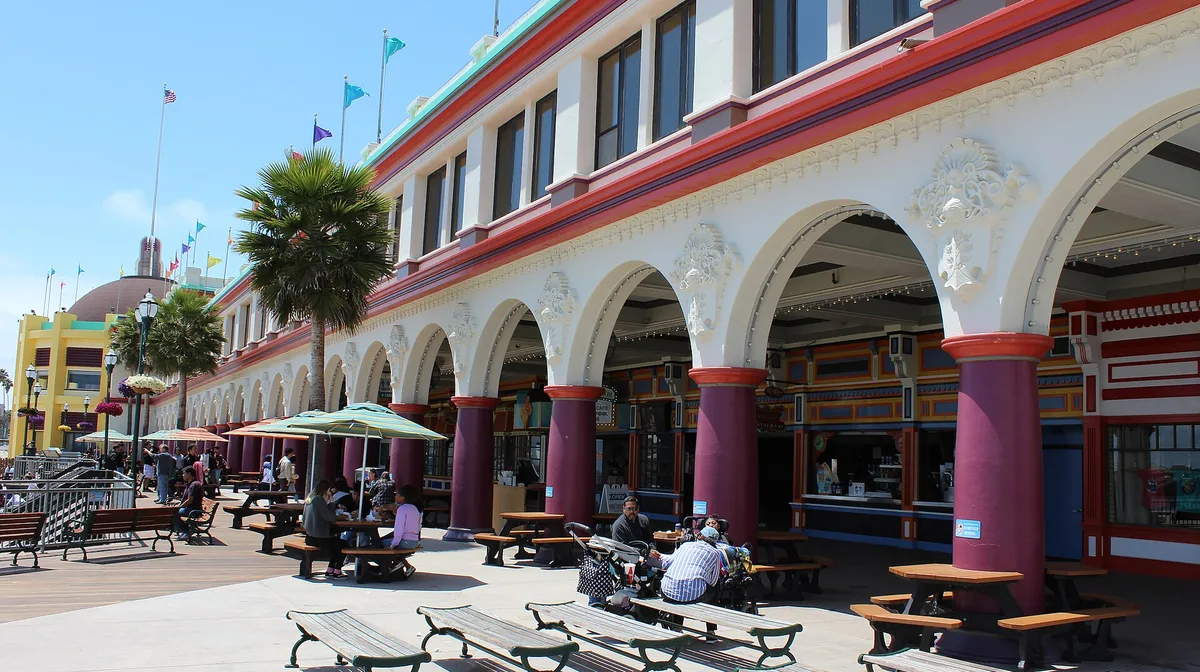
A few of the visual fingerprints we lean into when we shoot, brand and market a Santa Cruz California boardwalk property — courtesy of the open Wikimedia Commons archive.
Cavmir markets Santa Cruz properties on the understanding that in a capped market the permit is the asset and the marketing has to be worthy of it. When the county has fixed the number of non-hosted rentals at 270 and begun retiring permits in the densest areas, every remaining permitted property is a genuinely scarce thing, and pricing it like ordinary beach inventory is a strategic error. We start by making the property's position legible: which jurisdiction it sits in, what permit class it holds, and what that means for a guest and for a future buyer. Then we sell the specific stretch of coast, because Santa Cruz is not one place. West Cliff, Pleasure Point, the Westside, Capitola and the redwood canyons up toward Felton are separate propositions with separate guests, and the surf, the sun and the walk to the water differ materially between them. We photograph the light this bay gets, which is the reason people come, and we shoot the walk to the beach rather than only the kitchen. We write copy that handles parking, the summer fog pattern and what is genuinely walkable. Then we build the direct booking site, run local SEO, place ads against the season, and hold the guest relationship directly. We help position and market your property. We never manage it or touch your keys.
Santa Cruz has sold its beachfront as a day at the shore since Fred Swanton lit up the boardwalk in 1904 — the casino, the coaster, the wharf. Cavmir simply writes the newest chapter.


The Spanish established Mission Santa Cruz in 1791 on the bluff above the San Lorenzo River, and a civilian settlement, Branciforte, across the water from it. Neither prospered as intended. What made the town was the redwoods behind it: from the 1850s onward the Santa Cruz Mountains were logged intensively, and lime, lumber, leather and gunpowder industries grew up around the port. The railroad arrived over the mountains in the 1870s, and with it came something that changed the town permanently, which was tourists. San Franciscans discovered they could reach a warm north-facing beach in a few hours, and the seaside resort economy began. The Santa Cruz Beach Boardwalk opened in 1907 and is the oldest surviving amusement park in California; the Giant Dipper, a wooden roller coaster built in 1924, is still running and is a National Historic Landmark. Then there is the surfing, which has a documented origin here that predates every other mainland claim. In July 1885 three Hawaiian princes studying at a school in San Mateo, David Kawananakoa, Edward Keliiahonui and Jonah Kuhio Kalanianaole, rode the waves at the mouth of the San Lorenzo River on boards milled from local redwood. That is the first recorded surfing in the continental United States, and Santa Cruz has been a surf town ever since, with Steamer Lane one of the best-known breaks in the country and a surfing museum inside the lighthouse above it. The University of California opened a campus in the redwoods above the town in 1965, and the arrival of ten thousand students and a research faculty in a small coastal city reshaped its politics and its culture in ways that are still evident. Silicon Valley sits directly over the hill, which has driven housing costs to levels the local economy cannot support on its own. All of which produces the market as it stands: extremely high demand, extremely high prices, a serious housing shortage, and a regulatory framework built specifically to keep short-term rentals from making that shortage worse.
Before the platforms, the promoters did the marketing. Frederick Hihn had already turned nearby Capitola into a seaside resort in the 1870s when Fred Swanton built the first beachfront Casino and Cocoanut Grove in 1904, lost them to fire in 1906, and rebuilt them grander a year later. Swanton wired the town for electric light, ran his own publicity, and sold Santa Cruz across the state as the place to spend a day at the shore. The wharf and the Giant Dipper gave visitors more reasons to come. Every bit of it was presentation and positioning, and it is the same business Cavmir is in now.
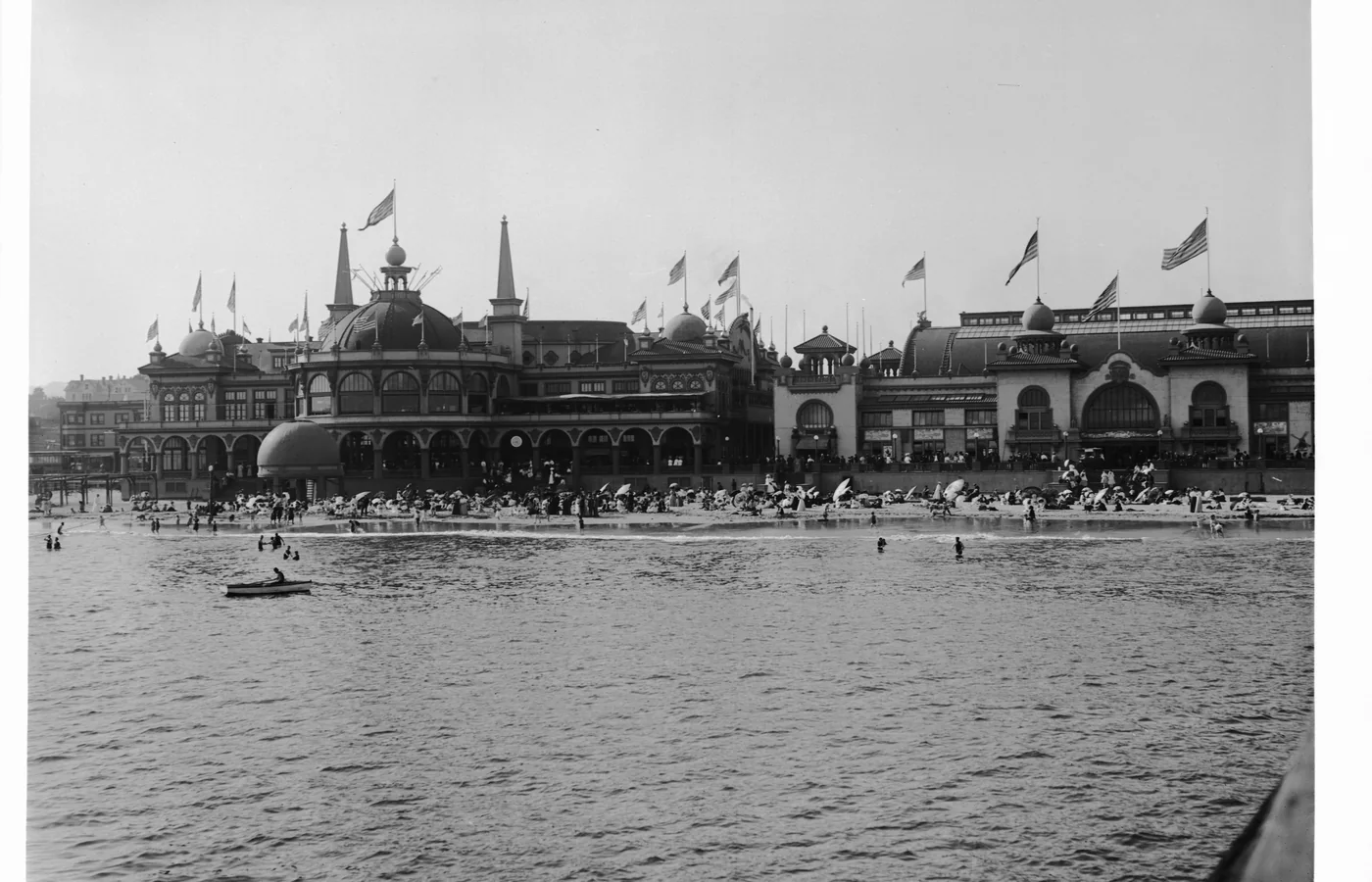

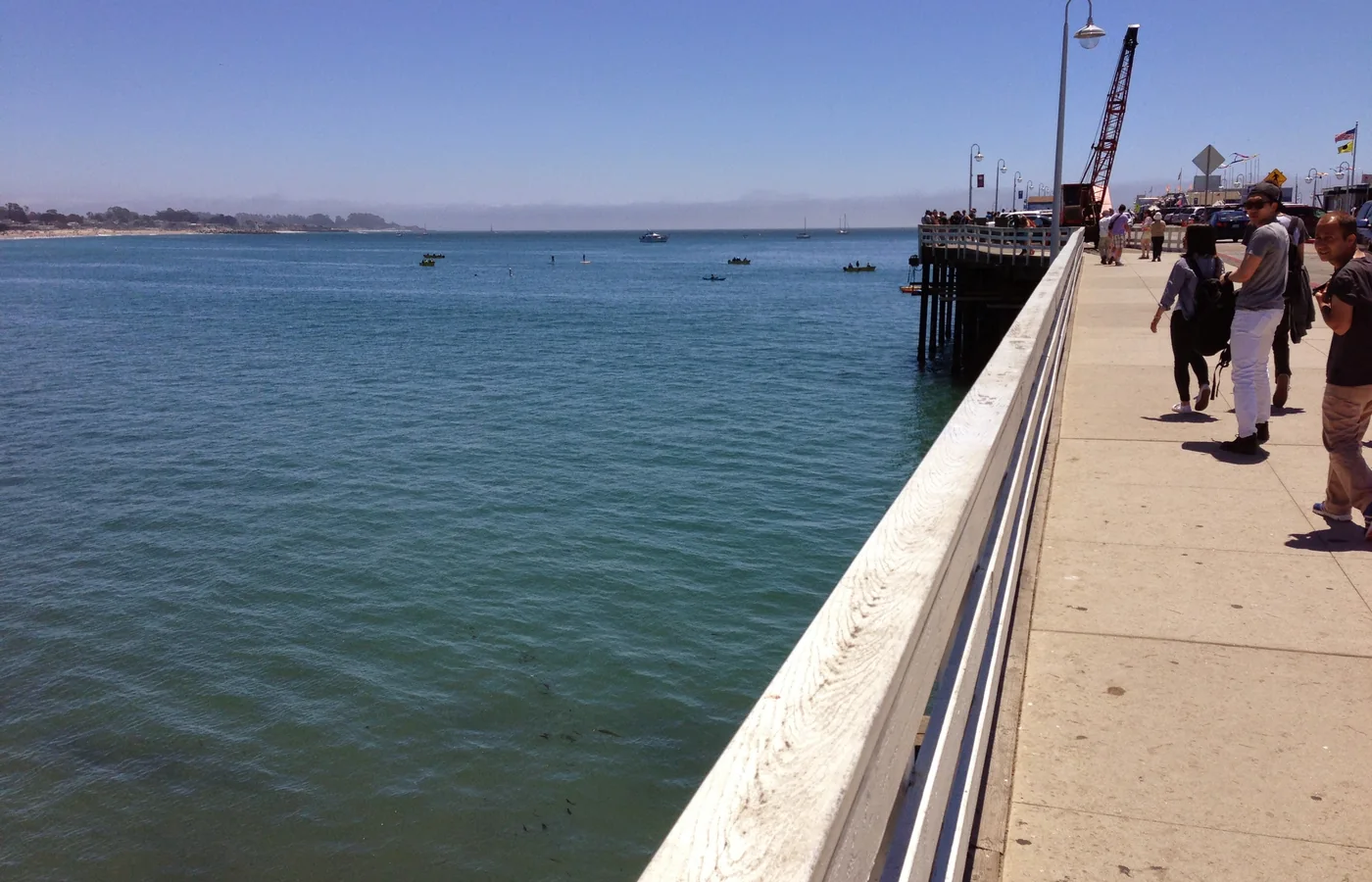
Historical images: public domain and Creative Commons via Wikimedia Commons — The Giant Dipper, 1924 (Henry Zbyszynski, CC BY 2.0); The Municipal Wharf (Runner1928, CC BY-SA 3.0); others public domain.
This is a high-rate market with a genuine season, and the pricing discipline that matters most is holding the summer rather than chasing volume in the winter. Summer, roughly late June through early September, is the peak: the fog burns off, the boardwalk is running, the water is as warm as it gets and demand comes from the entire Bay Area and beyond. Set those rates early and hold them; discounting into July is a decision you cannot undo. The shoulder months are better than most owners think and worse than they hope. September and early October are often the finest weather of the year here, with warm water and no fog, and they are consistently under-priced because visitors assume the season ends with the school year. Sell that as its own season with its own pitch. Spring is variable and fog-affected. Winter is genuinely quiet, and the honest plays are longer stays, storm-watching and the surf market, since the best waves at the reef breaks arrive with winter swell. Two structural factors should shape your rate card. The first is that permitted inventory is capped and shrinking in the designated high-density areas, which makes a permitted property a scarce asset that should not be priced against unpermitted or out-of-area competition. The second is the tax: residential short-term rentals are taxed at 14% transient occupancy in both the city and the unincorporated county, against 12% for hotels, so your guest's total sits well above the nightly figure and should be presented honestly.
Summer is the peak and it is intense, running from the end of the school year through Labor Day, with the boardwalk, the beaches and the warmest water of the year. The best-kept secret is September and early October, when the fog pattern breaks, the water is still warm and the crowds have gone; it is frequently the nicest weather of the year and it is under-sold. Spring is unpredictable, with the marine layer sitting over the coast for long stretches. Winter is quiet and wet, sustained mainly by the surf trade, storm-watching, and visitors to the university, and it is the right window for maintenance, reshoots and longer bookings.
The single most important fact about short-term rental regulation here is that the City of Santa Cruz and the County of Santa Cruz are two different regimes, and the county's rules explicitly do not govern the incorporated cities of Santa Cruz, Scotts Valley, Capitola or Watsonville. Establish which one your parcel falls under before anything else, because the caps, the permit classes and even the tax rates differ. Santa Cruz County has recently overhauled its ordinance, and the new rules, approved by the California Coastal Commission on 16 April, are now in effect throughout the unincorporated county. The framework is a hard cap: non-hosted rentals, where the owner does not live on the property, are capped at 270 countywide, and hosted rentals at 250. Ownership is limited to one short-term rental permit per owner or entity, a provision aimed directly at corporate accumulation of inventory. Existing valid permits are grandfathered within the caps, and there are no forced mid-permit revocations, so current holders are not being turned out. Hosting platforms are required to remove unpermitted listings within 10 days of receiving notice from the county. And a phase-down begins in 2026: up to 10 permits a year are allowed to expire without replacement in the designated high-density short-term rental areas, which means the permitted pool in those neighbourhoods contracts gradually and deliberately over time. The City of Santa Cruz operates separately, with its residential short-term rental programme sitting at Municipal Code Chapter 24.12, Part 18, structured around a hosted-rental permit. Reports of the city's specific cap figure vary between sources, so confirm the current cap, whether it has been reached and whether a waitlist is operating directly with the City rather than relying on a guide. For any purchase in this market, the permit is the thing being bought, and its status, class and transferability should be verified with the correct jurisdiction in writing before an offer is made.
In a capped market the first job of your marketing is to make the scarcity legible, because a guest comparing your property with an unpermitted listing somewhere down the coast has no idea they are not comparing like with like. State the permit position plainly. Second, sell the specific stretch of coast rather than the town, because these are genuinely different products. West Cliff and the Westside are about the walk along the bluff, the lighthouse and Steamer Lane. Pleasure Point is a surf neighbourhood with a different rhythm and a different clientele. The area near the boardwalk is a family proposition. Capitola is a village. Up the canyons toward Felton and Boulder Creek you are in redwoods, which is a completely separate trip. A listing that says Santa Cruz and stops has told the guest nothing. Third, explain the fog. The marine layer is a defining feature of this coast in early summer, it burns off at different times in different microclimates, and a guest who arrives in June expecting Southern California will be disappointed unless you have set the expectation and told them that September is the sunny month. Fourth, handle parking and beach access with real specificity, since both are genuine constraints in summer and both generate complaints. Fifth, take the surf market seriously if your property suits it: board storage, an outdoor shower, a place for wetsuits and honest information about which breaks suit which ability will win bookings from a segment that travels in winter, which is exactly when you need them.
Regulation is the dominant challenge and it is tightening by design: caps are fixed, ownership is limited to one permit, and the phase-down in high-density areas means the permitted pool in the most desirable neighbourhoods shrinks each year. Prices are extremely high relative to achievable revenue, so yields are thin and the entry cost is severe. The 14% transient occupancy rate on residential short-term rentals is higher than the hotel rate, which is a deliberate policy signal. Summer parking and access pressure generate guest friction. And there is a genuine local political dimension: short-term rentals are widely seen here as a contributor to a serious housing shortage, and an owner operating without visible regard for that gets a harder reception than in most markets.
Insure a Santa Cruz property on a policy written for paid guest occupancy, either a dedicated short-term rental product or a landlord policy with an explicit short-term rental endorsement. Standard homeowner's cover will generally decline a guest-related claim. Ask about liability limits, loss of income and guest belongings. California-specific issues dominate here and they should be resolved before purchase rather than after. Wildfire is the first: the Santa Cruz Mountains have burned severely in recent years, the CZU fires in 2020 destroyed a great many properties, and carriers have withdrawn from or repriced the wildland interface across this region. If the property is in or near the mountains, establish insurance availability and cost before you commit, and understand what the FAIR Plan does and does not cover if you end up relying on it. Second, coastal exposure: bluff erosion is an active process along this shoreline, and properties near the edge face both insurance and lending questions. Third, earthquake, which is excluded from standard policies and is a separate decision on the San Andreas system. Fourth, flood, relevant near the river and the lower-lying areas. Platform host protection supplements a policy rather than replacing it.
Transient occupancy tax here is charged at a higher rate for residential short-term rentals than for hotels, which is deliberate. In the City of Santa Cruz the rate for residential properties requiring a short-term rental permit rose from 11% to 14% with effect from 1 January 2023, while the rate for hotels, motels, inns and bed and breakfasts rose from 11% to 12%. In the unincorporated county the pattern matches: 12% for hotels and motels, 14% for vacation rentals. Since the city and county are separate taxing jurisdictions as well as separate regulators, confirm which applies to your parcel and register with the correct authority; the county's tax collector administers the unincorporated area and the city administers its own. California does not impose a state-level transient occupancy tax, so the local rate is the lodging tax. Platforms may collect and remit transient occupancy tax on bookings made through them under agreements with the jurisdiction, but that does not necessarily cover direct bookings, which remain your responsibility. Confirm current rates and your registration obligations before publishing a total, and ask your accountant how the income is treated federally and for California purposes.
Financing here is dominated by two things: high prices and permit risk. Santa Cruz property values are driven substantially by proximity to Silicon Valley rather than by what a short-term rental can earn, so the income rarely supports the purchase price in the way it might in a heartland market, and buyers should expect to bring substantial equity. Conventional mortgages, portfolio loans and DSCR products are all available, but a DSCR calculation on a property at this price point often does not work without a large deposit. The permit question is the more subtle one. Because the county caps permits, limits ownership to one per owner or entity, and has begun a phase-down in the high-density areas, a lender assessing short-term rental income needs to understand whether the permit attaches to the property, whether it survives the transaction and whether the phase-down applies to that neighbourhood. Get written confirmation from the correct jurisdiction and put it in the loan file early. Two further conditions have become routine on the California coast: insurance availability must be resolved before closing in wildfire-exposed areas, and properties near the bluff edge may require geotechnical review that lenders will want to see.
The direction of travel is unambiguous and owners should plan for it rather than hope against it. The county has capped non-hosted rentals at 270 and hosted at 250, limited ownership to a single permit, obliged platforms to remove unpermitted listings within ten days of notice, and started a phase-down that retires up to ten permits a year in the highest-density short-term rental areas. None of that is a temporary measure or a negotiating position; it is a settled policy that a permitted property will become progressively scarcer over the coming years, particularly in the neighbourhoods where demand is strongest. The strategic conclusion follows directly. If you hold a permit here, it is the most valuable thing you own in this market, and the marketing should reflect that: premium positioning, a direct booking channel that does not depend on a platform's willingness to list you, and a guest relationship you own outright. If you are buying, buy the permit rather than the house, and verify it in writing with the correct jurisdiction before you commit. The demand side is not in question. The Bay Area is not going to stop wanting this coastline, the September weather will keep being the best-kept secret on it, and the surf will keep arriving every winter.
Santa Cruz faces south from the top of a bay, which means the sun goes down over the water in a way it does not on most of the California coast, and the light along West Cliff Drive in the evening is one of the great free things in the state. There is a boardwalk from 1907 with a wooden roller coaster from 1924 still running on it, and a lighthouse on the bluff above Steamer Lane that contains a surfing museum, because surfing arrived on the American mainland right here in July 1885 when three Hawaiian princes had boards milled from redwood and paddled out at the river mouth. Behind the town the redwoods start almost immediately, and you can be under two-hundred-foot trees fifteen minutes from the beach. There are monarch butterflies at Natural Bridges in the autumn. There is a university in a forest above the city. There is a serious surf culture that has nothing to do with tourism and a farming and food economy in the valley that is among the best in the country. What we like most is that Santa Cruz has never quite tidied itself up. It remains a working coastal town with a boardwalk and a fishing wharf and an argument about housing, rather than a curated resort, and that is exactly why people keep coming back.
A great property in Santa Cruz California boardwalk doesn't just want a listing — it wants a point of view, an audience, and a brand the city itself would recognise.
Eight things to know about this coast before writing listing copy, starting with the fact that the city and the county are two different rulebooks a mile apart.
The county's rules do not govern the cities of Santa Cruz, Scotts Valley, Capitola or Watsonville. Establish which applies before anything else.
Steamer Lane, the lighthouse and the path along the cliffs. The most photogenic part of town and the easiest to sell.
A surf neighbourhood with its own rhythm. Board storage, an outdoor shower and honest break information matter here.
The oldest surviving amusement park in California, with the Giant Dipper from 1924. The family anchor of the whole market.
Coloured houses on the beach and a walkable centre. A different, quieter proposition from central Santa Cruz.
Henry Cowell, Roaring Camp and the canyons toward Felton. A completely separate trip from the beach and worth selling as one.
The marine layer sits on this coast in early summer and burns off at different times by microclimate. September is the sunny month.
County-wide limits, one permit per owner, and a phase-down from 2026 in the high-density areas. A permit is a scarce asset.
The three examples below are composite and illustrative. They are drawn from patterns we see in capped, high-value coastal markets, and they are not accounts of specific businesses or specific clients.
A property holding a valid non-hosted permit in the unincorporated county was priced against listings up and down the coast, some of which were operating without permits, and was winning bookings on price rather than on position.
We made the permit position explicit in the listing and on the direct booking site, repositioned the property as scarce permitted inventory rather than as one option among many, rebuilt the photography around the specific stretch of coast, and repriced against comparable permitted properties.
The property moved out of the price-led tier, guests began selecting it for its location and its legitimacy rather than its rate, and summer bookings held at a materially higher level.
A well-located house was priced and photographed entirely for July and August and sat quiet from October onward, with the owner assuming the season simply ended after Labor Day.
We built a September and early-October proposition around the fact that this is often the best weather of the year on this coast, added a winter surf offer with board storage and an outdoor shower, wrote honestly about the fog pattern, and set shoulder rates that were attractive without undercutting the peak.
The autumn shoulder became a genuine second season at strong rates, and winter produced consistent bookings from a surf audience the property had never previously addressed.
A purchaser was evaluating a coastal property on the assumption that the City of Santa Cruz programme applied, when the parcel actually sat in the unincorporated county under a different permit class, a hard cap and a phase-down schedule.
We identified the correct jurisdiction, set out the county's cap structure, the one-permit-per-owner limit and the phase-down position in the designated high-density areas, and outlined exactly what needed confirming in writing with the county before an offer was made.
The buyer proceeded with an accurate understanding of the permit class, the cap position and the long-term phase-down risk, rather than discovering the difference after closing.
Demand in Santa Cruz peaks around June through September and runs quietest around January, February and November. Here is how the year actually books — and what to do about each stretch of the calendar.
Summer runs from the end of the school year through early September and it is intense, with the boardwalk running, the warmest water of the year and demand from across the Bay Area. Set those rates early and hold them, because discounting into July is a decision you cannot undo. Permitted inventory is capped here, which means you are not competing on volume.
September and early October are frequently the best weather of the entire year on this coast, with the fog pattern broken, warm water and no crowds, and they are consistently priced as an afterthought. Sell that period as its own season with its own photography and its own pitch. Spring is more variable and fog-affected.
Winter is genuinely quiet and the honest plays are longer stays, storm-watching and the surf market, because the best waves at the reef breaks arrive with winter swell. A property set up for surfers, with board storage and an outdoor shower, wins bookings in exactly the months when everything else is empty.
Summer weeks book months ahead, and the best properties are gone by spring. The September shoulder books much closer in, which is precisely why it stays under-priced. Winter is largely last-minute and swell-driven.
Summer skews to full weeks from Bay Area families, with weekend trips filling the shoulders. Surf stays in winter are shorter but repeat. Holiday weekends behave like peak regardless of the month.
Location on this coast is not a gradient, it is a set of separate places. West Cliff and the Westside sell the bluff walk and the surf, Pleasure Point sells a surf neighbourhood, the boardwalk area sells families, and the canyons sell redwoods. Whichever you are, commit to it and photograph the walk to the water.
Start with photography that shows what a guest actually gets here, then write the listing around a real itinerary rather than a feature list. Build a direct-booking site so returning guests can come back without going through a platform, and keep an email list segmented by season so you can reach last year's visitors before the calendar opens. Local search matters more than people expect in a market this size, because guests search the destination and the attraction rather than the word rental. A marketing agency layer handles the photography, the listing copy, the direct-booking site and the local SEO as one system instead of four disconnected jobs.
Summer from late June through early September is the peak, with the boardwalk running and the warmest water of the year. September and early October are frequently better weather and consistently under-priced. Winter is quiet apart from the surf trade, which arrives with the swell.
Summer weeks book months ahead and the best properties go by spring. The September shoulder books much closer in, which is part of why it stays cheap. Winter is largely last-minute and driven by surf forecasts.
Overwhelmingly a Bay Area drive market from San Jose, San Francisco and Oakland, with San Jose barely half an hour over the hill. There is a smaller flown-in layer from Southern California and the Pacific Northwest, mostly in summer.
An outdoor shower and board storage are genuine differentiators here and open up the winter surf market entirely. For families, the walk to the beach measured in minutes, parking, a full kitchen and beach gear matter more than interior finish.
Run your Airbnb, Vrbo, or website through Cavmir's free grader. It checks the things that decide whether guests book in Santa Cruz — photos, listing copy, page speed, local search — and shows you where bookings leak. Takes about a minute, and there's no sales call attached.
If the report says your booking engine is the weak link, that's fixable: a direct-booking website of your own means repeat guests stop paying platform fees to come back to you. That's the work Cavmir does — see Airbnb website design in Santa Cruz.
Send us the listing and we'll tell you what we'd change. Not a pitch deck — a straight read on your photos, your title, your rates against the Santa Cruz comp set, and whether a direct-booking site would pay for itself.
You'll hear back from a person, usually inside one business day. If we don't think we can move your numbers, we'll say so. Cavmir is a short-term rental marketing agency — we position and market properties, we don't manage them.
Talk to Cavmir today. We'll show you exactly what your Santa Cruz property is leaving on the table — and how fast we can change that.
Book a Free Strategy CallPhotography via Wikimedia Commons (images resized and cropped): Neptune's Kingdom, Santa Cruz Beach by Sarbjit Bahga (CC BY-SA 4.0) · Steamer lane by Alexlamwiki (CC BY-SA 4.0) · Natural Bridges 1975 by Dicklyon (CC BY-SA 4.0) · Boats in Santa Cruz Harbor (6868331295) by Don DeBold (CC BY 2.0) · Neary-Rodriguez Adobe 2 by WCCasey (CC BY-SA 3.0) · The Wooden Giant Dipper (13698603535) by Henry Zbyszynski from Capitola California, USA (CC BY 2.0) · Santa Cruz municipal wharf by Runner1928 (CC BY-SA 3.0) · Surfing Monument In Santa Cruz California - panoramio by Noah_Loverbear (CC BY-SA 3.0).
