

Hosts go into 2027 with a higher fee on two platforms, a new Airbnb limit on asking guests for contact details, AI search inside the Airbnb app and a market that currently favors people who already own over people hoping to buy. Some of that favors hosts and some of it doesn't. Airbnb is growing faster in North America than it has in almost three years, yet professional managers took a smaller share of their bookings directly in 2026 than they did in 2025.
This guide sets out the trends a US host should plan around, the numbers behind each one and how to respond. Figures were checked between late October and early November 2026 against the sources at the bottom of this page. Airbnb's third-quarter letter wasn't out when this was written, so its numbers here stop at June 30. Forecasts are marked as forecasts, since several depend on mortgage rates and energy prices nobody controls, and where we're guessing, we say so. Cavmir™ sells websites and marketing to hosts, so read the direct booking sections with that in mind. The numbers that cut against us are in there too.
The US Market Going Into 2027
The most useful single read on the US market is AirDNA's midyear outlook, published July 8, 2026, and its main finding is about supply. AirDNA has cut its forecast for new listings this year to 2.7%, from the 4.6% it projected when the year began, because mortgage rates climbed back above 6% and fewer people bought homes to rent out. With less new competition, it lifted its occupancy forecast from 56.7% to 57.4% for 2026 and put 2027 at 57.5%, a little over the pre-COVID average of 57%.
For owners, that's a comfortable position. AirDNA forecasts revenue per available rental up 2.9% in 2026, nearly all of that from rate. Its index of prices for the same listings over time has been rising faster than average rates overall, which suggests established hosts are passing on their higher costs more easily than newcomers, who lack reviews and still compete on price. Looking ahead, AirDNA expects demand to stay soft through the rest of 2026 and then recover as inflation eases. It also expects mortgage rates to stay above 6% through much of 2027, so new supply should return slowly. Rate growth may run slightly slower next year, though each dollar of it should go further once inflation cools.
Airbnb's own numbers show steady demand. Between April and June 2026, nights and seats booked, its measure of stays plus experiences and services, rose 10% from a year earlier to 148.3 million. North America grew at a high-single-digit rate, its best in almost three years. The average daily rate reached $184, up 5% worldwide and 7% in North America. First-time bookers grew 11%, the fastest pace in four years, and the company guided to low double-digit growth in nights and seats for the third quarter.
Two cautions before you build a budget on any of this. AirDNA's base case assumes the ceasefire in Iran holds and energy markets keep settling, and it names renewed energy disruption as the biggest downside risk. The second caution is that a national figure hides your market. AirDNA calls supply the dividing line: places where listings are shrinking, such as San Francisco (revenue per rental up 12.1%), Anaheim (up 11%) and Philadelphia (up 10.1%), are pulling ahead, while Florida Gulf Coast markets such as Cape Coral and Fort Myers, Sarasota and St. Petersburg keep adding listings faster than guests.
So the first job for 2027 is finding out which kind of market you're in. Pull your area's listing count for the past twelve months from a data service such as AirDNA, and set it beside nights booked. If you don't pay for one, count the listings on Airbnb's map for the same dates each month and keep a note of the number. If listings are flat or falling, you have room to hold your rate. If they're rising faster than demand, a lower price won't separate you from the new arrivals for long, and better photos and a clearer listing will do more for you.
Airbnb's Single 15.5% Service Fee
This change reaches more hosts than anything else on the list. Airbnb started with hosts connected through booking software, shifting most of them off the old split, where the host paid about 3% and the guest paid a separate service fee, and onto one 15.5% charge that comes out of the payout. In July 2026 it said most remaining hosts would follow, with the move expected to finish this year. Its help page now puts most hosts at 15.5% and the others typically between 14% and 16%, with Brazil and Mexico at 16%.
Airbnb's overall take hadn't moved much by mid-2026. Its implied take rate, meaning revenue as a share of everything booked, was 13.2% in the second quarter, level with a year earlier, and the company says raising prices lets hosts hold their net earnings steady. So the change is mostly about who sees the fee. Guests see one full price up front, and hosts see 15.5% leave every payout.
The practical risk is a host who never changed the nightly rate. To net $1,000 under the old split, you'd charge about $1,031. To net the same $1,000 under a 15.5% fee, you need to charge about $1,183. A host who stayed at $1,031 now takes home about $871 on that stay. Airbnb's own notice to software-connected hosts said much the same thing: those who didn't act by its October 13 deadline now have lower prices and lower payouts per night. If your statements look thinner than last year while your calendar looks the same, check this first. Your earnings statement shows which fee you're on today.
Federal rules bear on how the new price appears as well. The FTC's fee rule, in force since May 2025, applies to short-term lodging: the all-in price, with every required charge, has to be the figure a guest notices first. Airbnb handles that on its own pages. On your own site, it's your job, so a low nightly rate shown first, with a large cleaning fee added at the end, can be a compliance problem as well as a poor first impression.
Do this once for every listing: write down your net per night before and after the switch, then set prices until the net matches your plan for 2027. Do it for your busiest month and your slowest month, because a rate that works in July may be out of line in February. The channel-by-channel math is in our guide to what Airbnb and a direct booking website each cost.
Vrbo's Flat 12% and Paid Placement
On October 29, 2026, Vrbo switched to a fixed 12%. Skift reported that hosts connected through software had been paying 5% and other hosts 8%, and it described the change as a doubling. Your real increase depends on whether you were also paying for card processing before, since Vrbo's help page says it adds no separate card fee when it processes the payment. Regions already paying more than 12% are excepted. The questions it raises about matching prices across channels have a guide of their own: what the new fee means for rate parity.
Vrbo is selling visibility too. Sponsored Listings are live through the Expedia Group advertising portal: hosts bid for a spot over the unpaid results and pay per booked night, from a minimum of $5, only when the placement produces a confirmed reservation. Rental Scale-Up, writing about Vrbo's second-quarter results, says more than 40% of Vrbo bookings now run on discounts paid for by hosts and managers. Put those together, and in a competitive market the 12% may be where a host's costs on Vrbo begin.
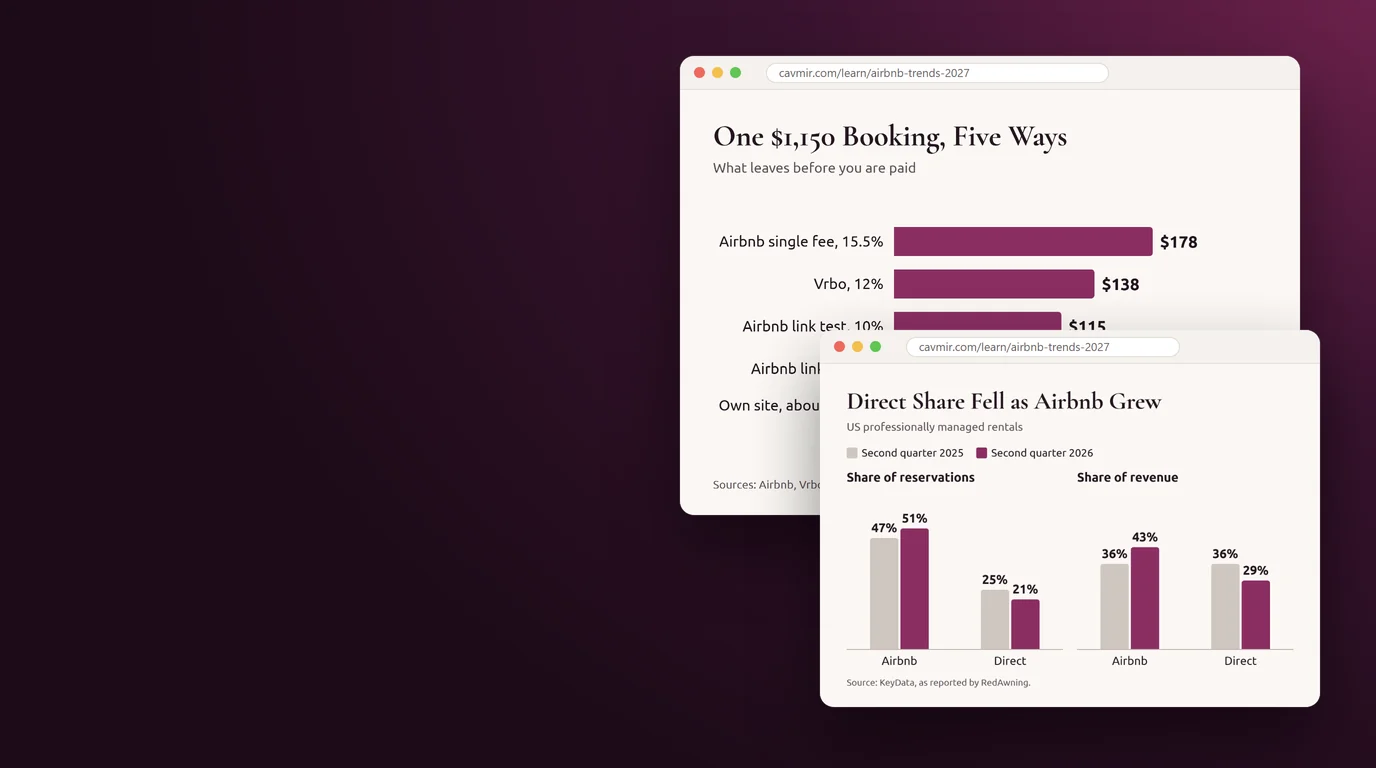
Here's what an example $1,150 stay costs in each channel at today's published and reported rates, rounded to the nearest dollar.
| Channel | Rate | Fee on a $1,150 booking | You keep |
|---|---|---|---|
| Airbnb single fee | 15.5% | $178 | $972 |
| Vrbo | 12% | $138 | $1,012 |
| Airbnb direct link, higher tier (test) | 10% | $115 | $1,035 |
| Airbnb direct link, lower tier (test) | 6% | $69 | $1,081 |
| Your own site | About 3% in card fees | $35 | $1,116 |
That last row leaves out what your site costs to run, which we come to below. It's still a useful table for a yearly budget, because few hosts have added up what their mix pays in total. Use your own figures here.
What Your Channel Mix Pays in Fees
Rough math for one year of bookings. Nothing you type leaves this page.
The inputs are examples. The math uses Airbnb's 15.5% and Vrbo's 12%, so change the answer in your head if you pay a different rate, and it leaves out promotions and paid placement.
Airbnb's Direct Booking Links Test
The most surprising direct booking news of 2026 came from Airbnb itself. Skift reported on August 29 that Airbnb was testing links hosts can share with their own guests, and charging less on what those links bring in. Rental Scale-Up and The Host Report describe two tiers, 6% and 10%. Airbnb has released no terms and no help page, and its second-quarter letter doesn't mention the test, so every detail here is provisional.
Look at what the test says about hosts' own audiences. An email list, an Instagram following or a network of past guests brings bookings Airbnb didn't have to find, and Airbnb is offering a smaller fee to keep those bookings on its rails. For some hosts that's a fair trade. At the 6% tier, a $1,150 booking leaves you about $1,081, only $35 less than you'd keep on your own site, before you count what your site costs to run.
What you give up doesn't show in a fee table. On a link booking, the guest remains an Airbnb guest as far as anyone outside the company can tell: the money moves through Airbnb, Airbnb's terms apply and its limits on contact details presumably still govern what you may ask. Airbnb can change the rate or end the test whenever it likes. A link also needs an audience to send it to, and building that audience is the same work a website needs.
If you're invited, try it. Send the link to an audience you built yourself, such as your social followers, and keep your own record of what it brings in. If you aren't invited, don't plan around it. There's a longer comparison in our section on direct booking links against your own website.
Direct Booking Share Fell in 2026
This number cuts against the usual story, including the one companies like ours tell. KeyData's marketplace data for professionally managed US rentals, as reported by RedAwning, shows direct bookings falling from 25% of reservations and 36% of the money in spring 2025 to 21% and 29% in spring 2026, both measured over the April-to-June quarter. Airbnb rose from 47% of reservations and 36% of revenue to 51% and 43%. Vrbo held 20% of reservations and 23% of revenue.
Some care is needed with these figures. They cover one quarter and professional managers, not owners with one home. The report doesn't give a sample size or say how KeyData defines direct, and RedAwning sells distribution to property managers. A falling share also doesn't prove fewer direct bookings, since Airbnb's volume grew over the same year. Even so, they fit Airbnb's account of its own year, with growth in app bookings, first-time guests and flexible payment options. Its app now accounts for 64% of nights booked, up from 59%, and a guest who books inside an app isn't searching for your website.
The same figures hold a more encouraging detail. Direct took a larger share of revenue than of reservations, while Airbnb took a smaller one. Dividing those shares, a direct reservation brought in about 1.6 times the revenue of an Airbnb reservation that quarter. A year earlier the same sum gave about 1.9 times, so the gap is narrowing. That's our arithmetic, and it doesn't prove why, though repeat guests, larger homes and longer stays are likely parts of the answer.
The lesson for 2027 is that a booking site isn't a source of traffic. A host who publishes a site and waits will see bookings keep flowing to the platform spending the most on finding guests. Airbnb and Vrbo both have whole teams working on winning those bookings. A direct channel deserves steady attention too: a monthly count of visits, inquiries and bookings, with one named source for each. Where those visits come from is covered in winning more direct bookings.
What These Trends Mean for a Direct Booking Website
Put the last four sections together, and the case for a direct booking website in 2027 looks different from the one made a few years ago. The old pitch was about skipping the fee, and for hosts on the single fee that cost now shows on every payout. At 15.5%, a $1,150 stay that comes through your site nets $144 over Airbnb and $104 over Vrbo. Fees also changed on both big platforms within twelve months, which is its own reason to hold one channel whose terms you set.
The newer reasons have less to do with fees. You alone decide what your site tells guests and search engines. After November 20, direct bookings and opt-in sign-ups on your site are also the plainest way to build a list of guests. And it gives travelers who already know your name a place to book, which matters more now that assistants name businesses in their answers and people go looking for them afterward.
A website doesn't pay for everyone. AirROI, which sells Airbnb data, worked out the break-even for one home in eight US markets, assuming $2,000 a year in software and site costs. The answer ranged from 31% of bookings direct in San Diego to 59% in Denver. Those are demanding numbers, and they set a fairly full software stack against one home's revenue. A host with several homes, repeat guests or higher-priced stays gets there much sooner, and a host with one modest home may never need to. We wrote a separate guide on whether your Airbnb needs a website, with a calculator for your own numbers.
One worry can probably be set aside: whether taking direct bookings hurts you on Airbnb. An August 2026 analysis of thousands of connected listings by Jeff Brown, reported by Houfy, which sells direct booking, found that homes with more than half their bookings direct reached Airbnb's first page about 26% less often. A same-listing comparison then showed impressions and conversion barely moving, which points to differences between kinds of host, with no sign of a penalty. It's one analysis, and Airbnb hasn't confirmed anything. Airbnb's rules still bar links off the platform in listing pages and messages, and they carry penalties up to removal.
For the plan that follows from all this, there's our 2027 strategy for direct bookings and what a direct booking website includes. Its price and running costs are laid out in the cost guide.
The November 20 Limit on Guest Contact Details
Airbnb rewrote its policy on host-imposed requirements for reservations booked on or after November 20, 2026. With limited exceptions, hosts can't request personal data from the moment of booking through checkout. The list covers phone numbers, home addresses and email addresses, ID documents and copies of them, payment details, background checks and biometric data. Hosts also generally can't require a separate contract, or make a guest register on another website or use a third-party app to get in or to use an important amenity.
The exceptions matter. Contracts remain possible for monthly stays (28 nights and up), Luxe listings, optional extras such as a golf cart, and cases where the law or a community association requires one. You can still look at a guest's ID in person at check-in if your listing discloses it, as long as you keep no copy. Reservations booked before the date stay under the older policy. Read the whole page for your own situation, since it lists further exceptions.
Plenty of common hosting habits run into this wording: a QR code in the guidebook that asks for an email, a Wi-Fi page that wants a sign-in, a pre-arrival form hosted somewhere else, a rental agreement sent by email. These have been popular ways to build a guest list, and advice online still recommends them. If you use one, read it against the policy before the date arrives, and ask your lawyer if you aren't sure where it falls.
The policy also sharpens the line between two kinds of guest. Someone who books through Airbnb is reached through Airbnb's messaging. Someone who books on your site, or signs up there by choice, can be on your own list. So that list now has to grow from channels you run: your site, your social accounts and the direct stays you've already hosted. Anyone planning to email past guests in 2027 should check which addresses were collected outside Airbnb, with permission, and leave the rest off the list. The sign-up pieces a site needs are in our Airbnb website checklist.
AI Search Inside the Airbnb App
On September 30, 2026, Airbnb released a fall update, and the part hosts should read closely is search. Starting in the US, guests can type or speak a plain sentence about the stay they're after, across homes, experiences and services. Filters respond too: a guest who types "baby" sees options for cribs, playgrounds and children's toys. Results now include short AI descriptions of each home's main features, and wishlist homes can be set next to each other with AI notes on each. Airbnb's second-quarter letter said its models already build highlights from listing descriptions and guest reviews.
Airbnb is moving with some care. TechCrunch reports that Brian Chesky has stayed away from a chatbot-style interface, calls this a first step and plans to change it quickly over the coming months. His stated worry is building AI search that doesn't damage conversion on a platform handling about $100 billion. For hosts, that means the feature will keep changing, so don't chase today's layout.
What you can control is the raw material. If AI is summarizing your listing, then your description, the amenities you've ticked and what guests say in reviews are what it has to work with. Nobody outside Airbnb knows how much any of those counts. The company says only that search favors higher-quality homes that fit the trip better. Rental Scale-Up's advice seems sound on this: go through every field, and move details buried in a paragraph into a tagged field wherever one exists. A fenced yard, a dedicated desk and a crib are all things a guest might now type.
Run a small test each quarter. Search your market in the app with a sentence a real guest might use, such as "quiet cabin for a family of six near skiing, with a crib," and see whether you appear and how your home is described. If a summary gets something wrong, fix the source text. Host tools due this fall include a multi-listing calendar, 3D floor plans, dynamic pricing inside a range you set and AI notes on the earnings dashboard. Try the floor plans if your layout confuses guests, and treat one-tap pricing as something to check against your own numbers each month. Our notes on how Airbnb's search ranks homes go further.
Trip Planning in ChatGPT and Other Assistants
Outside the app, the shift is larger still. Phocuswright's February 2026 survey of 1,570 US leisure travelers found that 56% had turned to AI on a trip in the previous twelve months. Deloitte asked a narrower question, about generative AI for planning travel, and got 25% in 2026 against 15% in 2025. Those measure different things, and Deloitte's figure rose by two-thirds in a year. Adobe data reported by Skift shows visits from AI sources to US travel sites up 194% in May 2026 from a year before, though those visitors still book at lower rates than others.
Where those assistants are allowed to read matters. Each platform publishes its rules for crawlers in a robots.txt file, and the three big ones differ widely.
| Where | What AI crawlers may read (robots.txt, read late October and early November 2026) |
|---|---|
| Airbnb | GPTBot and ClaudeBot are blocked from the whole site and PerplexityBot from listing pages. OpenAI's search crawler can open the main listing page, but not its reviews, amenities, photos or description sub-pages. |
| Vrbo | The main AI search crawlers are named and allowed, and listing pages are open. |
| Booking.com | No AI crawler is named, and property pages are open. |
| Your own site | Whatever you decide. |
These files can change without notice, and they tell only part of the story, since a platform can also block bots in other ways. The point for hosts is that none of those decisions is yours. On a website you own, it is.
Fewer clicks come with all this. Pew found in 2025 that Google users clicked a regular result in 8% of visits showing an AI summary, against 15% without one. Phocuswright found that 51% of its AI users typically went on to source websites. So the aim for 2027 has two halves: being named in the answer, and having a page good enough for the person who clicks. That's the work of generative engine optimization, and our article on whether websites still matter explains how assistants weigh a business's own pages.
The practical steps are plain. Write a page for each home with the facts an assistant would need: sleeping arrangements, distances, seasons, rules. Keep those facts the same on your listings. Let search crawlers in. Earn mentions on other sites, because assistants check your account of yourself against what others say. Be wary of anyone promising a placement inside ChatGPT, since nobody outside OpenAI can deliver one.
Later Bookings and Shorter Stays
AirDNA says booking windows, the gap between booking and arrival, have been shrinking since 2023. Urban markets average a little more than 20 days, their shortest since the pandemic. Other market types leveled off late in 2025 and coastal markets ticked up slightly in early 2026, but AirDNA expects windows to shorten again. Stays have also become shorter across every location type after rising through much of 2025, and coastal resorts just hit a post-pandemic low for average stay.
Two mistakes follow from misreading this. The first is panic. When guests book later, next month's calendar looks emptier than it did at this point last year, even if the month ends in the same place. AirDNA warns that pacing can look softer than demand turns out to be, and that cutting rates at that moment hands a discount to guests who'd have booked anyway. Before you lower a price, check how your market's calendar looked last year this many days before arrival.
The second mistake is holding on to long minimums. A seven-night minimum in a market moving toward four-night trips leaves the middle of your calendar empty. AirDNA recommends staying flexible on minimum stays to catch these bookings. One way to test it: shorten the minimum inside 30 days of arrival, and keep your longer rule on holiday weeks and on dates booked further out. Each extra turnover has a cost, so work out your net on a three-night stay before you open one, cleaning included.
Later booking also changes when you market. A post six months ahead still reaches the planners, but AirDNA's data suggests more guests are deciding closer to arrival. Keep a short message ready for your own list and social accounts whenever you have open dates inside three weeks, and say what's special about those dates rather than leading with a price. Where a holiday or local event falls inside that window, name it.
AirDNA expects travelers' focus to shift gradually back toward trips built around an experience as incomes recover in 2027. It doesn't say booking windows or stays will lengthen, so plan for short and late first, and treat any return of longer stays as a bonus when it arrives.
Bigger Homes Keep Pulling Ahead
Size is another clear split in the current data. AirDNA's figures for the first five months of 2026 grade neatly by bedroom count. Studios through two-bedroom listings were roughly flat, with occupancy down about 0.7% and modest rate gains, whereas homes of five bedrooms and up gained about 1.3% in occupancy and 2.2% in rate. Airbnb reports the same from its side: entire homes, especially those with four or more bedrooms, grew fastest in the second quarter, and bedroom nights booked rose over 12% against 10% for nights and seats.
AirDNA expected this appeal to fade after the pandemic, and it hasn't. Traveling together has become a way for families and friends to spend less than they would on several hotel rooms and still get more space. Among the priciest homes, the picture is less simple than headlines suggest. The gap between luxury and budget rates that opened in early 2025 narrowed through that year and has since turned around, with the two tiers now converging. AirDNA reads this as similar pressure reaching guests at every price level, so a high rate alone won't protect you.
Owners of large homes should sell the group. Write out exactly who sleeps where, how many cars fit, where twelve people eat together and what a split of the cost per person comes to against hotel rooms. Reunions, milestone birthdays and work retreats each deserve their own paragraph, and a page of their own if you have a website.
If you own a small one, don't try to compete for groups. Studios and one-bedrooms sit closest to hotels, and AirDNA warns that hotel pricing could cap rate gains where the two meet head to head in cities and event markets. Lean on what a hotel room can't offer: a kitchen, a washer, a neighborhood, a desk that works for a week. Our guide on pricing against hotels has the details. Shorter stays suit you too, because they're the ones a guest would otherwise take at a hotel.
Drive-To Markets Gain, and So Does Their Competition
AirDNA expects smaller cities, rural areas and regional drive-to destinations to outperform as travelers look for value, with higher gas prices nudging people toward closer trips. There's a catch: higher borrowing costs are steering new listings into those same lower-cost places, so some of the gain gets shared with new hosts. Its view by market type sets out the differences.
| Market type | What AirDNA expects |
|---|---|
| Mid-size cities | Rate growth speeds up in 2027 on regional drive-to demand. |
| Small cities and rural areas | A modest lift from closer trips, with most new listings arriving here too. |
| Coastal resorts | Softer rate growth in 2027 against strong 2026 comparisons. |
| Mountain and lake | A rebound if the snow returns, after a drought hurt places such as Breckenridge and Big Bear. |
| Large cities | The best occupancy growth of 2026, up 1.7%, helped by the World Cup and limited new supply. |
A host in a drive-to market should know exactly who can reach them in a tank of gas. Draw a four-hour circle around your home and list the cities inside it. Those are your feeder markets, and they deserve specific marketing: the drive time from each, the road you'd take, what's worth stopping for, which weekends suit people with school-age children. Your past reviews and booking records can tell you which of those cities send guests already.
That work pays off on a website more than on a listing, since a listing has one description and a site can give every sort of trip its own page. It also shows up in paid ads, where you can aim at a few nearby cities for far less than a national campaign would cost. Our 2027 marketing plan for rentals lays out the calendar.
If you're in one of the fast-growing supply markets, watch your competitors monthly. A new listing at a low introductory price can pull down what a whole street charges for a season. AirDNA's point about reviews helps here: new listings have to compete on price because they have few reviews, so don't race them to the bottom when your record is what they're missing.
International Demand Shifts From Canada and Western Europe to Latin America
International guests are a small slice of US rental demand, but they weigh heavily in gateway, coastal and big-city markets. AirDNA's data shows international demand turning negative in mid-2025 and still down 11.7% in May 2026 from a year earlier. Compared with 2024, the weakness sits in a handful of places: Canada is down 32%, Germany 23%, Spain 18%, Belgium 16% and France 12%. Other countries moved the opposite way, with Mexico up 16%, Brazil up 22% and Argentina up 85%.
Airbnb's global figures fit that shape, though they measure bookings everywhere, with no split for trips to the US. Latin America grew about 20% in the second quarter and Asia Pacific grew in the high teens. First-time bookers rose 40% in Brazil and more than doubled in India. Its AI support assistant now works in more than 50 languages.
For a host near the northern border or in a market that used to fill with Canadians, this is a planning item. Check how many of your 2024 guests came from Canada and where you'd replace them. AirDNA says border markets that rely on Canadians are taking the hit. Domestic demand has carried the market in the meantime, so the replacements are more likely to come from nearby US cities than from overseas.
For a host in Miami, Orlando or another city with Latin American visitors, there's a small opportunity. Airbnb translates listings on its own platform, but your own site says only what you've published. A Spanish or Portuguese page for your home, written by a person who knows how those guests plan, is rare and can be useful. Keep it to markets where your own booking records show the demand.
AirDNA expects international visitors to give US rentals some extra lift as incomes recover in 2027. AirDNA reports that the national tourism office expected only around 3% growth in arrivals for 2026, held back by visa and border frictions. Treat any improvement as welcome, and leave it out of next year's budget until it shows up in your bookings.
Airbnb Now Sells Hotels, Services and Experiences
Airbnb wants to be the place guests go for the whole trip. Its second-quarter letter says it added thousands of boutique and independent hotels in more than 20 top destinations, including New York, Paris and London. Hotels are still a single-digit share of nights, but hotel nights grew at roughly triple the pace of homes. About 35% of first-time guests who booked a hotel came back to book a home within a year. Featured hotels come with a price match and up to 15% in Airbnb credit toward a later booking.
Experiences are moving quickly as well, with supply up nearly 80% from a year earlier. Services now include grocery delivery, car rentals, airport pickups and luggage storage, and the fall update adds laundry pickup in select US cities, meal delivery in parts of Europe and baby gear set up at the listing, from November in over 60 US cities. Airbnb also added a way for guests to connect with people they know and see on a map where those people stayed and what they recommend.
This has three effects on hosts. In some cities, your home now shares a results page with hotels offering a credit you can't match, at a moment when hotels are doing well: AirDNA notes US hotels are gaining occupancy, with a 2026 revenue forecast almost identical to rentals. Hotel guests who come back for a home are good news, since they're new customers Airbnb found for you. Over time, we'd guess guests will also expect some of these conveniences to be easy to arrange.
The sensible reply is to make what's already in your home easy to find. If you own a crib, a high chair or a washer, list it in the amenity fields so that a guest filtering for them finds you, and keep it in good condition. If you know a local guide, a boat captain or a chef you trust, mention them by name inside Airbnb's messaging after guests have booked, with no links and no payment outside the platform. And if you run something guests could book on its own, such as a cooking class, an Airbnb Experience may be worth a look for the extra exposure. Recommendations now travel inside the app too, so a guest's friends may see your home and what they wrote about it.
After the World Cup
Airbnb counts over 150,000 homes listed for the first time in host cities for the 2026 tournament. Guest demand turned out uneven, according to AirDNA: strong in the Bay Area, Miami and Mexico's host cities, and flatter in Chicago, Seattle, Los Angeles and New York. Most host markets still gained pricing power, helped by steady domestic travel and a weaker dollar.
Nobody has published how many of those new listings stayed live after the final. That's the number to watch in your own area. A first-time host who did well may keep going, and one who didn't may be gone by spring. Check your competition set in January and again in April, and look at each listing's calendar for signs of life. In a host city, this could change your supply picture more than the national forecast does.
Be careful with comparisons next summer. June and July 2027 will be measured against tournament months, so a host-city calendar may look weak next to 2026 even if it's healthy. AirDNA gives similar warnings about one-off events: San Jose and Palo Alto had both the Super Bowl and the World Cup this year, and New Orleans faced hard comparisons after hosting the Super Bowl in 2025. Compare with 2025 as well, and judge the month against its normal shape.
Next year's events will set their own peaks. Our calendar of 2027 events lists the dates to price ahead of, and it's worth going through before you open those weekends at normal rates. With guests booking later, it's fine to hold those dates a little longer than you used to.
Local Rules With Dates You Can Plan Around
Rules keep moving at the city level, and platforms are being pulled into enforcement. Houston's first ordinance took effect on January 1, 2026, requiring a certificate of registration, at $275 a year per property, for any home rented for under 30 days at a time. Starting January 1, 2027, it will tell platforms to take down listings that lack one. In Austin, every rental needs an operating license, and since July 1, 2026 platforms must show a license field and take down unlicensed listings when asked. Those details come from AirROI's regulations tracker, checked October 17, which cites each city. Confirm them with your city before relying on them.
Not every move is a tightening. Under Florida law, towns and counties can't ban vacation rentals or limit the length or frequency of stays, apart from local rules adopted by June 1, 2011. Arizona bars cities and towns from banning them. Both still leave room for other local rules, so check before assuming anything is free of restriction.
Party houses are getting the most attention. After a May 2026 shooting at a West Dallas short-term rental left three people dead, AirROI counted Houston, Scottsdale and Dallas moving on party-house enforcement within days. Expect more talk of occupancy caps, neighbor notification and proof of liability coverage. Clear house rules and a careful read of each booking request protect you here, as well as your neighbors. Our advice on screening guests and stopping parties covers both, though check any older tip against Airbnb's November 20 limits on what you can ask.
In Europe, the rules in Regulation (EU) 2024/1028 began applying on May 20, 2026. Countries can choose whether to use it. Where they do, hosts get a registration number, platforms must show and check it, authorities can ask for non-compliant listings to come down and platforms send monthly data on stays. The US has no national version, but platforms displaying a local license number and removing listings on request is plainly the direction of travel in cities here as well.
Show your license or registration number on your listing and your website, and put the renewal date in your calendar. The wider picture is in our rules by country and city. If your city has a draft ordinance moving through council, go to a meeting or send a comment: hosts who show up usually get a better rule than hosts who read about it later.
A Host's Plan for 2027
Most of this boils down to a few dated jobs. Here they are in order, for a US host with one to five homes. Skip any that don't apply to your market.
| When | What to do | Trend behind it |
|---|---|---|
| Before November 20 | Review guest forms, QR codes, Wi-Fi sign-ins and contracts against Airbnb's policy. | Contact details limit |
| November | Recheck net per night on Airbnb and Vrbo, in your best and worst months. | 15.5% and 12% fees |
| December | Search for your home in the Airbnb app in plain sentences. Fix the fields behind any bad summary. | AI search |
| January 1 | Houston hosts: have your certificate in place. Everyone: check your city's page for changes. | Local rules |
| January | Pull your market's listing count, and go through your competition set for World Cup leftovers. | Supply |
| First quarter | Run your own figures on a website, and start a monthly count if you already have one. | Falling direct share |
| Spring | Set shorter minimums inside 30 days and write your last-minute message. | Later, shorter stays |
| June and July | In host cities, compare with 2025 as well as 2026. | World Cup comparisons |
Host Checklist for 2027
Tick each job as you finish it. Your progress is saved on this device only.
- Rules and fees
- Search and listing
- Market and pricing
- Direct channel
Most of these jobs take an afternoon. To hand off the website or the marketing, you can compare what Cavmir charges with the cost of doing it yourself. Airbnb's next shareholder letter and AirDNA's next outlook will both change some of these numbers, so we'll update this guide when they do.
Sources
- AirDNA: US outlook for 2026 and 2027, midyear update, July 8, 2026
- Short Term Rentalz: AirDNA's midyear supply forecast, July 9, 2026
- Airbnb: second-quarter 2026 shareholder letter, SEC exhibit
- Airbnb newsroom: fall product update, September 30, 2026
- TechCrunch: interview on Airbnb's AI search, September 30, 2026
- Airbnb help: current service fee rates
- Airbnb resources: moving hosts to one service fee
- Airbnb help: limits on host contracts and personal data, from November 20, 2026
- Airbnb help: pricing and payment policy, including off-platform links
- Airbnb robots.txt, read November 2, 2026
- Vrbo robots.txt, read October 29, 2026
- Booking.com robots.txt, read October 29, 2026
- Vrbo help: how the pay-per-booking commission works
- Skift: Vrbo's commission change, September 29, 2026
- Rental Scale-Up: how Vrbo's paid placement works, August 19, 2026
- Skift: Airbnb's lower fee test for hosts' own guests, August 29, 2026
- Rental Scale-Up: the 6% and 10% link tiers, August 31, 2026
- The Host Report: Airbnb's link test, September 8, 2026
- RedAwning: KeyData channel share for the second quarter of 2026
- AirROI: break-even math for going direct in eight US markets, April 15, 2026
- Houfy: account of Jeff Brown's connected-listing analysis, September 2026
- Phocuswright study of US travelers and AI, press release reprint, March 26, 2026
- Deloitte: summer 2026 survey of American travelers, May 19, 2026
- Skift: Adobe's data on AI visits to travel sites, June 17, 2026
- Pew Research Center: Google clicks with and without AI summaries, July 22, 2025
- AirROI: US short-term rental rules, checked October 17, 2026
- AirROI: party-house enforcement after the West Dallas shooting, May 29, 2026
- CBS Texas: West Dallas shooting report, updated May 28, 2026
- European Commission: new short-term rental rules apply, May 20, 2026
- FTC: guidance on its lodging and ticketing fee rule